Fo by Wajo logo

Fo by Wajo Review

Visit

Action agents that get things done in the physical world

Fo is an AI agent product by Wajo for completing real-world tasks like booking services and errands.

AI Panel Score

7.0/10

6 AI reviews

Reviewed

Facts checked against wajo.ai

About Fo by Wajo

Fo is built to complete tasks that require interacting with the physical world rather than just generating text or code. Example use cases described by Wajo include finding and booking service businesses, grocery ordering, delivery coordination, and errands. The product is positioned around the idea of agents that are accountable to outcomes rather than simply producing plausible-looking output.

Wajo describes underlying technology that supports Fo's operation, including agent verification and evaluation through behavioral benchmarks and adversarial eval suites, with agents verified before deployment and monitored continuously for drift. A self-improving flywheel applies RL training pipelines, RLHF, DPO, and constitutional AI methods using real enterprise task trajectories at each deployment cycle. A collaborative intelligence layer adaptively routes between autonomous agent action and human expertise, using configurable trust thresholds, approval queues, and full audit trails.

Fo is accessed through a Wajo account, with signup currently open. Wajo also publishes developer-facing documentation covering building agents, connectors (REST API), sessions for long-running agent work, and a public MCP server with a tool catalogue, indicating the platform supports programmatic and agent-native integration alongside the consumer-facing Fo product.

Features

AI

  • Self-Improving Flywheels

    Uses RL training pipelines built from real enterprise trajectories, applying RLHF, DPO, and constitutional AI at every deployment cycle.

Automation

  • Orchestrated Team of SWE Agents

    Coordinates SWE, Design, Security, Performance, and SRE agents designed to work together within an AI-native development stack.

  • Service Commerce Agents (Fo)

    An action agent that completes real-world tasks like finding and booking service businesses, ordering groceries, arranging delivery, and running errands.

Collaboration

  • Agent and Human Expert Marketplace

    Provides a network of expert humans and agents that agents can call on, including evaluations, quality guarantees, privacy verifications, and aggregated reviews.

  • Collaborative Intelligence with Humans

    Adaptively routes tasks between autonomous agent action and human expertise using configurable trust thresholds, approval queues, and full audit trails.

Core

  • Sessions

    Manages session IDs, continuity, and long-running agent work across interactions.

Integration

  • Agent Manifest

    Provides a machine-readable capability manifest (agents.json) describing Wajo's capabilities for agentic clients.

  • REST API Connectors

    Allows agents to connect to external systems via REST API connectors as documented in the Connectors guide.

  • Wajo MCP Server

    Exposes a public MCP endpoint and account-scoped tools, including a search_documentation tool, for agentic clients to connect to Wajo.

Security

  • Agent Verification & Evaluation

    Runs behavioral benchmarks and adversarial evaluation suites to verify agents before deployment and monitor them continuously for drift.

Preview

Fo by Wajo desktop previewFo by Wajo mobile preview

Pricing Plans

Popular

Fo Mini

Free

For anyone who wants everyday help from an AI action agent at no cost, with a reset-daily usage cap.

  • 1,000 tasks per day, resetting daily
  • Agent calls, emails, and books on your behalf
  • Single-use payment cards for purchases
  • Fo's own email address and phone number

OG Fo

Free

For heavy personal users who have received an invite; removes the daily task cap for unlimited everyday use.

  • Unlimited tasks (no daily cap)
  • Unlimited call time
  • Group chats with Fo
  • Invite-only access

Pro

Contact sales

For demanding individual or business workloads; pricing is not publicly listed and requires contacting Wajo's sales team. Note: an unverified $99/mo figure has circulated on third-party benchmark/comparison sites, but multiple sources (including a GitHub correction) confirm Wajo has never published this price and it remains unverified.

  • Support for heavier workloads
  • MCP (Model Context Protocol) access
  • Custom-built agents
  • Team use

AI Panel Reviews

The Decision Maker

The Decision Maker

Strategic bet, vendor viability, timing, adoption approval
7.2/10

An agent that actually touches the real world, priced free until it isn't

“Fo books services and runs errands with single-use payment cards and trust-threshold approvals. The ambition is real; the business-tier pricing is not public yet.”

1,000 free tasks a day on Fo Mini is a real offer, not a teaser. The single-use payment card for checkout is the detail that matters most here — Fo never sees your actual card number, which is the right answer to the obvious objection about letting an agent shop for you.

The approval-queue model is the honest part of the pitch. Fo doesn't pretend full autonomy is safe yet; it escalates hard-to-reverse actions to a human, which is the correct tradeoff for anything involving money or bookings in the physical world.

Pro tier is contact-sales only, no number attached, and that unverified $99/mo figure floating around third-party sites isn't theirs. Wajo also ships MCP server access and REST connectors, so this isn't just a consumer toy. Pilot it on Fo Mini before committing a team to Pro.

Competitive Positioning7.0

Acting in the physical world — booking, groceries, errands — with configurable trust thresholds is a distinct lane from code or chat agents.

Reputation Risk7.0

Single-use payment cards and password-free login are strong trust design; audit trails and approval queues back that up.

Speed to Value7.5

1,000 free daily tasks on Fo Mini means you're testing real outcomes on day one, no procurement needed.

Strategic Fit7.5

Physical-world task execution is a different category from text-generation agents, not just a cheaper version of one.

Vendor Viability7.0

Docs cover connectors, sessions, and an MCP server — that's real build depth even without a visible changelog.

Pros

  • 1,000 free tasks per day with no cap reset friction on Fo Mini
  • Single-use payment cards keep real card data away from merchants and Fo itself
  • MCP server and REST connectors support programmatic use beyond the consumer app
  • Configurable trust thresholds mean autonomy scales with task risk, not blanket trust

Cons

  • Pro tier pricing isn't public — you'll need a sales call to know real cost
  • An unverified $99/mo figure circulating online isn't confirmed by Wajo, which muddies expectations
  • OG Fo's unlimited tier is invite-only, so heavy users can't just pay their way in

Right for

Individuals or small teams who want an agent handling real bookings and errands without full-send autonomy.

Avoid if

Skip it if you need firm enterprise pricing locked in before you'll even pilot.

The Domain Strategist

The Domain Strategist

Craft and strategy in the product's domain — adapts identity per category, same lens
7.3/10

An agent architecture built for action-with-accountability, but the orchestration layer is still an unknown quantity.

“Fo's trust-threshold routing and verification pipeline show real systems thinking about agent risk. The open question is whether that architecture holds up once you're running it against your own infrastructure, not just Wajo's demo surface.”

The agents.json manifest plus a public MCP server with a documented tool catalogue tells me Wajo built for agent-native consumption from day one, not as a bolted-on afterthought. That's the right call architecturally — if MCP becomes the integration lingua franca over the next three years, Fo is positioned rather than retrofitted. REST connectors and session continuity for long-running work round out a stack that looks less like a chatbot wrapper and more like infrastructure.

The verification piece — behavioral benchmarks, adversarial eval suites, continuous drift monitoring — is the part I'd want to pressure-test before committing production workloads. Claiming it is one thing; I can't independently verify eval coverage or drift detection latency from the outside, and that's exactly the layer that matters when an agent is booking services and spending money autonomously.

The RL/RLHF/DPO flywheel training on 'real enterprise task trajectories' means model behavior shifts under you between deployment cycles — fine if you want continuous improvement, a liability if you need deterministic behavior for compliance-sensitive workflows.

Category Positioning7.2

Positions against generic text-output agents by targeting physical-world task completion, a narrower and less crowded claim than most assistants make.

Domain Fit7.8

Approval queues and audit trails match how engineering teams actually want to govern autonomous action, not just demo it.

Integration Surface7.6

REST connectors, a public MCP server, and an agents.json manifest give programmatic teams a real entry point beyond the consumer app.

Long-term Implications6.8

A self-improving flywheel retraining on live trajectories means behavior drifts release over release, which cuts against workflows needing stable, auditable outputs.

Strategic Depth7.5

Trust-threshold routing and adversarial eval suites go beyond prompt-and-pray agent design, though depth of the eval suite itself is unverifiable from outside.

Pros

  • Public MCP server with a documented tool catalogue for agent-native integration
  • Sessions architecture supports long-running, stateful agent work rather than one-shot calls
  • Audit trails and approval queues give engineering teams a governance hook on autonomous actions

Cons

  • Continuous RL/DPO retraining on live trajectories means agent behavior isn't static release over release
  • Eval suite and drift monitoring claims aren't independently verifiable from the outside
  • Orchestrated multi-agent team (SWE, Security, SRE) adds surface area that's hard to assess without deployment data

Right for

Engineering teams comfortable integrating via MCP or REST who want governed autonomy rather than a black-box agent.

Avoid if

Avoid if your workflow requires deterministic, non-drifting agent behavior across releases.

The Finance Lead

The Finance Lead

Money, total cost of ownership, contracts, procurement math
6.6/10

Two free tiers, one invite-only. The real tier has no number.

“Fo Mini is free, capped at 1,000 tasks/day. Pro costs whatever a sales call tells you.”

Two tiers priced at $0. Fo Mini: 1,000 tasks/day, resets daily. OG Fo: unlimited, but invite-only — you can't buy your way in. That's a usable free product, not a monetization plan.

Pro tier: no listed price. Contact sales. A $99/mo figure floats around online; Wajo hasn't confirmed it, so don't budget against it. At team of 50, Pro is your real line item, and it's opaque. Run the TCO math on a number you don't have yet.

Freemium with an invite wall on the unlimited tier is an odd shape for procurement. Finance can approve $0. Finance can't approve a sales call outcome. Budget this one in two phases: Mini now, Pro once you've actually seen the quote.

Billing & Procurement6.2

Signup is self-serve for free tiers; Pro routes through sales, adding procurement friction for the only paid plan.

Contract Flexibility6.5

No term length or renewal terms published for Pro; free tiers carry no contract risk by definition.

Pricing Transparency5.5

Two free tiers are fully visible; Pro tier requires a sales call with no published number.

ROI Clarity6.0

Task volume is countable, but value per task (time saved, errand completed) isn't priced anywhere I could find.

Total Cost of Ownership5.8

Mini's 1,000 tasks/day is free, but Pro costs are unknown — can't model year-3 spend without a quote.

Pros

  • Fo Mini is $0 with 1,000 tasks/day, no card required to start
  • REST connectors and MCP access give finance a path to track usage programmatically

Cons

  • Pro tier has no published price — real cost requires a sales conversation
  • Unverified $99/mo figure online creates planning risk if teams budget against it

Right for

Teams willing to run on free tiers first and negotiate Pro pricing once usage patterns justify it.

Avoid if

Avoid if your procurement process requires a published price before you'll even take a sales call.

The Domain Practitioner

The Domain Practitioner

Daily hands-on reality in the product's domain — adapts identity per category, same lens
7.3/10

An agent with a sessions model and an MCP endpoint — the plumbing a backend engineer actually checks first.

“Fo's docs expose Sessions, an agents.json manifest, and REST connectors, which signals a platform built for integration, not just a chat window. Whether the orchestration underneath holds up under real load is unverifiable from the outside.”

The agents.json manifest is the detail that tells me someone building this cares about agentic clients discovering capability programmatically, not just a human clicking through onboarding. Pairing that with a public MCP server and a documented tool catalogue (search_documentation as a named tool, for instance) means I can probe the surface before committing a production workflow to it.

Sessions handling long-running agent work is the right primitive — one-shot API calls don't model a multi-step errand or booking flow, and if session IDs persist state cleanly across retries that's a real engineering win. What I can't tell from docs alone is error semantics: when Fo's approval queue blocks on a hard-to-reverse action, does the REST connector surface a typed status I can branch on, or just a generic pending state I have to poll blindly?

Multi-agent orchestration (SWE, Security, SRE agents coordinating) adds real surface area. Debugging a failure across five coordinated agents is a different problem than debugging one model call, and I didn't find failure-mode documentation for that case.

Day-3 Reality7.0

Sessions and trust thresholds suggest real engineering thought, but drift monitoring and eval claims aren't independently checkable from outside.

Documentation Practitioner-Fit7.6

Docs cover connectors, sessions, and an MCP tool catalogue — the vocabulary of someone who's shipped integrations, not just a landing page.

Friction Surface6.8

Approval-queue blocking behavior on hard-to-reverse actions isn't documented clearly enough to know how it reads in a CI/CD-adjacent pipeline.

Power-User Depth7.2

Custom-built agents and MCP access exist at the Pro tier, but the gap between Fo Mini and that tier's actual capability ceiling isn't spelled out.

Workflow Integration7.5

REST connectors plus a public MCP server mean it can sit inside an existing agent stack rather than demanding a new one.

Pros

  • Machine-readable agents.json manifest for agentic client discovery
  • Sessions architecture built around session IDs rather than stateless calls
  • Public MCP server with a named tool catalogue to probe before integrating

Cons

  • No documented error semantics for how blocked approval-queue actions surface over the REST API
  • Multi-agent orchestration across SWE/Security/SRE roles lacks visible failure-mode documentation
  • Eval suite and drift-monitoring claims can't be independently tested from outside the platform

Right for

Engineers who want to wire an action agent into existing systems via REST or MCP rather than living only in a chat UI.

Avoid if

Avoid if you need documented, typed error states for blocked or escalated actions before you'll trust it in a pipeline.

The Power User

The Power User

Daily human experience, onboarding, polish, learning curve, reliability
7.2/10

An agent that books your haircut but asks permission first, mostly

“Fo is trying to feel like a trustworthy assistant, not a chatbot toy, and the approval-queue design backs that up. Whether the day-to-day experience holds up outside demos is the open question.”

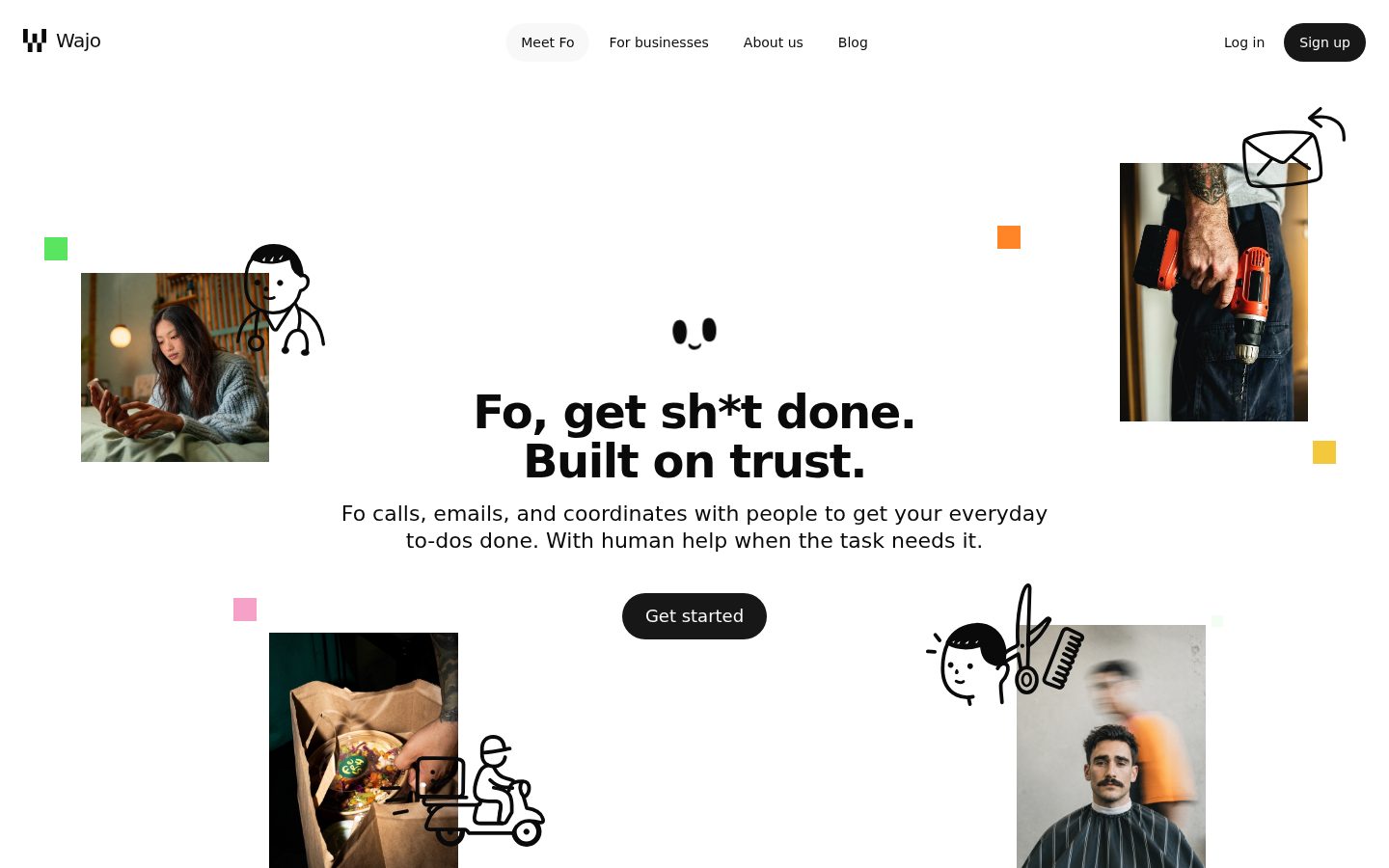
The H1 says 'built on trust,' which is a bold thing to put at the top of the page for a product whose whole job is spending your money and talking to businesses on your behalf. The trust thresholds and approval queues are the right instinct — autonomy where it's cheap to be wrong, a human check where it isn't.

What I can't tell from the outside is how that actually feels day to day. Does the approval ask show up as a push notification, an email, a text from 'Fo's own phone number'? The docs mention sessions for long-running work, which is good architecture, but session continuity only matters if the interface around it doesn't make you re-explain yourself every time you check in.

Fo Mini's 1,000 tasks a day is generous on paper, but errands and bookings aren't API calls — they involve waiting on a business to answer the phone. If that wait is a blank screen, the generous quota won't feel generous by week two.

Daily Polish7.0

Thoughtful touches like single-use payment cards and a dedicated Fo phone number suggest real design care, but I can't see the everyday interface.

Learning Curve7.5

A documented MCP tool catalogue and REST connectors give technical users a clear ramp from consumer use into custom agent building.

Mobile Parity6.0

Phone and call-time features (including unlimited call time on OG Fo) imply a phone-first use case, but I couldn't find any detail on what the mobile app itself looks like.

Onboarding Experience7.0

Signup is open and free tier requires no card, which lowers the homework feel, though OG Fo being invite-only adds a locked-door moment early on.

Reliability Feel6.5

Audit trails and verification benchmarks suggest backend discipline, but there's no visible error-state or status-page detail to judge how failures surface to users.

Pros

  • Free Fo Mini tier needs no card to start, lowering the barrier to try it
  • Trust-threshold routing between autonomous action and human approval feels built for real errands, not demos
  • Single-use payment cards and no password storage are concrete, user-facing privacy choices

Cons

  • No visible detail on what an approval request actually looks like day to day
  • OG Fo's unlimited tier is locked behind an invite, so motivated heavy users hit a wall
  • Mobile experience quality is untestable from what's public

Right for

Someone who wants a free assistant to handle phone calls and bookings and is comfortable approving riskier actions by hand.

Avoid if

You need guaranteed turnaround on errands and can't tolerate waiting on approval-queue back-and-forth.

The Skeptic

The Skeptic

Contrarian. Watch-outs, deal-breakers, broken promises, category patterns
6.3/10

An agent that books your groceries and also fields security and SRE work. Pick one story.

“Fo wants to be a consumer errand-runner and an enterprise multi-agent platform at once. The physical-world pitch is specific; the flywheel language underneath it is not.”

'Self-improving flywheel' with RLHF, DPO, and constitutional AI, all 'at every deployment cycle' — that's the kind of stacked-acronym claim that means a lot or nothing depending on what's actually measured. I've seen this pattern before: agent demos that look crisp, training claims that can't be checked from outside. Doesn't mean it's false. Means I'd want a benchmark, not a sentence.

The real-world task list — booking a service business, ordering groceries — is concrete and testable in a way 'adversarial eval suites' isn't. That gap between the grounded consumer feature and the aspirational infra language is the tell worth watching.

Exception: the orchestrated SWE/Security/SRE agent team sits oddly next to a grocery-booking bot. Two very different products wearing one brand. Pro tier is sales-call-only, no number attached, so cost risk stacks on top of the trust question.

Competitive Differentiation6.8

Physical-world task focus with single-use payment cards is a distinct lane versus text/code-only agents.

Exit Portability6.0

Sessions and agents.json are proprietary constructs; REST connectors help but task history likely doesn't export cleanly.

Long-term Viability6.5

Docs and blog are live and MCP server is documented, but no visible changelog cadence to judge update pace.

Marketing Honesty5.8

Concrete errand features sit next to unverifiable flywheel/eval claims with no external benchmark attached.

Track Record Match6.0

Trust-threshold routing and single-use cards are specific; drift monitoring and adversarial evals aren't independently checkable.

Pros

  • Free Fo Mini tier at 1,000 tasks/day with no card required
  • Specific, testable use cases: booking service businesses, grocery orders, delivery
  • Documented MCP server and agents.json manifest for programmatic clients

Cons

  • Flywheel and drift-monitoring claims carry no external verification
  • Pro tier cost unknown until a sales call, with an unconfirmed $99/mo figure muddying expectations
  • Consumer errand-agent and enterprise SWE/Security agent team feel like two products under one name

Right for

Early adopters comfortable testing free-tier errand automation without needing proof behind the training claims.

Avoid if

You need verifiable evaluation data or predictable enterprise pricing before committing budget.

Buyer Questions

Common questions answered by our AI research team

Pricing

What's included in the free Fo Mini plan?

Fo Mini is free and includes 1000 tasks per day, with the limit resetting every day.

Features

Does Fo ever act without human approval?

Yes. Fo works with configurable trust thresholds, operating autonomously for defined work, asking for approval before hard-to-reverse actions, and escalating to a human or trained executive assistant when judgment is needed.

Security

How does Fo protect my payment card info?

Fo checks out using a one-time, single-use payment card for each purchase, so your real card details are never shared with the merchant or seen by Fo.

Integration

What apps and tools can Fo connect to?

Fo connects to email, calendar, Google services such as Gmail, Calendar and Drive, Slack, the web, and phone. Custom agents can also connect to CRMs, storage, forms, payments, and internal tools depending on permissions and plan.

Security

Does Fo see or store my website passwords?

No. Fo signs in to websites on your behalf without seeing or storing your password, keeping your login credentials private.

Also in AI Agents & Assistants