AI-powered enterprise search that finds information across all your company's apps
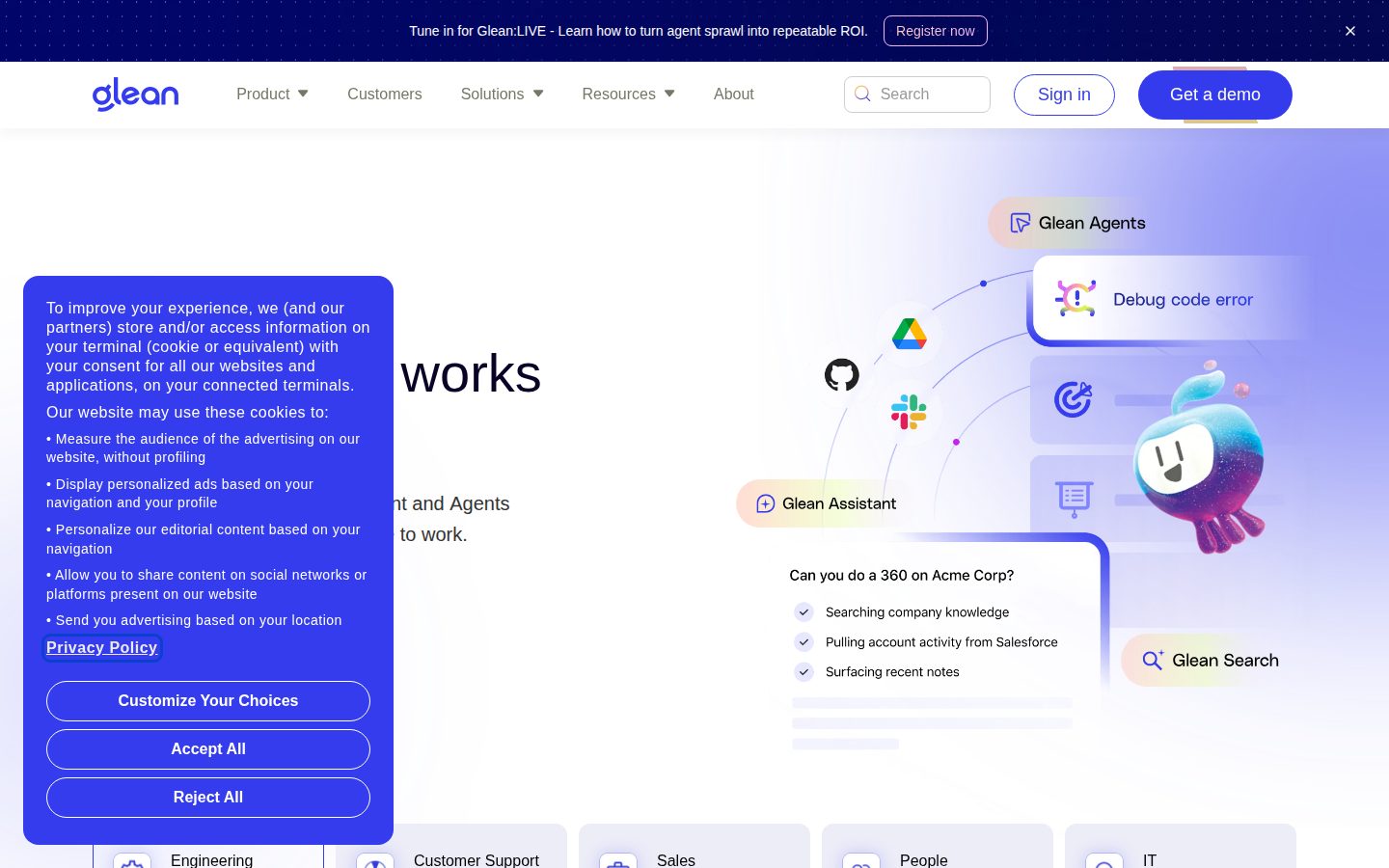
Glean is an enterprise search platform that uses AI to help employees find information across company applications.
AI Panel Score
6 AI reviews
Reviewed
AI Editor ApprovedApproved and published by our AI Editor-in-Chief after full panel analysis.Glean is an AI-powered enterprise search platform that connects to company applications and provides unified, permissions-enforced search across tools like Slack, Google Drive, and Jira. It is aimed at mid-market and enterprise organizations running heterogeneous SaaS stacks who need governed, AI-assisted knowledge retrieval at scale. Pricing is quote-based with no published tiers, though a free trial is available. Key capabilities include Glean Search across more than 100 native app connectors, Glean Assistant for answers and summarization, Glean Agents for building AI workflows, and Glean Protect, which inherits existing app-level access controls rather than re-implementing them; deployments typically run about three weeks. TopReviewed's six-seat AI review panel scored it 7.6/10, praising connector breadth with real-time permissions enforcement while noting the Salesforce connector covers only four standard objects, leaving custom objects unindexed. It best fits teams facing information silos across ten or more tools.
Glean is an enterprise search platform designed to help organizations make their internal information more discoverable and accessible. The platform connects to dozens of popular business applications including Google Workspace, Microsoft 365, Slack, Jira, Confluence, and many others to create a unified search experience.
The platform uses artificial intelligence and machine learning to understand context and deliver relevant results when employees search for information. Glean's AI capabilities include natural language processing, semantic search, and personalization features that learn from user behavior to improve search accuracy over time. The system can surface documents, conversations, people, and other content types across connected applications.
Glean is primarily targeted at mid-market and enterprise organizations that struggle with information silos and want to improve employee productivity. The platform includes features like customizable search interfaces, analytics dashboards for administrators, and security controls that respect existing permissions from connected applications.
The company competes in the enterprise search market alongside solutions like Microsoft Viva Topics, Elasticsearch, and various knowledge management platforms. Glean differentiates itself through its AI-first approach and focus on ease of deployment across existing enterprise software stacks.

Generates content updates and deliverables, and summarizes documents, threads, and meetings on demand.
A personalized AI assistant that adapts to the user and can create content, summarize documents, threads, and meetings, and analyze for insights and answers.
Automatically generates responses to communications, reducing internal support requests such as IT and HR inquiries by up to 20%.
Creates and deploys AI agents to automate repetitive tasks, departmental workflows, and orchestrate processes at scale.
Provides AI-assisted onboarding to new jobs and projects, saving an average of 36 hours per employee during onboarding.
Searches across 100+ connected enterprise applications to find documents, messages, files, and people wherever they live.
Provides APIs, SDKs, and custom plugins to extend Glean functionality into any application.
Native, push API, and web history based connectors index content from apps including Slack, Google Drive, Jira, Salesforce, GitHub, Confluence, Microsoft Teams, and more.
Enforces real-time permissions and access controls to ensure AI responses respect enterprise data security boundaries.
Indexes and searches content while enforcing each user's existing app-level permissions so results are personalized and access-controlled.
Contact for pricing. AI Assistant and Agents platform for enterprise teams, connecting company knowledge across 100+ apps.
Glean is the enterprise search bet that actually has legs right now.
“100+ connectors, real-time permissions enforcement, and a three-week deployment claim make this credible. No public pricing is the friction point every procurement team will hit.”
The 36-hour onboarding savings stat and the sub-six-month ROI claim backed by Forrester are the kind of numbers a board will ask about. No pricing page means every deal is a negotiation, which slows pilots and creates budget uncertainty. That's the real cost here, not the license.
Glean Search across 100+ apps with Glean Protect enforcing real-time permissions is the right architecture. Microsoft Viva Topics can't match the connector breadth, and Elasticsearch requires you to build everything yourself. The Salesforce gap is worth noting — custom objects aren't indexed, which matters in any revenue-heavy org.
Glean Agents is the forward bet. If they execute, this becomes a workflow automation layer, not just search. That's what separates a point solution from platform stickiness. Pilot it fast before the pricing conversation gets complicated.
Beats Microsoft Viva Topics on connector depth and beats Elasticsearch on time-to-value, but contact-only pricing makes peer benchmarking harder.
Category-recognized vendor with Forrester backing and CIO-level testimonials — this won't raise eyebrows in a board deck.
A CIO quote cites three-week deployment; the 36-hour onboarding savings per employee is a fast, visible win.
Glean Agents pushing into workflow automation means this advances how work gets done, not just where information lives.
No public funding data surfaced, but enterprise customer base, 100+ connectors, and active product development suggest a durable business — not a feature looking for a company.
Mid-market or enterprise teams drowning in information silos across 10+ tools who need something running inside a month.
Your Salesforce instance relies heavily on custom objects or you need transparent per-seat pricing before legal will engage.
Glean is the enterprise knowledge infrastructure bet worth making at scale.
“100+ connectors with real-time permissions enforcement is the right architectural foundation for any serious KM program. The platform has moved well past search into assistant and agent territory, which extends its strategic value considerably.”
Glean Search across 100+ app connectors isn't a feature list — it's a federated index architecture. The permissions-enforced model, where Glean Protect respects each user's existing app-level access controls, solves the single hardest problem in enterprise KM: surfacing knowledge without creating security debt. That's not table stakes; Microsoft Viva Topics never cleanly solved it.
The 36-hour onboarding savings claim and the three-week deployment timeline from a CIO quote are plausible and consistent with category benchmarks. Glean Agents extending into workflow automation means this becomes a knowledge operating layer, not just a search widget. That changes the three-year calculus significantly.
The Salesforce connector gap is real — custom objects unsupported means any org with a complex CRM schema hits a ceiling fast. No public pricing page also makes budget planning opaque before you're deep in a sales cycle. Sized right for mid-market and above; below that, it's likely oversized.
Glean sits ahead of Microsoft Viva Topics on AI-first execution and connector depth, positioning it as the default enterprise search choice for non-Microsoft-native orgs.
Permissions-enforced search and the 100+ connector surface directly maps to how KM practitioners manage information governance across heterogeneous stacks.
Native connectors for Slack, Google Drive, Jira, Confluence, GitHub, and Salesforce cover the canonical enterprise stack, and Platform APIs and SDKs extend further.
If Glean becomes your knowledge layer, the three-year dependency is on their connector roadmap — custom Salesforce object gaps today hint at where that roadmap may lag.
Glean Assistant plus Agents signals genuine platform ambition beyond search, with semantic understanding and personalization built into the index layer.
Mid-market and enterprise orgs running heterogeneous SaaS stacks who need governed, AI-assisted knowledge retrieval at scale.
Your knowledge base lives primarily in a single Microsoft 365 environment where Viva Topics is already licensed.
100+ connectors, zero published pricing — budget blind until sales calls you back
“Glean is a capable enterprise search platform with real AI depth. But no pricing page means every budget model is a guess.”
No pricing page. Contact-only. 50-seat deal, 500-seat deal — no way to differentiate without a sales call. That's not a procurement process, that's a hostage negotiation. Compare to Microsoft Viva Topics, which at least publishes M365 bundle pricing. Glean gives you nothing to anchor against.
The 36-hours-saved-per-onboarding claim is specific enough to model. 50 employees onboarded annually × 36 hours × $50 blended cost = $90K year-1 productivity recovery. The Forrester sub-6-month ROI claim has no published methodology. Treat it as a marketing number until the full report is in hand.
Glean Protect and permissions-enforced search are real differentiators — access controls that respect source-app permissions matter at enterprise scale. But no overage rates, no term lengths disclosed, no auto-renewal window published. Three-year TCO is genuinely unknowable pre-contract. That's the real risk.
Contact-only procurement, no invoicing model disclosed — high friction for any finance team running a standard vendor onboarding process.
No auto-renewal window, term length, or termination-for-convenience clause disclosed publicly.
No pricing page exists; contact-only model with zero published tiers, seat rates, or add-on costs.
36-hours-saved onboarding stat is modelable, but the Forrester sub-6-month ROI claim lacks published methodology.
100+ connectors reduce integration cost, but no published rates make 3-year TCO modeling impossible without a signed NDA.
Enterprise procurement teams with dedicated vendor negotiation bandwidth and a 500+ seat footprint to justify the sales cycle.
Your team needs a published price to get internal budget approval before talking to a vendor.
100+ connectors and real permissions enforcement make Glean a serious enterprise knowledge layer
“Glean indexes across 100+ enterprise apps with genuine permission-respecting search — that's the core value. No public pricing and opaque Salesforce coverage are the friction points researchers will actually feel.”
Glean Search across 100+ connectors is the headline feature, and it earns that billing. Slack, Confluence, Jira, Google Drive, GitHub — the sources researchers actually triangulate across daily. Glean Protect enforcing real-time permissions matters: you're not getting results you can't actually open, which is a category-level problem Microsoft Viva Topics still handles inconsistently. Three-week deployment timeline per a quoted CIO is credible for a well-staffed IT org.
The Salesforce coverage gap is worth flagging. The docs indicate only four indexed objects — Accounts, Contacts, Opportunities, Leads. No custom objects. For research workflows tied to CRM data, that's a real ceiling, not a footnote.
No public pricing and no changelog page make it hard to track what's actually improving. The Forrester ROI claim (investment recovered under 6 months) is cited without methodology. Glean Assistant and Glean Agents add automation depth, but their day-three behavior — how well they hold context across a long research session — isn't visible from public materials.
36-hour onboarding savings claim and three-week deployment suggest quick time-to-value, but no changelog means it's hard to track whether rough edges actually get fixed.
No public docs page flagged (docs=N in capabilities), which means the API and SDK depth that power users need isn't externally verifiable.
Salesforce limited to four standard objects and contact-only pricing adds friction for researchers who need CRM depth or want to self-serve a trial budget conversation.
Platform APIs, SDKs, custom plugins, and Glean Agents signal genuine extensibility for teams willing to build on top of the search layer.
100+ native connectors covering the researcher's core stack — Slack, Confluence, GitHub, Jira — reduces the habit-change burden significantly.
Enterprise research and knowledge teams drowning in siloed apps who need unified, permission-safe search without building custom connectors.
Your research workflow depends heavily on custom Salesforce objects or you need transparent pricing to move a procurement process forward.
Glean solves the real problem, but you're buying blind on price
“Enterprise search that actually connects 100+ apps is genuinely useful. No public pricing and web-only platform are real friction points.”
The core pitch is honest: employees lose hours hunting across Slack, Google Drive, Jira, Confluence, and a dozen other silos. Glean Search indexes 100+ apps and enforces each person's existing permissions automatically — so you don't get results you shouldn't see. That's not nothing. The claimed 36 hours saved per onboarding employee and 3-week deployment timeline are big numbers, and the Forrester ROI-under-6-months claim has at least a named source behind it, even if the methodology is opaque.
The tradeoff that'll matter day-to-day: this is web-only. No mobile app listed anywhere. For a tool positioned as your company's memory, that's a real gap when someone's at a client site and needs an answer fast. Microsoft Viva Topics has the same problem, but 'so does the competitor' isn't comfort.
No public pricing page is the other thing. Contact-only means every evaluation starts with a sales call, which adds weeks to decisions at organizations that already move slowly. The free trial exists, at least.
Glean Assistant and personalized search suggest thoughtful daily-use design, but no changelog and limited public UX evidence make this hard to fully verify.
Natural language search and a personalized AI assistant lower the floor; Agents and API extensibility raise the ceiling for power users who want more.
Platform listed as web-only — no mobile app in evidence, which is a meaningful gap for an enterprise search tool people need anywhere.
A CIO-quoted 3-week deployment and 36 hours saved per employee onboarding suggests setup is unusually fast for enterprise tooling.
Real-time permissions enforcement via Glean Protect implies a system that has to be solid to stay trusted, which usually means reliability gets attention.
Mid-market and enterprise teams drowning in app sprawl who need unified search without rebuilding their stack.
You need mobile access or want to evaluate pricing without talking to sales first.
100+ connectors, zero public pricing — classic enterprise black box
“Glean has real connectors, real permissions enforcement, and a plausible deployment story. The opacity on pricing and a Forrester-cite-without-methodology are the flags worth watching.”
Three tells upfront. One: no pricing page whatsoever. Two: 'Work AI that works' is the kind of headline that could mean anything. Three: the '6-month ROI' claim cites Forrester but no methodology visible. I've seen this framing from Guru, from Coveo, from several others still standing — doesn't disqualify Glean, but it's pattern-recognition territory.
What's actually solid: 100+ native connectors, real-time permissions enforcement via Glean Protect, and a 36-hour onboarding savings claim with enough specificity to take seriously. The API and SDK availability matters for exit options. Microsoft Viva Topics competes here and has serious distribution advantages — Glean's differentiation is deployment speed (three weeks per a CIO quote) and neutrality across stacks.
The Salesforce gap is a real tell: only four standard objects indexed, no custom objects mentioned. For any CRM-heavy org, that's a friction point worth surfacing before signing. Contact pricing means you won't know your number until you're already in the funnel.
Stack-neutral deployment and Glean Protect's real-time permissions enforcement are credible differentiators vs. Microsoft Viva Topics' walled-garden approach.
APIs and SDKs exist, but proprietary indexing with no changelog visible and contact-only pricing means vendor lock risk is real if direction shifts.
No public funding data visible, no changelog, but API availability and enterprise customer quotes suggest an active, funded operation.
No pricing page, a Forrester ROI claim with no visible methodology, and superlative headline language are compounding yellow flags.
100+ connectors and a named three-week deployment match patterns from surviving category players like Coveo and Elastic, not the ones that failed.
Mid-to-large enterprises with fragmented SaaS stacks who need permissions-aware unified search and have budget to absorb opaque enterprise pricing.
You need Salesforce custom object indexing, transparent pricing, or a free tier to evaluate before committing.
Common questions answered by our AI research team
According to a customer quote on the Glean homepage, one CIO stated: 'We're up and running in three weeks. I don't think I've ever been able to integrate something quicker and faster than that.' This suggests a typical deployment timeline of around three weeks.
Glean searches across messages and files from public channels, and also private channels and DMs, but only 'as permissioned.' This means access to private channels and direct messages depends on the permissions granted during setup.
The content lists only four Salesforce objects that Glean indexes: Accounts, Contacts, Opportunities, and Leads. There is no mention of custom Salesforce objects being supported.
The content states that companies recover their Glean investment in under 6 months and references a Forrester Report as supporting evidence. However, the specific details of the Forrester Report's methodology or findings are not provided in the available content.
Company
Glean Technologies, Inc.Founded
2019Pricing
Contact for pricingFree Trial
AvailableGlean is a Palo Alto-based enterprise search and AI assistant company that connects to a company's internal apps to surface knowledge.