Google Analytics logo

Google Analytics Review

Visit

Free web and app analytics for measuring the customer journey across devices

Google Analytics is a web and app analytics platform for measuring traffic, user behavior, and conversions across websites and mobile apps.

Google·Founded 1998·FreeFree PlanAI AnalyticsAI Marketing Tools

AI Panel Score

7.9/10

6 AI reviews

Reviewed

AI Editor Approved

What is Google Analytics?

Google Analytics is Google's web and app analytics platform, used to measure traffic, user behavior, and conversions across websites and mobile apps. It suits everyone from small-business owners to enterprise marketing teams, with the standard GA4 version free of charge and the enterprise tier, Analytics 360, sold on a quote basis with higher limits and service-level agreements. Event data collected through JavaScript tags, app SDKs, or the Measurement Protocol feeds real-time, acquisition, engagement, and monetization reports. Machine-learning models predict outcomes such as purchase probability and churn, Explorations support funnel, path, and cohort analysis, and native connections to Google Ads and BigQuery move audiences and raw data into advertising and warehouse workflows. Reports live in a web interface, with companion iOS and Android apps for monitoring on the go. It is the default fit for teams invested in Google's advertising ecosystem; alternatives include Adobe Analytics, Matomo, Plausible, Mixpanel, and Amplitude.

About Google Analytics

Google Analytics measures activity on websites and apps through JavaScript libraries, mobile app SDKs, and an open Measurement Protocol that can import interaction data from any internet-connected system. Once tagging is in place, typically via Google Tag Manager, events flow into standard reports covering real-time activity, user and traffic acquisition, engagement, and monetization from ecommerce, subscriptions, or ads. A natural-language search bar answers questions about the data directly, so users can find a metric or report without digging through menus.

The Explorations workspace handles free-form, funnel, path, cohort, segment-overlap, and user-lifetime analyses, built by dragging dimensions and metrics onto a canvas. Google's machine learning adds predictive metrics such as purchase probability and churn risk that can be turned into advertising audiences, while automatic insights flag significant changes and emerging trends. Attribution reporting includes data-driven attribution and model comparison across the funnel, and a native BigQuery export opens raw event data to SQL analysis and predictive modeling.

The standard version, Google Analytics 4, is free and serves businesses of any size, which makes it the default measurement layer for teams already running Google Ads. Analytics 360, sold through Google's sales team on a quote basis as part of Google Marketing Platform, adds enterprise capacity: continuous intraday data freshness, unsampled explorations of up to 50 billion events per day, higher limits such as 125 custom dimensions and 400 audiences, sub-properties, roll-up reporting, and service-level agreements. Alternatives include Adobe Analytics on the enterprise side, and Matomo, Plausible, Mixpanel, and Amplitude for teams that want open-source, privacy-focused, or product-analytics tooling.

Reports live in a web interface, with companion mobile apps for iOS and Android. Programmatic access comes through the Data API for reporting and the Admin API for configuration, and integrations extend to Search Console, Firebase, Salesforce Marketing Cloud, Google Play, AdMob, and Ad Manager alongside the Google advertising stack.

Features

Analysis

  • Explorations workspace

    Ad hoc analysis techniques including free-form, funnel, path, segment overlap, cohort, user lifetime, and backwards pathing explorations; Analytics 360 runs them unsampled at up to 50 billion events per day.

Attribution

  • Data-driven attribution

    Advertising workspace assigns conversion credit across marketing touchpoints with data-driven attribution, conversion paths, and model comparison reports.

Data Management

  • BigQuery export

    Exports raw event-level data to Google BigQuery for SQL analysis; Analytics 360 adds automatic custom tables and enhanced limits.

  • Data import and custom definitions

    Ingests external data via Data Import and extends the measurement schema with custom dimensions and metrics.

Integration

  • Google Ads and Marketing Platform integrations

    Built-in links to Google Ads, Display & Video 360, Search Ads 360, Google Ad Manager, AdMob, Google Play, Search Console, and Salesforce Marketing Cloud export conversions and audiences directly.

Machine Learning

  • Predictive metrics

    Google machine learning models forecast future user actions such as purchase probability, churn probability, and predicted revenue.

  • Proactive insights

    Built-in automation automatically surfaces trends, changes, and anomalies in the data and answers natural-language questions about it.

Measurement

  • Cross-platform measurement

    Measures user behavior across websites and apps in a single property, following the customer journey across devices throughout its entire lifecycle.

Privacy

  • Privacy-safe modeling and data controls

    Controls govern how data is used in Analytics, and privacy-safe modeling uses machine learning to report on behavior while protecting user privacy.

Reporting

  • Acquisition, engagement, and monetization reports

    Prebuilt report sets cover user and traffic acquisition, events and conversions, pages and screens, and revenue from ecommerce, in-app purchases, and publisher ads.

  • Real-time reporting

    Monitors site and app activity as it happens with real-time reports on active users, events, and conversions.

Setup

  • Tag management and collection APIs

    Deploys measurement through Google Tag Manager support, programmatic Collection APIs for event data, and an Admin API for property configuration.

Preview

Google Analytics desktop previewGoogle Analytics mobile preview

Pricing Plans

Free

Free

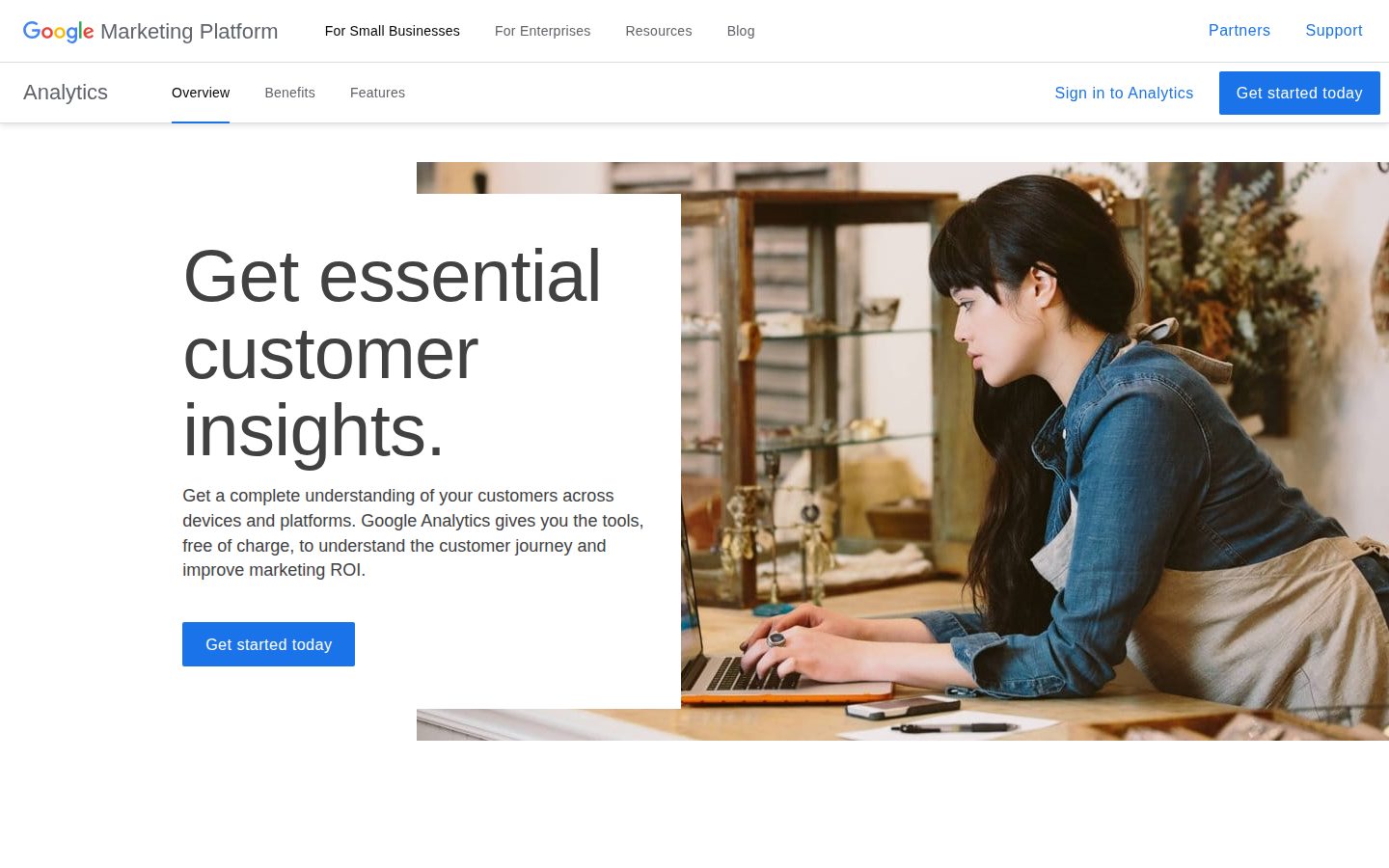
Standard Google Analytics (GA4) for businesses of any size — "gives you the tools, free of charge, to understand the customer journey and improve marketing ROI."

  • Web and app measurement (GA4 events model)
  • Built-in reports and automated insights
  • Audiences and customer-journey analysis
  • Integrations with Google Ads and Search Console
  • Standard data limits with sampling on complex queries

Analytics 360

Contact sales

Enterprise tier sold via Google sales ("Talk to Sales") as part of Google Marketing Platform; no public list price. Third-party sources quote roughly $50,000+/year, scaling with monthly event volume.

  • Higher data limits with unsampled results
  • Enhanced data freshness (intraday data within about an hour)
  • Enterprise SLAs from data collection to BigQuery daily export
  • Advanced customization: subproperties and roll-up properties
  • Integrations with Search Ads 360, Display & Video 360, and Salesforce
  • Enterprise-level support

AI Panel Reviews

The Decision Maker

The Decision Maker

Strategic bet, vendor viability, timing, adoption approval
8.1/10

Google isn't going anywhere, and free is a hard price to argue with at board level.

GA4 is the default measurement layer for anyone already in the Google Ads ecosystem. The real decision is whether $50K/year buys you enough at the 360 tier.

Vendor risk here is basically zero. Google Analytics has been around since 2005 and sits inside a trillion-dollar ad business. Nobody's asking if Google exists in three years.

The question is strategic fit, not survival. Free GA4 gives you predictive metrics, purchase probability, churn risk, BigQuery export. That's real capability, not just cost savings on what you already do.

Two tradeoffs worth flagging. Standard GA4 samples data on complex queries; Analytics 360 fixes that but starts around $50,000 a year. And GA4 optimizes for the Google ad stack — Mixpanel or Amplitude may fit better if product analytics, not marketing attribution, is the actual job. For most companies, GA4 free tier is the obvious default. Pilot 360 only once event volume justifies the spend.

The Domain Strategist

The Domain Strategist

Craft and strategy in the product's domain — adapts identity per category, same lens
8.4/10

GA4's integration surface justifies the lock-in, if you treat the event schema as a three-year contract.

GA4's free tier plus Measurement Protocol, BigQuery export, and native ad-stack pipes make it the default measurement layer for Google-anchored marketing orgs. The constraint is tenancy — Google controls the roadmap, and unsampled depth is paywalled behind Analytics 360.

Measurement taxonomy is a three-year commitment, and GA4 asks you to sign it on day one. Every report, predictive audience, and BigQuery row keys off the event schema you design — the real work is governance, not tagging. Get the taxonomy right and the whole Google stack compounds on it.

The integration surface is what you're really adopting. Measurement Protocol ingests events from any server, the Data and Admin APIs script reporting and configuration, and Google Ads pipes make audience activation a checkbox. At the top end, Analytics 360's sub-properties, 125 custom dimensions, and 400 audiences put it in Adobe Analytics territory.

The catch is tenancy: Google sets deprecation timelines and retention defaults unilaterally, and the free tier samples complex Explorations just as analysis gets serious. For a marketing org anchored on Google Ads, this is the defensible default; owning the pipeline via Snowplow is a project, not a purchase.

Category Positioning8.8

The web's default measurement layer; only Adobe Analytics competes at multi-brand roll-up scale.

Domain Fit8.0

Shaped for marketing measurement and attribution around Google Ads; product-analytics workflows feel secondary.

Integration Surface9.0

Measurement Protocol, Data and Admin APIs, and native links to Google Ads, Search Ads 360, and Salesforce Marketing Cloud.

Long-term Implications7.8

Google sets migration and retention policy on its own schedule, as the Universal Analytics sunset showed; BigQuery export is the hedge.

Strategic Depth8.2

Explorations plus native BigQuery export set a craft ceiling most free analytics tools can't touch.

Pros

  • Free standard tier with predictive metrics and BigQuery export undercuts every paid rival at entry.
  • Measurement Protocol and the Data and Admin APIs allow server-side ingestion and full programmatic control.
  • Native audience export into Google Ads, Search Ads 360, and Display & Video 360 removes reverse-ETL work.
  • Analytics 360 adds sub-properties, roll-up reporting, and 125 custom dimensions for multi-brand governance.

Cons

  • Free-tier sampling on complex Explorations pushes serious analysis toward a quote-based 360 contract.
  • Google controls deprecations and data-retention policy unilaterally, as the Universal Analytics sunset proved.
  • Attribution-first reporting leaves product-analytics depth to Amplitude and Mixpanel.

Right for

Marketing teams who run acquisition on the Google ad stack.

Avoid if

Product analytics teams who need unsampled behavioral depth without an enterprise contract.

The Finance Lead

The Finance Lead

Money, total cost of ownership, contracts, procurement math
8.1/10

$0/year for GA4. The real cost shows up if you outgrow the free tier.

GA4 is free, feature-complete, and the default measurement layer for anyone in Google Ads. The catch is Analytics 360 — quote-based, roughly $50K/year and up.

Free tier, $0/seat, no cap on users. That's rare in analytics. Compare to Mixpanel or Amplitude, where usage-based pricing kicks in fast as event volume grows.

3-year TCO on free GA4: near-zero licensing, but budget engineering time. Tag Manager setup, BigQuery export config, ongoing schema maintenance. Call it $5-15K/year in internal labor for a team of 50, depending on tagging complexity. Sampling on complex queries is the hidden cost — you either live with it or upgrade.

Analytics 360 breaks the free story. No published price, quote-only, third parties peg it at $50,000+/year, scaling with events. No termination clause published, no auto-renewal terms visible — because there's no self-serve contract. Procurement has to go through Google sales, which adds cycle time most free-tier buyers won't expect. Standard tier: no invoice at all. Enterprise tier: full negotiation, full opacity.

The Domain Practitioner

The Domain Practitioner

Daily hands-on reality in the product's domain — adapts identity per category, same lens
7.6/10

Free tier is generous, but sampling and GA4's event model are the daily tax you pay for it.

GA4 gets you enterprise-grade attribution and BigQuery export at zero dollars, which is hard to argue with. But the standard tier's sampling on complex Explorations queries and the event-based data model create real friction once you're querying daily.

GA4's event model replaced sessions with events-for-everything, and that migration still shows up in how reports read. Building a funnel Exploration feels natural once you know dimensions-and-metrics drag-and-drop, but standard-tier sampling kicks in fast on anything beyond basic date-range pulls — Analytics 360's unsampled 50-billion-events-a-day ceiling exists precisely because free-tier sampling is a known daily annoyance.

The natural-language search bar helps surface metrics without menu-diving, and BigQuery export is the real unlock for anyone doing SQL-level modeling rather than living in the UI. Predictive metrics like purchase probability are genuinely useful for building Ads audiences without a data science team.

Docs are Google-thorough but written for breadth, not for the analyst debugging a discrepancy at 5pm. Compare to Amplitude or Mixpanel, whose docs and UX assume a product analyst's daily workflow — GA4's docs assume every business size, which dilutes practitioner depth.

Day-3 Reality7.0

GA4's event-based model and sampling limits surface quickly once queries get complex.

Documentation Practitioner-Fit6.5

Docs cover breadth across business sizes but lack the analyst-workflow depth of Mixpanel or Amplitude docs.

Friction Surface6.8

Standard-tier sampling on Explorations and Tag Manager setup add recurring small frictions.

Power-User Depth8.2

Explorations, data-driven attribution, and BigQuery export scale well; 125 custom dimensions in 360 shows real headroom.

Workflow Integration8.0

Deep native links to Google Ads, Search Ads 360, and BigQuery fit teams already in Google's stack.

Pros

  • Free tier includes BigQuery export and predictive metrics like churn probability
  • Native integration across Google Ads, Search Ads 360, and Display & Video 360
  • Explorations workspace supports funnel, path, and cohort analysis without extra tooling

Cons

  • Standard tier applies sampling on complex queries, unlike unsampled Analytics 360
  • Analytics 360 pricing starts around $50,000/year with no public list price
  • Event-based GA4 model still creates a learning curve for teams migrating from Universal Analytics

Right for

Teams already running Google Ads who want free cross-device measurement with a clear upgrade path to BigQuery.

Avoid if

Avoid if you need unsampled reporting or product-analytics depth without paying the six-figure Analytics 360 jump.

The Power User

The Power User

Daily human experience, onboarding, polish, learning curve, reliability
7.2/10

Free and everywhere, but the first week feels like assembling furniture with no picture on the box.

GA4 is the default analytics tool because it's free and plugs straight into Google Ads. Getting it to actually tell you something useful takes real effort.

Day one, you drop in a tag through Google Tag Manager, and then... nothing feels obvious. GA4's whole event model is a rebuild from the old Universal Analytics brain most marketers had memorized, so even veterans are relearning where things live. The natural-language search bar helps, but it's a crutch for a navigation problem, not a fix.

Where it earns its keep is three months in. Explorations for funnels and cohorts, predictive metrics like churn probability, BigQuery export for when you outgrow the UI entirely — that's real depth, and it's free, which Mixpanel and Amplitude are not at any real scale. The Google Ads integration alone justifies the tool for anyone running paid.

Mobile apps exist for iOS and Android but feel like a status check, not a workspace. Reliability is fine, standard data sampling on complex queries is the one asterisk. If you want unsampled data, that's a ~$50,000/year jump to Analytics 360.

Daily Polish6.5

Functional prebuilt reports, but the interface still feels like a menu maze despite the added search bar.

Learning Curve6.5

Steep first month, but Explorations, BigQuery export, and predictive metrics reward the climb by month three.

Mobile Parity5.0

iOS and Android apps exist for monitoring, not for doing the analysis work Explorations offers on web.

Onboarding Experience5.5

GA4's event model and Tag Manager setup mean real homework before the first useful report appears.

Reliability Feel7.5

Solid at scale, but standard tier applies sampling on complex queries, which undercuts trust in the numbers.

Pros

  • Free tier is genuinely capable, including predictive metrics and BigQuery export
  • Deep native integration with Google Ads, Search Console, and Display & Video 360
  • Explorations workspace handles funnel, cohort, and path analysis without extra tools

Cons

  • GA4's rebuilt event model means a real relearning curve even for past Universal Analytics users
  • Mobile apps are secondary to the web dashboard
  • Standard tier applies sampling, and removing it costs roughly $50,000+/year via Analytics 360

Right for

Teams already running Google Ads who want free, integrated measurement without buying a separate platform.

Avoid if

You want product-analytics simplicity out of the box, in which case Mixpanel or Amplitude will get you there faster.

The Skeptic

The Skeptic

Contrarian. Watch-outs, deal-breakers, broken promises, category patterns
8.1/10

Free, entrenched, and it's Google — the risk isn't shutdown, it's neglect.

GA4 is the default measurement layer for anyone already in Google Ads. That default status is the whole moat.

No pricing page listed here, but I know the number anyway: free for GA4, roughly $50,000+/year once you hit Analytics 360. That gap is the tell. Google isn't selling you analytics. It's giving you the pipe that feeds Google Ads.

Track record match is genuinely strong — this replaced Universal Analytics and survived the transition, which is more than Optimizely's optimization suite or Google's own Firebase-only path can say. Compare to Mixpanel, Amplitude, or Plausible: they compete on product-analytics depth or privacy simplicity. GA4 competes on being already installed.

Exit portability is the real cost. BigQuery export helps — raw event data is yours in SQL. But the tagging, the custom dimensions, the attribution models: rebuilding that in Matomo or Adobe Analytics is real migration work, not a config export. Three green flags: BigQuery, free tier, Google's staying power. One yellow: sampling on the free tier isn't mentioned lightly in their own pricing table.

Competitive Differentiation7.0

Not differentiated on analytics depth vs Mixpanel or Amplitude — differentiated on being free and pre-wired to Google Ads.

Exit Portability6.5

BigQuery export is a real out, but re-tagging and rebuilding custom dimensions elsewhere is nontrivial work.

Long-term Viability9.0

Backed by Google's ad business; Analytics 360 SLAs and enterprise sales motion signal this isn't going away.

Marketing Honesty8.0

"Essential customer insights" is modest by category standards; features listed match what's actually shipped.

Track Record Match8.5

Survived the Universal Analytics sunset and still owns default-tool status alongside Google Ads.

Pros

  • Free tier with real depth: predictive metrics, Explorations workspace, BigQuery export
  • Native integration across the entire Google Ads and Marketing Platform stack
  • Google's institutional backing means no shutdown risk

Cons

  • Free tier applies sampling on complex queries — the fine print buyers skip
  • Analytics 360 pricing is opaque, quote-only, reportedly $50k+/year
  • Migrating tagging and custom setups elsewhere is real work, not a button

Right for

Any team already running Google Ads that wants free, integrated measurement without a separate analytics budget.

Avoid if

Avoid if you need unsampled data at scale without paying enterprise prices, or want analytics decoupled from Google's ad stack.

Buyer Questions

Common questions answered by our AI research team

Pricing

How much does Google Analytics cost?

The standard version of Google Analytics is free of charge. Analytics 360, the paid enterprise tier, is quote-based through Google sales, starting around $50,000 per year and scaling with event volume.

Features

Can Google Analytics predict future customer behavior?

Yes. Google's machine learning generates predictive metrics such as purchase probability, churn probability, and predicted revenue, and proactive insights automatically surface trends and anomalies in your data.

Integration

Does Google Analytics integrate with Google Ads?

Yes. Built-in integrations link Analytics to Google Ads, Display & Video 360, Search Ads 360, Google Ad Manager, AdMob, Google Play, and Search Console, so you can export conversions and audiences directly into campaigns.

Setup

How do I install Google Analytics on my website?

You add the Analytics JavaScript tag to your pages or deploy it through Google Tag Manager. The tag collects event data from your site and apps, which Analytics processes into acquisition, engagement, and monetization reports.

Security

Does Google Analytics offer privacy and data controls?

Yes. Analytics includes controls that govern how your data is used, and its built-in automation features privacy-safe modeling, which uses machine learning to report on user behavior while protecting privacy.

Product Information

  • Company

    Google
  • Founded

    1998
  • Pricing

    Free
  • Free Plan

    Available

Platforms

webiosandroid

About Google

Google is a Mountain View, California-based technology company operating Search, YouTube, Android, Google Cloud, and Workspace, and is a subsidiary of Alphabet Inc.

Resources

Documentation
API
Blog

Also in AI Analytics