AI-native software delivery across CI/CD, testing, security, and cloud cost
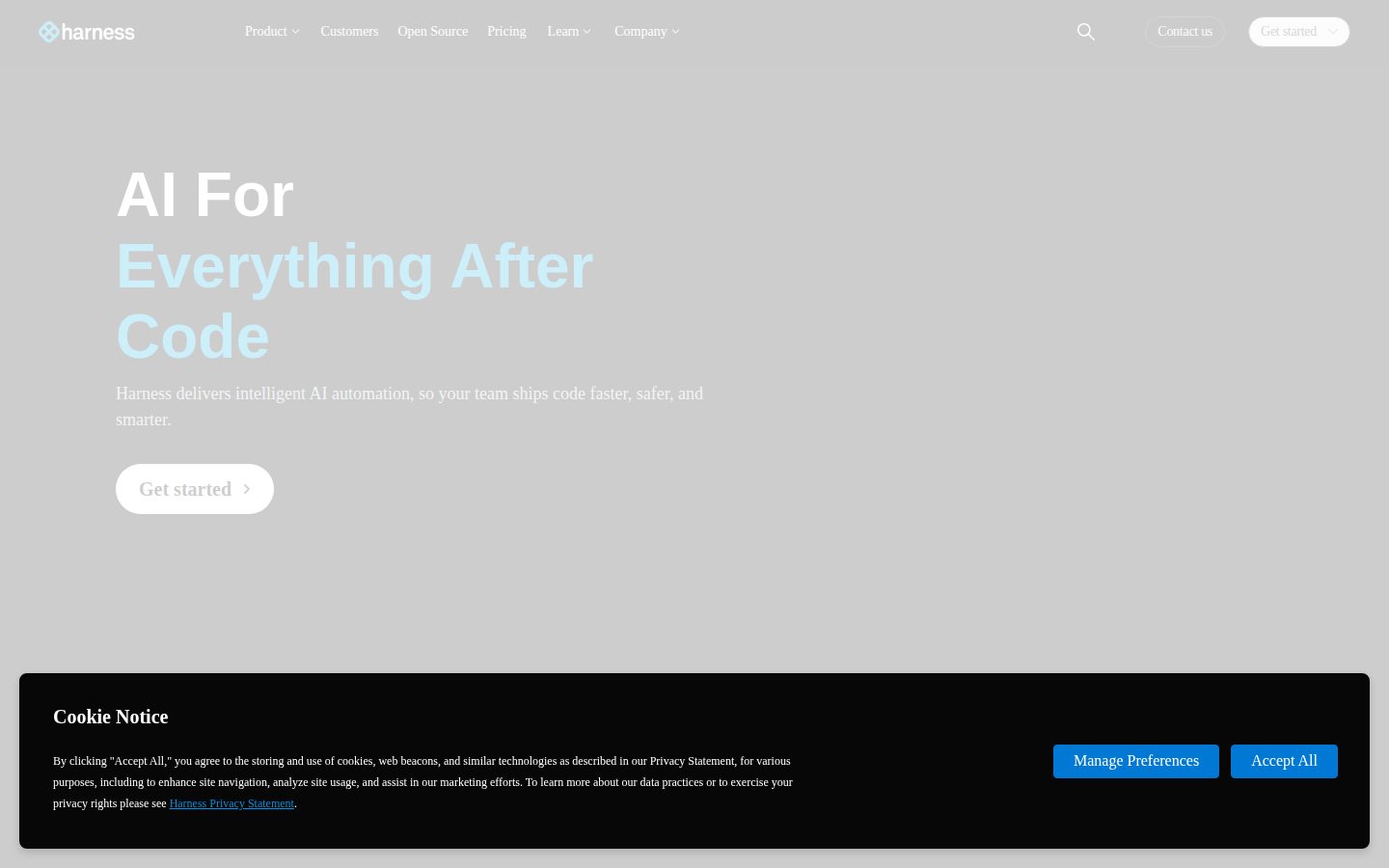
Harness is an AI-native software delivery platform for DevOps, testing, security, and cloud cost engineering teams.
AI Panel Score
6 AI reviews
Reviewed
AI Editor ApprovedApproved and published by our AI Editor-in-Chief after full panel analysis.Harness is an AI-native software delivery platform for DevOps, platform engineering, SRE, security, and FinOps teams that want to automate the full software delivery lifecycle. It packages modular products including Continuous Integration, Continuous Delivery & GitOps, Feature Management & Experimentation, Cloud Cost Management, Security Testing Orchestration, and Chaos Engineering on one platform with 100+ integrations across AWS, Azure, GCP, and Kubernetes. A permanently free plan covers individual developers and small teams, while the Essentials and Enterprise plans are priced per developer through a sales quote, with the median buyer paying roughly $48,000 per year. Standout capabilities include Continuous Verification that uses machine learning to auto-rollback bad releases, AI-generated pipelines, AutoStopping for idle cloud resources, and DORA metrics via Software Engineering Insights. Harness best fits organizations consolidating CI/CD, security scanning, and cloud cost tooling into a single delivery platform. Alternatives include GitLab, CircleCI, Jenkins, Azure DevOps, and Octopus Deploy.
Teams assemble software delivery pipelines from Harness modules on a single platform. Continuous Integration builds and tests code with hosted or self-hosted runners and intelligent caching, while Continuous Delivery & GitOps orchestrates deployments to Kubernetes and cloud targets with approval gates. Continuous Verification analyzes metrics and logs after each release and automatically rolls back deployments when it detects anomalies.
Beyond CI/CD, Harness adds Feature Management & Experimentation for feature flags and A/B tests, Chaos Engineering built on Litmus for resilience testing, Security Testing Orchestration to run and deduplicate SAST, DAST, and SCA scans, Cloud Cost Management with AutoStopping for idle resources, Infrastructure as Code Management for Terraform and OpenTofu, an Internal Developer Portal, Database DevOps, and Artifact Registry. The platform connects to 100+ integrations across AWS, Azure, GCP, and Kubernetes.
Harness targets platform engineering, DevOps, SRE, security, and FinOps teams consolidating delivery tooling. A permanently free plan covers individual developers, while Essentials and Enterprise are priced per developer through a sales quote. It competes with GitLab, CircleCI, Jenkins, Azure DevOps, GitHub Actions, and Octopus Deploy.
Harness runs as SaaS or a self-managed deployment, exposes REST APIs, and uses Delegates to reach private infrastructure behind a firewall. Gitspaces provides cloud development environments, and Software Engineering Insights reports DORA and SPACE metrics.
An AI development assistant that generates pipelines, explains and remediates failures, and answers questions across the platform.
Reports DORA and SPACE engineering metrics to measure delivery speed, quality, and developer productivity.
Uses machine learning to analyze post-deployment metrics and logs and automatically rolls back releases when it detects anomalies.
Builds and tests code on hosted or self-hosted runners with intelligent caching and test intelligence to skip unaffected tests.
Orchestrates deployments to Kubernetes and cloud targets with GitOps workflows, approval gates, and rollout strategies.
Manages feature flags and A/B experiments to roll out and target changes without redeploying code.
Provides per-cluster cost visibility and uses AutoStopping to shut down idle non-production resources and restart them on demand.
Runs Terraform and OpenTofu provisioning in pipelines with drift detection and centralized state management.
Provides a Backstage-based service catalog and self-service workflows for developers to scaffold and manage services.
Injects faults using Litmus-based experiments to test how services withstand failures and validate resilience.
Runs and aggregates SAST, DAST, and SCA scanners, deduplicates findings, and enforces policy gates in the pipeline.
Generates and self-heals UI and API tests to reduce manual test maintenance as applications change.
For individual developers and small teams getting started with software delivery.
For growing organizations with small to mid-size teams that need bundled delivery modules.
For large organizations that need the full module suite at scale with premium support.
Harness bets your entire delivery stack on one vendor, backed by a founder who's exited before.
“Harness consolidates CI/CD, security, cost, and feature flags into one AI-native platform led by a founder with a $3.7 billion exit behind him. The vendor risk is low and the platform is real, but single-vendor lock-in is the price of the consolidation.”
Jyoti Bansal sold his last company, AppDynamics, to Cisco for $3.7 billion in 2017. Then he built Harness. Goldman Sachs led a $240 million round at a $5.5 billion valuation this past December, so runway isn't the question.
What you're buying is consolidation. Continuous Verification uses ML to watch post-deploy metrics and roll back bad releases on its own, and that's real, not a checkbox. But you're also betting your whole delivery stack on one vendor, and GitLab sells the same all-in-one story.
Reputation-wise, this is a safe pick your board won't second-guess, and peers are consolidating the same way. The free tier lets five engineers prove value before procurement gets involved. Pilot two teams for a quarter, then negotiate the per-developer enterprise price.
Strong all-in-one story against GitLab, though the CI/CD field is crowded.
A well-funded, founder-proven vendor is an easy choice to defend to a board.
The free tier starts fast, but wiring the full platform takes real setup time.
Consolidating CI/CD, security, and cost onto one platform advances a platform-engineering direction.
Repeat founder, $5.5 billion valuation, and a Goldman-led round signal strong staying power.
Platform teams who want to consolidate fragmented delivery tooling onto one vendor.
Small teams who only need a single CI runner.
Harness is the platform bet for teams tired of owning the glue between delivery tools.
“Harness consolidates CI/CD, developer portal, cost, and metrics into one opinionated platform aimed at platform-engineering teams. The strategic depth and DORA reporting are real, but standardizing on its DSL is a three-year commitment you don't unwind casually.”
Every VP of Engineering hits the same fork: stitch together best-of-breed tools and own the glue, or standardize on one platform and inherit its opinions. Harness is the platform bet. Its Internal Developer Portal, built on Backstage, gives you golden paths and a service catalog without staffing a team to run Backstage yourself.
The strategic depth is real. Software Engineering Insights reports DORA and SPACE metrics natively, so delivery data lives where the pipelines run. However, standardizing 15+ modules here means your golden paths are defined in Harness's DSL, and unwinding that in three years is a genuine migration, not a config change.
Integration surface is broad: 100+ connectors, Delegates for private infra, REST APIs throughout. Against Octopus Deploy or a self-hosted Backstage stack, Harness trades some flexibility for coherence. For a platform team that wants to cut toil and ship golden paths this year, it's the right bet.
A leading consolidation play against point tools and self-hosted stacks.
Golden paths, a service catalog, and pipelines match how platform teams actually operate.
100+ connectors, Delegates, and REST APIs reach private and multi-cloud infrastructure well.
Powerful today, but standardizing on the Harness DSL creates a real migration cost later.
15+ modules with native DORA reporting show a genuinely deep platform, not a thin shell.
Platform teams who want golden paths without operating their own Backstage.
Engineering orgs who prefer assembling best-of-breed tools themselves.
Free is truly $0, but two of three tiers price per developer per module behind sales.
“Harness offers a genuinely free tier with 2,000 monthly cloud credits, then hides Essentials and Enterprise behind custom per-developer, per-module quotes. The free plan de-risks the trial, but the per-module pricing axis makes a multi-module rollout hard to forecast.”
Two of three tiers hide behind a sales call. Free is genuinely $0: 2,000 cloud credits a month, six modules, no card. Essentials and Enterprise are both custom-quoted, priced per developer, per module.
So model it. 50 developers across three modules, at a category-normal $30-40 per developer per module, runs roughly $54K-72K a year before support. The catch is the per-module axis, since every capability you add multiplies against the whole seat count. CircleCI meters by credits; Harness meters by developer, per module.
ROI is measurable here. AutoStopping shuts down idle non-prod resources, and Cloud Cost Management reports the savings in dollars. Enterprise adds a dedicated account manager. But with no published overage rate on cloud credits, the invoice you can't predict is the real risk.
The free plan eases procurement, though custom quotes add negotiation friction.
Enterprise is negotiable and per-developer, which is standard for the category.
The free tier is fully visible, but Essentials and Enterprise both require a sales quote.
Cloud Cost Management and AutoStopping report savings in dollars you can measure.
Modelable per developer, but the per-module axis multiplies cost as adoption grows.
Finance teams who can negotiate per-developer enterprise contracts.
Buyers who need published all-in pricing before committing.
Continuous Verification auto-rolls-back bad deploys, the feature SREs actually want at 2am.
“Harness gives SREs automated post-deploy rollback through Continuous Verification and firewall-friendly Delegates for private infrastructure. The on-call ergonomics are strong, but 15+ modules and sprawling docs mean real surface-area friction to work through.”
The first thing an SRE checks is what happens when a deploy goes sideways at 2am. Harness answers with Continuous Verification, which watches post-deploy metrics and logs and auto-rolls-back on an anomaly instead of paging you. That's the feature that earns its keep on-call.
Delegates are the connective tissue: install one in-cluster and the SaaS control plane reaches private infra with no inbound firewall rules, cleaner than babysitting a Jenkins agent. Pipelines are YAML with a visual editor on top, and Test Intelligence skips tests unaffected by a diff to trim CI feedback loops.
By day three, the friction is surface area, since 15+ modules mean the UI carries concepts you'll never touch. The docs sprawl to match, however, so finding the page you need is its own small fight. Still, for a team living in Argo CD wishing rollbacks were automatic, this is a real upgrade.
Strong on-call value from auto-rollback, offset by UI carrying unused modules.
Docs are extensive and practitioner-written but sprawl across a large platform.
15+ modules and doc sprawl create daily surface-area friction to navigate.
Continuous Verification, Test Intelligence, and a deep pipeline DSL reward advanced users.
Delegates and YAML pipelines fit GitOps and private-infra workflows naturally.
SREs who want automated rollback baked into their deployment pipelines.
Small teams who only run a handful of simple deploys.
Harness is a mile wide but dodges the inch-deep trap most all-in-one tools fall into.
“Harness packs a genuinely useful free tier and an AI assistant that softens a steep learning curve. It's solid and well-funded, but the breadth means month one is spent still discovering what's in the box.”
All-in-one platforms usually make me nervous. They go a mile wide and an inch deep, and you end up with twelve mediocre tools instead of three good ones. Harness mostly dodges that, since the free tier actually hands you 2,000 cloud credits and six real modules, not a crippled demo.
Onboarding is where the breadth bites. There's a lot of platform staring back at you on day one, and Harness AI softens it by generating pipelines and explaining why a build failed. Reliability-wise it feels solid, a $5.5 billion company rather than a weekend project.
It's a web console built for engineers, so mobile parity isn't the point and I won't ding it. The catch is the learning curve, since month one you're still finding modules you didn't know existed. Next to GitLab's familiar single-app feel, Harness asks more of you before it pays you back.
A coherent, engineer-grade console that doesn't feel like twelve stapled tools.
Steep at first, with module discovery continuing well into month one.
A web console for engineers where mobile isn't a use case, scored neutral.
The sheer breadth makes day one heavy, though Harness AI eases the ramp.
Feels mature and stable, backed by a $5.5 billion company with real scale.
Engineers who want one platform instead of juggling separate delivery tools.
People who want something simple they can learn in an afternoon.
Half the suite came by acquisition, but the founder and funding make it a real bet.
“Harness assembled part of its platform through acquisitions like Split.io, which raises integration questions. But a founder with a $3.7 billion exit and a $5.5 billion valuation make long-term viability the least of the worries here.”
Half this suite arrived by acquisition. Feature Management & Experimentation is Split.io, bought in 2024. Chaos Engineering is Litmus. The pattern usually means integration seams, modules that feel stapled together at the edges.
But the fundamentals check out. The founder took AppDynamics to a $3.7 billion Cisco exit in 2017, and Goldman Sachs just led a round at $5.5 billion. This isn't a vendor that vanishes in 18 months. Exit portability is decent too, since pipelines are YAML and IaC is standard Terraform and OpenTofu.
The yellow flag is scope. 15+ modules is a lot of surface to keep best-in-class, and LaunchDarkly still out-focuses their flags. Where Spinnaker sprawled and stalled, Harness has the funding and cadence to avoid that fate. Fair bet for a platform team. I'd watch the per-module bill.
Breadth is the differentiator, though point tools like LaunchDarkly out-focus single modules.
YAML pipelines and standard Terraform and OpenTofu ease exit, despite some DSL lock-in.
A $5.5 billion valuation and Goldman-led round make survival the least of the risks.
The AI-native framing is aspirational, but the free tier delivers real modules.
A repeat founder, strong funding, and steady shipping match survivor patterns.
Platform teams who want one funded vendor over many point tools.
Teams who need best-in-class feature flags above everything else.
Common questions answered by our AI research team
Yes. The Free plan costs $0 and includes 2,000 monthly cloud credits with six modules, including Continuous Integration, Continuous Delivery & GitOps, Code Repository, and Cloud Cost Management. Paid Essentials and Enterprise plans are priced per developer via a sales quote.
Yes. The Continuous Delivery & GitOps module deploys to Kubernetes and cloud targets with 100+ integrations across AWS, Azure, and GCP. Continuous Verification analyzes post-deploy metrics and automatically rolls back releases when it detects anomalies.
Yes. Security Testing Orchestration runs and aggregates SAST, DAST, and SCA scanners, deduplicates findings, and enforces policy gates inside the pipeline. Harness also offers Supply Chain Security and Application & API Security modules.
Yes. The Feature Management & Experimentation module handles feature flags and A/B experiments, letting teams roll out changes gradually and target specific releases without redeploying code.
Yes. Harness offers a self-managed deployment option on the Enterprise plan, and Delegates let the SaaS platform reach private infrastructure behind your firewall without requiring inbound network access.
Company
Harness Inc.Founded
2017Pricing
FreemiumFree Trial
AvailableFree Plan
AvailableHarness runs an AI-native software delivery platform that automates building, testing, deploying, and securing software, based in San Francisco.