Humanitec logo

Humanitec Review

Visit

The Internal Developer Platform engine for engineering teams

Humanitec is a platform engineering tool that helps teams build and operate Internal Developer Platforms.

Humanitec·Founded 2018·Contact for pricing from 2199.00Free TrialAI DevOpsAI CloudCollaboration Tools

AI Panel Score

6.9/10

6 AI reviews

AI Editor Approved

About Humanitec

Humanitec is a platform engineering solution that provides the infrastructure and tooling needed to build Internal Developer Platforms (IDPs). It centers on a 'Platform Orchestrator' that manages dynamic configurations and connects application workloads to the underlying infrastructure resources they need. Engineering platform teams use it to reduce developer cognitive load and standardize deployment workflows across organizations.

Humanitec is a platform engineering product designed to help infrastructure and platform teams build Internal Developer Platforms (IDPs). Rather than replacing existing tools, it acts as an orchestration layer that sits on top of a company's existing cloud infrastructure, CI/CD pipelines, and Kubernetes clusters, coordinating how applications are deployed and how resources are provisioned. At the core of Humanitec is a component called the Platform Orchestrator, which manages the relationship between application workloads and the infrastructure resources they depend on, such as databases, message queues, and DNS configurations. It uses a concept called 'Dynamic Configuration Management' to automatically resolve and inject the correct environment-specific configurations at deploy time, reducing the need for manual secret and config management. Humanitec is primarily targeted at platform engineering teams and DevOps engineers at mid-to-large organizations who are tasked with building developer self-service capabilities. By providing a structured framework and pre-built abstractions, it aims to shorten the time required to build and maintain an IDP compared to building one entirely from scratch. The product also includes a reference architecture called the Score specification, an open-source, platform-agnostic workload specification format that allows developers to describe their application requirements without being tied to a specific infrastructure tool. This separation of developer concerns from infrastructure concerns is a central design principle of the platform. In the broader platform engineering market, Humanitec competes with products like Backstage-based solutions, Port, and Cortex. It differentiates itself by focusing on the orchestration and dynamic configuration layer rather than purely on the developer portal interface layer.

Features

AI

  • AI Agent Infrastructure Provisioning

    Allows AI agents to provision infrastructure autonomously without tickets or manual reviews while enforcing platform-team-defined security, cost, and compliance policies.

Analytics

  • Impact Analysis

    Shows exactly what is affected and the scope of the issue within seconds when an agent or developer misconfigures something.

Automation

  • Ephemeral Environments

    Spins up a full environment to validate changes and automatically tears it down when validation is complete.

  • Progressive Rollouts

    Rolls out infrastructure changes in waves so that failures are contained to a limited blast radius rather than affecting all deployments at once.

Core

  • Dynamic Configuration Management

    Manages dynamic configurations that connect application workloads to the underlying infrastructure resources they need across the organization.

  • Platform Orchestrator

    An orchestration and governance layer that connects CI/CD, infrastructure as code, and cloud accounts to ensure every provisioning request follows the same defined rules.

  • Rollback

    Restores everything to the last known-good state with a single command when a deployment breaks something.

Integration

  • Terraform and OpenTofu Module Integration

    Connects existing Terraform or OpenTofu modules to the orchestrator and applies rules governing who can use them and where.

Security

  • Drift Detection

    Immediately alerts platform teams when an agent or developer changes infrastructure in a way that deviates from defined rules.

  • Policy Enforcement

    Enforces security, cost, and compliance policies on every deployment regardless of whether the request originates from a human developer or an AI agent.

Pricing Plans

Teams

$2199/monthly

Built for small teams that want to orchestrate one application.

  • 5 users included
  • 1 project with up to 5 environments
  • Email support
  • Public office hours
  • SSO (Google, Github)
  • API & CLI access
Popular

Pro

$5499/monthly

Built for growing teams with multiple applications to orchestrate.

  • 50 users included
  • Max 10 projects
  • Standard support
  • Monthly office hours with platform architect
  • Role-Based Access Control (RBAC)
  • Sandbox organization

Enterprise

Free

Built for large teams with complex needs and compliance requirements.

  • Unlimited users
  • Unlimited projects and environments
  • Premium support
  • Weekly office hours with dedicated platform architect
  • SAML
  • Audit logs

Self-hosted

Free

Full control and compliance for regulated industries or private-cloud deployments.

  • Unlimited users
  • Self-hosted Orchestrator and Runner
  • Installation support and onboarding
  • Weekly office hours with dedicated platform architect
  • Ideal for regulated industries or private-cloud deployments
  • SOC 2 Type II, GDPR, Regular Pen-Tests

AI Panel Reviews

The Decision Maker
The Decision MakerStrategic bet, vendor viability, timing, adoption approval
7.2/10

Serious orchestration muscle at $2,199/month minimum — board will ask hard questions.

Humanitec's Platform Orchestrator solves a real problem: teams burning months building IDPs from scratch. The pricing floor is steep and the vendor signal is thin, which gives me pause before standardizing.

Founded 2018. Six years in market. No public funding data I can find, which either means they're profitable or they're quiet about it. The free trial and a $2,199/month Teams floor suggests they're selling upmarket deliberately — this isn't a PLG play.

The Platform Orchestrator plus Dynamic Configuration Management is genuinely differentiated from what Backstage or Port give you. Those are portal layers. Humanitec is the wiring underneath. One CTO claims they had an IDP MVP in 24 minutes versus a 24-month plan. That's a testimonial, not a benchmark, but the architecture supports the claim.

Two things bother me. One: SAML is Enterprise-only, so a mid-size company on the $5,499/month Pro plan can't get it. That's a compliance red flag for regulated industries. Two: no changelog visible on the site, which makes it harder to judge how fast they ship.

The AI Agent Infrastructure Provisioning feature with drift detection and policy enforcement is exactly what matters right now as teams start letting agents touch prod. If your platform team is stretched thin managing Terraform sprawl, pilot this for 90 days before committing to Enterprise pricing.

Competitive Positioning7.5

Differentiates from Port and Backstage by owning the orchestration layer rather than the portal layer — a more defensible technical position for platform teams.

Reputation Risk7.0

Platform engineering is a recognized category and Humanitec is a named player alongside Port and Backstage-based solutions — adoption looks considered, not experimental.

Speed to Value7.5

The MVP Program promises a working Orchestrator in 2 weeks with a dedicated Platform Architect, which is a credible onboarding structure for the price point.

Strategic Fit8.0

AI Agent Infrastructure Provisioning with policy enforcement directly addresses the emerging problem of agents touching production infrastructure without guardrails.

Vendor Viability6.5

Founded 2018 with six years in market is positive, but no public funding data and no changelog make it hard to assess runway or shipping velocity.

Pros

  • Orchestration layer approach means it won't replace your Terraform, CI/CD, or cloud accounts — lower adoption risk
  • Drift detection and policy enforcement cover AI agent provisioning, which most competitors haven't caught up to yet
  • Ephemeral environments and progressive rollouts are production-grade features, not demos
  • Score spec is open-source, which limits lock-in on the developer side

Cons

  • SAML locked to Enterprise tier — the $5,499/month Pro plan leaves compliance teams exposed
  • No public funding data and no visible changelog makes vendor health hard to assess
  • $2,199/month floor with contact-only Enterprise pricing means cost can escalate quickly
  • One-project limit on the Teams plan makes it a proof-of-concept tier, not a real starting point

Right for

Platform teams at mid-to-large organizations already running Kubernetes who need to stop rebuilding IDP scaffolding from scratch.

Avoid if

You're a small team without a dedicated platform engineer — the pricing and complexity will outpace your capacity to extract value.

The Domain Strategist
The Domain StrategistCraft and strategy in the product's domain — adapts identity per category, same lens
7.8/10

Humanitec's orchestration-first bet is architecturally sound but priced for commitment.

Humanitec sits at the right layer of the IDP stack — orchestration and dynamic config, not just a pretty developer portal. The $2,199/month Teams entry point signals this isn't a self-serve tool; it's infrastructure you're betting a platform team on.

The Platform Orchestrator concept is what makes this architecturally interesting. Humanitec isn't trying to replace your Terraform modules, your CI/CD pipelines, or your Kubernetes clusters — the docs indicate it wraps around them as a governance and wiring layer. That's the right call. If you adopt this, in 3 years you have an organization where deployment workflows are standardized through Humanitec's abstraction layer, which means your platform team scales without proportional headcount growth. The risk is that Humanitec's Dynamic Configuration Management becomes load-bearing infrastructure; migrating off it later means re-solving config injection across every environment you've built.

The AI Agent Infrastructure Provisioning feature is where this gets strategically interesting for 2025. Policy-enforced autonomous provisioning with drift detection and progressive rollouts is a coherent answer to a real engineering problem: AI agents touching infrastructure without guardrails. The Impact Analysis feature — showing blast radius immediately on misconfiguration — is the kind of operational depth that suggests engineers with production incident scars actually designed this.

Compared to Port or a Backstage-based solution, Humanitec is betting on the orchestration layer rather than the portal layer. That's a defensible differentiation, but it means your developers still need a portal story. The Score specification being open-source is a genuine hedge — your workload definitions aren't locked to Humanitec's format even if the orchestrator is proprietary.

The pricing architecture tells you who they're actually building for. SAML is Enterprise-only, RBAC doesn't appear until the $5,499/month Pro tier, and the Teams plan caps at one project with five environments. Any mid-to-large org will hit Pro pricing within months of real adoption.

Category Positioning7.5

Orchestration-layer focus differentiates clearly from Port and Backstage, but leaves the developer portal gap for buyers to solve elsewhere.

Domain Fit8.0

Ephemeral environments, progressive rollouts, and drift detection map directly to how platform teams actually manage deployment risk at scale.

Integration Surface8.2

Explicit Terraform and OpenTofu module integration without replacement is the right non-invasive architecture for teams with existing IaC investments.

Long-term Implications7.0

The orchestration layer becomes deeply embedded in deployment topology; Score spec as open-source provides some exit optionality but the orchestrator itself is proprietary.

Strategic Depth8.5

Dynamic Configuration Management plus policy-governed AI agent provisioning shows genuine systems thinking beyond typical IDP tooling.

Pros

  • Orchestration-first architecture doesn't force you to rip out existing Terraform, CI/CD, or Kubernetes tooling
  • Policy-enforced AI agent provisioning with drift detection is a credible answer to agentic infrastructure risks
  • Score spec is open-source, providing workload-definition portability even if the orchestrator isn't
  • Progressive rollouts and rollback are production-grade operational features, not demo-ware

Cons

  • RBAC gated behind $5,499/month Pro tier is a real constraint for any team with multi-team access requirements
  • SAML only at Enterprise means regulated industries can't evaluate SSO posture without a sales conversation
  • No developer portal layer means platform teams need a parallel solution like Port or Backstage for the UI surface
  • Pricing page shows no usage-based path — cost scales by tier jump, not by actual platform adoption rate

Right for

Platform engineering teams at mid-to-large orgs who already own Kubernetes and IaC but need governance and self-service orchestration without rebuilding from scratch.

Avoid if

Your team is pre-platform-engineering maturity and needs a lightweight developer portal before you need orchestration infrastructure.

The Finance Lead
The Finance LeadMoney, total cost of ownership, contracts, procurement math
6.2/10

$5,499/month Pro tier: 50 users, but SAML locked behind Enterprise negotiation.

Pricing page exists and is readable — rare for this category. But Enterprise and Self-hosted show $0, which means the real number lives in a sales call.

Teams plan: $2,199/month. Pro: $5,499/month. That's $65,988/year at Pro before you touch Enterprise. Both numbers are published without a sales call, which puts Humanitec ahead of most IDP vendors. Port, a named competitor, gates similar detail behind demos. Credit where it's due.

50 users at Pro × $5,499 × 12 = $65,988/year. Add implementation — their own docs reference a 2-week MVP program with a Platform Architect, which won't be free at Enterprise scale. Year 3 TCO for a 100-person engineering org likely clears $200K once you factor SAML requirements (Enterprise-only), custom support tiers, and the seat creep that follows any successful IDP rollout. The Teams plan caps at 5 users and 1 project. That ceiling hits fast.

SAML is the tell. SSO via Google and GitHub ships at $2,199/month. SAML — what every enterprise security team requires — is Enterprise-only, no published rate. That's a standard SSO tax structure, just dressed differently. Contract terms, auto-renewal windows, and termination clauses aren't visible publicly. Negotiation room is unknowable from here. Procurement teams will need a full paper trail before signing anything above Pro.

Billing & Procurement5.8

Monthly pricing shown on Teams and Pro aids procurement; Enterprise negotiation opacity adds friction for teams with standard vendor onboarding requirements.

Contract Flexibility4.5

No public data on auto-renewal windows, term lengths, or termination-for-convenience clauses — category norm is 30-60 day auto-renewal traps.

Pricing Transparency7.0

Teams and Pro rates are published; Enterprise and Self-hosted show $0 with no guidance, requiring a sales call for anything at scale.

ROI Clarity6.0

The '24 minutes to MVP' testimonial is a single data point; no published time-to-value benchmarks or quantified cognitive load reduction metrics appear in evidence.

Total Cost of Ownership5.5

$5,499/month Pro plus SAML-gating at Enterprise means year-3 costs are structurally unpredictable for orgs over 50 seats.

Pros

  • Teams and Pro sticker prices published without a sales call
  • SSO included at $2,199/month — not a paid add-on at base tier
  • RBAC included in Pro at $5,499/month, not an upsell
  • Self-hosted tier exists for regulated industries — rare option in IDP category

Cons

  • SAML locked to Enterprise, no published Enterprise rate
  • 5-user, 1-project cap on Teams forces fast upgrade to $5,499/month
  • Zero contract term visibility — auto-renewal risk is unquantifiable
  • No overage rates published for environments or projects beyond plan limits

Right for

A 30-50 person platform engineering team that can operate within Pro plan limits and doesn't need SAML yet.

Avoid if

Your security team requires SAML and your legal team needs contract terms before a purchase order.

The Domain Practitioner
The Domain PractitionerDaily hands-on reality in the product's domain — adapts identity per category, same lens
7.2/10

Orchestration layer that actually fits SRE reality, but $2,199/month buys you only one project

Humanitec's Platform Orchestrator addresses a genuine SRE pain point: configuration drift and manual secret injection at deploy time. The pricing tiers reveal a product built for mid-to-large orgs, not scrappy platform teams trying to justify the spend.

Dynamic Configuration Management is the feature worth paying attention to. The promise is that environment-specific configs and secrets get resolved and injected at deploy time without a human touching a YAML file at midnight. For SREs who've spent hours debugging why staging got production creds, that's a real workflow win. Drift Detection shipping as a named feature — not buried in an audit log — suggests someone on the product team has actually been paged at 2am.

The Progressive Rollouts and Rollback features read like they were specced from an SRE runbook. Blast radius containment baked into infrastructure rollouts, and a single-command restore to last-known-good state. Compared to Backstage-based solutions where rollback is whatever your CI/CD pipeline happens to support, this is more opinionated in a useful direction. The tradeoff: opinionated means you're adapting your mental model to their abstraction layer. Score spec and Platform Orchestrator are new vocabulary your entire team learns or nobody does.

The Teams plan at $2,199/month caps you at one project and five environments. For an SRE running microservices across dev, staging, canary, prod, and a DR environment, that's a hard ceiling that forces an upgrade conversation before you've finished onboarding. Pro at $5,499/month unlocks RBAC — which shouldn't be a premium feature for any team serious about access control.

Docs indicate an MVP Program where a Humanitec architect sets up your first app end-to-end in two weeks. That's a reasonable runway. What isn't clear from public materials is what day-30 operational ownership looks like when the architect hands off the keys.

Day-3 Reality6.8

The one-project limit on the $2,199 Teams plan will surface as a real constraint within the first week for any SRE managing multiple services.

Documentation Practitioner-Fit7.0

The MVP Program and Platform Architect onboarding suggest docs are backed by guided implementation, though no public changelog is visible to verify cadence.

Friction Surface6.5

SAML gated to Enterprise tier means SSO friction for any org using non-Google/GitHub identity providers on lower plans.

Power-User Depth7.8

AI Agent Infrastructure Provisioning with policy enforcement and Impact Analysis indicates the platform has depth beyond basic deployment orchestration.

Workflow Integration7.5

Explicit Terraform and OpenTofu integration without replacing existing CI/CD pipelines reduces the adoption activation energy considerably.

Pros

  • Drift Detection as a first-class feature, not an afterthought
  • Progressive Rollouts with blast radius containment built into the model
  • Terraform and OpenTofu integration without ripping out existing IaC
  • Single-command rollback to last-known-good state

Cons

  • $2,199/month buys only one project and five environments — a ceiling most SRE teams hit fast
  • RBAC locked behind the $5,499 Pro tier despite being a baseline access-control requirement
  • No public changelog makes it hard to evaluate release velocity before committing
  • 'Immediate' drift alert claim carries no SLA or defined response time in public materials

Right for

Platform engineering teams at mid-to-large orgs who need governance guardrails around Kubernetes deployments without rebuilding their entire toolchain.

Avoid if

Small teams or startups who'll hit the one-project Teams tier ceiling before the platform proves its value.

The Power User
The Power UserDaily human experience, onboarding, polish, learning curve, reliability
6.8/10

Serious infrastructure muscle, priced like it knows you need it

Humanitec's Platform Orchestrator solves a real, painful problem for platform teams drowning in manual config work. But at $2,199/month just to start, you'd better have a clear mandate before you knock on finance's door.

The pricing page tells you a lot. Teams plan starts at $2,199 a month and caps you at one project, five environments, five users. That's not a trial balloon — that's a statement about who they're selling to. This isn't a tool you're going to spin up because you're curious. You arrive here with a problem and a budget code.

What they're actually selling is governance under pressure. The Platform Orchestrator sits between your developers, your AI agents, and your infrastructure and says 'everyone goes through me.' Drift Detection, Policy Enforcement, Progressive Rollouts — these aren't shiny features, they're the stuff that keeps a platform team from getting paged at midnight. The 24-minute MVP claim from a customer is marketing, but the underlying idea — that building an IDP from scratch takes forever — is completely true. Compared to assembling something Backstage-based by hand, this probably does cut months off.

The daily feel, though, is harder to read. The website runs on Webflow, no changelog is publicly surfaced, no API docs linked directly. That's a little thin for a product asking $5,499/month at the Pro tier. And mobile? Web-only. For a tool positioned around platform team visibility, that's going to sting someone standing in a war room with a phone.

Learning curve is the real wildcard. Dynamic Configuration Management is a genuinely different mental model. Month one you're probably leaning on their office hours heavily. Month three, either it clicks and becomes invisible infrastructure, or your team is still translating between their abstractions and your actual setup.

Daily Polish5.5

No public changelog, Webflow-built marketing site, and sparse API documentation signals the daily experience details haven't been sweated publicly.

Learning Curve6.0

Dynamic Configuration Management and the Score specification are non-trivial mental models; monthly office hours on the Pro tier at $5,499/month suggests Humanitec knows this.

Mobile Parity3.0

Web-only platform with no mention of mobile support — rough for on-call platform engineers who need visibility away from a desk.

Onboarding Experience7.0

The MVP Program with a dedicated Platform Architect doing the first setup in 2 weeks is a real hand-hold, but without a free plan, you're committing cold.

Reliability Feel7.5

Features like Rollback, Progressive Rollouts, and Drift Detection suggest the team has thought hard about failure states, which is confidence-building for a governance layer.

Pros

  • Platform Orchestrator genuinely solves the 'everyone managing configs differently' problem at scale
  • Drift Detection and Policy Enforcement cover AI agent chaos, which is a real and growing concern
  • Doesn't rip out your existing Terraform or CI/CD setup — it layers on top
  • Free trial exists so you can sanity-check before the $2,199 conversation

Cons

  • Floor price of $2,199/month means smaller teams are priced out entirely
  • SAML locked to Enterprise means mid-size security-conscious teams hit a wall on Pro
  • No public changelog makes it hard to track whether the product is moving fast or slow
  • Web-only with no mobile support

Right for

Platform engineering teams at mid-to-large orgs who are currently building an IDP by hand and losing.

Avoid if

Your team is under 20 engineers and nobody has 'platform' in their job title yet.

The Skeptic
The SkepticContrarian. Watch-outs, deal-breakers, broken promises, category patterns
6.2/10

3 green flags, 2 yellow ones — not bad for a 2018 vendor in a graveyard category

Humanitec has been around since 2018, which matters in a space where most IDP tools quietly died before reaching their third birthday. The orchestration-over-replacement angle is legitimate, but $2,199/month for five users and one project is a hard first ask.

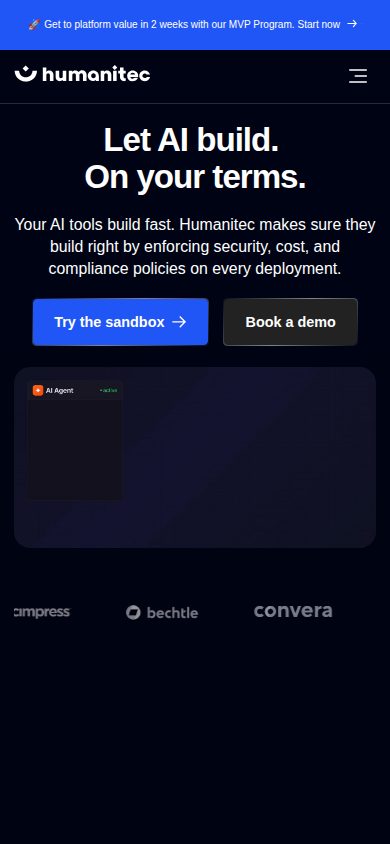
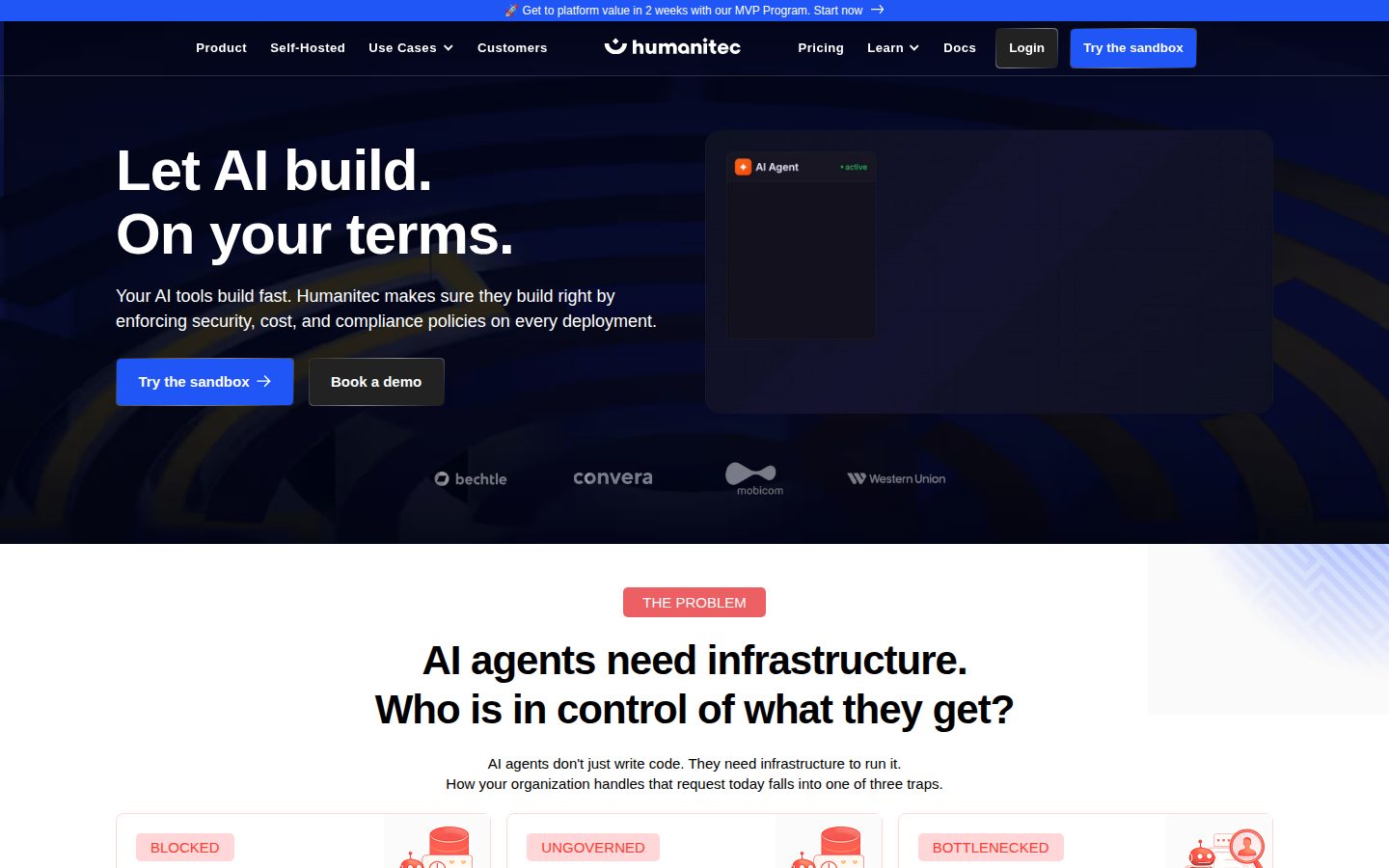
The IDP space is littered with vendors who pitched 'reduce cognitive load' and shipped a glorified YAML wrapper. Humanitec's been at this since 2018, which is longer than most. No changelog listed publicly, no API docs visible from the scrape — that's a yellow flag. The H1 says 'Let AI build. On your terms.' That kind of headline wants to be a 2024 pivot. Maybe it's genuine. Could go either way.

The Score specification being open-source is the most credible signal here. Platform-agnostic workload specs mean a real exit story exists if Humanitec folds. That's not nothing. Terraform and OpenTofu module integration without ripping out existing pipelines is also the right design call — the products that died usually forced full replacement. Port and Backstage-based solutions are the named competition, and Humanitec's dynamic configuration layer is a plausible gap against both.

Two flags I'd watch. One: $2,199/month gets you one project and five users. That's steep for a proof of concept. Two: 'We had a first MVP after 24 minutes' is a testimonial I've seen in every category before a renewal problem surfaces. Enterprise and Self-hosted tiers listed as 'Free' with no contact pricing is the kind of transparency gap that ages poorly in budget conversations.

Competitive Differentiation6.5

The dynamic configuration management layer is a real gap versus Port's portal-first approach, but the AI agent provisioning framing feels category-chasing.

Exit Portability7.5

The open-source Score specification is a genuine escape hatch; Terraform and OpenTofu integration means existing modules aren't held hostage.

Long-term Viability5.8

No public funding data visible, no changelog listed in capabilities, and a support email of info@ doesn't project enterprise-grade staying power.

Marketing Honesty5.5

The '24-minute MVP' testimonial is doing heavy lifting, and 'Let AI build' reads like a pivot headline bolted onto an older product story.

Track Record Match6.8

Founded 2018, still shipping — that's above average survival rate in a category where most vendors didn't make it to 2022.

Pros

  • Open-source Score spec means exit portability is real, not marketing
  • Orchestration-over-replacement design avoids the forced migration trap that killed competitors
  • Drift detection and policy enforcement on AI agent actions is a credible differentiator in 2024
  • Six-year survival in a notoriously brutal category is a signal worth weighting

Cons

  • $2,199/month for one project and five users is a steep entry price for a tool you're still evaluating
  • No public changelog makes shipping cadence impossible to verify from the outside
  • SAML locked to Enterprise means mid-market teams hit a real compliance wall at Pro tier
  • No SLA documentation visible — 'you'll know immediately' on drift detection isn't a commitment

Right for

Platform engineering teams at mid-to-large orgs who already have Kubernetes and Terraform in place and need governance without starting over.

Avoid if

Your organization is still deciding on cloud infrastructure foundations and can't absorb $2,199/month before you've validated the IDP concept.

Buyer Questions

Common questions answered by our AI research team

Pricing

What is the price difference between the Teams and Pro plans, and what additional features like RBAC do I get by upgrading to Pro?

In USD monthly pricing, the Teams plan is $2,199/month (5 users, 1 project with up to 5 environments) and the Pro plan is $5,499/month (50 users, unlimited environments), a difference of $3,300/month. Upgrading to Pro adds RBAC, a Sandbox organization, standard support, and monthly office hours with a platform architect.

Features

Does Humanitec support drift detection, and how quickly does it alert me when an AI agent or developer changes something it shouldn't have?

Yes, Humanitec supports drift detection. According to the content, 'Agent changed something it shouldn't have. You'll know immediately' — however, no specific alert time or SLA is provided beyond that immediate notification claim.

Security

Is SAML single sign-on only available on the Enterprise plan, or is it included in the Pro tier as well?

Based on the content, SAML is listed as an 'Enterprise feature' under the Enterprise and Self-hosted tiers. It is not mentioned as available on the Pro plan, indicating it is exclusive to Enterprise and Self-hosted.

Setup

How long does it take to get a working Internal Developer Platform set up — I saw a claim about a first MVP in 24 minutes. Is that realistic for my team?

A customer testimonial from a CTO (Markus Schünemann) states: 'We had planned 24 months to get our V1 for the IDP. With Humanitec we had a first MVP after 24 minutes.' The content also references an MVP Program where a Humanitec Platform Architect sets up the Orchestrator and deploys your first app end-to-end in 2 weeks. Individual results will vary and this represents one customer's experience.

Integration

Can Humanitec connect to my existing Terraform or OpenTofu modules without replacing my current CI/CD pipeline or infrastructure-as-code setup?

Yes, Humanitec explicitly states you can 'Connect your existing Terraform or OpenTofu modules' and that 'Humanitec doesn't replace any of it' — referring to your existing CI/CD, infrastructure as code, and cloud accounts. It positions itself as 'the orchestration and governance layer that connects them.'

Product Information

  • Company

    Humanitec
  • Founded

    2018
  • Pricing

    Contact for pricing from 2199.00
  • Free Trial

    Available

Platforms

web

About Humanitec

Humanitec is a Berlin-based platform orchestration company offering tools to help platform teams build internal developer platforms.

Resources

Documentation
Blog

Built With

Webflow

Also in AI DevOps