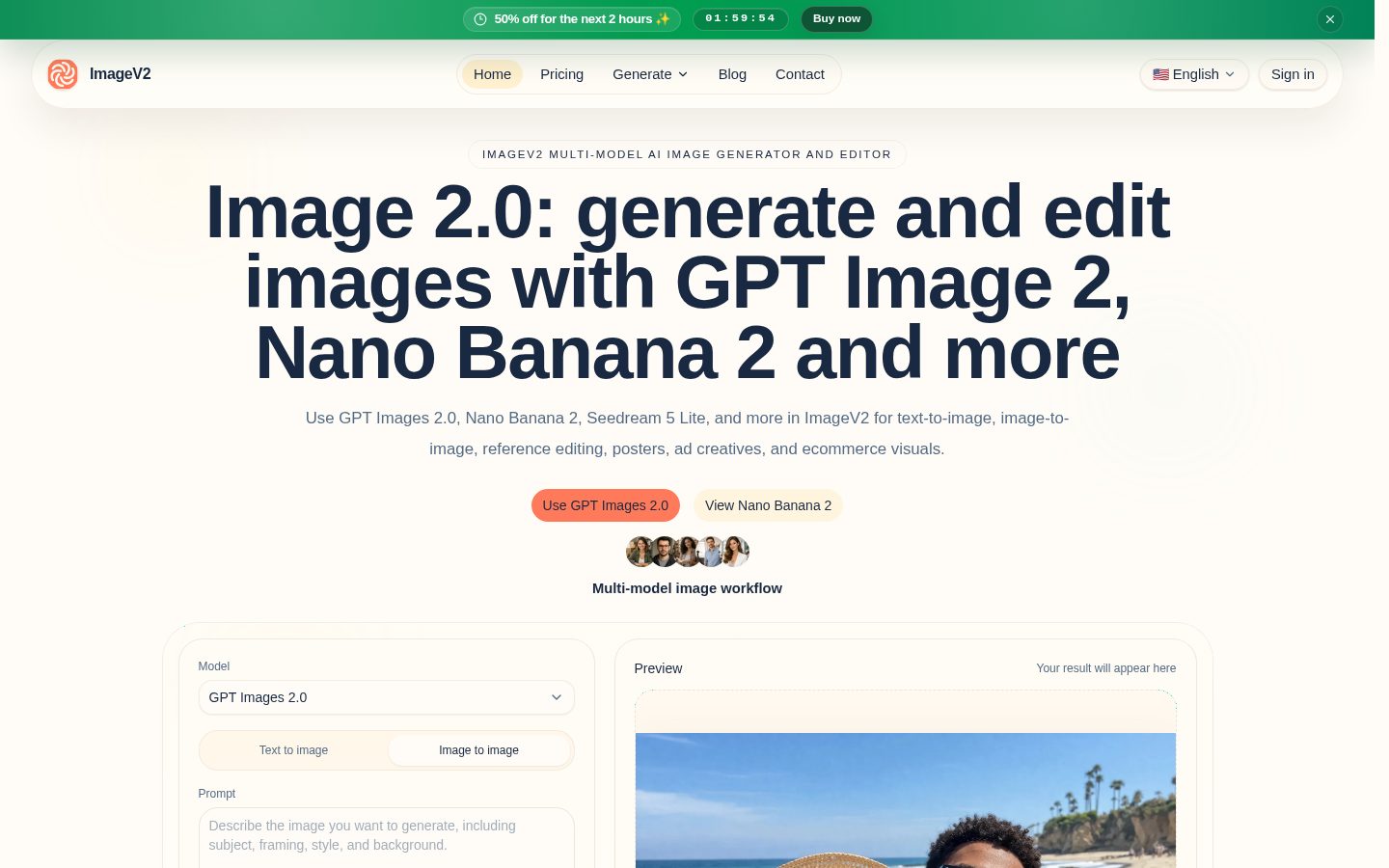
AI image generation across multiple models in one place
ImageV2 is an AI image generation platform for text-to-image creation and reference-based editing.
AI Panel Score
6 AI reviews
Reviewed
Facts checked against imagev2.org
ImageV2 lets users generate images from text prompts or edit images by uploading reference files, supporting workflows across marketing, ecommerce, and creative production. The platform is built around fast iteration, giving users a way to produce and refine images without switching between separate tools for generation and editing.
A distinguishing feature of ImageV2 is its access to multiple named image models on individual pages, including GPT Images 2.0, Nano Banana 2, and Seedream 5 Lite, which users can review and compare before generating an image. Generated results are retained and saved for 30 days, and outputs can be used commercially subject to rights checks.
ImageV2 offers both subscription plans and credit packs as purchasing options, suited to users who need occasional image generation as well as those with ongoing production needs.
Provides access to multiple distinct AI image models, each with its own dedicated page.
Edits images using uploaded reference images to guide the output.
Generates images from user-written text prompts.
Keeps generated image results saved and accessible for 30 days.
Offers subscriptions or one-time credit packs to pay for image generation usage.
Lets users view public pages for each image model to compare capabilities before generating images.
Verifies rights so generated outputs can be used commercially.
Provides a dedicated support email and contact page for user assistance.
Lower annual cost for steady weekly production
Lower annual cost for teams producing every month
Annual scale for always-on creative production
One subscription, three serious image models, no tool-switching tax.
“ImageV2 wraps GPT Images 2.0, Nano Banana 2, and Seedream 5 Lite behind one $8.33/month plan. The pitch is consolidation, not a new capability — and that's exactly its value.”
450 credits a month for $8.33, billed yearly, with all models included. That's the Basic tier, and the Standard tier at $16.67 triples the credits to 1200. Pro goes to 3600 at $41.67. Reasonable ladder, clear math, no quote-a-sales-rep nonsense.
The real feature isn't any single model — it's the comparison pages letting you pick GPT Images 2.0 versus Nano Banana 2 versus Seedream 5 Lite before you spend a credit. Reference editing supports up to 16 images on GPT, 14 on the others. That's a genuine workflow advantage over picking one model and living with it.
Tradeoff: credits reset monthly and don't roll over, so bursty production months get punished unless you buy credit packs instead. Thirty-day result storage is fine for iteration, thin for an archive. I couldn't find a changelog or docs page, so judge the roadmap by what's shipped, not promised.
Access to GPT Images 2.0, Nano Banana 2, and Seedream 5 Lite under one plan beats committing to a single-model alternative for teams that need flexibility.
Commercial rights checks are a good sign, but 30-day storage and no roll-over credits mean unclear data permanence if a team pauses.
At $8.33/month with 450 credits and instant model comparison, a team can be producing usable output same day.
Consolidating multiple image models into one workflow saves tool-switching for marketing and ecommerce production, a real operational gain not just cost-cutting.
Pricing is concrete and the model lineup looks maintained with named versions like GPT Images 2.5 and Seedream 5.5 mentioned alongside current ones.
Marketing and ecommerce teams who want to compare image models without juggling separate subscriptions.
Skip it if you need permanent asset storage beyond 30 days without manual export.
A model aggregator, not a creative system — useful for output, thin on craft infrastructure.
“ImageV2 packages three named models under one roof with a workable credit ladder. But there's no brief, no moodboard, no asset library — this is a generation terminal, not a production environment.”
Multi-Model Access across GPT Images 2.0, Nano Banana 2, and Seedream 5 Lite is the whole pitch, and it's a real one for anyone tired of tab-switching between model playgrounds mid-concept. But a model switcher isn't a creative system. There's no brief structure, no shared style reference library across projects, no way to lock a visual direction and iterate a campaign against it — just prompt, generate, compare.
The Model Comparison Pages suggest someone understood that art directors need to see a model's bias before committing a client's budget to it. That's a thoughtful touch most aggregators skip. Still, 450 credits on the Basic Yearly tier is a tight allotment for anyone running real production volume, and credits resetting monthly rather than banking punishes uneven creative cycles — the week you need 40 variants is rarely the week you budgeted for it.
For three years out: this is a sourcing tool you bolt into a larger workflow, not a system you build a studio's visual identity around. Fine for ecommerce teams needing fast product shots. Thin for anyone building a durable brand language.
Three named models at $8.33/month entry is a genuinely differentiated aggregation play against single-model generators.
Fits fast production (ecommerce, marketing shots) well; doesn't match how art directors manage ongoing campaign consistency.
Reference-based editing up to 16 images on GPT Images 2.0 covers a real workflow step, but there's no mention of API or plugin access for pipeline integration.
30-day result retention and non-rolling credits mean no durable creative archive builds up inside the tool itself.
Model comparison pages show curatorial thinking, but there's no versioning, style-locking, or iterative refinement layer beyond prompt-and-regenerate.
Ecommerce and marketing teams who need fast, model-flexible product and campaign shots without managing separate subscriptions.
Avoid if you need a system to build and maintain a consistent brand visual language over time.
$8.33 a month, three models, no sales call. Procurement sails through this one.
“Three tiers, all priced in public, from $8.33 to $41.67 monthly. Credits reset monthly with no stated multi-year lock, which matters more than the entry price.”
Pricing is posted, not gated. $8.33, $16.67, $41.67 monthly, billed yearly at 50% off the monthly-equivalent rate. No demo request, no quote form. That alone clears most procurement desks.
TCO math: Standard tier at $16.67/mo × 12 = $200/year per seat-equivalent. Unit isn't specified as per-seat, which matters once a team of 5 tries to share one subscription against 1200 credits monthly. Credit packs sit alongside subscriptions for overflow, which is the right structure, but I couldn't find a per-credit cost to model true overage.
Contract terms are thin on specifics. I didn't find an auto-renewal window or a termination clause, and annual billing without a visible cancellation path is a standard watch-item, not a red flag yet. ROI is measurable at the credit level — cost per generated image is calculable once credit-to-image ratios are known — but I couldn't confirm that ratio. Access to GPT Images 2.0, Nano Banana 2, and Seedream 5 Lite under one invoice beats paying three vendors separately, assuming usage stays inside the monthly reset.
Self-serve subscription plus credit packs, no procurement friction visible, standard SaaS invoicing model.
No visible auto-renewal window or cancellation terms; annual billing without published exit clause is a gap, not necessarily a trap.
Three tiers with exact monthly figures, $8.33 to $41.67, posted without a sales call.
Credit-based usage is countable in theory, but credit-to-image ratio isn't stated, so cost-per-output can't be pinned down.
Low entry price but unit basis unclear and per-credit overage cost not visible for 3-year modeling.

Solo creators or small teams who want predictable monthly cost and don't need multi-seat licensing clarity.
Avoid if your procurement process requires a published cancellation clause before signing annual terms.
Three models, one canvas, zero sense of a project — just loose generations piling up
“ImageV2 swaps model-hopping for a single workspace, which helps iteration speed. But there's no layer structure or asset grouping, so it reads as a generation tool, not a design tool.”
Switching between GPT Images 2.0 and Seedream 5 Lite without leaving the tab is the real win here — no exporting a reference image from one app to paste into another's upload field. That's a genuine daily-fight reduction for anyone juggling model quality against speed.
But after the first session, the gaps show. There's no canvas to stack variations against each other, no way to tag a generation as 'client approved' versus 'exploring.' Reference editing tops out at 14-16 images depending on model, which is generous for compositing references, but nothing in what I found suggests masking, selective regions, or layer-level control — you're sending a whole reference image and hoping the model reads intent correctly.
Credit math adds its own friction: 450 credits on the $8.33 entry tier resets monthly with no carryover, so a slow week just evaporates unused capacity. Fine for exploration, awkward for anyone trying to budget a client project against it.
Model-switching inside one tab removes real friction, but lack of project grouping means day-3 users are scrolling flat generation history.
I couldn't find docs or a changelog, so I can't judge whether guidance covers per-model prompt quirks designers would need.
Reference uploads capped at 14-16 images per model keep compositing workflows simple but reduce fine control over which element gets emphasized.
Model comparison pages help beginners pick a model, but nothing suggests batch generation or seed-locking for iterative refinement at scale.
No visible brief or moodboard structure means it sits apart from existing creative production pipelines rather than slotting into them.
A solo designer or small studio that wants fast model comparison without managing three separate subscriptions.
Avoid if your workflow depends on layer-level editing control or organizing assets by campaign rather than by individual generation.
Three good engines, one dashboard, zero sense that anyone's organized your week.
“ImageV2 bundles GPT Images 2.0, Nano Banana 2, and Seedream 5 Lite under one $8.33/month entry plan. The generation part feels built with care; the surrounding workflow feels like it stopped at the invoice.”
Ten minutes in, you're picking a model off a comparison page and typing a prompt. That part's smooth, genuinely, and it's the right first move — most tools make you guess which model handles what before you've spent a credit. Good instinct.
But the first hour is also the easiest hour this product will ever give you. The real test is week three, when you've got forty generations sitting in a flat list with a 30-day clock running out on each one, and you're trying to remember which prompt made the good poster. There's no folder, no tagging, nothing — just you, scrolling.
I couldn't find a mobile app or any indication this works as anything but a desktop browser tab, which for an image tool used in ecommerce and marketing workflows feels like half the job. Credits resetting monthly with no rollover also means your learning curve gets taxed — burn credits experimenting with Seedream versus GPT Images 2.0 and you're paying tuition every cycle.
Model comparison pages are a thoughtful touch, but nothing in the storefront suggests attention to the generation-to-generation experience beyond that.
Three models with distinct reference-image limits (16 vs 14) means real decisions to learn, and monthly credit resets punish slow learners.
Platforms are listed as web only, with nothing suggesting a mobile-tuned experience for an on-the-go marketing or ecommerce workflow.
Picking a model before spending a credit via the comparison pages is a low-homework start.
Commercial rights checks suggest some backend rigor, but I found no mention of error states, retries, or generation failure handling.
Marketing or ecommerce teams who want multiple image models on one bill and work entirely from a desktop.
Avoid if you need mobile generation or long-term organized archives of client work.
A reseller of other people's models, priced like a product.
“ImageV2 is a front end over GPT Images 2.0, Nano Banana 2 and Seedream 5 Lite, not a model of its own. The pricing ladder is clean, but what you're buying is convenience, not a moat.”
No model here is ImageV2's. GPT Images 2.0, Nano Banana 2, Seedream 5 Lite — all licensed, all swappable by the vendor at will, with a buyer Q&A already naming more variants (GPT Images 2.5, Seedream 5.5) waiting in the wings. That's the whole pitch: aggregation. Fine, if the aggregation stays current.
The risk isn't quality, it's dependency on someone else's roadmap. If GPT Images 2.0 gets deprecated upstream, your $8.33/month entry tier changes shape overnight and you didn't get a vote.
Exit is easy in one sense — prompts and reference files aren't locked in, nothing proprietary to untangle. But your 450 monthly credits and any workflow habits built around three specific named models evaporate if you leave. I couldn't find a changelog, so I can't gauge how fast they add or drop models. That's the thing to watch, not the output quality.
Multi-model access under one invoice is the whole differentiator, and it's a layer any competitor licensing the same models could replicate.
No proprietary file format to escape, but 30-day storage and monthly credit resets mean little carries over if you walk away.
A support email and contact page are listed, but I couldn't find a changelog or docs to judge release cadence or how fast new models get added.
The H1 names GPT Image 2 and Nano Banana 2 directly instead of vague superlatives, which matches what the pricing page actually sells.
Reference limits (16 images on GPT Images 2.0, 14 on the others) are specific enough to check, but there's no usage data behind the commercial-rights-check claim.
Teams who want one invoice for multiple image models and don't mind the vendor controlling which models stay available.
Avoid if you need guaranteed long-term access to one specific model regardless of licensing changes upstream.
Common questions answered by our AI research team
ImageV2 draws on multiple underlying image models, currently including GPT Images 2.0, Nano Banana 2, and Seedream 5 Lite, alongside other listed models like GPT Images 2.5, Nano Banana 2.1, Seedream 5.0 Pro, Seedream 5.0 Flash, MiniMax H3 Image, and Seedream 5.5.
Reference image capacity depends on the model: GPT Images 2.0 supports up to 16 reference images, while Nano Banana 2 and Seedream 5 Lite each support up to 14.
Generated results are kept saved for 30 days after creation.
The Standard Yearly plan includes 1200 credits monthly, access to all image models, prompt/edit/reference workflows, results saved for 30 days, and commercial use with rights checks, priced at $16.67/month billed yearly ($33.33 without the discount).
No. Subscription credits reset every month and unused subscription credits do not roll over; credit packs, by contrast, stay available until used.
ImageV2 is a web-based platform that provides access to multiple AI image generation and editing models, including GPT Image 2, Nano Banana 2 and Seedream 5.