Generative AI platform for end-to-end drug discovery and development
Insilico Medicine is a generative AI drug discovery platform for pharmaceutical researchers and biotech organizations.
AI Panel Score
6 AI reviews
Reviewed
AI Editor ApprovedApproved and published by our AI Editor-in-Chief after full panel analysis.Insilico Medicine is a generative AI drug discovery platform for pharmaceutical researchers and biotech organizations. It covers the full pipeline from disease modeling and target identification through molecule generation, lead optimization, and clinical trial prediction. Core modules include PandaOmics for AI target and biomarker discovery, Chemistry42 for generative small-molecule design, and inClinico for clinical trial outcome prediction, alongside the Dora multi-agent research assistant and the Life Star autonomous robotics laboratory that closes the wet-lab gap. Pricing is quote-based, with no free plan or trial. TopReviewed's six-seat AI review panel scored it 7.7/10, praising the internal pipeline whose Phase II clinical data validates Chemistry42 in production while noting that no public pricing or trial access means long sales cycles before technical diligence. It best fits pharma or biotech organizations with dedicated computational biology teams and active small-molecule programs needing integrated target-to-clinic AI infrastructure.
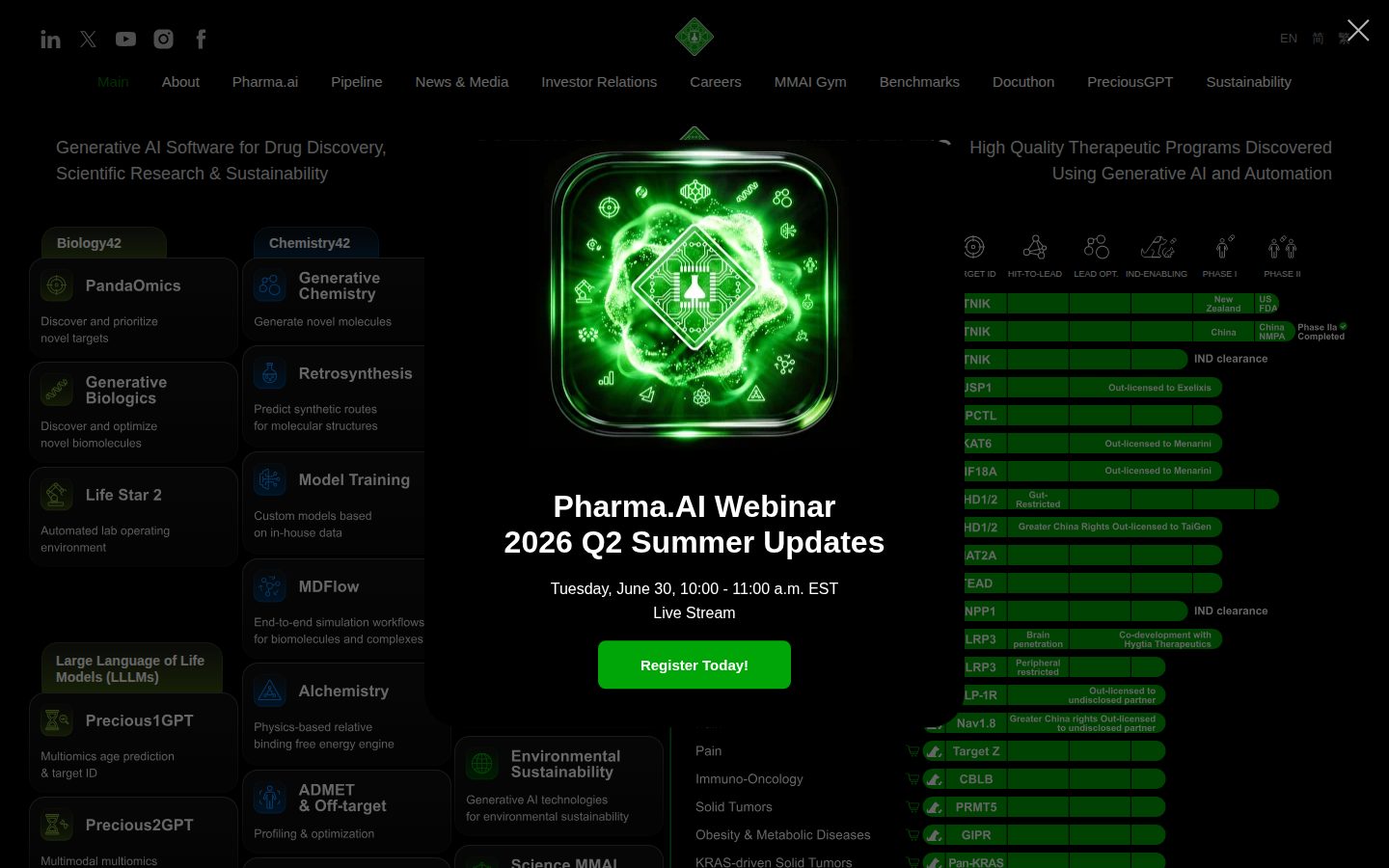
Insilico Medicine's Pharma.AI platform organizes drug discovery into modular software products that researchers use at each stage of the pipeline. Users start with PandaOmics to analyze omics data and identify disease targets, then move to Chemistry42 to generate and optimize small molecules using generative models, and can extend into biologics design via Generative Biologics. Science42 and its DORA component provide a large language model assistant trained on life sciences literature to support research tasks across the workflow.
The platform explicitly highlights what it calls Large Language of Life Models (LLLMs) — foundation models trained on biological and chemical data rather than general text — as a core differentiator. Chemistry42 has been used to generate molecules for Insilico's own internal pipeline, which currently spans over a dozen oncology and fibrosis programs at various clinical stages, including a TNIK inhibitor in Phase II trials. inClinico is designed to predict clinical trial success probabilities before trials are initiated.
The primary audience is pharmaceutical companies, biotech organizations, and academic research groups working on target identification, small molecule drug design, and clinical development. Pricing is not publicly listed; the website directs prospective users to contact the company for licensing terms. Competitors in the AI-driven drug discovery platform category include Schrödinger, Recursion Pharmaceuticals, Exscientia, and BenchSci.
The platform is delivered as a web-based SaaS suite, with individual modules available for separate licensing. A free course on disease modeling and target discovery is offered publicly, providing limited access to educational content built around the platform's methodology.

A core component of Pharma.AI focused on generative AI for biological target identification, disease hypothesis generation, and omics-driven insights as part of the end-to-end drug discovery pipeline.
A generative AI engine incorporating 42+ machine learning techniques (GANs, autoencoders, evolutionary algorithms) and ~500 pre-trained models to design novel small-molecule drug candidates with custom physicochemical and ADME properties from scratch.
A multi-agent AI research assistant within Pharma.AI that builds focused research plans, retrieves high-quality peer-reviewed sources scored by author expertise and relevance, and provides traceable citations to support scientific decision-making.
A Pharma.AI sub-platform covering AI-assisted medicine development and clinical stage analysis, completing the biology-to-clinic loop within Insilico's integrated drug discovery system.
A multimodal foundation model within Pharma.AI that bridges natural language and chemical language representations, enabling cross-modal understanding for drug discovery research tasks.
A cloud-based platform that applies AI and bioinformatics to multimodal omics and biomedical text data (gene expression, proteomics, methylation, etc.) to rank and prioritize novel therapeutic targets and biomarkers by disease association and druggability.
An absolute binding free energy (ABFE) calculation capability within the Pharma.AI platform used for high-accuracy molecular optimization, supporting multi-target molecular generation in generative biologics workflows.
Uses machine learning models trained on historical clinical trial data to predict the likelihood of a drug candidate successfully advancing from Phase 2 to Phase 3 trials.
A physics-based module layered atop AI generative models that runs molecular dynamics simulations for each drug candidate to refine binding affinity estimates and filter out structurally unstable scaffolds.
A fully automated, AI-powered robotics lab operated by AI systems and robotic vehicles that performs cell culture, imaging, sequencing, genomic analysis, and high-throughput compound screening, with data flowing directly into PandaOmics for target validation.
A supervised and reinforcement fine-tuning training and benchmarking system designed to improve the performance of causal large language models on real-world drug discovery tasks, enabling compact, specialized LLMs that outperform larger general models.
An integrated, cloud-based generative AI platform spanning biology, chemistry, and clinical development that connects all discovery modules (PandaOmics, Chemistry42, InClinico) into a single pipeline from target identification to clinical trial prediction, available via licensing or collaboration.
Insilico Medicine operates as a sales-led, enterprise-only vendor with no publicly listed pricing. Access to its Pharma.AI platform — including Chemistry42 (generative small molecule design), PandaOmics (target discovery and multiomics analysis), and inClinico (clinical trial outcome prediction) — is available through licensing agreements, R&D collaborations, or direct partnership discussions. Pricing requires contacting the vendor.
A TNIK inhibitor in Phase II tells you more than any demo ever will.
“Insilico has a live pipeline — 12+ programs, one in Phase II — built on the same Chemistry42 and PandaOmics modules they're selling. That's the whole proof of concept.”
Most AI drug discovery vendors are selling a hypothesis. Insilico is selling what they actually use. Chemistry42's 42+ ML techniques and ~500 pre-trained models generated candidates for their own TNIK inhibitor, now in Phase II. That's not a case study — that's a production deployment. Against Schrödinger and Recursion, this platform-eats-its-own-cooking story is the real differentiator.
The coverage is legitimately broad: PandaOmics for target ID, Chemistry42 for molecule generation, inClinico for trial outcome prediction, and Life Star robotics feeding data back into the loop. The tradeoff is access. No pricing page, no free trial, no API docs publicly available. This is a sales-led enterprise vendor. You won't pilot this in a weekend.
Three questions before you engage. One: does your team have the biology depth to use PandaOmics without heavy onboarding? Two: can you negotiate modular licensing rather than a full-suite commitment? Three: what's their SLA on the cloud infra? Escalate to a structured proof-of-concept. Don't sign a broad license first.
Schrödinger competes on physics-based modeling depth; Insilico's generative-first approach with a live internal pipeline is a distinct and defensible position.
A peer-reviewed, Phase II-backed platform won't raise board eyebrows — it's a credible bet in a category the industry is watching closely.
No free trial, no public pricing, and a modular enterprise sales process means onboarding won't be fast — budget 6+ months to first real output.
End-to-end coverage from PandaOmics target discovery through inClinico trial prediction advances pipeline velocity, not just cost reduction.
Boston-headquartered with 12+ active clinical programs including a Phase II asset — that's a company with real skin in the game, not just a SaaS wrapper.
Pharma or biotech organizations with a dedicated computational biology team and active small-molecule programs.
Your team needs a fast, self-service proof-of-concept before committing to an enterprise contract.
End-to-end pipeline coverage with a Phase II asset to prove it isn't just software.
“Insilico's Pharma.AI suite spans target identification through clinical trial prediction in a single integrated architecture — rare in this category. The TNIK inhibitor in Phase II is the most credible third-party validation any AI drug discovery platform can offer: their own molecules in the clinic.”
Chemistry42's 42+ ML techniques and ~500 pre-trained models is library-grade depth, not a demo wrapper. PandaOmics handling multimodal omics — gene expression, proteomics, methylation — and feeding directly into the Life Star robotics lab creates a wet-dry lab loop that Schrödinger and Exscientia don't offer as an integrated stack. The Large Language of Life Models framing signals genuine foundation model investment, not GPT wrappers renamed for pharma.
The three-year concern is pipeline dependency. If you license Pharma.AI and anchor your target ID workflow in PandaOmics, your scientific decision infrastructure sits inside a vendor that is simultaneously running its own competing drug programs across oncology and fibrosis. Conflict-of-interest governance becomes a real compliance conversation your legal and BD teams will need to resolve before renewal.
No public pricing and no trial access means procurement cycles are long and comparison is opaque — BenchSci and Recursion both offer clearer entry points for research teams under $10M in budget. But for a large pharma or well-capitalized biotech, the modular licensing model and clinical-stage proof points make this a serious procurement conversation, not a pilot experiment.
Among Schrödinger, Recursion, and Exscientia, Insilico is the only platform with an integrated robotics lab feeding back into its AI target discovery layer, which is a meaningful architectural differentiator at this stage of the category.
The biology-to-clinic loop — PandaOmics to Chemistry42 to inClinico — maps directly to how a discovery organization structures its pipeline stages, including ADMET profiling and ABFE calculations that medicinal chemists actually require.
AWS and Amazon SageMaker infrastructure plus support for external QSAR models and in-house databases suggests reasonable interoperability, but no public API documentation limits pre-contract technical diligence.
Vendor runs competing internal drug programs across 14+ targets in oncology and fibrosis, creating data governance and conflict-of-interest questions that a CMO must contractually resolve before deep platform adoption.
Chemistry42's ~500 pre-trained models plus the Nach01 multimodal foundation model bridging natural language and chemical language represents genuine foundation model investment with clinical proof in a Phase II TNIK inhibitor program.
Large pharma or well-capitalized biotech with active small molecule programs needing integrated target-to-clinic AI infrastructure.
Academic labs or early-stage biotechs without budget for enterprise licensing and legal resources to manage vendor conflict-of-interest governance.
No public pricing, no free trial, one Phase II asset — contact sales for everything.
“Insilico's Pharma.AI platform covers the full discovery pipeline across 12+ programs, but zero pricing is public. Every number requires a sales call.”
No pricing page. No tiers. No trial. Chemistry42, PandaOmics, inClinico — each module licensed separately, terms undisclosed. That's not rare in enterprise pharma software, but it means procurement starts blind. Schrödinger publishes at least some academic and small-business rates. Insilico publishes nothing.
TCO is genuinely unknowable from public materials. Multi-module licensing for a team accessing PandaOmics plus Chemistry42 plus inClinico could plausibly run $500K–$2M annually at a mid-size biotech — category norm for integrated platforms — but that's inference, not evidence. No overage rates, no seat model, no term lengths disclosed.
The one concrete data point in their favor: a TNIK inhibitor in Phase II. That's proof the platform generates real pipeline candidates, not just demos. ROI story is defensible if your org can negotiate milestone-based terms. Contract flexibility is the unknown that matters most here.
Sales-led, collaboration-or-license model with AWS/SageMaker infrastructure suggests complex onboarding and extended procurement cycles.
No auto-renewal terms, cancellation clauses, or term lengths are publicly disclosed — category norm for enterprise pharma, still a procurement risk.
No public pricing, no tiers, no starting rate — 100% contact-sales, per the pricing page evidence.
TNIK inhibitor in Phase II provides concrete pipeline validation; inClinico's Phase 2-to-3 prediction model offers a measurable success-probability metric.
Multi-module architecture with separate licensing for Chemistry42, PandaOmics, and inClinico means year-3 costs are structurally unpredictable.
Mid-to-large biotech or pharma org with a dedicated procurement team and budget headroom for a multi-year platform negotiation.
Your team needs price certainty before stakeholder approval or lacks the procurement bandwidth to negotiate enterprise licensing from scratch.
End-to-end pipeline depth that Schrödinger can't touch, but black-box AI demands institutional trust
“Pharma.AI covers the full discovery arc — PandaOmics through inClinico — in a single integrated SaaS suite. No public pricing and no free trial means every evaluation starts as a sales conversation.”
Chemistry42 with 42+ ML techniques and ~500 pre-trained models isn't a demo toy. That's production-grade generative chemistry. The TNIK inhibitor in Phase II is the proof point — Insilico has run their own molecules through this pipeline, which changes how seriously I take their lead optimization claims. MDFlow layering physics-based dynamics on top of generative outputs is the kind of depth that separates real platform thinking from a wrapper around an LLM.
The daily workflow question is harder. No changelog public, no API docs visible, no pricing page. That's three signals that post-sales friction is real. Schrödinger at least gives you Glide documentation you can live in. DORA's traceable citations help, but without practitioner-authored docs, a medicinal chemist on week three is navigating by sales material.
The tradeoff is genuine: autonomous robotics lab (Life Star), multimodal foundation models (Nach01), and clinical trial prediction in one platform is extraordinary breadth. But contact-only pricing plus no trial means academic groups and lean biotechs can't evaluate it without a procurement cycle.
No changelog, no public API docs, and no free trial means day-three friction lands entirely on how good the onboarding team is — not the product itself.
A free disease modeling course exists publicly, but no practitioner-facing technical docs are evident from the scraped evidence — that's a gap for bench scientists trying to self-serve.
Contact-only access, no visible docs portal, and no changelog indicate that small daily questions escalate to vendor tickets rather than self-resolution.
42+ ML techniques in Chemistry42, ABFE calculations via Alchemistry, and MMAI Gym for fine-tuning specialized LLMs signal serious depth for computational chemists who know what they're doing.
PandaOmics to Chemistry42 to inClinico is a coherent pipeline handoff; the modular licensing means teams can adopt one stage without forcing a full rip-and-replace.
Mid-to-large pharma and well-funded biotech organizations running serious target-to-candidate pipelines across oncology or fibrosis who can commit to an enterprise licensing cycle.
Academic labs or early-stage startups needing transparent pricing, self-serve evaluation, or documented APIs before committing.
The most complete AI drug discovery stack you'll never casually try
“Insilico has built something genuinely impressive — PandaOmics, Chemistry42, and inClinico covering the full pipeline from target to trial. But contact-only pricing and no free trial means you're committing to a sales process before you've touched anything.”
Forty-two-plus ML techniques in Chemistry42, 500 pre-trained models, a TNIK inhibitor already in Phase II — this isn't vaporware. Insilico has actually run their own pipeline through their own platform, which is the kind of proof that separates real infrastructure from demo decks. PandaOmics doing multimodal omics analysis while feeding directly into Chemistry42's molecule generation is a genuinely tight loop. Competitors like Schrödinger are modular and powerful, but the biology-to-clinic integration here is a real differentiator.
The daily-use experience is a blind spot in the public evidence. No changelog, no public docs, no trial. The free disease modeling course gives a window into the methodology but nothing about what it actually feels like to work inside the platform for six weeks straight. Loading behavior, empty states, error handling — no visibility.
Mobile is almost certainly an afterthought for a platform this complex, and that's probably fine — nobody's running generative molecule design from their phone. The real tradeoff is access: no pricing page, no trial, no self-serve. You're betting on a sales conversation before a single molecule gets generated.
No changelog, no public docs, and zero visibility into micro-copy or empty states makes this impossible to assess confidently — and that opacity itself is a signal.
Twelve-plus named modules including MMAI Gym and Alchemistry ABFE suggest steep domain expertise requirements — this rewards Ph.D.-level users and punishes everyone else.
Web-only delivery for a platform running molecular dynamics simulations and omics analysis — mobile parity isn't the goal and probably shouldn't be, but it's still a gap.
No free trial and contact-only access means onboarding starts with a sales call, not the product — the free disease modeling course is educational scaffolding, not a real first-run experience.
AWS and Amazon SageMaker infrastructure, plus an active internal pipeline with Phase II clinical programs, suggests the platform runs real workloads at real stakes.
Pharma or biotech organizations with computational biology teams who need an integrated target-to-clinical AI platform and budget for enterprise licensing.
You need self-serve access, transparent pricing, or a quick proof-of-concept before committing to a vendor relationship.
42+ ML techniques, one Phase II drug, zero public pricing — credible but opaque
“Insilico has actual clinical validation — a TNIK inhibitor in Phase II is a real proof point, not a slide deck claim. But no changelog, no API docs, no pricing, and no trial means you're buying on faith and sales calls.”
Three tells before I dig in. One: the meta description says 'Longevity and Sustainability' but the product is a pharma pipeline tool — that's brand drift. Two: no public pricing, no free trial, no changelog visible. Three: Chemistry42 claims 42+ ML techniques and ~500 pre-trained models — superlatives that could mean anything.
Fair counter: the pipeline is real. A TNIK inhibitor in Phase II, 14+ programs across oncology and fibrosis — that's evidence of actual usage, not demo-ware. Exscientia made similar claims and hit clinical stage too, then faced reproducibility questions. Schrödinger has the longer track record. Insilico's differentiation — LLLMs trained on biological data, the Life Star robotics lab feeding directly into PandaOmics — is at least specific.
The exit story is rough. No API docs visible, no data export standards mentioned, enterprise-only licensing. If direction shifts in 18 months, you're negotiating with lawyers, not reverting a config.
LLLMs trained on biological data plus an autonomous robotics lab (Life Star) feeding PandaOmics is a more integrated stack than Schrödinger's physics-first approach — specific and credible.
No API documentation visible, enterprise-only licensing, no stated data portability standards — migration would require a contract renegotiation, not a CSV export.
Boston HQ, dedicated Security & IT, 14+ pipeline programs, and AWS/SageMaker infrastructure suggest institutional build — but no changelog and no public funding data leaves durability partially unverifiable.
Meta tag promises 'Longevity and Sustainability' while the product is an enterprise pharma platform — misaligned framing, and no public pricing creates artificial opacity.
Phase II TNIK inhibitor is a concrete milestone; category peers like Exscientia and Recursion show this model can reach clinical stage, though reproducibility questions follow the whole cohort.
Pharma or biotech orgs with budget for enterprise licensing who need an integrated target-to-clinic AI pipeline and can validate fit through a structured sales process.
You need transparent pricing, API-first integration, or a clean exit path — this vendor won't give you any of those upfront.
Common questions answered by our AI research team
PandaOmics handles target discovery and disease modeling, identifying new biological targets using AI trained on large datasets. It is part of the Pharma.ai suite and is also available as PandaOmics Box.
Yes. Chemistry42 generates small molecules and supports lead optimization as part of the full drug discovery pipeline, from hit-to-lead through lead optimization stages.
Yes. Insilico Medicine has a dedicated Security & IT function, listed under the About section of their main navigation.
The pipeline spans oncology (breast cancer, mesothelioma, solid tumors, BRCA-mutant cancer), fibrotic diseases (lung, kidney), IBD, CKD, and COVID-19, targeting proteins like TNIK, USP1, QPCTL, PHD, MAT2A, TEAD, ENPP1, KAT6, DGKA, CDK12, FGFR2/3, KIF18A, and 3CLPro.
Yes. inClinico models clinical trial outcome predictions and is a dedicated component of the Pharma.ai suite focused on clinical trial outcome modeling.


Insilico Medicine is a clinical-stage AI-driven drug discovery company using generative AI and deep learning to identify targets and design novel drug candidates.