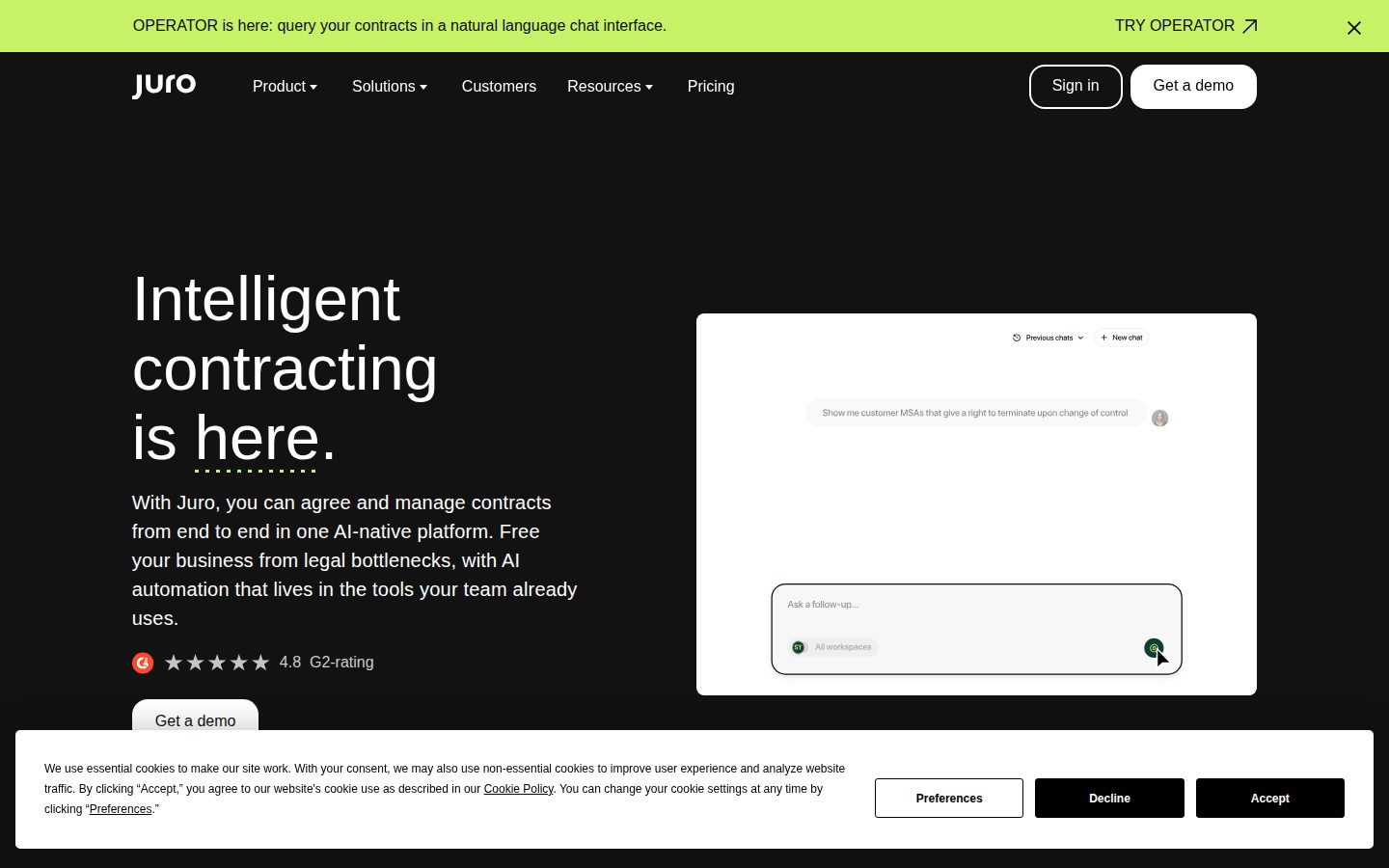
AI-native contract management from drafting to signature
Juro is an AI-native contract lifecycle management (CLM) platform for legal, sales, HR and finance teams.
AI Panel Score
6 AI reviews
Reviewed
AI Editor ApprovedApproved and published by our AI Editor-in-Chief after full panel analysis.Juro handles the contract lifecycle in a single browser-based workspace: users create contracts from legal-controlled templates or generate them directly from an integrated CRM or ATS, route them for approval and negotiation, collect e-signatures, and store executed agreements in a searchable repository. Contracts can also be embedded into the day-to-day tools sales, HR and other business teams already use, rather than requiring them to work inside a separate legal system.
The platform applies AI at each stage of this workflow. AI agents review and redline incoming contracts, reducing the need for manual legal review, while a self-serve template system lets non-legal teams generate compliant contracts without involving lawyers directly. Its repository includes AI Extract and Operator, a chat-style interface that lets users query contract data in natural language instead of manually searching documents in Excel, Google Docs or PDFs. Juro positions these AI capabilities as replacements for combining generic tools like Word, Docusign, MS Copilot or ChatGPT for contract-related tasks.
Juro is aimed at legal, sales, HR, finance and procurement teams at mid-size and larger companies that manage contract volume across departments, rather than individual freelancers or very small businesses. Pricing is not published on the website and is quote-based, requiring prospective customers to request a demo. It competes in the CLM category with products such as Ironclad, DocuSign CLM, ContractPodAi and PandaDoc.
The product is delivered as a web application, with integrations into external systems such as CRM and applicant tracking software rather than a downloadable desktop or mobile client. It holds SOC 2 Type 2 certification, according to the company's own site claims.

Uses AI to extract and organize contract data so businesses can query stored contracts in natural language for governance and reporting.
AI agents review and redline contracts automatically, reducing manual legal bottlenecks in the approval process.
A conversational AI that understands all stored contracts, answers plain-language questions about them, takes actions, and cites its sources.
Tracks contract status and lifecycle progress so users can monitor where each contract stands.
Enables structured approval workflows so contracts move through required sign-off stages before signature.
Lets teams create contracts instantly from templates controlled by legal, without needing direct legal involvement for each contract.
Provides a workflow for negotiating contract terms collaboratively within the platform rather than over email or Word.
Centrally stores all contracts in one repository for easy retrieval and management.
Allows contracts to be signed electronically within the platform, replacing tools like DocuSign.
Generates contracts directly from integrated CRM or ATS systems, embedding contract creation into existing business tools.
Connects Juro to Claude so users can query and work with contracts directly through the Claude interface.
Embeds contract initiation and management into everyday business tools through plug-and-play integrations.
Juro offers custom pricing built around each business's needs, based on factors like contract volume, contract types, AI features, and integrations required. No public pricing tiers are listed; interested buyers submit their requirements to receive a tailored quote.
Solid CLM with real AI teeth, but you'll pay to find out what that means.
“Juro bundles drafting, redlining, e-signature and a natural-language query layer into one browser workspace. No pricing on the site and no free trial means the board sees a black box until legal actually runs the demo.”
British legal tech, SOC 2 Type 2, browser-only, no downloadable client. That's fine for most legal teams in 2024, less fine if procurement wants an offline story.
Operator is the real pitch here — a conversational agent that cites sources when it answers questions about your contract repository. That's a genuine step past static CLM tools like DocuSign CLM or PandaDoc, and closer to what Ironclad and ContractPodAi are also racing toward.
Two concerns. One: quote-based pricing tied to contract volume (0 to 1,000+/month) means you can't size cost before a sales call. Two: no free trial, no public runway or funding data, so viability rests entirely on customer logos, not balance sheet. Pilot it with actual contract volume data in hand before signing anything multi-year.
Operator and Claude MCP integration put Juro ahead of static tools like PandaDoc on the AI-native claim.
CLM adoption reads as competent, not risky, to a board — category is well established with named peers like Ironclad.
Self-serve templates and CRM-triggered generation should shorten cycle time fast, but no trial means payback timeline is unproven pre-contract.
Moves legal ops from manual redlining to AI-assisted workflow embedded in CRM/ATS, not just a cheaper DocuSign swap.
No public funding data or headcount; SOC 2 Type 2 and named integrations suggest maturity but runway is unverifiable.
Mid-size to large companies with real contract volume across legal, sales and HR who want AI-assisted redlining without stitching Word, DocuSign and ChatGPT together.
Skip if you're a small team or need transparent pricing before committing legal budget to a demo cycle.
A capable CLM that pushes contract authority to sales and HR — governance has to be built in, not assumed.
“Juro's AI Review and self-serve templates genuinely reduce intake volume on my desk. My exposure is in how much redlining authority I'm delegating to an agent I don't fully control.”
AI Extract, AI Review, and Operator are the pitch: contracts get reviewed, redlined and queried without lawyers touching every document. That's real leverage against contract sprawl. But 'legal-controlled templates' only holds if my team actually governs the template library — self-serve for sales and HR is a compliance surface, not just a productivity win.
SOC 2 Type 2 is table stakes at this contract volume, and it's there. Quote-based pricing tied to monthly contract count (0 to 1,000+) means I'm negotiating scope every renewal with no published anchor, unlike more transparent competitors.
Three years in, embedding contract creation into Salesforce and Greenhouse via plug-and-play integrations means the workflow migrates out of legal's direct line of sight. Versus Ironclad or DocuSign CLM, Juro's bet is deeper AI agency earlier in the lifecycle. That's the right direction, but it raises the bar on my audit trail requirements before I'd sign off enterprise-wide.
Competes directly with Ironclad and DocuSign CLM on AI-native positioning rather than legacy e-signature-first design.
Legal-controlled templates plus self-serve for sales/HR matches how contracts actually originate outside legal departments.
Named integrations span Slack, Salesforce, HubSpot, Docusign, Workday, Zapier plus REST API and Claude MCP connectivity.
Embedding creation into Salesforce/Greenhouse migrates contract origination outside legal's direct oversight over time.
AI Review, AI Draft and Operator cover drafting through query, a fuller AI stack than most CLM competitors publish.
Mid-size and larger companies with cross-departmental contract volume who need legal oversight embedded in sales and HR tools.
You're a small legal team or freelancer wanting transparent pricing without a quote-based sales cycle.
No price on the site. Volume-based quote, 0 to 1,000+ contracts a month. Budget blind.
“Juro gates all pricing behind a demo call, tiered by monthly contract volume. Procurement can't model cost without engaging sales first.”
No published tiers. Contact Sales is the only listed plan. Their configurator asks contract volume, 0 to 1,000+ per month, then quotes. That's usage-based pricing dressed as enterprise custom pricing — fine in CLM, but it means finance can't build a TCO model pre-call.
Compare to Ironclad and DocuSign CLM: both similarly opaque, category norm for CLM. PandaDoc, by contrast, publishes tiers. If your CFO wants a number before a meeting, Juro won't give one.
Real cost driver: AI Draft, AI Review, AI Extract are listed as optional add-ons. Ask if they're bundled or metered per contract — that's where the invoice surprises live. SOC 2 Type 2 is a real line item off your security review checklist, cuts vendor-onboarding friction. Contract term and auto-renewal language: not disclosed here. Get it in writing before signature, not after.
SOC 2 Type 2 certification eases security review, but quote-only pricing adds a sales-cycle step most self-serve CLM tools skip.
No auto-renewal or term-length terms disclosed anywhere in the evidence; category norm skews toward annual lock-in.
No tiers or numbers published; volume-based quote requires a sales call to get any figure.
Track and Approve give measurable cycle-time and bottleneck data, but no published benchmark numbers to size the gain.
AI Extract/Draft/Review listed as optional add-ons, so a base quote likely understates the real 3-year cost.
Mid-size legal or sales-ops teams processing enough monthly contract volume to justify a custom CLM quote.
Avoid if you need a firm number before your first sales call.
Redlines your NDAs while you're still opening the email — but the repository is where trust gets tested.
“Juro's AI Review and self-serve templates cut down the routine contract triage that eats a paralegal's morning. Operator's natural-language querying is the real day-3 test — it's only as good as its citations.”
Self-serve templates mean sales pulls their own NDA without pinging legal, which sounds great until version control questions come up in month two. Legal-controlled templates help, but I'd want an audit trail showing who edited what before signature, not just after.
Operator is the interesting piece — ask it plain-language questions about stored contracts instead of Ctrl+F-ing through PDFs or a shared Excel tracker. It cites sources, which matters; I've seen too many AI tools state contract terms with false confidence. Whether those citations hold up against a real M&A due diligence pull, no public case study says.
No published pricing, no free trial — everything's quote-based against contract volume (0 to 1,000+/month), so you can't stress-test the workflow before buying. Compares against Ironclad and DocuSign CLM, both of which also gate advanced AI behind sales calls. SOC 2 Type 2 is table stakes here, not a differentiator.
AI Review reduces redline grunt work, but self-serve templates shift version-control risk onto legal without a visible audit trail in the evidence.
No public docs page or changelog listed, just a blog and API reference, which leaves practitioner-level how-tos thin.
Single browser workspace cuts tool-switching, but quote-based pricing and no trial means friction shows up before you even touch the product.
Operator plus Claude MCP integration signals real depth for querying at scale, though discoverability of advanced features isn't demonstrated publicly.
Salesforce, HubSpot, Greenhouse and Workday integrations mean contracts start where sales and HR already work, not in a separate portal.
Mid-size legal, sales and HR teams pushing enough monthly contract volume to justify a quote-based CLM.
Avoid if you're a small legal team or solo practitioner who needs to test-drive a tool before committing budget.
A real contract tool for real teams, but you'll never see the price until you sit through a demo.
“Juro bundles drafting, redlining, e-signature and a chat-style query tool called Operator into one browser workspace. Solid feature set for mid-size teams, but the no-pricing-page, no-free-trial setup is a homework assignment before you even get to try it.”
No mobile app, no free trial, no listed price. You have to talk to sales to find out what this costs, and the pricing page is basically a calculator asking how many contracts you push a month, from under 20 to 1,000+. That's a fine way to price enterprise software, but it means day one is a sales call, not a sandbox.
Once you're in, the actual workflow looks thought-through. Templates, approvals, negotiation, signature and a searchable repository all live in one place, and Operator lets you ask plain-language questions about stored contracts instead of digging through PDFs. That's a genuine daily-use win over juggling Word, DocuSign and ChatGPT separately, which is exactly the combo Juro says it replaces.
Compared to Ironclad or PandaDoc, Juro's pitch is tighter integration with CRMs and ATS tools like Salesforce and Greenhouse. SOC 2 Type 2 is a good sign for legal buyers who care about that. Whether it feels this clean three months in, with real contract volume and messy edge cases, is the open part.
Feature list (templates, approvals, Operator) suggests real workflow thought, but no evidence of empty-state or micro-copy care.
Self-serve templates let non-legal teams generate contracts without lawyers, easing scale from first use to month three.
Delivered as web-only with no downloadable or mobile client listed.
No free trial and quote-only pricing means onboarding starts with a sales call, not a self-serve first look.
SOC 2 Type 2 certification and REST API/webhooks support signal enterprise-grade infrastructure.
Mid-size or larger companies with real contract volume across legal, sales and HR who want everything in one system.
You're a freelancer or small business that just needs occasional e-signature without a sales call.
Solid CLM bones, AI layer riding the same wave as everyone else in the category.
“Juro's core workflow — draft, negotiate, sign, store — is category-standard and well-documented. The AI framing (Operator, AI Extract) is the newer bet, and newer bets are the part I'd watch.”
Three tells before the pitch fully lands. One: 'Intelligent contracting is here' — the kind of headline every CLM vendor has used since 2023. Two: no pricing published, quote-based against contract volume tiers from under 20 to 1,000+. Three: 'replaces Word, Docusign, MS Copilot or ChatGPT' is a lot of replacing for one browser tab.
Ironclad and DocuSign CLM run the same playbook: repository plus e-sign plus AI review. Juro's differentiation is Operator, a Claude-MCP-connected query agent that cites sources. Real feature, not vaporware — but ContractPodAi has something adjacent, and PandaDoc undercuts on price for smaller teams.
Exit story: it's a browser workspace holding your executed contracts and CRM/ATS hooks. SOC 2 Type 2 is claimed, which matters, but migration means re-exporting a repository and untangling Salesforce/HubSpot integrations — not trivial, not catastrophic. No changelog visible, so shipping cadence is a blind spot.
Operator's source-citing query agent is a genuine differentiator against Ironclad and PandaDoc, though ContractPodAi is chasing the same ground.
Repository plus CRM/ATS embedding means real migration friction if you leave, per the integration list (Salesforce, HubSpot, Workday).
SOC 2 Type 2 claim, REST API, and a broad integration list (10+ named tools) suggest real infrastructure, though no changelog or funding figures are visible.
Claims to replace four separate tool categories at once — plausible per feature list, but the kind of superlative that ages poorly if adoption stalls.
Matches the successful Ironclad/DocuSign CLM pattern structurally; AI-agent layer is the untested part of the bet.
Mid-size or larger companies with real contract volume across legal, sales and HR wanting one workspace instead of stitched-together tools.
You're a small team or freelancer needing transparent, low-commitment pricing rather than a quote-based enterprise sale.
Common questions answered by our AI research team
Operator is Juro's conversational AI agent that manages contracts. It understands all your stored documents, takes actions on your behalf, answers questions in plain language, and cites its sources.
Yes. Juro's custom pricing tool asks how many contracts your business processes per month, with tiers ranging from less than 20 up to 1,000+, to calculate an approximate price.
Yes, Salesforce is listed as one of the integrations you can select when building custom pricing on Juro's pricing page.
Yes, both HubSpot and Pipedrive appear as selectable integration options in Juro's pricing configurator, alongside Slack, Docusign, Greenhouse, Workday, Zapier, Google Drive, and Sharepoint.
Juro offers AI Extract, AI Draft, and AI Review as core AI features, plus Operator, a conversational AI that answers questions about contracts and takes actions in plain language.
Juro is a London-based legal technology company that develops browser-native contract lifecycle management software with AI-powered drafting and negotiation tools.