Agentic document extraction APIs that turn real-world documents into structured data
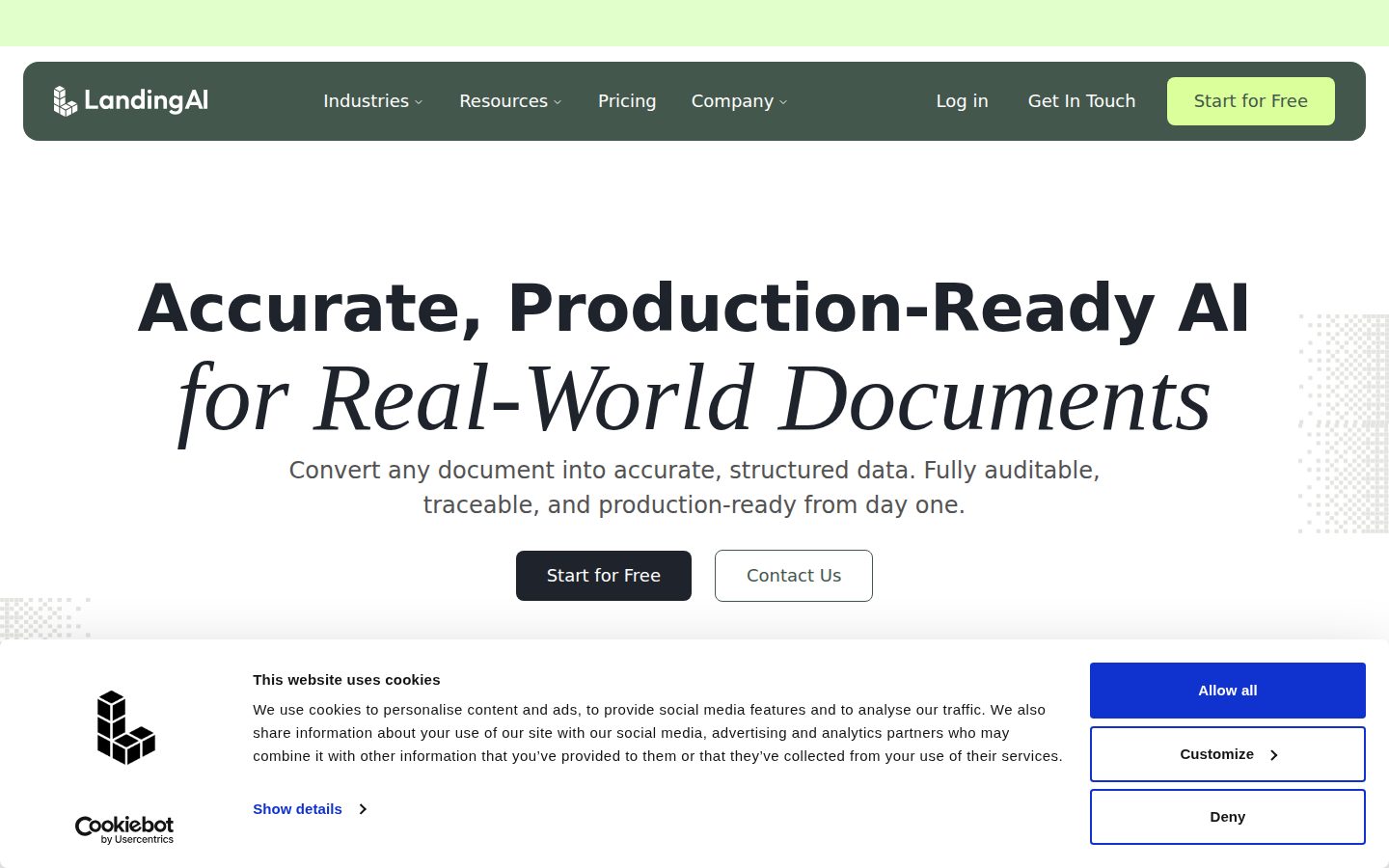
LandingAI is an agentic document extraction platform for enterprise developers building document automation pipelines.
AI Panel Score
6 AI reviews
Reviewed
AI Editor ApprovedApproved and published by our AI Editor-in-Chief after full panel analysis.LandingAI is an agentic document extraction platform that converts real-world documents such as loan applications, insurance claims, and medical records into structured, auditable data through its Parse, Split, and Extract APIs. It is built for enterprise developers creating document automation pipelines in financial services, insurance, healthcare, legal, and logistics. Pricing is usage-based: the Explore tier starts with 1,000 free credits at $1 per 100 credits, the Team plan costs $250 per month with 27,500 credits and unlimited seats, and Enterprise pricing is quote-based. Distinctive capabilities include visual grounding that cites the page, coordinates, and table cell behind every output, schema-defined field extraction, large table extraction spanning thousands of rows, and multilingual document support. It fits regulated teams that need traceable results, SOC 2 Type II and HIPAA compliance, and VPC or on-premises deployment. Alternatives include Amazon Textract, Google Document AI, and Azure AI Document Intelligence.
LandingAI's Agentic Document Extraction (ADE) works as a set of modular APIs that developers drop into document pipelines. Parse converts variable documents into LLM-ready Markdown with layout-aware structure; Split automatically segments multi-document files, including multi-hundred-page batches, into clean, classified sub-documents; and Extract pulls specific fields using a schema the developer defines, supporting flat or nested structures, arrays, and multi-table layouts. Teams can prototype in the ADE Playground in the browser, then move to production via the Python or TypeScript SDKs or the REST endpoints.
What sets ADE apart is auditability. Visual grounding attaches precise citations to every output block, including the page, coordinates, and table-cell location the data came from, and confidence scoring flags uncertain fields for review. The platform is built on vision-first proprietary models, reports 99.16% accuracy on the DocVQA benchmark with under 2-second processing, and has processed over 1 billion images and documents. It handles complex real-world layouts such as large tables spanning thousands of rows across many pages, plus multilingual documents.
ADE is aimed at enterprise developers in financial services, insurance, healthcare, energy and utilities, legal, and logistics who automate documents like loan applications, insurance claims, medical records, and regulatory filings. Pricing is usage-based: the Explore tier starts with 1,000 free credits at $1 per 100 credits, the Team plan costs $250 per month with 27,500 credits and unlimited seats, and Enterprise pricing is custom. Alternatives in the category include Amazon Textract, Google Document AI, and Azure AI Document Intelligence.
On the platform side, LandingAI is SOC 2 Type II certified and GDPR and HIPAA compliant, with a zero data retention option and a BAA available on the Team plan. Enterprise customers can deploy via SaaS, VPC, or on-premises, get SLAs and priority rate limits, and run ADE inside Snowflake through its native integration. Documentation covers async endpoints, rate limits, supported file types, and a public changelog.

Attaches precise citations to every output block, including the page, coordinates, and table-cell location the extracted data came from.
Automatically segments multi-document files, including multi-hundred-page batches, into clean sub-documents classified by type within a single PDF.
Pulls specific fields from documents using a developer-defined schema, supporting flat or nested structures, arrays, and multi-table extraction.
Extracts complex tables spanning thousands of rows across many pages into structured output.
Enterprise deployments run as SaaS, in a virtual private cloud, or fully on-premises with SLAs and priority rate limits.
Browser-based playground for testing parsing and schema extraction on real documents before writing integration code.
Processes documents in multiple languages across all pricing tiers.
Converts variable documents into LLM-ready Markdown with layout-aware structure, preserving the original document's organization.
Official client libraries for Python and TypeScript alongside modular REST APIs with async endpoints and documented rate limits.
Runs Agentic Document Extraction inside Snowflake as a native app, with integration support on the Enterprise plan.
Returns per-field confidence scores so pipelines can route uncertain extractions to human review.
Optional zero data retention mode processes documents without storing them, available from the Team plan up.
Pay-as-you-go tier for individual developers evaluating the APIs.
Monthly plan for teams running shared document pipelines in production.
Custom-priced plan for organizations needing dedicated deployment and support.
A defensible audit trail and a famous founder make this document extraction bet easier than most.
“The pedigree is real and the product is aimed at exactly the buyers who pay for auditability. Pilot economics are low-risk, so this one is worth a quarter of evaluation.”
Andrew Ng founded this company in 2017, and that name still opens boardroom doors. I care more about the $57M Series A McRock Capital led in 2021 and a team that's since bet the company on one product. Focus like that usually survives.
The audit story is the buy signal. Visual Grounding ties every extracted field to a page and table cell, which is what compliance asks for the moment documents touch loans or claims. ABBYY built a business on this promise; LandingAI's version is API-first and faster to pilot.
The catch: they're selling against three hyperscaler bundles, and procurement will notice. SOC 2 Type II and HIPAA remove the easy objections. Pilot it on your messiest document class, watch the confidence scores for a quarter, then decide.
Auditability differentiates it, but AWS, Google, and Microsoft bundle rival tools.
SOC 2 Type II, GDPR, HIPAA with BAA, and traceable citations limit downside.
The ADE Playground and 1,000 free credits let a team validate in days.
Purpose-built for loan, claim, and medical-record automation in regulated industries.
Andrew Ng founded it in 2017 and McRock Capital led a $57M Series A in 2021.
Enterprise leaders who need document automation their compliance team can defend.
Small teams who only need occasional OCR on simple documents.
Confidence-routed extraction with real deployment options is the right architecture for regulated document automation.
“ADE treats human review as part of the pipeline, not a failure mode. That design choice matters more than any accuracy benchmark over a three-year horizon.”
Straight-through processing is the number an automation program lives or dies on, and ADE's design takes it seriously. Confidence Scoring routes uncertain fields to human review instead of letting bad data flow downstream. That's the control loop most IDP stacks make you build yourself.
The integration surface fits how automation teams actually deploy. Python and TypeScript SDKs, async endpoints, a Snowflake native app, and VPC or on-prem options on Enterprise mean it slots into existing exception queues rather than replacing them. Azure AI Document Intelligence covers similar ground but keeps you inside one cloud's gravity.
The tradeoff is concentration risk. Document AI is a side feature for the hyperscalers but the entire business here, and the 99.16% DocVQA figure is vendor-reported. If we standardize on ADE, portable schemas and Markdown outputs keep the exit cheap.
Auditability-first positioning separates it from hyperscaler OCR bundles.
Targets loan, claim, and medical-record classes — exactly the workloads IDP programs own.
Python and TypeScript SDKs, async REST, Snowflake native app, and VPC or on-prem deployment.
Portable Markdown and JSON outputs keep switching costs low if the vendor stumbles.
Confidence Scoring and Visual Grounding form a genuine human-in-the-loop control architecture.
Automation leaders who run document pipelines across regulated business lines.
Teams who are locked into one cloud's document stack.
$250 buys 27,500 credits and unlimited seats, which beats seat-priced document AI for large teams.
“Published pricing, unlimited seats, and bundled compliance make the Team plan honest value at $3,000 a year. Credit consumption per document is the number you still have to earn yourself.”
Unlimited seats on the $250 Team plan is the quiet discount. Seat-priced competitors charge per reviewer; here a 40-person operations team pays the same as four. That changes the comparison math before you touch a credit.
Forecasting is harder on the credit side. Team includes 27,500 monthly at $1 per 110 credits, 10% better than Explore's $1 per 100. $250 × 12 = $3,000 a year, before overage. Credit burn per document depends on the API mix. Model your unit cost from a pilot, not the sticker.
Google Document AI bills per page, simpler to forecast. However, ADE bundles Zero Data Retention and a BAA into Team — those are usually enterprise-tier upsells. Procurement gets published prices and no sales call. That's rarer than it should be.
Usage-based billing with SOC 2 Type II and a BAA smooths procurement review.
Pay-as-you-go entry and monthly Team billing avoid annual lock-in.
Two tiers fully published with per-credit rates; only Enterprise requires a sales call.
Vendor-reported accuracy and speed numbers support the case but lack published customer ROI data.
Unlimited seats cap headcount costs, but per-document credit burn needs a pilot to model.
Operations teams who process steady document volume with many reviewers.
Budget owners who need exact per-page costs before committing.
Extract's schema-driven payloads with cell-level grounding cut the glue code out of document pipelines.
“The API shape does the tedious work — schemas in, grounded JSON out, confidence scores for routing. Real accuracy on your own corpus is the open question a pilot has to answer.”
Schema-in, JSON-out is the right contract for an extraction API. Extract takes your field definitions — nested structures, arrays, multi-table — and returns per-field confidence plus Visual Grounding coordinates down to the table cell. That payload design saves you the reconciliation layer Amazon Textract makes you write, stitching block geometry back into rows.
The pipeline path is sensible. Prototype against real documents in the ADE Playground, then move to the Python or TypeScript SDK; async endpoints and documented rate limits are there for batch loads. Split handles multi-hundred-page files and classifies the pieces — one less preprocessing service to maintain.
Friction lives in the metering. Credits, not requests, so cost-per-document only surfaces after you run your own corpus. The 99.16% DocVQA score is impressive, but benchmarks aren't your documents — thousand-row tables will tell the real story.
Playground-to-SDK path means working extraction code within a day, based on the docs.
Docs cover async endpoints, rate limits, file types, and keep a public changelog.

Credit metering hides per-document cost until you run a real corpus.
Nested schemas, arrays, and thousand-row multi-page table extraction go well past basic OCR.
Python and TypeScript SDKs plus async REST endpoints fit standard pipeline tooling.
ML engineers who ship document extraction pipelines to production.
Developers who need a quick one-off OCR pass on clean documents.
The playground and clickable citations make this the rare document API that respects your time.
“Free credits, a real playground, and citations you can see make evaluation painless. Schema writing is the skill you'll actually have to build.”
You get 1,000 free credits and a browser playground before anyone asks for a credit card. Drop in your actual worst PDF — the scanned one with the sideways table — and watch what comes back. That's a vendor confident in its product, and it shows.
The part I'd actually enjoy: click an extracted field and the ADE Playground shows exactly where on the page it came from. No more squinting at page 47 to check whether the number is real. Amazon Textract gives you coordinates too, but you assemble the picture yourself from raw JSON.
It's an API product, so there's no app to polish and mobile isn't a thing here — fair enough. The catch is the learning curve: writing good extraction schemas takes real thought, and day three you'll still be tuning field descriptions.
Playground, public changelog, and grounded citations show sustained attention to developer experience.
Schema design and confidence-threshold tuning take real practice past the demo stage.
API-first developer platform where mobile isn't a relevant use case; scored neutral.
1,000 free credits and a browser playground with no sales call in the way.
Vendor reports sub-2-second processing, though SLAs are reserved for Enterprise.
Hands-on evaluators who test tools on real documents before committing.
Non-technical users who expect a finished document management app.
Vendor-reported benchmarks and a pivot history earn scrutiny, but the exit terms are honest.
“The accuracy claims all trace back to the vendor, and the document product is younger than the brand suggests. Portable outputs and published pricing keep this out of trap territory.”
A vendor that publishes its own report card deserves a second read. 99.16% on DocVQA, under 2 seconds, 1 billion documents processed — all from the vendor's own materials, based on what's visible. Could be true. Could be the best slice of many runs.
The history gives me pause too. This company spent years selling factory-floor vision before turning to documents. Pivots can work — Slack was a game studio — but ADE's short operating record has to carry the trust the brand implies.
Credit where due: the exit story is genuinely good. Markdown and JSON out, your own schemas, Zero Data Retention on Team at $250 a month. If Google Document AI undercuts them next year, you leave without a hostage negotiation. That's rarer than the accuracy claims.
Grounded citations are real differentiation until a hyperscaler ships the same.
Markdown and JSON outputs plus your own schemas make leaving cheap.
$57M Series A in 2021 is solid but that round is five years old now.
Specific, checkable claims like 99.16% DocVQA, but all self-reported.
The Andrew Ng brand is older than the document product it now fronts.
Pragmatic buyers who verify vendor benchmarks before signing anything.
Buyers who need a long public track record in document AI.
Common questions answered by our AI research team
The Explore tier is pay-as-you-go with 1,000 free credits to start and $1 per 100 credits. The Team plan costs $250 per month with 27,500 credits and unlimited seats, and Enterprise pricing is quote-based.
Yes. LandingAI is SOC 2 Type II certified and GDPR and HIPAA compliant. The Team plan adds HIPAA-compliant processing with a BAA available, plus a zero data retention option for sensitive documents.
ADE turns PDFs and other documents into structured data via three APIs: Parse outputs layout-aware Markdown, Split segments and classifies multi-document files, and Extract pulls fields using your schema, with visual grounding citations on every result.
Yes. LandingAI ships official Python and TypeScript SDKs plus modular REST APIs with async endpoints, documented at docs.landing.ai. A Snowflake native integration is also supported on the Enterprise plan.
Yes. The Enterprise plan supports SaaS, VPC, and on-prem deployments, along with custom processing pipelines, SLAs and uptime guarantees, and priority rate limits. Explore and Team run on LandingAI's cloud.
Company
LandingAIFounded
2017Pricing
From $250/moFree Trial
AvailableFounded by Andrew Ng, LandingAI builds computer vision and agentic document extraction software for enterprises. Based in Palo Alto, California.