Reducto logo

Reducto Review

Visit

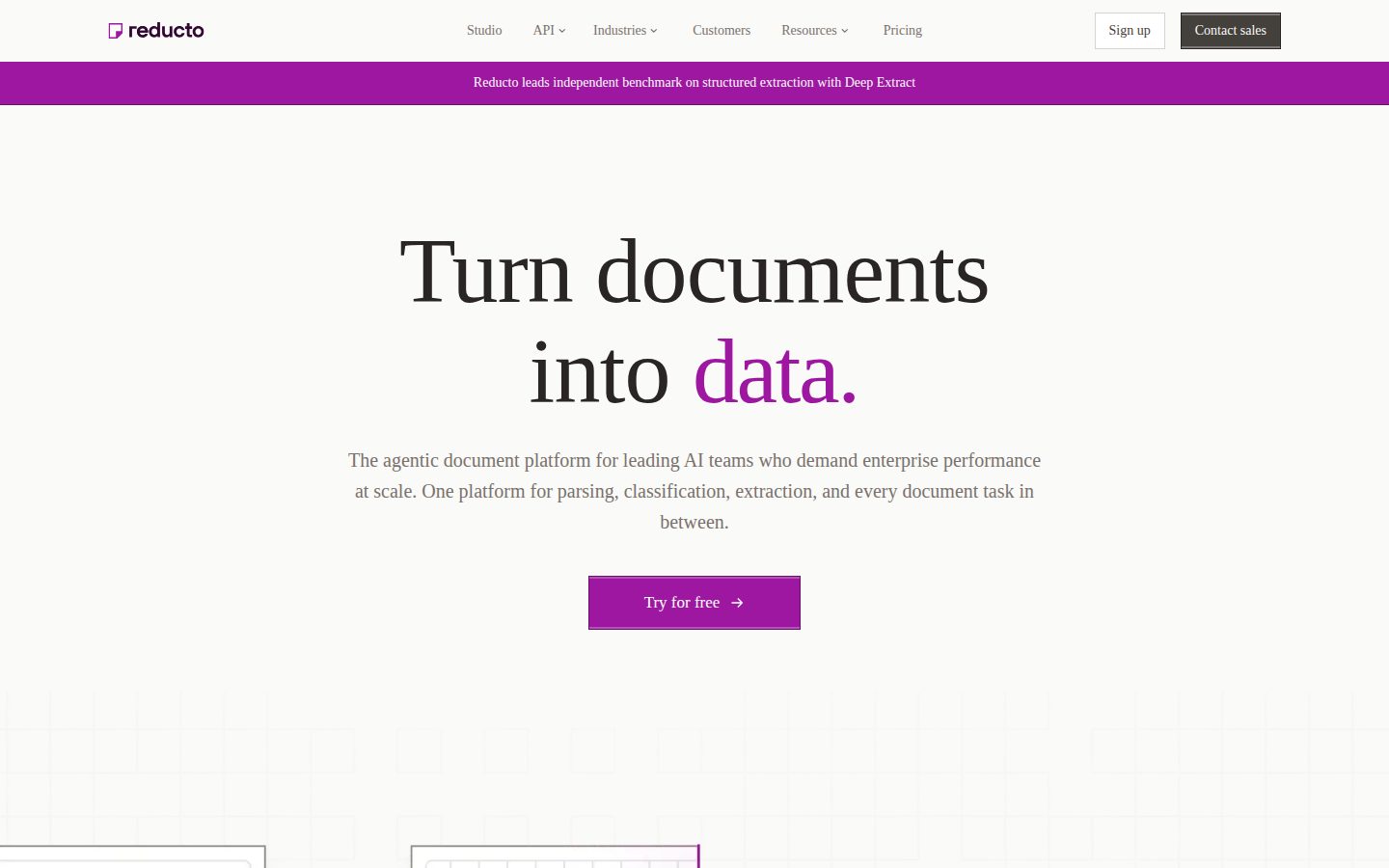
The agentic document platform for parsing, extraction, and workflows

Reducto is a document processing platform for AI teams that need parsing, extraction, splitting, and classification at scale.

AI Panel Score

7.6/10

6 AI reviews

Reviewed

About Reducto

Reducto is used through an API, CLI, or no-code Studio workspace to turn documents into structured data. The core workflow moves through five layers: Parse converts raw files into structured JSON, Split segments multi-document files into page ranges based on plain-language descriptions, Extract pulls defined fields into typed JSON with citations, Classify routes documents against a taxonomy with confidence scores, and Edit writes extracted data back into finished files with vision-based field detection. Studio, included with every plan, provides a no-code interface backed by the same engine as the API, including a side-by-side citation viewer for checking extracted values against source documents.

The platform automatically routes documents across 12+ orchestrated models to balance accuracy, latency, and throughput, which the company says removes the need for teams to continuously re-evaluate frontier model releases. A specific feature, Deep Extract, is built for production accuracy on long-tail extraction cases and is reported to reach 99% recall and precision on micro1's LongExtractionBench. For AI agent use, Reducto ships an Agent skill file, a hosted MCP server (also runnable locally via uvx), and a CLI (reducto-cli) that writes agent-readable Markdown output alongside processed files, with support for Claude Code, Claude Desktop, Codex, Cursor, VS Code, and Windsurf.

Reducto is aimed at AI teams building document-heavy products in finance, healthcare, legal, insurance, government, construction, and logistics, with named customers including Harvey, Scale AI, and Vanta. It competes with OCR and intelligent document processing (IDP) tools and other document parsing/extraction APIs; the company positions itself as a replacement for stitching together 4-5 separate vendors. Pricing is credit-based across three tiers: Standard (self-serve, pay-as-you-go), Growth (volume credit tiers with added security and compliance features, including HIPAA BAAs), and Enterprise (custom pricing with VPC, on-premises, or air-gapped deployment).

The platform is SOC 2 and HIPAA compliant, with zero data retention by default, and can be deployed via hosted cloud, hybrid VPC, on-premises, or fully air-gapped environments. It offers Python and Node SDKs, a REST API, an OpenAPI specification, and an RFC 9727-compliant API catalog, along with autoscaling for bursty processing workloads.

Features

AI

  • Extract

    Returns user-defined fields as typed JSON with a citation and bounding box on every value, using schemas, prompts, and Deep Extract for long-tail accuracy.

  • Multi-Model Orchestration

    Automatically routes documents across 12+ in-house and frontier models to balance accuracy, latency, and throughput for each document's complications.

Analytics

  • Citation and Bounding Box Verification

    Attaches a citation and bounding box to every extracted value, with a side-by-side citation viewer in Studio for verification.

Automation

  • Classify

    Routes documents by matching them against a plain-language taxonomy, returning the best match plus per-criterion confidence scores fast enough to gate pipelines.

Core

  • Edit

    Turns extracted data back into a finished file using vision-based field detection, reusable form schemas, and optional DOCX highlighting.

  • Parse

    Converts PDFs, scans, spreadsheets, and slides into structured, citation-ready JSON for LLM, RAG, and agent workloads at production scale.

  • Split

    Segments documents into sections based on plain-language descriptions, returning page ranges and automatically grouping repeating sub-documents via partition keys.

  • Studio

    A no-code workspace to build, test, and deploy document pipelines using the same engine as the API, included with every plan.

Integration

  • Agent Skill and API Documentation

    Provides a self-contained Agent skill file, API reference, and SDKs for Python and Node so AI agents and developers can integrate Reducto's document workflows.

  • MCP Server and CLI

    Connects AI agents directly to Reducto through a hosted or local MCP server, or via a CLI for parsing, extracting, splitting, classifying, and editing from the terminal.

Security

  • Compliance and Data Retention Controls

    Provides SOC 2 and HIPAA compliance with BAAs on Growth tier and above, and zero data retention by default.

  • Flexible Deployment Options

    Deploys via hosted cloud, hybrid VPC, on-premises, or fully air-gapped environments to meet data residency and security requirements.

Preview

Reducto desktop previewReducto mobile preview

Pricing Plans

Standard

Contact sales

Self-serve, pay-as-you-go plan for teams getting started with Reducto; new sign-ups get 15,000 free credits at studio.reducto.ai

  • Pay as you go credit-based pricing
  • Access to Parse, Split, Extract, Classify, Edit
  • Studio no-code workspace included
  • API, SDKs (Python and Node), CLI and MCP server access
Popular

Growth

Contact sales

Volume credit tiers for scaling teams needing security and compliance features; pricing not publicly listed

  • Volume-based credit tiers
  • SOC 2 and HIPAA compliance with BAAs available
  • Zero data retention by default
  • Priority support

Enterprise

Contact sales

Custom pricing for large-scale or highly regulated deployments; contact sales for a quote

  • Hybrid VPC, on-premises, or fully air-gapped deployment
  • Custom SLAs and autoscaling for bursty workloads
  • White-glove forward-deployed engineering support
  • Custom volume pricing

AI Panel Reviews

The Decision Maker

The Decision Maker

Strategic bet, vendor viability, timing, adoption approval
7.8/10

Real customers, real citations, no public funding data — that's the gap.

Reducto solves document parsing for AI teams with named references like Harvey and Vanta. No funding or headcount disclosed, so viability is a judgment call.

Three named customers — Harvey, Scale AI, Vanta — plus 99% recall claims on micro1's benchmark. That's not vaporware. Deep Extract and the citation/bounding-box layer solve a real trust problem in RAG pipelines: knowing where a number came from.

No public funding data, no headcount, no time-in-market disclosed. Category is crowded — Textract, Azure Document Intelligence, and half a dozen IDP startups fight here. Reducto's pitch is replacing 4-5 vendors with one API, which advances your stack rather than just cutting an invoice.

15,000 free credits, then $0.015/credit — cheap enough to pilot without a procurement fight. SOC 2, HIPAA, air-gapped deployment options check enterprise boxes early. The board won't flinch at the cost. They should ask about the company's balance sheet before you standardize.

Competitive Positioning7.6

Competes directly with Textract and Azure Document Intelligence; citation/bounding-box feature is a real differentiator, not table stakes.

Reputation Risk7.8

Harvey and Vanta as customers make this a safe-looking pick to a board, not a sketchy one.

Speed to Value8.0

15,000 free credits and Studio no-code workspace let a team validate fit before any contract.

Strategic Fit8.2

Consolidates parsing, extraction, splitting, classification into one API — advances the stack rather than just cutting spend.

Vendor Viability6.5

No public funding, team size, or years-in-market data; customer roster is the only viability signal available.

Pros

  • Named enterprise customers (Harvey, Scale AI, Vanta) signal real production use
  • Citation and bounding box on every extracted value solves a trust gap in RAG pipelines
  • Free tier with 15,000 credits removes pilot friction
  • Deployment flexibility (VPC, on-prem, air-gapped) fits regulated industries

Cons

  • No public funding, headcount, or founding date to assess runway
  • Enterprise pricing is custom quote only, no transparency until you're deep in sales process
  • Crowded category against entrenched cloud OCR incumbents

Right for

AI teams in regulated industries who need auditable, citation-backed extraction without stitching together multiple vendors.

Avoid if

Skip it if you need contractual certainty on vendor stability before committing budget.

The Domain Strategist

The Domain Strategist

Craft and strategy in the product's domain — adapts identity per category, same lens
8.1/10

Consolidates document infrastructure into one vendor relationship instead of five, with the compliance posture to match.

Reducto replaces the parse-extract-classify vendor stitching most document-heavy AI teams inherit. The operational question is whether the credit-based pricing and deployment flexibility hold up as volume scales.

Five capabilities under one API — Parse, Split, Extract, Classify, Edit — is the right shape for how document-heavy teams actually operate. Most orgs I'd oversee are running OCR from one vendor, extraction from another, classification homegrown. Reducto's pitch to replace 4-5 stitched vendors is a real operational simplification, not just marketing.

The compliance stack — SOC 2, HIPAA BAAs on Growth tier, zero data retention by default, air-gapped deployment on Enterprise — tells me this was built for regulated verticals from day one, not retrofitted. Customers named include Harvey and Vanta, both compliance-sensitive buyers. That's the right signal for finance, healthcare, legal deployments.

15,000 free credits, then $0.015/credit on Standard — fine for piloting, opaque for budgeting at scale since Growth and Enterprise pricing isn't published. Competing against traditional OCR/IDP vendors and parsing APIs, Reducto's 12+ model orchestration removes the burden of tracking frontier model releases yourself. Three-year risk: you're dependent on their routing logic and model relationships, not just their API surface.

Category Positioning8.0

Positions directly against fragmented OCR/IDP stacks with named enterprise customers like Harvey and Scale AI as proof points.

Domain Fit8.5

Citation and bounding box on every extracted value matches how finance/legal/healthcare teams actually need to audit outputs.

Integration Surface8.0

API, CLI, Python/Node SDKs, hosted MCP server, and Agent skill files cover both engineering and agentic workflows out of the box.

Long-term Implications7.6

Consolidation cuts vendor overhead now, but ties future accuracy and cost entirely to Reducto's model-routing decisions.

Strategic Depth8.3

Five-layer workflow plus Deep Extract's reported 99% recall on LongExtractionBench signals genuine engineering depth, not a thin wrapper.

Pros

  • Single platform replaces 4-5 stitched vendors for parse/extract/classify/edit
  • SOC 2 + HIPAA with zero data retention by default, VPC/on-prem/air-gapped options
  • Citation and bounding box on every extracted value for auditability

Cons

  • Growth and Enterprise pricing undisclosed publicly, complicates budget forecasting
  • Multi-model routing creates dependency on Reducto's orchestration decisions
  • No free trial beyond one-time 15,000 credit allotment

Right for

AI teams in regulated industries who need auditable, citation-backed extraction without managing multiple vendors.

Avoid if

You need fully transparent, predictable per-unit pricing at enterprise volume before committing.

The Finance Lead

The Finance Lead

Money, total cost of ownership, contracts, procurement math
6.9/10

$0.015 per credit after 15,000 free. Growth and Enterprise pricing hidden behind sales.

Standard tier is genuinely self-serve and cheap to test. Growth and Enterprise, where most real volume lands, require a call.

15,000 free credits, then $0.015 each. Standard tier math is visible, no sales call needed. That's rare in document AI — category norm is quote-only from page one.

But Growth tier, the one with HIPAA BAAs and priority support, has no published price. Enterprise is fully custom. A team of 50 processing real volume lands in Growth territory fast, and that's exactly where the pricing page goes dark. Compare to Textract or Azure Document Intelligence, both consumption-priced and published per-page — Reducto's credit system adds a conversion layer procurement has to model blind.

No stated contract term or auto-renewal language in the evidence. No overage rate beyond Standard. Deep Extract's 99% recall claim helps ROI conversations, but only if you can price the tier that includes it. Three-year TCO is a guess until Growth numbers surface.

Billing & Procurement6.5

Self-serve signup with 15,000 free credits lowers onboarding friction, but Growth/Enterprise revert to sales-led procurement.

Contract Flexibility6.0

No term length or auto-renewal terms disclosed in public materials; Enterprise mentions custom MSA only.

Pricing Transparency6.5

Standard tier pricing ($0.015/credit) is public; Growth and Enterprise are quote-only.

ROI Clarity7.5

Citation and bounding box on every extracted value, plus a stated 99% recall benchmark, gives measurable accuracy checkpoints.

Total Cost of Ownership6.0

Credit-based billing across 5 workflow layers (Parse, Split, Extract, Classify, Edit) makes per-document cost hard to model without a usage baseline.

Pros

  • Standard tier self-serve with published per-credit rate
  • Citation and bounding box on every value aids audit and QA
  • Deployment flexibility (VPC, on-prem, air-gapped) for regulated buyers

Cons

  • Growth and Enterprise pricing invisible without sales contact
  • No disclosed contract term or auto-renewal window
  • Credit-based pricing adds a modeling step vs. flat per-page competitors

Right for

Teams that can pilot on Standard credits before negotiating Growth volume pricing.

Avoid if

You need locked-in three-year pricing before finance will sign off.

The Domain Practitioner

The Domain Practitioner

Daily hands-on reality in the product's domain — adapts identity per category, same lens
7.9/10

Citations and bounding boxes on every field — the part that actually saves your afternoon.

Reducto's five-layer pipeline (Parse, Split, Extract, Classify, Edit) covers the document workflow most teams stitch together from four or five vendors. The 15,000 free credits and Studio viewer make evaluation fast, but pricing past that stays opaque until you talk to sales.

Dropping a messy multi-doc PDF into Extract and getting typed JSON back with a citation and bounding box on every value is the feature that matters at 4pm when someone questions your numbers. You click the box, see the source line, move on. That's the whole point of a citation viewer, and Studio ships it free on every plan, unlike bolting a review UI onto an API-only tool like Textract.

Split's plain-language page-range logic beats writing regex against page breaks, and Classify's per-criterion confidence scores are genuinely useful for gating a pipeline before it hits a human queue.

Day-3 friction: credit-based pricing at $0.015 per credit after the 15,000 free tier means cost modeling requires actually running documents through first — no calculator, no published Growth tier pricing. Compared to a flat per-page rate, that's an extra spreadsheet you didn't want to build. Docs cover Parse/Split/Extract cleanly; Edit's vision-based field detection is less documented for edge cases.

Day-3 Reality8.0

Citation-and-bounding-box verification directly addresses the trust gap that shows up once real documents start hitting the pipeline.

Documentation Practitioner-Fit7.8

Agent skill files, OpenAPI spec, and SDKs for Python/Node suggest docs built for integration, though Edit's edge cases are thinner.

Friction Surface7.0

Credit-based pricing at $0.015/credit past 15,000 free credits means cost isn't predictable until usage patterns are known.

Power-User Depth8.3

Deep Extract's 99% recall/precision claim on LongExtractionBench and 12+ model routing show depth beyond basic OCR wrapping.

Workflow Integration8.2

API, CLI, MCP server, and Studio cover both engineer and non-technical review workflows without forcing a single interface.

Pros

  • Citation and bounding box on every extracted value, verifiable in Studio
  • 15,000 free credits with no page limits to start
  • Covers parse/split/extract/classify/edit in one platform instead of stitching vendors

Cons

  • Growth and Enterprise pricing not publicly listed
  • $0.015/credit billing requires running real docs to model true cost
  • No free trial beyond the credit allotment, no listed platform support details

Right for

AI teams processing document-heavy workflows in regulated industries who need auditable citations, not just extracted text.

Avoid if

You need predictable flat-rate pricing without running usage tests first to model your monthly bill.

The Power User

The Power User

Daily human experience, onboarding, polish, learning curve, reliability
7.6/10

A real tool for a boring, expensive problem, if you live in an API not an app.

Reducto isn't something you click around in for fun, it's plumbing for teams drowning in PDFs. The 15,000 free credits and Studio viewer make it easy to poke at before you commit engineering time.

This one's built for developers, not for someone opening a dashboard every morning, so my usual daily-polish questions get a little sideways. But the bones are there: 15,000 free credits to start, then $0.015 a credit, and a Studio workspace with a side-by-side citation viewer so you can actually check if the bounding box matches the number it pulled. That citation-on-every-value thing matters more than it sounds, because the alternative is trusting a black box with your invoice data.

The five-layer workflow, Parse, Split, Extract, Classify, Edit, reads clean on paper, and routing across 12+ models instead of making you pick one is a real convenience versus stitching together your own pipeline of, say, an OCR tool plus a separate LLM extraction layer. Competing against players like Textract-style IDP stacks, that consolidation pitch is the whole argument.

The tradeoff: no mobile story at all, no stated uptime or spinner behavior, and pricing opacity above Standard. Fine for an API-first buyer. Less fine if you wanted to just log in and see it work.

Daily Polish7.5

The Studio side-by-side citation viewer — checking the bounding box against the extracted number — is the detail that matters.

Learning Curve8.0

The Parse-Split-Extract-Classify-Edit pipeline reads clean, and model routing spares you building your own.

Mobile Parity4.5

No mobile story at all — it's API plumbing, not an app.

Onboarding Experience8.0

15,000 free credits and a visual Studio make it easy to poke at before committing engineering time.

Reliability Feel7.5

Citations on every value beat trusting a black box with invoice data, though uptime behavior isn't stated.

Pros

  • 15,000 free credits to evaluate before committing
  • Citation viewer verifies every extracted value against its source bounding box
  • 12+ model routing replaces stitching your own OCR-plus-LLM pipeline

Cons

  • Pricing opacity above the Standard tier
  • No mobile story, no stated uptime or error-state behavior
  • API-first — nothing to just log into and see work if you're not a developer

Right for

Engineering teams drowning in PDFs who want verifiable extraction plumbing behind an API.

Avoid if

You wanted an app to click around in rather than an API to build on.

The Skeptic

The Skeptic

Contrarian. Watch-outs, deal-breakers, broken promises, category patterns
7.3/10

Solid IDP stack, but 'agentic' is doing a lot of marketing work here.

Reducto has the receipts — named customers, citation-verified extraction, 15,000 free credits. Whether it beats Textract or Azure Document Intelligence long-term is the open question.

Three tells I look for: benchmark claims, named customers, real pricing. Reducto has two out of three. The 99% recall claim on micro1's LongExtractionBench is specific enough to check, and Harvey, Scale AI, Vanta as customers is a real signal — not vaporware logos.

What's missing: no public pricing past $0.015/credit on Standard. Growth and Enterprise are both 'contact sales,' which is category-normal but still opaque.

Competitive field is crowded — Textract, Azure Document Intelligence, Unstructured, LlamaParse all chase the same PDF-to-JSON problem. Reducto's pitch is consolidation: replace 4-5 vendors with one. That's the same story Unstructured told two years ago. Exit portability is fine — structured JSON output, standard SDKs, no lock-in trickery visible. Deep Extract and citation/bounding-box verification are genuinely differentiated features, not just repackaged OCR. SOC 2, HIPAA, air-gapped deployment options suggest enterprise-serious infrastructure, not a weekend API wrapper.

Competitive Differentiation7.0

Citation/bounding-box verification and 12+ model orchestration stand out versus Textract or Azure Document Intelligence, but the category is crowded.

Exit Portability7.8

Structured JSON output plus standard Python/Node SDKs and REST API keep migration friction low.

Long-term Viability7.2

Enterprise deployment options (VPC, air-gapped) and named customers suggest real revenue, though no funding figures are public.

Marketing Honesty7.5

Benchmark citation (LongExtractionBench) is checkable, not just a superlative claim.

Track Record Match7.0

Named enterprise customers (Harvey, Scale AI, Vanta) match patterns of IDP vendors that survived, not ones that vanished pre-revenue.

Pros

  • Citation + bounding box on every extracted value, verifiable in Studio
  • 15,000 free credits with no page limits to start
  • Deployment flexibility: hosted, VPC, on-prem, air-gapped

Cons

  • No public pricing beyond Standard tier's $0.015/credit
  • Crowded field: Textract, Azure Document Intelligence, Unstructured, LlamaParse
  • 'Agentic' framing is aspirational — core value is still parsing and extraction

Right for

AI teams processing complex tables, scans, or handwriting who need citation-backed extraction at scale.

Avoid if

You need transparent published pricing before talking to sales.

Buyer Questions

Common questions answered by our AI research team

Pricing

How much does the free plan include?

The Standard plan is free and includes up to 15,000 credits, with access to the Parse, Extract, Edit, and Split APIs, 30+ supported file types, no page limits, and up to 5 seats for Reducto Studio.

Pricing

What happens after I use my free credits?

After your first 15,000 free credits, usage is billed at $0.015 per credit on the Standard plan.

Features

What file types does Reducto support?

Reducto supports 30+ file types, including PDF, PNG, JPEG/JPG, GIF, BMP, TIFF, and PSD; spreadsheets like CSV, XLSX, and XLSM; and presentation/text formats such as PPTX, PPT, DOCX, DOC, and TXT.

Features

Does Reducto handle handwriting and non-English text?

Yes. Reducto includes OCR for scanned pages, faxes, and handwritten content, plus multilingual OCR supporting parsing across 100+ languages, including mixed-language documents.

Security

Can Reducto be deployed on-prem or in a VPC?

Yes. The Enterprise plan includes VPC and On-Prem Deployments, along with custom MSA, custom SLA, custom rate limits, and role-based access control.

Also in AI Document Processing