LangSmith logo

LangSmith Review

Visit

Observability and evaluation tooling for LLM applications

LangSmith is a developer platform for debugging, testing, evaluating, and monitoring large language model applications.

AI Panel Score

8.2/10

6 AI reviews

Reviewed

AI Editor Approved

About LangSmith

In practice, developers instrument their LLM application by adding LangSmith's SDK, after which every run—prompt inputs, model outputs, tool calls, latency, and token counts—is logged to a centralized trace view. From the UI, a developer can drill into any trace, replay individual steps, and compare runs side by side to isolate where a chain broke down or produced a poor result.

Beyond tracing, LangSmith includes a dataset management layer where developers curate example inputs and expected outputs, then run those datasets through automated evaluators—either LLM-as-judge evaluators or custom code-based evaluators—to score application behavior. An Annotation Queue feature lets human reviewers label production traces, which can then be added to datasets to expand test coverage over time. The platform also exposes a Playground for iterating on prompts directly against logged traces without rerunning full application code.

LangSmith targets ML engineers, AI product teams, and software developers building production LLM applications. It integrates natively with LangChain and LangGraph but works with any framework through its REST API and Python and TypeScript SDKs. The platform offers a free Developer tier for individuals, with paid Plus and Enterprise plans that unlock higher usage limits, SSO, and access controls. Comparable tools in the observability and eval space include Weights & Biases Weave, Arize Phoenix, Braintrust, and Honeyhive.

LangSmith is delivered as a cloud-hosted SaaS product, with a self-hosted deployment option available for Enterprise customers who require data to remain on their own infrastructure. The SDK supports Python and TypeScript, and the tracing layer is compatible with OpenAI, Anthropic, and other model providers in addition to LangChain-based stacks.

Features

AI

  • Insights Agent & Trace Clustering

    Automatically analyzes and clusters traces to detect usage patterns, common agent behaviors, and failure modes, with an AI assistant (Polly) that helps debug long traces and summarizes findings.

Analytics

  • Online & Offline Evaluation

    Supports two evaluation modes: offline testing against curated datasets before shipping, and online evaluation that automatically scores real production traces in real-time for safety, quality, and format compliance.

  • Real-Time Monitoring & Alerting

    Provides dashboards and alerts to track cost, latency, errors, and qualitative metrics encoded in online evaluations, enabling teams to spot issues early and understand their impact.

Collaboration

  • Annotation Queues & Human Review

    Sends production traces to annotation queues for human review, allowing teams to build labeled datasets from real interactions and align automated evaluations to human judgment.

Core

  • Agent & LLM Tracing

    Breaks each agent run into a structured, step-by-step timeline so developers can see exactly what happened, in what order, and why — including every LLM call, tool invocation, and intermediate reasoning step.

  • Dataset Management

    Enables creation and management of evaluation datasets from manually curated test cases, historical production traces, or synthetic data, which can then be used to run regression tests and benchmark experiments.

  • LangSmith Deployment (Agent Infrastructure)

    Purpose-built managed infrastructure for running agents in production, featuring durable execution, horizontal scaling, a centralized agent registry with versioning, instant rollbacks, and native A2A, MCP, and Agent Protocol support.

  • Prompt Playground

    A UI-based environment for testing and iterating on prompts, allowing users to run experiments, compare versions, and evaluate prompt changes without writing code.

Integration

  • Multi-SDK & Framework Support

    Works with any LLM framework via Python, TypeScript, Go, and Java SDKs, and natively traces applications built with OpenAI SDK, Anthropic SDK, Vercel AI SDK, LlamaIndex, and custom implementations.

  • OpenTelemetry Integration

    Supports end-to-end OpenTelemetry so teams with existing observability pipelines can both send LangSmith trace data to their own tools and ingest OTel data into LangSmith.

Security

  • HIPAA, SOC 2 & GDPR Compliance

    Meets HIPAA, SOC 2 Type 2, and GDPR compliance standards, and guarantees it will never train models on customer data, with all traces, prompts, and outputs remaining private to the organization.

  • Self-Hosted & BYOC Deployment

    Offers managed cloud, bring-your-own-cloud (BYOC), and fully self-hosted options for teams with data residency or compliance requirements, with Enterprise support for Kubernetes clusters on AWS, GCP, or Azure.

Preview

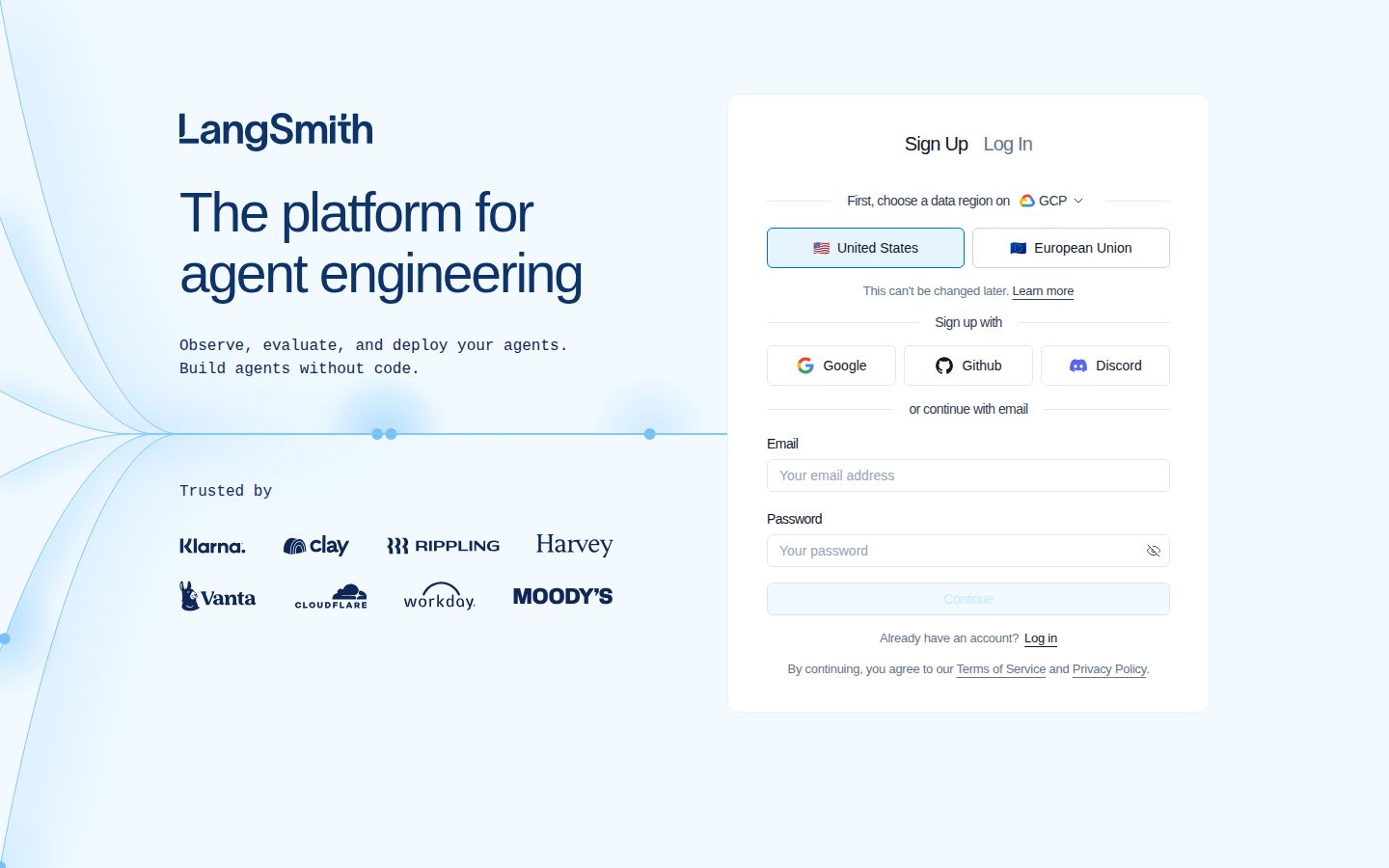
LangSmith desktop previewLangSmith mobile preview

Pricing Plans

Developer

Free

For solo users getting started.

  • 1 seat
  • Up to 5k base traces/mo included, then pay-as-you-go
  • Tracing, online and offline evals
  • Prompt Hub, Playground, and Canvas
  • Annotation queues for human feedback
  • 1 Fleet agent, up to 50 Fleet runs/mo
Popular

Plus

$39/monthly

For teams building and deploying agents.

  • Unlimited seats at $39/seat/mo
  • Up to 10k base traces/mo included, then pay-as-you-go
  • 1 free dev-sized agent deployment included
  • Unlimited Fleet agents, up to 500 Fleet runs/mo (then $0.05/run)
  • Up to 3 workspaces
  • Email support

Enterprise

Contact sales

For teams with advanced hosting, security, and support needs.

  • Custom seats and workspaces
  • Hybrid and self-hosted deployment options (data stays in your VPC)
  • Custom SSO and RBAC
  • Support SLA and access to deployed engineering team
  • Team trainings and architectural guidance
  • Custom Fleet packages

AI Panel Reviews

The Decision Maker

The Decision Maker

Strategic bet, vendor viability, timing, adoption approval
8.4/10

LangChain's commercial bet is the default observability layer for production agents.

LangSmith is the most complete trace-to-eval pipeline in the LLM tooling market right now. At $39/seat with unlimited team access, the pricing won't trigger a procurement fight.

LangChain, Inc. built the most-used LLM orchestration framework, then built the observability layer on top of it. That's not a coincidence — they see every failure mode real teams hit. The Insights Agent with trace clustering and Polly debugging isn't a demo feature; it's what happens when you have millions of real traces to learn from. Braintrust and Arize Phoenix compete here, but neither has this distribution advantage.

The tradeoff worth naming: if you're not building on LangChain or LangGraph, integration is still possible via OTel and the Python/TypeScript SDKs, but native instrumentation is shallower. You'll get tracing. You won't get the same depth on agent step attribution that LangGraph users get.

The Deployment layer — durable execution, versioning, instant rollbacks — is the strategic move. This isn't just observability anymore. Pilot with your agent team for 60 days. If they're shipping, standardize.

Competitive Positioning8.0

Peers building serious agent stacks are already here; waiting while they build labeled datasets and regression baselines from Annotation Queues is a real gap to close.

Reputation Risk8.2

LangSmith is the name your board will hear when they ask who's running evals — SOC 2 Type 2 and HIPAA compliance handles the security question before it gets asked.

Speed to Value8.6

SDK instrumentation and a free Developer tier mean a solo engineer can have traces running same-day before any budget conversation happens.

Strategic Fit8.8

Online and Offline Evaluation plus agent deployment infrastructure advances teams building production agents, not just cuts cost on existing work.

Vendor Viability8.5

LangChain, Inc. owns the most-used open-source LLM framework and has a commercial product with a clear freemium-to-enterprise funnel — a defensible 36-month bet.

Pros

  • Full trace-to-eval-to-deploy loop in one platform — rare at this price
  • $39/seat with unlimited seats removes the per-engineer procurement friction
  • OpenTelemetry support means it fits existing observability pipelines without a rip-and-replace
  • SOC 2 Type 2, HIPAA, GDPR plus self-hosted option clears most enterprise security reviews

Cons

  • Non-LangChain stacks get shallower agent-step attribution despite OTel support
  • Trace volume pricing is pay-as-you-go above base limits — costs can surprise teams with high-volume agents
  • Deployment infrastructure is new; maturity vs. dedicated agent hosting options is unproven at scale

Right for

ML engineers and AI product teams shipping production agents who need a single platform for debugging, eval, and deployment.

Avoid if

Your stack is entirely non-Python and you've already standardized on Arize or Weights & Biases Weave for observability.

The Domain Strategist

The Domain Strategist

Craft and strategy in the product's domain — adapts identity per category, same lens
8.4/10

LangChain's observability layer is the closest thing this category has to a standard.

LangSmith solves the hardest production problem in LLM engineering — you can't fix what you can't see. Tracing plus evaluation plus deployment in one platform is a serious architectural bet.

OpenTelemetry support is the tell here. A team that wires in OTel natively isn't building a walled garden — they're building infrastructure. Python, TypeScript, Go, and Java SDKs with first-class support for OpenAI, Anthropic, LlamaIndex, and Vercel AI SDK means the instrumentation layer survives framework churn, which is the actual risk in this category right now.

The eval architecture is library-grade. Offline dataset regression plus online production scoring plus human annotation queues forming a feedback loop back into datasets — that's not a feature list, that's a quality pipeline. Braintrust and Arize Phoenix have pieces of this; LangSmith has the full cycle. The $39/seat Plus tier is aggressive pricing for what you get.

The tradeoff worth naming: LangSmith Deployment now puts them in the agent execution layer, not just observability. If you adopt both, your operational dependency on LangChain, Inc. deepens materially. SOC 2 Type 2 and BYOC/self-hosted Enterprise options de-risk the compliance angle, but the vendor concentration risk is real if agents-plus-observability becomes a single throat to choke.

Category Positioning8.6

Broadest feature surface in the LLM observability segment — Braintrust and Arize Phoenix have focused offerings but neither has closed the full eval-to-deployment loop.

Domain Fit9.0

Step-by-step agent trace timelines with tool call visibility matches exactly how ML engineers diagnose production failures.

Integration Surface8.5

Four SDK languages plus native OTel ingestion and emission means it fits existing observability pipelines rather than replacing them.

Long-term Implications7.8

OpenTelemetry compatibility preserves exit options on tracing, but adding LangSmith Deployment creates deeper vendor lock-in over time.

Strategic Depth8.8

Online plus offline eval with annotation queues feeding back into datasets is a complete quality pipeline, not just tracing with a UI.

Pros

  • OpenTelemetry support preserves stack portability — traces flow both directions
  • Online plus offline evaluation with human annotation queues is a complete quality architecture
  • BYOC and self-hosted options with SOC 2 Type 2 and HIPAA cover regulated industry requirements
  • $39/seat Plus tier is well-priced for the feature breadth delivered

Cons

  • Adding LangSmith Deployment alongside observability creates meaningful vendor concentration risk
  • Polly AI assistant and trace clustering are differentiated features with no public performance benchmarks to evaluate
  • Free Developer tier caps at 5k traces/month — production debugging headroom is thin before costs escalate

Right for

ML engineering teams shipping production agents who need a single platform covering tracing, regression testing, and deployment infrastructure.

Avoid if

Your team wants to keep observability and agent execution on separate vendor contracts to limit blast radius.

The Finance Lead

The Finance Lead

Money, total cost of ownership, contracts, procurement math
7.8/10

$39/seat with no SSO tax and visible overage rates — rare in this category.

LangSmith publishes three tiers without a sales call. Overage at $0.05/Fleet run is visible; trace overage rates need verification.

$39/seat/month. Unlimited seats on Plus. 50-user team: $39 × 50 × 12 = $23.4K/year. Add 30% seat creep by year 3 — call it $30K. Enterprise adds self-hosted deployment and custom SSO, which competitors like Braintrust or Arize Phoenix typically gate behind opaque negotiation. SSO isn't taxed at the Plus tier based on their pricing page. That's meaningful.

The overage model is partially visible. Fleet runs beyond 500/month bill at $0.05/run — logged. Trace overage rates are listed as pay-as-you-go but the per-trace price isn't published on the scraped page. That's the one number procurement needs before signing. No published overage rate is always the real risk.

No free trial listed — Developer free tier substitutes. Contract flexibility terms aren't public. Auto-renewal window unknown. For a 50-seat team, year-3 TCO lands around $30K cloud-hosted, more with Enterprise infrastructure. Workable math if the trace overage fills in cleanly.

Billing & Procurement7.8

Freemium entry removes procurement friction for developers; Plus self-serves at $39/seat; Enterprise requires a sales call but that's category norm.

Contract Flexibility6.5

No public data on auto-renewal windows, termination-for-convenience clauses, or term lengths — standard enterprise gap.

Pricing Transparency7.5

Three tiers visible without a sales call; Fleet run overage at $0.05 is published, but per-trace overage rate isn't confirmed on the pricing page.

ROI Clarity8.2

Online and Offline Evaluation with regression tracking makes quality-over-time measurable; cost and latency dashboards give concrete numerators for ROI math.

Total Cost of Ownership7.2

$39/seat base is clean; year-3 TCO at 50 seats plus trace overages is estimable but not fully modelable without confirmed per-trace pricing.

Pros

  • $39/seat with no SSO surcharge at Plus tier
  • Fleet run overage published at $0.05/run — predictable
  • Free Developer tier enables zero-cost evaluation before commit
  • SOC 2 Type 2 and HIPAA compliance documented — procurement won't fight this

Cons

  • Per-trace overage rate not confirmed in scraped evidence — invoice risk
  • Auto-renewal and cancellation terms not public
  • Enterprise self-hosted TCO requires a sales call to model
  • No free trial — only a usage-capped free tier

Right for

A 10-50 person AI product team that needs tracing plus eval in one bill without negotiating SSO separately.

Avoid if

Your team needs firm per-trace overage pricing before legal will sign.

The Domain Practitioner

The Domain Practitioner

Daily hands-on reality in the product's domain — adapts identity per category, same lens
8.4/10

The observability layer your LLM stack actually needs on day three.

LangSmith solves the real engineering problem: you shipped a chain, something broke in prod, and you have no idea why. Tracing every LLM call, tool invocation, and intermediate step into a structured timeline is exactly the primitive missing from raw OpenAI/Anthropic SDK work.

Python and TypeScript SDKs, plus Go and Java. That's not an afterthought — that's someone who knows LLM apps aren't all Python notebooks. The OpenTelemetry integration is the tell: teams already running Datadog or Honeycomb can pipe LangSmith trace data outbound rather than forklift their whole observability stack. CLI-first engineers will appreciate that the instrumentation layer is SDK-level, not a proxy or sidecar.

The Offline + Online Evaluation split is the daily workflow win. Offline evals against curated datasets before merging a prompt change, online scoring of production traces after — that's a real regression-testing loop, not a demo feature. Annotation Queues closing the human-feedback cycle into datasets is methodical. At $39/seat/month for Plus, compare that to Braintrust's similarly-tiered pricing; LangSmith's 10k base traces and unlimited seats make the math reasonable for a 4-person team.

The tradeoff: LangSmith Deployment bundling agent infrastructure into an eval/observability tool creates surface area. If you want pure observability without the deployment layer, Arize Phoenix stays narrower. And trace volume costs balloon fast on pay-as-you-go above the 10k included base — high-throughput prod apps will need Enterprise conversations quickly.

Day-3 Reality8.1

Structured step-by-step trace timeline and side-by-side run comparison are genuinely useful after the demo; the Playground lets you iterate on prompts against logged traces without rerunning application code, which removes a daily context-switch.

Documentation Practitioner-Fit7.8

Multi-framework coverage (LlamaIndex, raw OpenAI SDK, Vercel AI SDK) in the docs signals practitioner authorship, though the scraped evidence shows no public changelog — version history visibility is unclear.

Friction Surface7.6

Pay-as-you-go trace overages above the 10k monthly base create billing anxiety for high-volume apps; the bundled Deployment infrastructure adds configuration surface that pure-observability teams won't want.

Power-User Depth8.3

LLM-as-judge plus custom code-based evaluators, BYOC/self-hosted Kubernetes on AWS/GCP/Azure, RBAC, and the Insights Agent with trace clustering give experienced teams real depth beyond basic logging.

Workflow Integration8.5

Native OpenTelemetry support means teams don't abandon existing pipelines; SDK-level instrumentation fits naturally into Python/TypeScript codebases without proxy overhead.

Pros

  • OpenTelemetry integration works with existing observability stacks — no forklift required
  • Offline + Online Evaluation loop is a real regression-testing primitive, not a checkbox feature
  • Four SDK languages including Go and Java; traces raw OpenAI and Anthropic SDK code, not just LangChain
  • SOC 2 Type 2, HIPAA, GDPR compliance plus self-hosted option clears most enterprise procurement hurdles

Cons

  • Pay-as-you-go trace overages above 10k/month get expensive fast for production-scale apps
  • Bundling agent deployment infrastructure into an observability tool adds complexity teams may not want
  • No public changelog visible — hard to track what changed between SDK versions without digging

Right for

ML engineers and AI product teams building production LLM apps who need a real eval loop, not just logging.

Avoid if

You want a narrow, pure-observability tool and don't need the agent deployment infrastructure bundled in.

The Power User

The Power User

Daily human experience, onboarding, polish, learning curve, reliability
8.2/10

The LLM observability tool that actually ships with your agents, not just beside them

LangSmith does one thing — make LLM app behavior legible — and does it seriously. At $39/seat for Plus, it's priced like infrastructure, not a luxury.

Trace every prompt, every tool call, every intermediate reasoning step in a structured timeline. That's the pitch, and the evidence suggests it delivers. The Annotation Queue feature is the kind of thing that looks like a small detail until you realize it's the whole loop — production traces become labeled datasets, labeled datasets become evals, evals catch regressions. That's not a demo feature, that's a workflow that actually matures over time.

The Prompt Playground is where day-three utility lives. Iterate on prompts against real logged traces without re-running full application code — that's hours saved per week. The AI clustering assistant Polly is a wild card; smart on paper, but AI-on-top-of-AI features need real usage to prove their weight.

Compared to Braintrust or Arize Phoenix, LangSmith's moat is the LangChain/LangGraph ecosystem plus the deployment layer. The tradeoff: this is a developer-first tool. Non-engineers won't wander through it comfortably. Mobile is web-only, which is fine — nobody's debugging traces on a phone.

Daily Polish7.8

Structured trace timelines and side-by-side run comparison suggest real care for the daily debugging loop, though no changelog evidence to confirm sustained polish investment.

Learning Curve7.2

Offline plus online evaluation modes, dataset management, and OpenTelemetry integration are genuinely powerful but add real surface area to master month over month.

Mobile Parity4.5

Web-only delivery — for a tracing and eval tool this is understandable but still a gap if you want to check production alerts off-hours.

Onboarding Experience7.5

Free Developer tier with 5k traces/month is a low-friction entry point, but SDK instrumentation first means developers hit code before they see value.

Reliability Feel8.0

SOC 2 Type 2, HIPAA, GDPR compliance plus self-hosted/BYOC options signals that infrastructure reliability was taken seriously, not retrofitted.

Pros

  • Full trace coverage — LLM calls, tool invocations, intermediate reasoning, token counts, latency all in one view
  • Annotation Queues close the loop between production traffic and eval datasets without extra tooling
  • Works with LlamaIndex, raw OpenAI/Anthropic SDKs, and any OTel-emitting stack — not just LangChain
  • Self-hosted and BYOC options mean compliance-heavy teams aren't locked out

Cons

  • Developer-first UI — non-engineers will struggle to get value without help
  • Mobile is read-only at best, non-existent in practice
  • Polly AI clustering assistant is promising but unproven without usage evidence
  • $39/seat scales up fast for larger teams before you hit Enterprise conversations

Right for

ML engineers and AI product teams who need full-stack observability and regression testing for production LLM apps.

Avoid if

You want a no-code monitoring dashboard your PM can check without a developer in the room.

The Skeptic

The Skeptic

Contrarian. Watch-outs, deal-breakers, broken promises, category patterns
7.8/10

3 green flags, 1 real lock-in concern — worth watching closely

LangSmith has the clearest feature set in LLM observability right now. The LangChain lineage is a strength and a risk at the same time.

Three tells going in. One: framework-agnostic claim from a company whose brand is literally LangChain. Two: no changelog visible in scraped capabilities — can't verify shipping cadence from public evidence. Three: the agent deployment feature is a significant scope expansion from observability tooling. That last one could go either way.

What's solid: the feature breadth is real. Offline and online eval in one platform at $39/seat, plus HIPAA/SOC2/GDPR compliance, plus self-hosted enterprise option — Braintrust and Arize Phoenix don't bundle all of that at this price. OpenTelemetry support is a meaningful exit hedge. The free tier at 5k traces/month is genuinely usable for solo devs.

The lock-in worry: deploying agents on LangSmith infrastructure compounds switching costs fast. Tracing is portable. Running production agents there isn't. If LangChain's OSS momentum cools, this platform follows. Watch the LangGraph adoption curve — that's the real health signal.

Competitive Differentiation8.0

Bundling offline eval, online eval, human annotation queues, and agent deployment at $39/seat undercuts Weights & Biases Weave on scope-per-dollar.

Exit Portability6.5

OpenTelemetry integration means trace data is portable, but the new LangSmith Deployment agent infrastructure creates compounding switching costs fast.

Long-term Viability7.2

No public funding data visible, no changelog cadence confirmable — viability relies on LangChain OSS momentum, which is real but not guaranteed.

Marketing Honesty7.2

'Framework-agnostic' is technically true via OTel but the LangChain-native positioning contradicts it throughout — minor but worth noting.

Track Record Match7.5

LangChain shipped LangSmith as observability matured in the category, matching the pattern of successful platform extensions rather than standalone failures.

Pros

  • Online + offline eval plus annotation queues in one platform — competitors split these
  • SOC 2 Type 2, HIPAA, GDPR at $39/seat is competitive for compliance-sensitive teams
  • OpenTelemetry support provides a meaningful escape hatch on tracing data
  • Free tier at 5k traces/month is genuinely usable, not a demo stub

Cons

  • Agent deployment infrastructure dramatically raises switching costs beyond tracing
  • LangChain brand dependency — if OSS adoption slips, the platform narrative weakens
  • No public changelog evidence makes shipping cadence unverifiable from outside

Right for

ML engineers building production agents who want eval, monitoring, and deployment in one platform without assembling four tools.

Avoid if

You're already committed to a separate observability stack and don't want agent infrastructure tying you deeper into one vendor.

Buyer Questions

Common questions answered by our AI research team

Pricing

How much does LangSmith cost?

Developer is free, Plus is $39/month per seat with higher trace limits and team features, Enterprise is custom-priced with self-hosting and SLA support.

Features

What does LangSmith trace?

LangSmith captures every step of an LLM chain or agent run — prompts, completions, tool calls, and intermediate reasoning — so developers can inspect failures and unexpected outputs.

Features

Can LangSmith run evaluations?

Yes. Online and Offline Evaluation lets developers grade outputs against custom criteria, run regression tests, and track quality across versions.

Integration

Does LangSmith work with frameworks other than LangChain?

Yes. Multi-SDK support and native OpenTelemetry integration mean LangSmith traces from LlamaIndex, raw OpenAI/Anthropic SDK code, and any OTel-emitting agent.

Features

Can I deploy agents from LangSmith?

Yes. LangSmith Deployment provides agent infrastructure to host and run production agents with versioning and rollback alongside the tracing data.

Product Information

  • Company

    Langchain
  • Founded

    2022
  • Pricing

    From $39/mo
  • Free Plan

    Available

Platforms

web

About Langchain

LangChain is a San Francisco-based company that maintains the open-source LangChain framework and offers LangSmith, an LLM observability platform.

Also in LLM Platforms