Track, visualize, and reproduce your machine learning experiments
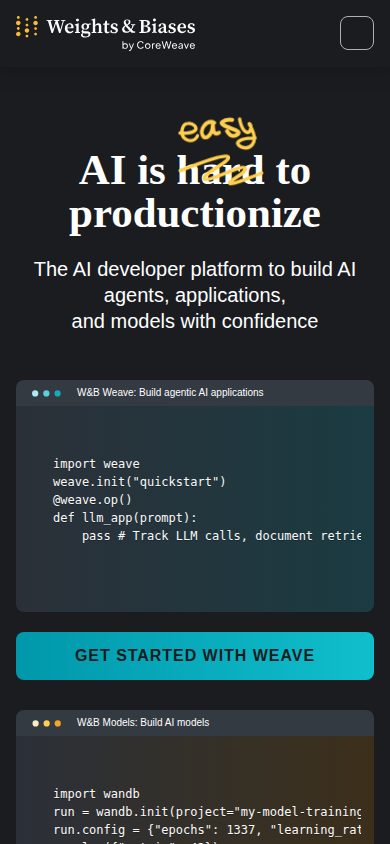
Weights & Biases is a machine learning experiment tracking and model management platform.
AI Panel Score
6 AI reviews
Reviewed
AI Editor ApprovedApproved and published by our AI Editor-in-Chief after full panel analysis.Weights & Biases is a developer-focused MLOps platform designed to help data scientists and machine learning engineers track experiments, manage models, and streamline the model development lifecycle. It captures training metrics, hyperparameters, system usage, and model outputs in real time, storing them in a centralized dashboard accessible to the whole team.
The platform's core feature, Runs, allows users to log and compare experiments across different configurations, making it straightforward to identify which hyperparameters or architectures yield the best results. Alongside experiment tracking, W&B offers Artifacts for versioning datasets and models, and Sweeps for automated hyperparameter optimization using strategies such as grid search, random search, and Bayesian optimization.
W&B integrates with a wide range of frameworks including PyTorch, TensorFlow, Keras, JAX, Hugging Face, and scikit-learn, typically requiring only a few lines of code to instrument an existing training script. This low integration friction has contributed to its broad adoption among individual researchers and large engineering teams alike.
The platform also includes Reports, a collaborative documentation feature that lets users combine live charts, media, and narrative text into shareable documents — useful for communicating findings internally or publishing reproducible research. W&B's Model Registry provides a centralized store for managing the lifecycle of production-bound models, from experimentation through deployment readiness.
Weights & Biases competes in the MLOps and experiment tracking space alongside tools such as MLflow, Neptune.ai, and Comet ML. It is used across academia, startups, and enterprise organizations, and offers both a cloud-hosted service and options for private cloud or on-premises deployment for teams with data residency requirements.
Provides access to leading open-source foundation models through an OpenAI-compatible API, with usage tracking and integration with Weave for tracing and evaluation.
Enables post-training of large language models using serverless reinforcement learning with fully managed GPU infrastructure and automatic scaling for multi-turn agentic tasks.
A lightweight toolkit that provides tracing, output evaluation, cost estimates, and a hosted playground for comparing different LLMs and settings in generative AI applications.
Automates hyperparameter optimization by running configurable sweeps across experiments to find the best-performing model configurations faster.
Enables teams to share results, leave comments, and collaborate on model optimization through a shared dashboard with a lightweight system of record for team projects.
Automatically versions logged datasets with diffing and deduplication, saving experiment files, model weights, and git commits needed to reproduce results later.
Automatically tracks every model, metric, and hyperparameter with a few lines of code, streaming live metrics into interactive graphs and tables for full visibility into the AI workflow.
Provides a centralized registry for versioning and reproducibility of trained models, enabling teams to manage the full lifecycle from experimentation to production.
Integrates with popular ML frameworks and libraries including PyTorch, TensorFlow, Keras, Hugging Face Transformers, LangChain, LlamaIndex, and more for fast setup in existing projects.
The first iOS app purpose-built to monitor AI experiments and track training runs anytime, anywhere, giving teams on-the-go access to their model metrics.
Certified under ISO/IEC 27001:2022, ISO/IEC 27017:2015, and ISO/IEC 27018:2019, and compliant with SOC 2, HIPAA, NIST 800-53, and GDPR requirements.
Supports multi-tenant cloud, dedicated single-tenant cloud (AWS, GCP, or Azure), and private infrastructure deployments, each with isolated network, compute, and storage.
Designed for personal development of AI applications and models
Professionals and small teams working to optimize AI applications and models (fewer than 50 employees)
Companies prioritizing security and compliance for AI applications and models
Run a W&B server locally on any machine with Docker and Python installed. For personal projects only; corporate use is not allowed.
Maximum control and privacy for enterprises running W&B on their own infrastructure
CoreWeave paid $1.7B in May 2025 to acquire the developer relationship the GPU cloud was missing.
“Weights & Biases is the 2017-founded MLOps platform — experiment tracking, model registry, sweeps — now a CoreWeave property after the $1.7 billion May 2025 close. The buying call isn't the tooling, which is industry-default; it's whether the new owner's GPU-cloud agenda starts shaping the roadmap.”
CoreWeave paid $1.7 billion to close this in May 2025. They didn't buy a tool — they bought the developer relationship their GPU cloud was missing. W&B has been shipping since 2017, and PyTorch and Hugging Face integration is how the ML world learns.
Runs and Sweeps are the workflow most data scientists already know. W&B Weave is the real bet — LLM tracing positioned against Comet ML and Neptune.ai for the gen-AI workload. Pro at $60/month for 10 seats is honest pricing for a 100K-customer base.
But the acquirer is the wrinkle. CoreWeave is a GPU cloud first, and the pressure to favor their own infrastructure is real, however neutral the docs stay. If your training runs on AWS or Azure, watch the changelog. Free tier is enough for a 90-day pilot.
Category default ahead of Comet ML and Neptune.ai; W&B Weave extends the moat into LLM tooling.
Industry-standard tool used across academia, startups, and enterprise — a safe board defense.
A few lines of code on top of PyTorch or Hugging Face and your first training run is logged.
Solid MLOps default that supports the workflow without redefining it; useful, not transformative.
Now owned by NYSE-listed CoreWeave after the $1.7B May 2025 close — the survival question is off the table.
ML teams who need experiment tracking with proven framework integrations.
Buyers who can't accept cloud-neutrality risk from the CoreWeave parent.
Eight years of W&B Runs became the experiment-tracking default, and CoreWeave bought the standard for $1.7B.
“Lukas Biewald's 2017 SDK turned a few lines of Python into the dashboard most ML teams now defend in roadmap reviews. CoreWeave closed the $1.7B acquisition in May 2025, which moves the long-term architectural call out of W&B's hands.”
CoreWeave closed the $1.7B Weights & Biases acquisition on May 5, 2025 — eight years after Lukas Biewald shipped the first tracking SDK in 2017. For a head of ML platform, that closes the question of whether W&B Runs is the segment default.
The craft shows above tracking. Sweeps handles Bayesian hyperparameter search natively, Artifacts versions datasets and weights with deduplication, and W&B Weave extends the same instrumentation pattern to LLM traces and evaluations. PyTorch, Hugging Face, and JAX integrations stay one import line — friction MLflow and Comet ML still negotiate per framework. Pro starts at $60/month with 100 GB storage.
However, the architectural call now lives on CoreWeave roadmap. The three-year bet is that a GPU-cloud parent keeps the open SDK over funnel pull into proprietary inference. MLflow stays the substrate that survives a hyperscaler swap; Neptune.ai stays the vendor-neutral hedge.
De facto experiment-tracking default; MLflow and Neptune.ai are the alternatives buyers actively compare against.
One-line instrumentation matches how PyTorch and Hugging Face engineers actually wire a training loop.
Native hooks for PyTorch, TensorFlow, Keras, JAX, Hugging Face, and LangChain cover the working stack.
The May 2025 CoreWeave acquisition introduces parent-roadmap risk for a three-year platform bet.
Sweeps, Artifacts, and W&B Weave show the craft extends from classical ML to LLM tracing without a rewrite.
ML platform leads who standardize experiment tracking across a multi-framework org.
Teams who need a vendor-neutral substrate independent of any GPU cloud roadmap.
Pro tops out at 10 seats — after that it's contact-sales Enterprise with no public floor.
“The Pro tier at $60/month caps at 10 model seats; everything above is Enterprise with no public pricing. CoreWeave's $1.7B acquisition in May 2025 closes the runway question but reopens the renewal one.”
Pro stops at 10 model seats. After that you're on Enterprise — contact-sales, no public floor. Free tier gets 5 seats and 5GB storage. The cliff between $60/month Pro and Enterprise is the conversation procurement doesn't want to have.
A 20-person ML team can't stay on Pro. SSO, SCIM, audit logs, CMEK — all gated to Enterprise. Category norm for MLOps enterprise lands $50K-$150K annually depending on storage and Weave ingestion. CoreWeave acquired W&B in May 2025 for $1.7B, up from a $1.25B 2023 mark.
MLflow is free and self-hosted, but you're staffing the platform yourself. Neptune.ai publishes per-seat pricing — rare in this category. W&B's Sweeps and Model Registry create real switching cost. The catch is the Weave ingestion meter — 1.5GB/month on Pro burns fast with LLM tracing.
Self-serve checkout on Pro removes procurement friction, but Enterprise still requires a discovery call.
Monthly billing visible on Pro, but the CoreWeave acquisition in May 2025 changes MSA assignment posture mid-renewal.
Free and Pro tiers published, but Enterprise is contact-sales with no public floor or overage rate.
Sweeps and Model Registry deliver measurable ROI through fewer wasted GPU runs and reproducibility wins.
Pro at $60/month is affordable, but Weave ingestion capped at 1.5GB/month makes year-3 LLM-tracing costs unpredictable.
Small ML teams who need experiment tracking under 10 seats.
Procurement teams who need published enterprise pricing upfront.
Sweeps and Artifacts carry the daily ML loop, but Pro's $60-per-seat math hits five-person teams hard.
“The wandb.init() call and Sweeps controller are why W&B beat MLflow in PyTorch training scripts. But Free tier's 5 GB ceiling fills inside a week, and Pro at $60/seat means a five-person team pays $300 before Enterprise.”
A wandb.init() call streams metrics from a PyTorch loop — that integration footprint is why W&B beat MLflow in daily training. The Sweeps controller runs grid, random, and Bayesian search from a YAML config; no Optuna wiring needed. GPU util, memory, and throughput land in the same run view as loss curves.
Artifacts catches the dataset-drift mistake every team makes by month three — model_v3 trained on a slightly different parquet than v2, and the lineage graph shows it. Weave extends the tracing model to LLM calls, useful once both classical and generative pipelines coexist in one repo.
But Free tier's 5 GB storage fills up inside a week on a vision project, and Pro at $60/seat means a five-person team pays $300/month. Neptune.ai is cheaper per seat; MLflow self-hosted is free with ops budget. CoreWeave's $1.7B acquisition (May 2025) buys runway.
Sweeps + Artifacts still feel useful past the demo; live system metrics show up next to loss curves.
Docs include runnable Colab notebooks per framework, which signals ML engineers wrote them.
Free tier's 5 GB storage and 1 GB Weave ingestion become the daily fight on any vision project.
Sweeps Bayesian search, Artifacts lineage, and Weave LLM tracing give advanced users real depth.
A wandb.init() call instruments PyTorch, TensorFlow, Keras, and Hugging Face training scripts without a refactor.
ML engineers who train models in PyTorch daily.
Solo researchers who exceed 5 GB of artifacts monthly.
W&B is the everything-bagel MLOps stack, and CoreWeave just paid $1.7B for the recipe
“W&B captures runs, sweeps, artifacts, and now Weave traces for LLM apps, with PyTorch and Hugging Face integration in a few lines. The catch is a heavy surface area versus MLflow or Neptune.ai, and Pro at $60/month gets thin once a team outgrows ten seats.”
The iOS Mobile App is the giveaway. Most MLOps platforms treat mobile like an apology — W&B shipped the first iOS app purpose-built for monitoring training runs, and that says someone on the team knows what it feels like to step away from a sweep at 11pm.
Three lines of code to instrument PyTorch or Hugging Face, Sweeps for hyperparameter search, Artifacts for dataset versioning, the Model Registry on top. Free tier gives 5GB and 5 seats — enough for a real solo project, not a teaser. Pro is $60/month for ten seats.
But the platform is heavy. Versus MLflow self-hosted or Neptune.ai for lighter teams, W&B is the everything-bagel — Weave for LLM tracing, Inference, Sweeps, Reports all under one dashboard. CoreWeave bought them for $1.7B in May 2025, which probably means more GPU coupling, fewer rough edges.
Dashboard, Reports, and the iOS app feel deliberate; some legacy surface shows on heavy projects.
Weave, Sweeps, Artifacts, Registry, Inference — discoverable but a lot to absorb past the first week.
First iOS app purpose-built for ML monitoring is rare in MLOps, even if not full feature parity.
Three lines of code to instrument an existing PyTorch or Hugging Face script is genuinely low-friction.
Mature platform trusted by large engineering teams; rare visible outages in changelog history.
Teams running multiple ML experiments who need centralized tracking.
Solo researchers who want a lighter open-source workflow.
CoreWeave closed the $1.7B acquisition in May 2025 — W&B isn't a standalone bet anymore.
“CoreWeave completed the $1.7B Weights & Biases acquisition on May 5, 2025, folding the MLOps standard into a GPU-cloud roadmap. The product itself is solid — Weave, Sweeps, and the PyTorch integration are real — but the standalone vendor thesis is gone.”
CoreWeave closed the $1.7B acquisition May 5, 2025. That changes the question. You're not buying an independent MLOps vendor anymore — you're buying a tool whose roadmap will tilt toward CoreWeave's GPU cloud.
The product is real. Founded 2017 by Lukas Biewald, Chris Van Pelt, and Shawn Lewis. Insight Partners led the $50M round at $1.25B in 2023. Weave for LLM tracing, Sweeps for hyperparameter search, Model Registry, Reports. Free tier still ships, Pro at $60/month. PyTorch and Hugging Face integration is two lines of code.
The catch is alignment. MLflow is open-source and Databricks-backed. Neptune.ai stays independent. CoreWeave will optimize W&B for their own infrastructure first. Exit is okay — runs export, but Weave traces and Registry lineage don't travel cleanly. Watch the changelog.
Weave plus PyTorch/Hugging Face integration breadth is a real edge over MLflow and Neptune.ai.
Runs export cleanly but Weave traces and Model Registry lineage are sticky.
Well-capitalized acquirer in CoreWeave but roadmap independence is now gone.
Claims map to product — Weave docs and integration list are concrete and verifiable.
Acquired by an infrastructure cloud — a real category exit pattern, neither standalone-win nor failure.
ML engineers who need experiment tracking already integrated with PyTorch and Hugging Face.
Teams that need a vendor independent from a single GPU cloud provider.
Common questions answered by our AI research team
W&B integrates with popular ML frameworks to automatically log metrics, hyperparameters, and outputs, though specific framework names are not listed in the available content.
Yes, W&B automatically logs hyperparameters during training runs as part of its experiment tracking capabilities.
Teams collaborate by comparing runs, reproducing results, and sharing model development work within W&B's collaborative environment.
Yes, W&B lets teams compare results across multiple training runs to evaluate model performance and select the best configurations.
Weights & Biases is a San Francisco-based MLOps company offering experiment tracking, model registry, and evaluation tools for machine learning teams, acquired by CoreWeave in 2025.