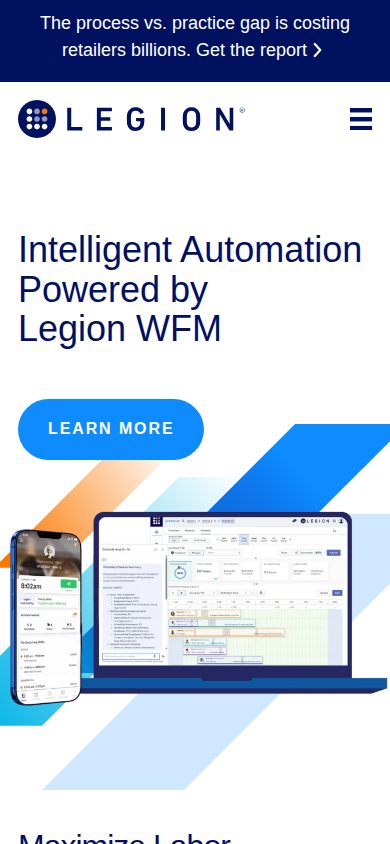
AI-native workforce management for hourly teams in retail, restaurants, and healthcare
Legion is an AI-powered workforce management platform for hourly employees at retail, restaurant, and healthcare enterprises.
AI Panel Score
6 AI reviews
Reviewed
AI Editor ApprovedApproved and published by our AI Editor-in-Chief after full panel analysis.Legion WFM is an AI-native workforce management platform built for enterprises that run large hourly workforces in retail, restaurants, healthcare, hospitality, and manufacturing. It forecasts customer demand with machine learning and turns those forecasts into optimized, compliant schedules generated in seconds, matching staffing to demand while honoring employee skills, availability, and labor budgets. Pricing is quote-based on a per-employee-per-month model, so organizations request a tailored proposal from the vendor. Core capabilities include demand forecasting, automated schedule optimization, time and attendance management, labor compliance enforcement, and an Employee Engagement Suite that unifies scheduling, communication, and Legion InstantPay earned-wage access in one mobile app. Legion AI adds generative AI Assistants that edit shifts, search timesheets, and draft multilingual announcements in natural language. It fits multi-location operators and enterprise retailers that need to control labor cost while improving the hourly-employee experience. Alternatives include UKG, Workday, Blue Yonder, WorkJam, and Deputy.
Legion WFM starts from demand: it uses machine learning to forecast customer traffic and translate it into precise labor requirements, then its optimization engine generates schedules in under ten seconds that respect skills, availability, labor budgets, and local compliance rules. Managers publish and adjust those schedules from a single interface, and the platform keeps forecasts, plans, and execution in sync as conditions change.
Legion AI drives the platform across deterministic, predictive, and agentic problems, and its generative AI Assistants automate routine work: the Shift Editing Assistant edits and publishes shifts, the Time and Attendance Assistant searches timesheets in natural language, and the Authoring and Translation Assistants handle multilingual announcements. The Employee Engagement Suite unifies scheduling, pay, and communication in one mobile app, with Premium Shift Offers for claiming open shifts and Legion InstantPay for early access to earned wages. Productivity-based scheduling assigns shifts on real-time performance data rather than availability alone.
It targets enterprises that run large hourly workforces in retail, restaurants, hospitality, healthcare, fitness, convenience stores, and manufacturing. Pricing is quote-based on a per-employee-per-month model, so buyers contact sales for a tailored proposal. Legion competes with UKG, Workday, Blue Yonder, WorkJam, and Deputy in the workforce management market.
The platform integrates with payroll, POS, and HCM systems including SAP and Workday, and its Platform Services layer provides enterprise-grade security, scalability, and a data pipeline connecting those systems. Control Center gives administrators self-service configuration over scheduling rules, labor models, and compliance policies.

Gives administrators self-service configuration of scheduling rules, labor models, and compliance policies.
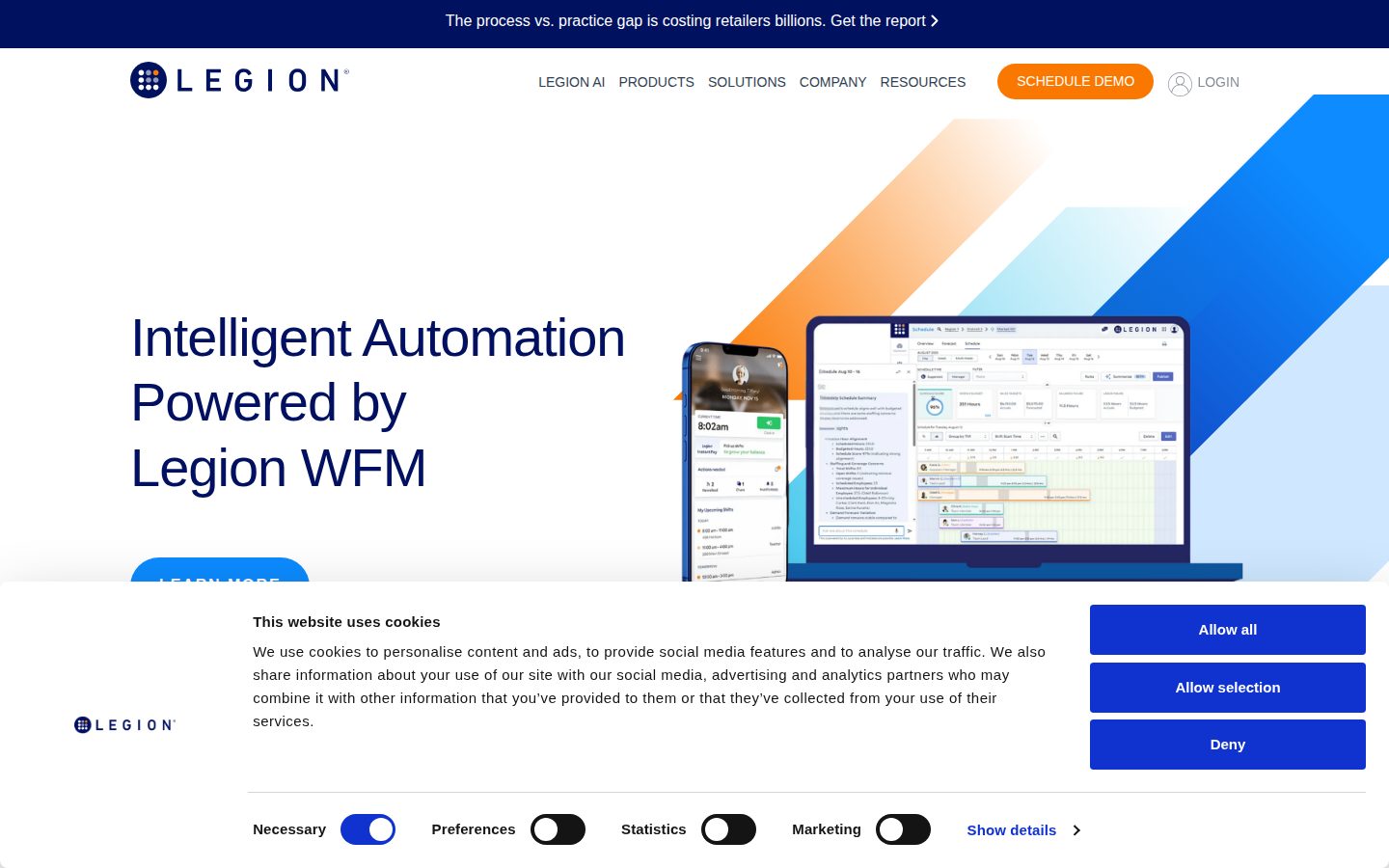
Generative AI assistants that edit and publish shifts, search timesheets, and draft announcements from natural-language prompts.
Unifies scheduling, pay, and communication for hourly workers in a single mobile app.
Predicts customer demand with custom machine-learning models that weigh historical data and external factors to size labor needs.
Produces extended-horizon demand forecasts that account for seasonal trends to support labor planning.
Calculates precise labor allocation against demand, labor models, policies, and budgets to control cost.
Gives hourly employees on-demand access to wages they have already earned before the regular payday.
Provides the enterprise-grade security, scalability, and data pipeline that connect Legion to payroll, POS, and HCM systems.
Lets eligible employees instantly claim open shifts in real time from their phone.
Assigns shifts using real-time performance data and machine-learning analytics rather than availability alone.
Generates compliant, budget-aware schedules in under ten seconds by matching demand to employee skills, availability, and preferences.
Automates time capture, approvals, and schedule-aware compliance to cut administrative work for payroll teams.
Pricing requires contacting the vendor.
Legion is a fundable, defensible WFM bet for enterprises ready to replace legacy scheduling.
“Legion pairs a credible enterprise team with an AI-first scheduling engine, and $195M in funding removes most of the vendor-survival doubt. Pricing is quote-only, which makes the board conversation harder than the product itself.”
Most WFM buyers already own a scheduler. The real question is whether machine-learning forecasting moves the labor line enough to justify ripping out an incumbent like UKG.
On vendor risk, Legion answers early. Founded in 2016 by a former SAP product chief, it has raised roughly $195M, including a 2024 growth round led by Riverwood Capital. That's a team that will still take your call in three years.
Strategic fit is strong for retail and restaurant chains where labor is the biggest controllable cost, and Legion InstantPay gives you a retention lever competitors charge extra for. However, pricing is quote-only with no public floor, so the board can't sanity-check the number without a sales cycle. Run a two-location pilot before you standardize.
AI-first forecasting differentiates against legacy schedulers, though giants like Workday loom.
Established enterprise brand competing head-on with UKG and Workday carries low embarrassment risk.
Schedules generate in under ten seconds, but enterprise WFM rollouts still take months.
Directly targets the biggest controllable cost for retail, restaurant, and healthcare operators.
$195M raised, an ex-SAP founder, and a 2024 Riverwood round signal a vendor that will endure.
Retail chains who run thousands of hourly workers across many locations.
Small operators who need transparent self-serve pricing.
Legion treats labor as a demand-driven operating system, not a scheduling afterthought.
“Legion starts from demand forecasting and pushes it through to compliant, budget-aware schedules, which is the right operating sequence for an hourly business. The heavy integration surface with payroll and POS is the real multi-quarter commitment, not the software itself.”
Labor is the largest controllable line in an hourly operation, often 30% of revenue. Legion's key choice is to start from Demand Forecasting and let optimization derive the schedule, not ask managers to guess headcount. That sequencing separates a labor operating model from a plain scheduler.
The three-year payoff is compliance and schedule adherence held centrally in Control Center, with local labor rules enforced by location. Productivity-Based Scheduling ties shifts to real performance data, which is where a COO finds margin. Blue Yonder and UKG cover similar ground, but Legion's forecasting-first architecture is cleaner.
The catch is the integration surface. Wiring SAP, Workday, and POS through Platform Services is a multi-quarter program, and quote-based pricing means you commit before seeing the full number. Worth it when labor optimization is a board-level priority.
Forecasting-first architecture differentiates cleanly from Blue Yonder and legacy UKG scheduling.
Purpose-built for retail, restaurant, and healthcare hourly operations where labor dominates cost.
SAP, Workday, and POS connections via Platform Services are a real multi-quarter commitment.
Central Control Center governance scales compliance across locations over a three-year horizon.
Forecast-first design turns scheduling into a genuine labor operating model, not a calendar.
COOs who want labor forecasting to drive the schedule automatically.
Operators who lack the POS data to feed accurate forecasts.
No public price, per-employee-per-month billing, and a labor ROI you must model yourself.
“Legion sells per-employee-per-month with no published rate, so every estimate starts at a sales call. The ROI case is real in labor savings, but the invoice is unpredictable until you negotiate.”
No public price list. Billing is per-employee-per-month, scaled to headcount and the modules you deploy. For a 2,000-employee chain, that's the whole evaluation — you can't model it without a quote.
The ROI math is where Legion earns its keep. Trim 2% off a labor line that's 30% of revenue and the platform pays for itself fast. Legion InstantPay is typically funded through fees, not your payroll, so it doesn't add to the base. Implementation and onboarding are separate line items too.
Compare Deputy, whose Core plan publishes $6.50 per user and lets procurement self-serve. Legion won't. The catch is contract opacity: no public overage rate, no visible term length, everything through sales. Budget for a negotiation, not a checkout.
Per-employee-per-month scales cleanly with headcount but requires a full sales engagement.
Custom enterprise contracts with no visible term length or termination terms disclosed.
No published rate, no public tiers, everything routed through sales.
Labor savings on a 30% cost line make ROI easy to model once priced.
Per-employee-per-month plus implementation and integration services stacks the real cost.
Enterprises who can model labor savings against a negotiated quote.
Budget owners who need transparent pricing before a sales call.
For a store manager, Legion turns call-outs and open shifts into taps, not phone trees.
“The daily grind for an operations manager is filling open shifts and fixing schedules fast, and Legion's assistants target exactly that. Forecast quality depends on the POS feed, so the tool is only as good as the data you give it.”
An operations manager's Monday is call-outs, no-shows, and open shifts. Legion's Premium Shift Offers push open shifts to eligible employees' phones, so filling a gap becomes a broadcast, not a phone tree. That's the friction that actually eats a manager's morning.
Schedule edits go through the Shift Editing Assistant in plain language, and Schedule Optimization regenerates a compliant plan in under 10 seconds. WorkJam leans harder on task and comms; Legion leans on the forecast. For a manager, the win is not re-solving the whole schedule by hand every time availability shifts.
The friction surface is real. Forecast accuracy depends on a clean POS and traffic feed, and if that pipe is messy, the schedule inherits the mess. Good self-service compliance rules in Control Center, but garbage in still means garbage out.
Filling open shifts via Premium Shift Offers targets a manager's real daily grind.
Control Center self-service configuration suggests admin-friendly docs, though depth is unverified.
Forecast quality is hostage to the POS and traffic data feeding it.
Productivity-Based Scheduling and natural-language assistants give power managers real depth.
Shift Editing Assistant and single-interface publishing fit a manager's actual routine.
Store managers who spend their mornings chasing open shifts.
Operations teams without clean POS or traffic data feeding forecasts.
For the person actually working the shift, Legion is one app that respects their time.
“Most workforce tools are built for the manager and treat the employee's phone as an afterthought. Legion flips that with a real mobile app, though you only get in if your employer sets you up.”
Most workforce apps are built for whoever runs the schedule, and the hourly worker gets a stripped-down afterthought. The Employee Engagement Suite is the opposite bet — scheduling, pay, and messages in one app on iOS and Android. That's the part that decides whether people actually open it.
The nice touch is Legion InstantPay. Getting earned wages before payday is the kind of thing that makes someone forgive a clunky screen, and claiming an open shift from your phone beats texting your manager. Deputy and When I Work do shift-swaps too, but the pay piece is a genuine reason to keep the app installed.
The catch: you can't just sign up. Legion's been at this since 2016 and it's clearly enterprise-grade, but it's employer-provisioned — your whole experience rides on how well your company configured it. Great app, zero control over whether you get to use it.
Unified scheduling, pay, and messaging in one app signals real consumer-grade care.
Claiming shifts and viewing pay are simple, though feature breadth adds some depth.
Mobile is the primary employee surface on iOS and Android, not an afterthought.
Employer-provisioned setup means the worker's onboarding depends on company configuration.
Enterprise Platform Services and $195M backing suggest a stable, dependable app.
Hourly workers whose employer already runs Legion.
Individuals who want a tool they can adopt themselves.
AI-native is a bold tagline, but the funding and track record mostly back it up.
“"AI-native" is the kind of superlative that usually hides a thin product, but Legion's nine years and $195M say otherwise. The real risk isn't survival — it's how hard you're locked in once forecasting runs your labor.”
"AI-native" is doing heavy lifting in that tagline. Usually that phrase hides a thin wrapper. Not here — Legion's Legion AI engine has been shipping since 2016, and $195M in funding through a 2024 Riverwood Capital round says a real team is behind it.
Track record checks out. Founder came from SAP. Kronos and Reflexis owned this category for years; both got swallowed, into UKG and Zebra. Legion's still independent, which cuts both ways.
The worry is exit. Once demand forecasting and Control Center run your labor model, ripping Legion out means rebuilding the whole engine — and quote-based pricing means no public benchmark to check you're not being squeezed at renewal. Differentiation is real, but so is the lock-in.
Forecasting-first approach genuinely differs from legacy Kronos and Reflexis scheduling.
Once forecasting and Control Center run labor, migrating out means rebuilding everything.
Riverwood-backed independence and a 2024 growth round suggest durable staying power.
"AI-native" is bold, but the underlying Legion AI engine largely substantiates it.
Nine years, an ex-SAP founder, and $195M funding match the enterprise claims.
Enterprises who accept deep lock-in for real forecasting gains.
Buyers who need an easy exit path later.
Common questions answered by our AI research team
Legion WFM uses quote-based pricing on a per-employee-per-month model, so cost scales with headcount and the modules you deploy. There is no public price list or free plan; you request a tailored proposal from Legion's sales team.
Yes. Schedule Optimization generates compliant, budget-aware schedules in under ten seconds, matching forecasted demand to employee skills, availability, and preferences. Productivity-based scheduling can also assign shifts using real-time performance data.
Yes. Legion connects to payroll, POS, and HCM platforms including SAP and Workday through its Platform Services layer and data pipeline, so demand, labor, and time data move between systems without manual re-entry.
Legion's Platform Services layer delivers enterprise-grade security and scalability for large hourly workforces, and the platform enforces labor and scheduling compliance rules by location. Administrators govern access and policies through the Control Center.
Yes. Legion InstantPay gives hourly employees on-demand access to wages they have already earned before the regular payday. It sits inside the Employee Engagement Suite alongside self-service scheduling and Premium Shift Offers for claiming open shifts.
Company
Legion Technologies, Inc.Founded
2016Pricing
Contact for pricing


AI-native workforce management platform handling scheduling, demand forecasting and time-and-attendance for enterprises with large hourly workforces. Based in Redwood City, CA.