Cloud-based eDiscovery and legal hold software for legal teams
Logikcull is a cloud-based eDiscovery and legal hold platform for corporations, government entities, and law firms.
AI Panel Score
6 AI reviews
Reviewed
AI Editor ApprovedApproved and published by our AI Editor-in-Chief after full panel analysis.Logikcull is used to run the full eDiscovery process in a browser: legal teams upload or connect data sources, issue and track legal holds, cull and search collected data, and export or produce documents for litigation, investigations, or records requests. The interface is built to be usable by legal staff without dedicated eDiscovery training, reducing reliance on outside vendors or specialized technical support for standard matters.
The platform integrates with Slack, Microsoft 365, and Google Workspace, using an Onna integration to preserve and search collaboration data from those sources. Logikcull AI is built into the review workflow to support tasks like document review and case assessment. The product covers specific workflows including early case assessment, internal investigations, subpoena response, open records requests, and Data Subject Access Requests (DSARs), each with dedicated tooling rather than generic document handling alone.
Logikcull is marketed toward corporate legal departments, government and public sector agencies, law firms, and educational institutions that need to handle discovery, investigations, or records requests in-house rather than outsourcing to traditional eDiscovery vendors. It positions itself as an alternative to legacy eDiscovery software in a category that includes vendors like Relativity, Everlaw, and DISCO. Pricing details are provided on request through the company's pricing page rather than being fully published.
The product is delivered as a cloud-based, web-accessed platform, so no local software installation is required for end users. Data collection integrations exist for Slack, Microsoft 365, and Google Workspace, with the Onna partnership extending support to a broader set of collaboration and communication data sources.

Applies integrated artificial intelligence capabilities to speed up document review and reduce manual effort.
Allows legal teams to quickly assess case data and determine relevance early in a matter.
Enables legal teams to initiate, manage, and track defensible legal hold procedures.
Automates the process of responding to third-party subpoenas efficiently.
Handles Data Subject Access Requests to support data privacy compliance workflows.
Collects data from M365, Google Workspace, Slack, and other sources in a defensible manner for eDiscovery.
Provides AI-powered tools for data collection, review, and production throughout the eDiscovery lifecycle.
Connects to Google Workspace data sources to collect and preserve information for discovery.
Connects to the Microsoft 365 ecosystem to collect and preserve data for legal matters.
Preserves, accesses, and searches collaboration data from Slack, Google Workspace, and other sources through the Onna partnership.
Collects and manages data directly from Slack workspaces for eDiscovery and investigations.
Provides platform security measures and compliance standards for handling sensitive legal data.
Logikcull does not publish specific pricing tiers or amounts on its site; prospective customers must request a demo or contact sales for a quote. A free trial is available to start using the platform before purchase.
Storage-priced eDiscovery that legal staff can actually run without a consultant on retainer.
“Logikcull trades Relativity-grade complexity for a browser tool non-specialists can drive. Pay-as-you-go pricing is honest but unpredictable at scale.”
Zero learning curve, per-GB billing, unlimited users on the base plan. That's a real pitch against Relativity and Everlaw, both of which assume you've got a trained eDiscovery team or an outside vendor on speed dial.
Two things stand out. Legal Hold Management and DSAR tooling are dedicated workflows, not bolted-on document search. Slack and M365 integration via Onna covers the collaboration-data gap that trips up older platforms.
Storage-based pricing means costs creep as data volume grows, and you won't know the number until sales calls you back. No published tiers is a small board-defensibility problem. Still, "hundreds of legal teams" and a free trial suggest this is provable in 90 days, not a leap of faith.
Solid mid-market alternative to Relativity/Everlaw but unpublished pricing makes it harder to benchmark against peers.
Named alternative to Relativity and DISCO in its own positioning; safe, unglamorous choice for general counsel.
Free trial plus no-install browser access and unlimited users on Pay As You Go shortens time to first matter.
Moves in-house teams off outside eDiscovery vendors for standard matters, a real capability shift not just cost trim.
Established player with an Onna partnership and years in market, though no public funding data given.
Corporate legal teams handling investigations and DSARs in-house without a dedicated eDiscovery specialist.
Skip if you need Relativity-level complexity for massive multi-party litigation.
Solid mid-market eDiscovery workhorse, but I still need outside counsel review before production goes out.
“Logikcull gives in-house teams a defensible, self-service path through legal holds, collection, and review without a Relativity-grade learning curve. The gaps are the usual ones: opaque pricing and unproven AI review at scale.”
Legal hold management, defensible collection from Slack, M365, and Google Workspace via the Onna integration — that covers the bulk of internal investigations and subpoena response without paying a vendor by the gigabyte and the hour. The DSAR-specific tooling is the detail that tells me this was built by people who've actually sat through a records request, not just discovery counsel generalists.
My concern is the AI review layer. 'ASK GenAI Fact-Finding,' gated to the annual Subscription tier, is doing real substantive work — relevance calls, privilege risk — and I have no published benchmark on defensibility for that output. Relativity and Everlaw have longer track records defending their analytics in front of a judge; Logikcull's newer AI claims haven't been pressure-tested the same way.
Pricing-by-request is a minor irritant, not disqualifying. Storage-based Pay As You Go with unlimited users is the right model for unpredictable matter volume. Three years in, this is a sound bet for routine matters — I'd still route anything bet-the-company to a full-service vendor.
Positioned below Relativity/DISCO in complexity but above generic document tools, a credible mid-market alternative.
Built for in-house staff without eDiscovery training, matching how corporate legal actually handles routine matters.
Direct Slack, M365, and Google Workspace integrations plus Onna cover the sources that matter most for internal investigations.
Reduces outside vendor dependency for standard matters, but locks workflows to Onna's integration scope for collaboration data.
Covers early case assessment through production, but AI review depth is unproven against Relativity's analytics track record.
Corporate legal departments and government agencies handling routine investigations and DSARs in-house.
Avoid if you need litigation-grade analytics with a court-tested defensibility record for high-stakes discovery.
Pay per GB stored. Sounds simple. Ends up unpredictable at scale.
“No published rate on the storage-based plan. That's the whole risk in one sentence.”
Two plans: Pay As You Go, billed per GB stored, and annual Subscription, which adds GenAI Fact-Finding and Slack chat filtering. No dollar figure on either. Contact sales for both.
Storage-based billing is the real TCO question. Legal holds accumulate data. Data doesn't get deleted mid-litigation. Year 1 might be cheap. Year 3, after three internal investigations and a DSAR backlog, storage costs compound in ways a per-seat model wouldn't. Unlimited users and unlimited projects are generous — but the meter's on GB, not seats, so headcount growth doesn't drive cost. Data volume does.
Compare to Relativity or Everlaw, both quote-only too — category norm is opacity here, not a Logikcull-specific flaw. Annual subscription locks you into a term; Pay As You Go claims no-commit, which is the better default for unpredictable matter volume.
Matter bill-back and 24/5 support noted; procurement still requires a sales call to get a number.
Pay As You Go is monthly no-commit; annual Subscription trades that flexibility for premium features like GenAI Fact-Finding.
No GB rate, no subscription price, no tiers published — quote-only, per the pricing page.
Unlimited users/projects and reduced outside-vendor reliance are measurable claims, but no benchmark numbers given.
Storage-based billing means 3-year cost tracks data volume, not seats — hard to forecast without a rate card.
Corporate legal teams with irregular matter volume who want no-commit monthly billing.
You need a fixed 3-year budget number before talking to sales.
Zero learning curve claim mostly holds up — the legal hold tracker is where I actually live
“Logikcull is built for legal staff who don't have a Relativity cert to lean on. Storage-based Pay As You Go pricing is refreshing until bill-back season hits.”
Legal hold management here is genuinely built for a paralegal running holds solo, not a review attorney with a support team on standby. Issuing and tracking a hold, then pulling status reports for the GC, doesn't require a ticket to IT. That's the daily win.
The friction shows up around Slack and M365 collection. Both integrations exist, but chat filtering for Slack sits behind the Subscription plan, so if you're on Pay As You Go, expect to discover that gate mid-collection, not before. The Onna partnership extends reach into more collaboration sources, which matters for internal investigations, but it's another vendor layer to explain when opposing counsel asks how data was preserved.
Ask GenAI Fact-Finding is locked to Annual plans too — the AI review speed-up everyone wants isn't in the base tier. Compared to DISCO or Everlaw, Logikcull trades some review horsepower for a genuinely lower floor of expertise required to run it day to day.
Legal hold tracking and case assessment are usable without a training week, per the 'zero learning curve' positioning.
Docs and blog exist but no changelog or API reference, thin for staff troubleshooting mid-matter.
Storage-based Pay As You Go billing means bill-back tracking becomes its own recurring task for matter budgets.
ASK GenAI Fact-Finding and premium features are reserved for Annual plans, gating advanced review from entry-level users.
Slack, M365, and Google Workspace integrations fit existing data sources but chat filtering is gated to Subscription tier.
In-house legal teams and government agencies handling investigations or DSARs without a dedicated eDiscovery specialist.
You need deep AI-assisted review depth comparable to Everlaw or DISCO without paying for the Annual tier.
Zero learning curve is the pitch, and the Slack integration mostly backs it up
“Logikcull trades the Relativity-style learning cliff for a browser tool a legal ops person can drive without a specialist. The catch is you won't know what it costs until someone gets you on a call.”
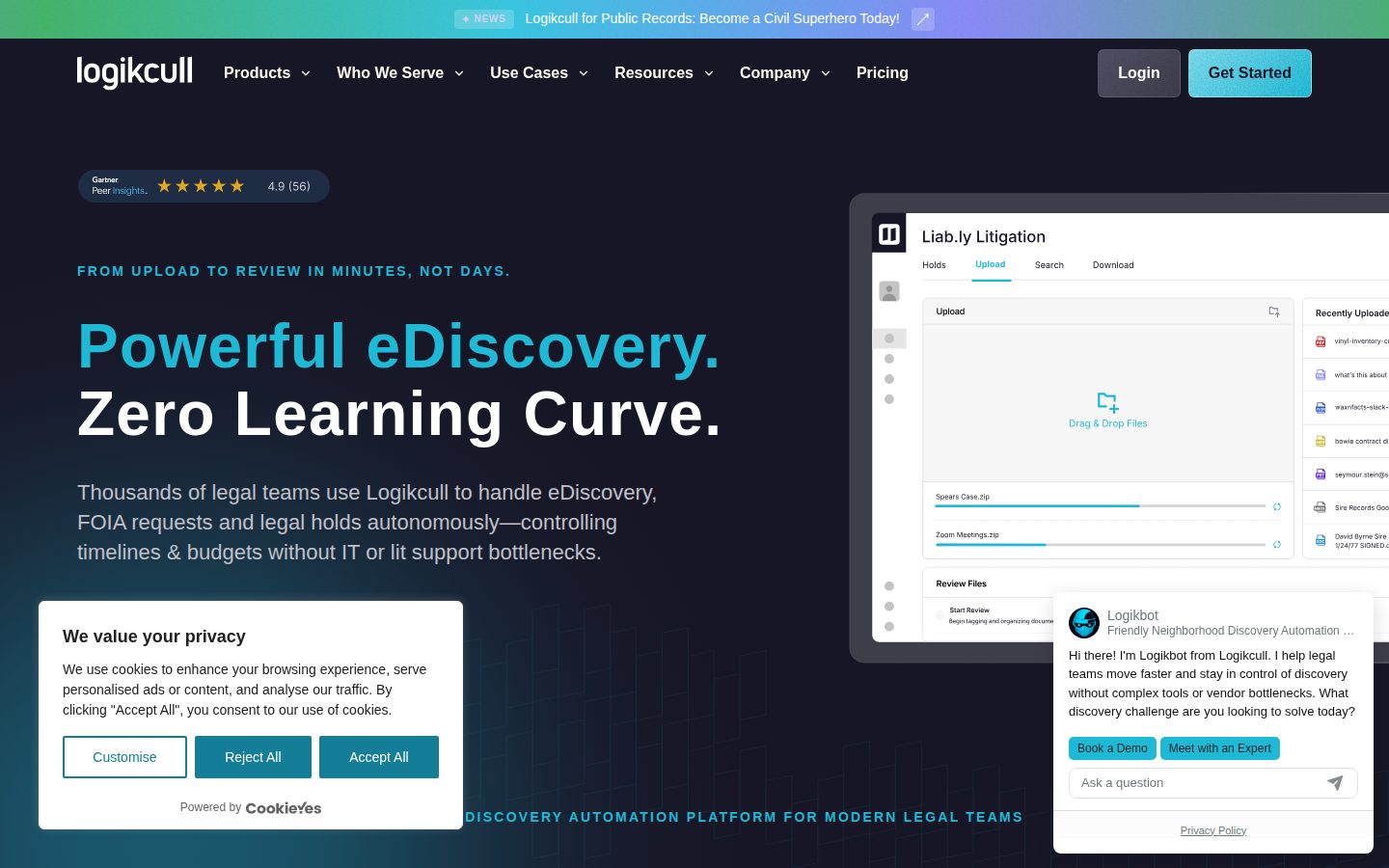
Logikcull's whole pitch is right there in the H1: 'Powerful eDiscovery. Zero Learning Curve.' That's a bold thing to promise in a category where tools like Relativity usually require actual certification to operate. Points for saying it out loud.
The features that matter for day-to-day use are here: legal hold tracking, direct Slack and M365 collection, and now ASK GenAI Fact-Finding on the Subscription tier. Pay As You Go billing by the GB with unlimited users and unlimited projects is a genuinely friendly structure for teams with unpredictable caseloads, and 24/5 in-app support suggests someone thought about what happens when you're stuck at 11pm on a subpoena deadline.
The tradeoff: pricing is 'contact sales' only, no published tiers, so you're doing a demo before you know if this fits your budget. And mobile is web-only, no dedicated app, which is fine for a desk tool but means no reviewing documents from your phone between meetings. For a browser-first product going up against Everlaw and DISCO, that's a reasonable spot to land, not a leader spot yet.
Direct Slack and M365 collection shows they've studied where evidence actually lives day to day.
Unlimited users and projects on GB-based billing means the whole team can learn it without seat anxiety.
Web-only, no dedicated app — fine for a desk tool, but no reviewing documents from your phone between meetings.
'Zero Learning Curve' is the whole pitch — a browser tool a legal ops person can drive without Relativity-style certification.
24/5 in-app support suggests someone thought about the 11pm subpoena deadline.
Legal ops teams with unpredictable caseloads who want eDiscovery they can drive themselves.
You need published pricing before committing to a demo cycle.
Zero learning curve, zero pricing transparency. Pick one.
“eDiscovery for legal teams that don't want a Relativity contract. Storage-based billing is refreshing, but 'contact sales' is doing a lot of work here.”
'Powerful eDiscovery. Zero Learning Curve.' The kind of headline that ages fine if true, badly if not. No pricing page with numbers — just per-GB storage plus a Subscription tier that unlocks 'ASK GenAI Fact-Finding'. Category norm for legacy vendors like Relativity is opaque enterprise contracts too, so Logikcull isn't worse here. Just not different.
Three tells worth noting. One: 'hundreds of legal teams' in the meta description — vague, unaudited. Two: no changelog, no API listed. Three: Onna integration is doing the heavy lifting for Slack and Workspace collection, meaning a third-party dependency sits underneath the pitch.
Exit story is decent — cloud-based, standard export/production workflow, not proprietary lock-in on the data itself. Differentiation vs Everlaw and DISCO is real: self-service, no dedicated eDiscovery staff required. Whether that holds for complex litigation is unproven from what's public.
Clear gap vs Relativity and DISCO on ease-of-use for non-specialist legal staff, per docs.
Cloud export/production workflow is standard; no proprietary format lock-in evident.
No funding figures, no changelog, no API — thin public signal despite named integrations.
'Zero learning curve' is the kind of superlative that ages poorly without user data to back it.
Storage-based pricing and self-service positioning mirrors successful SMB-legal-tech patterns, not failed ones.
Corporate legal teams handling routine investigations or DSARs without in-house eDiscovery specialists.
You need transparent published pricing or complex multi-matter litigation support at Relativity scale.
Common questions answered by our AI research team
Logikcull offers two main plans: Pay As You Go, a monthly no-commit, storage-based plan billed per GB stored, and Subscription (Annual Plans) with fixed pricing that adds premium features on top of the Pay As You Go base.
Yes, Logikcull integrates directly with Slack, including chat filtering for Slack under its Subscription plan features.
Yes, Logikcull integrates directly with Microsoft 365 to preserve and collect data as part of its eDiscovery lifecycle automation.
Yes, Logikcull applies AI-powered features to speed up review, including ASK GenAI Fact-Finding available on Subscription (Annual) plans.
The Pay As You Go plan is storage-based, charging per GB of data stored each month, and includes unlimited users, unlimited projects, unlimited downloads, 24/5 in-app support, easy matter bill-back, and initial onboarding & training.
Company
LogikcullFounded
2011Pricing
Contact for pricingFree Trial
AvailableLogikcull is a San Francisco-based cloud eDiscovery platform that automates evidence collection, legal holds, and document review for legal teams.