Lovable logo

Lovable Review

Visit

Build apps and websites by chatting with AI

Lovable is an AI-powered app builder for users who want to create web apps and websites through conversational prompts.

AI Panel Score

7.3/10

6 AI reviews

Reviewed

AI Editor Approved

About Lovable

Lovable works by accepting text-based chat input from the user and translating those instructions into working application code. The primary workflow involves typing what you want to build — a web app, a website, or a feature — and the AI generates the result iteratively as the conversation continues. Users can refine the output through follow-up messages without switching to a code editor.

The platform emphasizes that teams from established companies already use it for real projects, positioning it as a production-capable tool rather than a toy or prototype generator. The mobile app availability suggests users can initiate or continue building from outside a desktop environment, which is relatively uncommon among AI coding tools.

Lovable targets non-engineers, solo founders, designers, and product teams who need to ship working software without dedicated developer resources. It competes in the AI-assisted development category alongside tools such as Bolt, Cursor, Replit, and GitHub Copilot Workspace, though Lovable's chat-first, no-code interface distinguishes it from editor-integrated alternatives. Pricing details are not surfaced on the homepage, so free plan and trial availability are not confirmed from the available page content.

The product is web-based and also available as a mobile app on iOS and Android, allowing users to interact with the builder across devices.

Features

AI

  • Chat-based App Creation

    Users create apps and websites by typing natural language descriptions in a chat interface.

Collaboration

  • Team Collaboration

    Teams from companies can build together using the Lovable platform.

Mobile

  • Lovable Mobile App

    A mobile version of Lovable is available, allowing users to build apps from their mobile device.

Preview

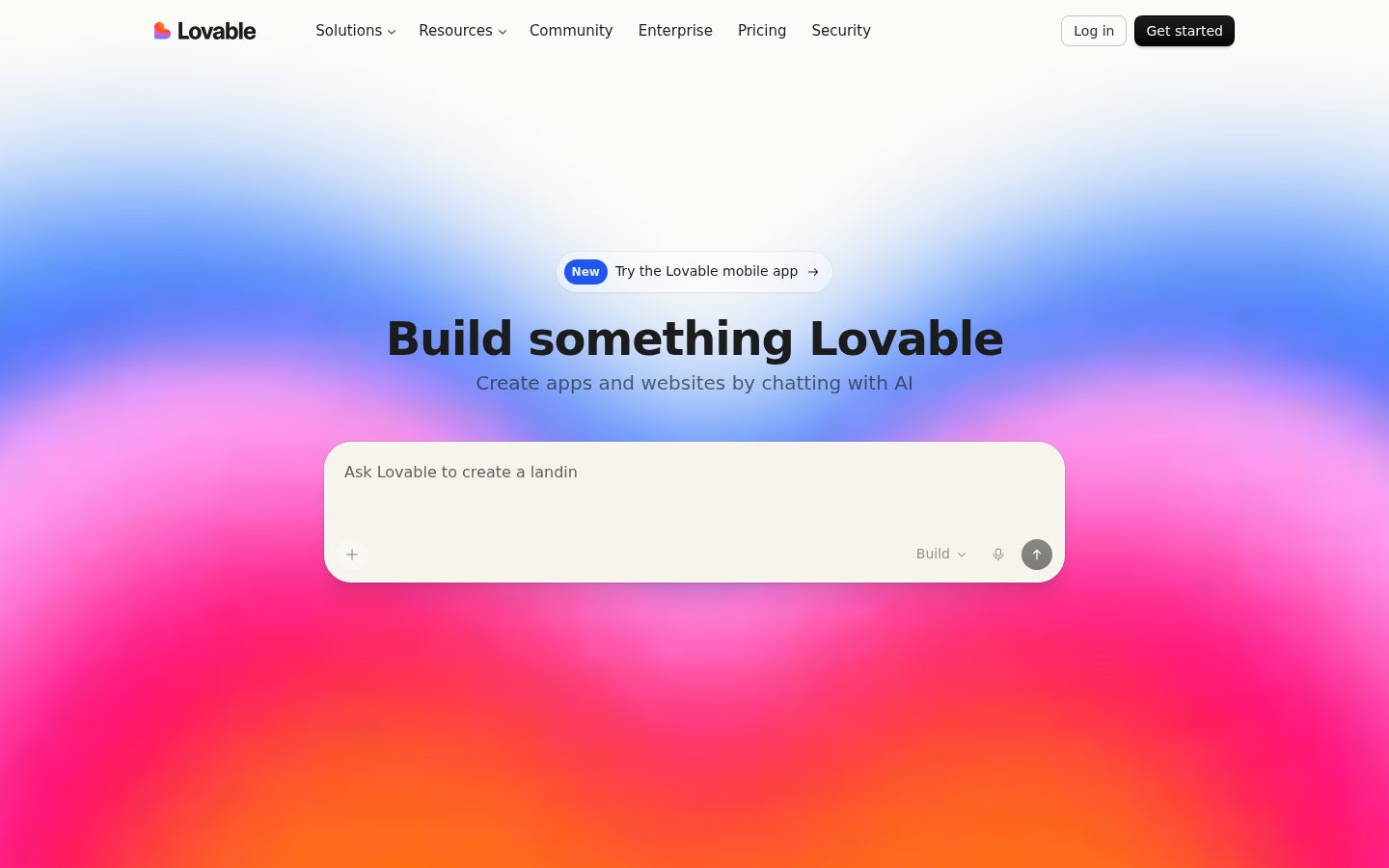
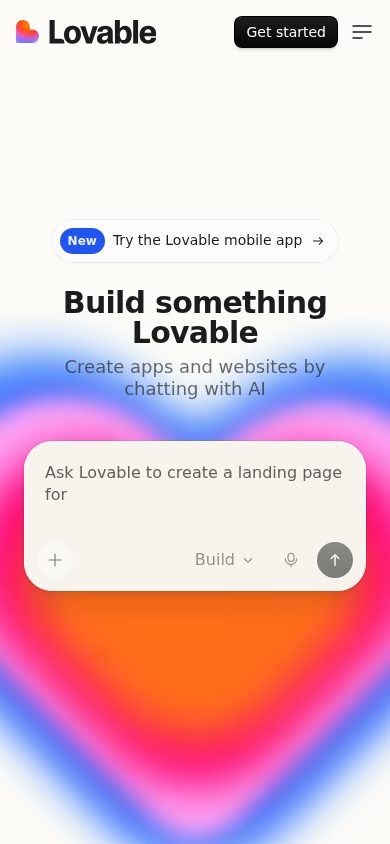
Lovable desktop previewLovable mobile preview

Pricing Plans

Free

Free

Start for free with basic access to Lovable

  • Limited credits per month
  • lovable.app domains
  • Basic project building
Popular

Pro

$25/monthly

Designed for fast-moving teams building together in real time

  • 100 monthly credits
  • 5 daily credits (up to 150/month)
  • Credit rollovers
  • On-demand credit top-ups
  • Unlimited lovable.app domains
  • Custom domains
  • Remove Lovable badge
  • User roles & permissions

Business

$50/monthly

Advanced controls and power features for growing departments

  • All Pro features
  • 100 monthly credits
  • Internal publish
  • SSO
  • Team workspace
  • Role-based access
  • Security center
  • Design templates

Enterprise

Contact sales

Built for large orgs needing flexibility, scale, and governance. Platform fee based on company size, covering all employees.

  • All Business features
  • Volume-based credit pricing
  • Dedicated support
  • Onboarding services
  • SCIM
  • Audit logs
  • Publishing & sharing controls

AI Panel Reviews

The Decision Maker

The Decision Maker

Strategic bet, vendor viability, timing, adoption approval
7.6/10

Lovable ships non-engineers to production faster than Bolt at $25/month.

Chat-first app builder with one-click deploy, templates, and a real enterprise tier. Pricing is clean and the use case is tight.

The $25 Pro plan with credit rollovers and custom domains is priced where a solo founder won't hesitate. The Business tier at $50 adds SSO and role-based access — that's a real security story, not just a checkbox. One-click deploy and third-party connectors suggest this isn't purely a prototype toy.

Two things worry me. One: no API docs or changelog surfaced, so I can't confirm how fast they ship or whether integrations run deep. Two: credits as the core unit creates unpredictable costs at scale — what looks like $25/month can drift.

Vs. Bolt or Replit, Lovable's chat-first workflow with mobile access is a genuine differentiator for non-engineers. Tradeoff is clear for engineers: this won't replace Cursor. It replaces the intern you haven't hired yet. Pilot it with one product manager before standardizing.

Competitive Positioning7.5

Mobile-accessible building and chat-first workflow separate it from editor-integrated tools like Cursor, but credit limits vs. Bolt need a direct comparison before committing.

Reputation Risk7.5

Established companies are cited as users and the Security Center plus SSO on Business tier make this boardroom-defensible.

Speed to Value8.5

One-click deploy and a template gallery mean a non-engineer can have a working app in the first session, not the first sprint.

Strategic Fit8.0

If you have non-engineers who need to ship, this advances capacity rather than just cutting cost on what developers already do.

Vendor Viability7.0

No public funding data surfaced, but the four-tier pricing structure including Enterprise with SCIM and audit logs suggests a company past early stage.

Pros

  • One-click deploy with custom domains on the $25 Pro plan
  • Enterprise tier has SSO, SCIM, audit logs — real governance story
  • Mobile app availability is uncommon in this category
  • Templates and connectors reduce cold-start friction

Cons

  • No changelog or API docs surfaced — shipping velocity is unconfirmed
  • Credit-based pricing creates cost unpredictability at volume
  • No confirmed free trial — harder to validate fit before paying

Right for

Product teams and solo founders who need to ship working software without engineering headcount.

Avoid if

Your team is primarily engineers who want editor-integrated AI — Cursor or Copilot Workspace will serve them better.

The Domain Strategist

The Domain Strategist

Craft and strategy in the product's domain — adapts identity per category, same lens
7.2/10

Lovable ships working apps fast, but the credit architecture will bite at scale.

Chat-first app generation with one-click deploy and a real enterprise tier — SSO, SCIM, audit logs — signals they're building beyond the prototype market. The credit model at $25/month for 100 credits is where growth-stage teams hit friction before they hit the engineering ceiling.

Three features matter to me architecturally: one-click deploy, third-party connectors, and the Business tier's internal publish control. That stack suggests someone thought about the deployment surface, not just the generation surface. The Security Center on Enterprise with SCIM and audit logs is the right signal — they've had enterprise conversations and responded in the changelog rather than just the marketing copy.

The credit model is my structural concern. 100 credits at $25/month caps throughput in a way that punishes iterative development, which is literally the product's core workflow. If a product team runs 10 daily build cycles, they're on credit top-ups within two weeks. Bolt and Replit don't constrain iteration this way.

If we adopt this for internal tooling or rapid prototyping, in 3 years we've shipped fast but accumulated apps with opaque dependency graphs we don't own. The no-code floor is also the ownership ceiling.

Category Positioning7.8

Lovable sits above Bolt in enterprise readiness (SSO, SCIM, audit logs) while staying more accessible than Cursor or GitHub Copilot Workspace for non-engineers.

Domain Fit6.8

Chat-first generation fits non-engineers and solo founders well, but senior engineers won't trust a system with no observable dependency management.

Integration Surface7.0

Connectors support and custom domains on Pro suggest reasonable integration surface; absence of a public API is a gap for any team with existing CI/CD pipelines.

Long-term Implications6.0

If we build on this, in 3 years we own apps with unknown tech debt and no clear migration path — the output code's portability is unconfirmed from available evidence.

Strategic Depth6.5

Template gallery and connectors add surface area, but no public API or changelog visibility makes it hard to assess how fast the generation layer is improving.

Pros

  • Enterprise tier has real governance: SSO, SCIM, audit logs, role-based access
  • One-click deploy lowers the last-mile friction that kills most no-code tools
  • Custom domains and badge removal on $25 Pro tier — production-capable at entry price
  • Template gallery and connectors reduce cold-start time

Cons

  • 100 monthly credits at $25 caps iteration velocity — a fundamental mismatch with chat-first workflows
  • No public API confirmed, which blocks integration into existing CI/CD or monitoring stacks
  • Output code ownership and portability are unconfirmed — critical for any production bet
  • No changelog or public docs surfaced, making it hard to evaluate trajectory

Right for

Non-technical founders or product teams who need to ship a functional web app without engineering headcount.

Avoid if

Your team runs iterative daily builds or needs to own and audit the generated codebase in production.

The Finance Lead

The Finance Lead

Money, total cost of ownership, contracts, procurement math
7.2/10

$25/month Pro tier hides the real cost: credit math at scale.

Lovable publishes 4 tiers without a sales call — rare discipline. But credit-based billing means month 6 invoices won't match month 1.

Three paid tiers, all priced publicly. $0 free, $25 Pro, $50 Business. SSO lives at Business — $50/seat minimum. For 50 users that's $2,500/month, $30K/year before enterprise negotiation. Compare to Bolt, where credit economics are similarly opaque. Neither publishes overage rates. That's the real exposure.

Pro includes 100 monthly credits plus 5 daily rollover credits — up to 150/month. "Credit top-ups" are listed as on-demand, but no published rate. Year 3 TCO for a 10-person team on Pro: $25 × 10 × 36 = $9,000, plus unquantified top-up spend. Budget a 20% buffer minimum.

Contract terms aren't published. Auto-renewal window unknown. One-click deploy and third-party Connectors reduce integration cost. Student discount exists — niche, but honest. Main tradeoff: credit caps suit occasional builders, not daily power users who'll burn through 150/month fast.

Billing & Procurement6.8

Self-serve up to Business tier reduces procurement friction; Enterprise requires platform fee negotiation based on company size.

Contract Flexibility5.5

No published auto-renewal window, cancellation terms, or termination-for-convenience clause in available evidence.

Pricing Transparency7.5

All 4 tiers published without a sales call, but credit top-up rates and overage costs aren't disclosed.

ROI Clarity7.0

One-click deploy and no-code creation compress time-to-ship, but value measurement depends on team's prior dev spend baseline.

Total Cost of Ownership6.5

50-user Business deployment runs $30K/year base; credit burn and top-up rates make year 3 unpredictable.

Pros

  • All tiers priced publicly — no discovery call required
  • SSO included at $50/month Business, not an add-on tax
  • One-click deploy reduces post-build integration cost
  • Enterprise includes SCIM and audit logs — real compliance surface

Cons

  • Credit top-up pricing not published — invoice risk at scale
  • Auto-renewal and cancellation terms absent from public docs
  • 150 credits/month Pro cap will constrain daily active builders
  • No free trial confirmed — evaluation friction for budget approvers

Right for

Non-technical teams under 20 seats needing fast app deployment without hiring developers.

Avoid if

Your team builds daily and needs predictable, flat-rate monthly billing.

The Domain Practitioner

The Domain Practitioner

Daily hands-on reality in the product's domain — adapts identity per category, same lens
7.2/10

Lovable ships working apps fast — but 100 credits a month is a real ceiling

Chat-first app generation that genuinely targets non-engineers and solo founders who need to ship without a dev team. Credit-gated iteration is the daily fight you won't see in the demo.

The workflow is: describe what you want, read the output, refine via follow-up. No CLI, no IDE, no git workflow unless you bolt one on yourself. For the target persona — designer, solo founder, product manager — that's the point. One-click deploy and custom domains at $25/month means something real can ship without touching a terminal. That's legitimately useful.

The 100 monthly credits on Pro is where day-three reality sets in. Iterative refinement is the core loop, and every iteration costs a credit. Compare Cursor's unlimited completions model — credit budgets change how you prompt. You start batching requests, second-guessing iterations. That's friction that doesn't show in the demo.

Docs and API availability aren't confirmed from public evidence, which is a gap for anyone who wants to automate or integrate Lovable into a real pipeline. No changelog visible either — hard to trust production stability without knowing what changed last week.

Day-3 Reality6.5

100 monthly credits caps iterative refinement — the core workflow — creating budget anxiety that reshapes how you work by week two.

Documentation Practitioner-Fit6.0

No confirmed docs availability from scraped evidence — can't assess depth, but absence from the homepage is a signal.

Friction Surface6.8

Credit budgeting, no confirmed public API, and no changelog surface create daily uncertainty for teams trying to treat this as production infrastructure.

Power-User Depth7.0

Business tier at $50/month adds SSO, role-based access, and internal publish — real features, but connectors and template gallery suggest breadth over depth for advanced workflows.

Workflow Integration7.5

One-click deploy and mobile app availability mean the build loop is genuinely device-agnostic, which is rare among AI coding tools.

Pros

  • One-click deploy with custom domains at $25/month Pro — real shipping, not just prototyping
  • Mobile app availability is genuinely uncommon in this category
  • SSO and audit logs at Business/Enterprise tiers signal they've thought about org-level adoption
  • Template gallery reduces cold-start friction for common project types

Cons

  • 100 monthly credits on Pro gates the iterative loop that is the entire product
  • No public API or changelog confirmed — hard to build trust in production stability
  • No free trial confirmed despite freemium pricing model listed

Right for

Solo founders and product teams who need to ship a working web app without engineer resources and can work within a monthly credit budget.

Avoid if

You're an engineer expecting to iterate fast — credit limits will fight your refactoring instincts and Cursor or Replit offer more headroom for tight loops.

The Power User

The Power User

Daily human experience, onboarding, polish, learning curve, reliability
7.8/10

Chat-first app building that actually ships — with some asterisks

Lovable turns plain-language chat into working web apps, and the $25/month Pro plan is priced for people who mean business. The credit system is the thing that'll make or break it for heavy users.

The core pitch is real: describe what you want to build, and it builds it. No code editor, no deployment headache — one-click deploy is confirmed in the docs. That's not nothing. For a solo founder or a designer who needs something shipped by Friday, that's the whole pitch right there. Templates and third-party connectors suggest the platform has grown past 'toy' stage into something that handles actual project complexity.

The credit system is where day-three reality sets in. Pro is $25/month for 100 credits plus 5 daily, and Business doubles the price but doesn't double the credits. Compared to Bolt or Replit, you're paying for polish and the team workflow layer — roles, permissions, custom domains — not raw generation volume. Rollovers help, but power users will hit the ceiling fast and reach for on-demand top-ups.

The mobile app is genuinely uncommon in this category, and it's either brilliant or a checkbox depending on how seriously they've built it. No evidence the mobile experience goes beyond basic. Pricing page evidence is thin across the board, which is a trust signal issue for buyers doing due diligence.

Daily Polish7.5

Template gallery and one-click deploy suggest intentional UX, but scraped evidence shows no changelog or blog — hard to know how fast rough edges get filed down.

Learning Curve8.0

Natural language input keeps the floor low; connectors, SSO, and role-based access on Business tier at $50/month give power users room to grow without hitting a wall.

Mobile Parity7.2

iOS and Android apps exist, which puts Lovable ahead of most competitors in this category, but no evidence yet that mobile does more than initiate or monitor builds.

Onboarding Experience8.2

Chat-first interface and available templates mean a new user can have something working in minutes without reading a manual.

Reliability Feel7.0

No public changelog or API docs surfaced, which makes it hard to gauge how aggressively bugs get patched — that absence itself is a mild yellow flag.

Pros

  • Chat-first creation with no code required — lowest possible floor for non-engineers
  • One-click deploy confirmed, which removes a whole category of frustration
  • Mobile app availability is genuinely rare in AI coding tools
  • Enterprise tier includes SSO, SCIM, and audit logs — real org controls, not theatrical ones

Cons

  • Credit limits at Pro ($25/month, 100 credits) will bite active builders fast
  • No pricing transparency on the homepage is a trust signal problem for cautious buyers
  • Business tier doubles the price without doubling credits — the value story gets murkier there
  • No public changelog means you're flying blind on how fast issues get fixed

Right for

Solo founders, designers, or small product teams who need working web apps shipped fast without a developer on staff.

Avoid if

You're a developer who wants fine-grained code control — Cursor or GitHub Copilot Workspace will fit your hands better.

The Skeptic

The Skeptic

Contrarian. Watch-outs, deal-breakers, broken promises, category patterns
6.8/10

Three missing pages, one credit system, and a real question about staying power

Lovable is a chat-first app builder targeting non-engineers who need to ship without developers. The $25/month Pro tier is priced competitively, but the evidence gaps — no changelog, no API, no blog — leave too much unverifiable.

Three tells from the scrape. One: zero meta, zero H1, zero title tags — the homepage is either very new or poorly maintained. Two: no changelog visible, which in 2024 is how I distinguish teams that ship from teams that announced. Three: the credit system at 100/month with 5 daily caps is the kind of constraint that doesn't surface until you're mid-project. Could be fine. Could be the reason you churn.

The exit story worries me more than Bolt or Replit, which at least surface generated code you can fork. No API listed means you're fully inside Lovable's walls. If they reprice or fold — and this category has a graveyard — portability is unclear based on the docs indicator showing N.

Fair counterpoint: SSO, SCIM, audit logs, and a Security Center at the $50 Business tier is a real enterprise signal. Student discount is a growth play that suggests they're building a funnel. One-click deploy is table-stakes here, but confirmed. If the changelog cadence were visible, I'd score this higher.

Competitive Differentiation7.5

Mobile app availability and enterprise tier with SCIM plus role-based access at $50/month is a real gap vs. Bolt, which skews pure prototype; SSO at Business is unusual at that price.

Exit Portability5.5

No API listed and no docs indicator means if Lovable disappears, migration path is opaque — worse than Replit or Cursor where code is at least forkable.

Long-term Viability6.2

No public funding data, no changelog, no blog in the evidence — could be a scrape gap, but based on what's visible, durability signals are thin.

Marketing Honesty6.0

No meta or H1 data scraped, and 'production-capable' claims can't be verified without a changelog or customer evidence in the evidence set.

Track Record Match6.5

Chat-first no-code builders have a mixed survival rate — Glide survived, Draftbit didn't — and no public shipping cadence is visible here.

Pros

  • SSO, SCIM, and audit logs at $50/month Business tier — real enterprise signals at an accessible price
  • One-click deploy confirmed; mobile app is genuinely uncommon in this category
  • Template gallery and third-party connectors reduce cold-start friction
  • Student discount suggests deliberate top-of-funnel strategy

Cons

  • No API, no changelog, no docs visibility — can't verify shipping cadence or extensibility
  • Credit cap at 100/month with 5 daily ceiling will frustrate active builders mid-sprint
  • Exit portability unclear — no evidence code is exportable outside the platform
  • Pricing lists a $0 Free tier, but 'has free plan: no' in the data — inconsistency that erodes trust

Right for

Non-technical founders who need a shippable prototype fast and can tolerate vendor dependency.

Avoid if

You need API access, predictable credit costs, or a clear path to self-hosting the output.

Buyer Questions

Common questions answered by our AI research team

Pricing

Is there a student discount available?

A student discount is available — it is listed as a dedicated offering in Lovable's product navigation.

Features

Can I deploy my app with one click?

Yes, you can deploy your app to the world with one click after refining your creation through simple feedback.

Security

Does Lovable have an enterprise security option?

Yes, Lovable has an Enterprise option with a dedicated Security and Trust Center section listed on the site.

Setup

Can I start from a template instead of scratch?

Yes, Lovable offers templates to start your next project, with a template gallery available to browse.

Integration

Does Lovable support third-party connectors?

Yes, Lovable lists Connectors as a resource/feature, indicating support for third-party integrations.

Product Information

  • Company

    Lovable
  • Founded

    2023
  • Pricing

    From $25/mo

Platforms

webiosandroid

About Lovable

Lovable is a Stockholm-based AI-powered web app builder that lets users generate, edit, and deploy full-stack web applications through a chat interface with GitHub sync.

Resources

Documentation
Blog
Changelog

Also in AI Coding Tools