Security awareness training for reducing human risk in organizations
Mimecast Awareness Training is a security awareness training platform for organizations seeking to reduce employee-driven cyber risk.
AI Panel Score
6 AI reviews
Reviewed
AI Editor ApprovedApproved and published by our AI Editor-in-Chief after full panel analysis.Mimecast Awareness Training is a security awareness platform that delivers phishing simulations, video-based education modules, and behavioral risk measurement to reduce employee-driven cyber risk. It operates within Mimecast's broader Human Risk Management platform, tying training outcomes to email threat data and other risk signals across the organization. The product suits security teams already running Mimecast email security who want training correlated to real threat data. Pricing is quote-based, with no free plan or trial. Key capabilities include SAFE Phish, which converts real phishing attempts into training exercises; a Human Risk Command Center unifying threat telemetry with simulation outcomes; predictive risk scoring; and a library of 200-plus video modules across 27 languages. TopReviewed's six-seat AI review panel scored it 7.5/10, praising SAFE Phish's native threat-to-training conversion while noting the strongest features require Mimecast Email Security MX, leaving partial-stack buyers with a weaker product.
In practice, administrators deploy training campaigns and phishing simulations to employees through a web-based console. Employees receive training content—typically short video modules or interactive lessons—and are tested through simulated phishing emails. Results are tracked per user, allowing security teams to identify high-risk individuals and adjust training frequency or content accordingly.
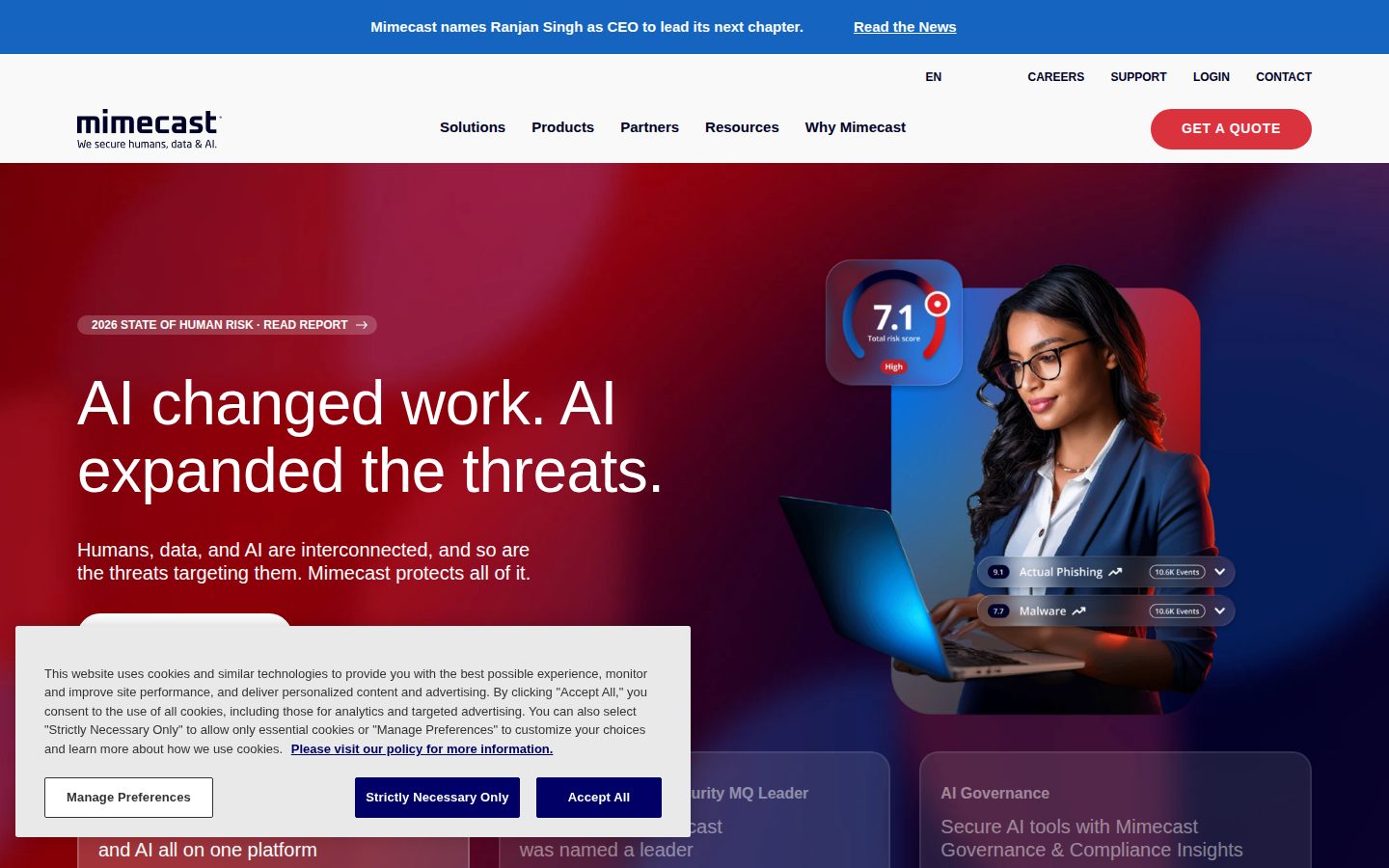
The platform is positioned within Mimecast's unified Human Risk Management suite, meaning awareness training data can be correlated with email threat events and data loss signals from other Mimecast modules. Mimecast highlights its risk scoring capability, which aggregates behavioral indicators across humans, data, and AI tool usage into a single view. The company reports being recognized as a Strong Performer in the Forrester Human Risk Management Solutions Wave.
Mimecast Awareness Training is aimed at IT and security teams across organizations of varying sizes, from SMBs to large enterprises, with customers including the Boston Red Sox and Moffitt Cancer Center cited on the company's homepage. Pricing is not publicly listed; prospective buyers must request a quote. Competitors in the security awareness training category include KnowBe4, Proofpoint Security Awareness Training, and Cofense.
The platform supports 300+ integrations with third-party security and IT tools, enabling automated threat response and shared intelligence across the security stack. Deployment is cloud-based, with the web console accessible via browser for administrators and employees.

Uses AI to generate and adapt phishing simulations — including QR code-based phishing templates — that mirror real-world attack patterns, with enhanced tracking of both link clicks and QR code scans.
Provides a centralized dashboard with real-time visibility into risky employee behaviors, aggregating data from real phishing attacks, simulated phishing metrics, and training metrics to surface the highest-risk users and departments.
Provides each employee with a personalized scorecard showing their risk level, completed training history, and areas for improvement to foster individual accountability for security behavior.
Delivers searchable, filterable Watchlist, User Performance, User Risk, and Efficacy reports — including industry benchmarking and ROI tracking — exportable as PDFs for management and compliance reporting.
Automatically delivers context-aware, real-time nudges via email, Slack, or Microsoft Teams to correct employee mistakes at the exact moment of risky behavior.
Automatically assigns follow-up training modules to specific users or groups based on their individual risk scores and behaviors, replacing one-size-fits-all training with precision-targeted remediation.
Offers 200+ short (3–5 minute), TV-quality humorous video modules covering topics such as phishing, ransomware, CEO fraud, GDPR, HIPAA, and PCI DSS, delivered in 27 languages on a monthly cadence.
Allows administrators to set up custom branding and notification sets for all training campaign emails, module notifications, and weekly reminders sent to employees across the organization.
Available for Mimecast Email Security MX customers, this feature examines logs of de-weaponized real phishing messages received by the organization and converts actual threats into training scenarios.
Supports rapid deployment aligned to key industry standards and regulatory frameworks including ISO, NIST, PCI DSS, GDPR, and HIPAA, with training modules dedicated to each compliance domain.
Enables administrators to create, launch, clone, and manage phishing simulation campaigns using a customizable template library, with test email capability to validate templates before full deployment.
Assigns every employee a personalized risk score derived from testing data, individual behavior, and their role within the organization to identify the weakest links and prioritize targeted intervention.
Mimecast Awareness Training pricing is not publicly listed. Prospective customers are directed to request a quote or contact sales for custom pricing.
Mimecast's training platform is a real contender if you're already in their email stack.
“Established vendor, serious feature set, no public pricing. Works best when you're already buying Mimecast email security.”
Mimecast has been in email security for decades. The Forrester Strong Performer recognition and 300+ integrations aren't marketing fluff — they signal a vendor that's built this as infrastructure, not a bolt-on. SAFE Phish, which converts real de-weaponized threats into training scenarios, is the feature that separates them from KnowBe4's templated approach.
The Human Risk Command Center and Predictive Risk Scoring are the real value proposition. You're not just running phishing drills — you're correlating email threat data with individual behavior across the org. That's a meaningful step up from standalone awareness training. The 200+ video modules in 27 languages handle the compliance coverage (HIPAA, PCI DSS, GDPR) without custom build.
The tradeoff is dependency. The best features — SAFE Phish especially — require Mimecast Email Security MX. If you're on Proofpoint or running a different email stack, you lose half the differentiation. No public pricing and no free trial make the evaluation process slower than it needs to be.
SAFE Phish and real-threat conversion are genuinely differentiated vs. KnowBe4, but only if you're running Mimecast's email product.
Boston Red Sox and Moffitt Cancer Center as named customers, plus Forrester placement, means no board member raises an eyebrow.
Watchlist Manager auto-assigns follow-up training quickly, but no trial and quote-only pricing slows time-to-deploy for new buyers.
Behavior-driven nudges and Predictive Risk Scoring advance human risk management beyond cost-saving compliance checkbox training.
Decades in market, Forrester recognition, and a unified platform strategy suggest this isn't a vendor who disappears in 36 months.
Security teams already running Mimecast email security who want training correlated to real threat data.
You're on a different email platform and evaluating this as a standalone awareness tool.
Mimecast ties phishing simulation to live email threat data — that's a real moat.
“The SAFE Phish feature, which converts actual de-weaponized threats into training scenarios, closes the gap between simulation theater and operational reality. If your org already runs Mimecast Email Security MX, this platform compounds that investment meaningfully.”
The Human Risk Command Center aggregating real phishing events, simulation metrics, and training outcomes into a single risk score is architecturally sound. Most competitors, including KnowBe4, keep simulation data siloed from live threat telemetry. Mimecast's correlation layer is the structural differentiator here. The 200+ video modules across 27 languages and the behavior-driven nudges via Slack and Teams suggest someone who understands that training friction kills compliance programs.
The constraint is platform dependency. SAFE Phish — arguably the strongest capability — is gated to Mimecast Email Security MX customers. If you're not already in that ecosystem, you get a capable but less differentiated product that competes on content quality and workflow automation rather than threat intelligence depth.
No public pricing and no free trial creates procurement friction. For enterprise security buyers that's table stakes, but it slows down mid-market evaluation cycles. The Forrester Strong Performer recognition is useful signal, not category leadership — KnowBe4 and Proofpoint still own more of the mindshare at the board level.
Forrester Strong Performer, not a Leader — sits behind KnowBe4 in mindshare but ahead of most pure-play SAT vendors on threat-data correlation.
Behavior-driven nudges at the moment of risk, individualized scorecards, and watchlist-based remediation map directly to how mature security teams actually run human risk programs.
300+ integrations and API availability are solid; SAFE Phish dependency on MX customers is the ceiling constraint for mixed-stack environments.
Deep integration with Mimecast's broader suite creates compounding value but increases switching cost — in 3 years, your training data is entangled with your email security vendor.
Predictive risk scoring plus real-threat conversion via SAFE Phish shows genuine platform thinking beyond checkbox compliance.
Enterprise security teams already running Mimecast Email Security who want training and threat telemetry on a unified risk plane.
Your email security stack runs on a different vendor and you need SAFE Phish-level threat correlation to justify the switch.
200+ modules, zero published prices — procurement starts blind here.
“Mimecast Awareness Training has real feature depth: predictive risk scoring, behavior-driven nudges, 27 languages, 300+ integrations. No public pricing means every TCO model starts with a blank cell.”
No pricing page. No free trial. No tier structure. That's three procurement friction points before the first demo. KnowBe4 publishes per-seat pricing; Mimecast does not. For a 50-seat SMB, year-1 sticker is genuinely unknown. Enterprise security budgets absorb this. SMB finance teams won't enjoy it.
The feature set is legitimate. Human Risk Command Center aggregates real phishing events plus simulation data into one dashboard — that's differentiated versus point-solution competitors. SAFE Phish converts actual de-weaponized threats into training scenarios, which is a real moat for existing Mimecast Email Security MX customers. 300+ integrations reduces stack fragmentation cost.
The tradeoff is ecosystem lock-in. SAFE Phish requires Mimecast email. Deeper ROI reporting requires more Mimecast modules. Efficacy and ROI reports are exportable as PDFs, which helps compliance teams. But contract terms — auto-renewal windows, termination clauses — aren't public. Assume standard enterprise hostage terms until the redline proves otherwise.
Contact-only sales motion adds procurement cycles; no self-serve onboarding; vendor onboarding cost is unquantified.
No public contract terms; no termination-for-convenience language visible; assume annual auto-renewal with standard enterprise notice windows.
No published tiers, no per-seat rate, no trial — pricing page confirmed absent per site evidence.
Efficacy and ROI reports are named features, exportable as PDFs, with industry benchmarking — that's measurable output, not hand-waving.
300+ integrations reduce third-party costs, but SAFE Phish and deeper analytics likely require additional Mimecast modules, inflating year-3 spend unpredictably.
Mid-market to enterprise buyers already inside the Mimecast ecosystem who can absorb opaque pricing and a sales-led procurement process.
Your team needs published per-seat pricing to get budget approval before a vendor conversation.
Mimecast's Human Risk Command Center is the strongest daily anchor in the category
“Solid phishing sim platform with real differentiation in cross-signal risk scoring. The no-public-pricing wall will slow down procurement conversations at every org.”
The SAFE Phish feature is the standout. Converting de-weaponized real threats from Mimecast email logs into training scenarios means your simulations aren't generic — they're drawn from actual attack patterns hitting your org. That's a meaningful gap over KnowBe4's template library approach. The Human Risk Command Center aggregating real phishing events, sim metrics, and training completions into one view is exactly what a security engineer wants during a weekly risk review.
Day-3 reality: the Behavior-Driven Nudges via Slack or Teams sound good on paper, but the friction shows up in tuning. Without a changelog visible in their docs, it's unclear how often nudge logic updates — category norm is quarterly. The 300+ integrations number is large; actual SIEM and SOAR connector quality matters more than count.
The Watchlist Manager plus Predictive Risk Scoring is a genuine power-user feature. Precision-targeted remediation beats spray-and-pray training. The tradeoff: you need Mimecast Email Security MX to unlock SAFE Phish, so the deepest capability is gated behind platform lock-in.
Human Risk Command Center gives security teams a real daily anchor, but no changelog means feature cadence is opaque after onboarding.
Docs flag shows N for changelog — that's a gap; security engineers need to track behavioral logic changes, not just release notes.
No public pricing means every procurement cycle restarts a sales conversation; no free trial means no low-friction proof-of-concept for security teams.
Watchlist Manager, Predictive Risk Scoring, and SAFE Phish conversion together form a genuinely advanced remediation loop unavailable in base-tier competitors.
Behavior-Driven Nudges firing through Slack and Teams fit existing comms workflows; 300+ integrations suggest serious SIEM/SOAR connectivity.
Security engineers managing human risk at mid-to-large orgs already running or evaluating Mimecast's email security stack.
Your org isn't on Mimecast Email Security — you'll lose the SAFE Phish capability that differentiates this from KnowBe4.
Deep risk measurement, but you'll never know the price until a sales call
“Mimecast Awareness Training is a serious, feature-complete platform that goes well beyond quiz-and-phish. The no-public-pricing wall is the first friction point and it won't be the last.”
The feature set here is genuinely thoughtful. Behavior-Driven Nudges that fire in Slack or Teams at the exact moment someone does something risky — that's the kind of thing that actually changes behavior, not a quarterly module nobody remembers. The 200+ video library in 27 languages with a monthly content cadence is real infrastructure. And the SAFE Phish feature, which converts actual de-weaponized phishing emails into training scenarios, is the kind of thing KnowBe4 doesn't do out of the box.
The Human Risk Command Center and per-employee scorecards suggest someone thought hard about the security team's daily workflow, not just the demo. Correlating training outcomes with live email threat data across 300+ integrations is a meaningful moat. That said, this is clearly built for IT and security teams at mid-to-large orgs — SMB admins will feel the weight of it.
No pricing page, no free trial, web-only platform. Those three things together tell you exactly where you sit in the buyer journey: you're a lead, not a user yet. Compared to Proofpoint, the behavioral risk angle feels more developed. But the opaque pricing and contact-sales-only flow adds friction before you've seen a single module.
The Human Risk Command Center and individual scorecards suggest real daily-use thinking, but no changelog and no pricing page hints at some surface areas the team hasn't fully sweated.
The Watchlist Manager, Predictive Risk Scoring, and campaign manager have real depth that'll reward admins who dig in, but month-one complexity for new security teams is real.
Listed platforms are web-only, which for a tool that delivers real-time behavioral nudges via Slack and Teams is a notable gap employees will notice immediately.
No free trial, no self-serve access — you can't even poke around without a sales call, which is the opposite of a welcoming first ten minutes.
Cloud-based deployment backed by Mimecast's established infrastructure and 300+ integrations suggests a solid, mature foundation — but no changelog makes it hard to track how actively bugs get fixed.
Mid-market and enterprise security teams already considering or using Mimecast's email security who want behavioral risk measurement tied to real threat data.
You're a small team that needs self-serve onboarding and transparent pricing before committing to a vendor conversation.
Solid KnowBe4 challenger — but no pricing page, no changelog, no free trial
“Mimecast has real enterprise credibility and a genuinely differentiated angle: training data correlated with live email threat signals. The no-public-pricing wall and missing changelog are yellow flags for a buying decision.”
Three tells upfront. One: no pricing page — quote-only on a product competing against KnowBe4's fully transparent tiers. Two: no changelog visible. Shipping cadence is unverifiable. Three: 'Forrester Strong Performer' is category-standard language. Everyone's a Strong Performer in something.
What's actually interesting: SAFE Phish. Converting de-weaponized real threats into training scenarios is a real differentiator — not a KnowBe4 or Proofpoint feature I've seen replicated. The Human Risk Command Center aggregating live email threat data with sim results is the genuine moat here, if it works as described. 200+ video modules in 27 languages is table-stakes now, but 300+ integrations suggests a mature platform.
Exit story is messy. Deep Mimecast integration means ripping out awareness training also touches email security and DLP data flows. Migration pain is real. Worth pricing that in upfront.
SAFE Phish and live email-threat-correlated risk scoring are genuinely distinct vs. KnowBe4 and Cofense; not a pure copycat, though the video library is category-standard.
Training data tied to Mimecast email threat signals and DLP means meaningful lock-in — moving off this isn't a clean CSV export situation.
Mimecast is an established vendor post-acquisition by Permira; no public funding risk, but no changelog means shipping cadence is opaque.
No pricing page, no trial, 'AI changed work' H1 is vague — aspirational framing with limited grounding, though named customer logos (Boston Red Sox, Moffitt Cancer Center) add some credibility.
Mimecast is a known email security vendor; awareness training as an adjacent expansion follows the Proofpoint pattern — a survivor pattern, not a failure pattern.
Security teams already in the Mimecast email ecosystem who want training and threat data correlated in one console.
You need transparent pricing to build a budget case or want a standalone tool you can migrate off cleanly.
Common questions answered by our AI research team
Yes, Mimecast Awareness Training includes phishing simulations alongside security education modules and behavioral risk measurement to reduce human-layer vulnerabilities.
Awareness Training operates within Mimecast's Human Risk Management platform, which ties training outcomes directly to email threat data and other risk signals across the organization.
The Mimecast platform supports 300+ integrations, enabling threat intelligence sharing, automated response, and gap closure across your security stack.
Yes, it is part of Mimecast's broader Human Risk Management platform, which secures humans, data, and AI in one unified solution.
Mimecast measures human risk through behavioral risk measurement within its Human Risk Management platform, correlating training outcomes with email threat data and other risk signals organization-wide.


Mimecast is a London-based cybersecurity company providing email security, human risk management, and data compliance solutions to 42,000 organizations worldwide.