Video-conditioned AI sound effects, Foley, and ambience synced to picture
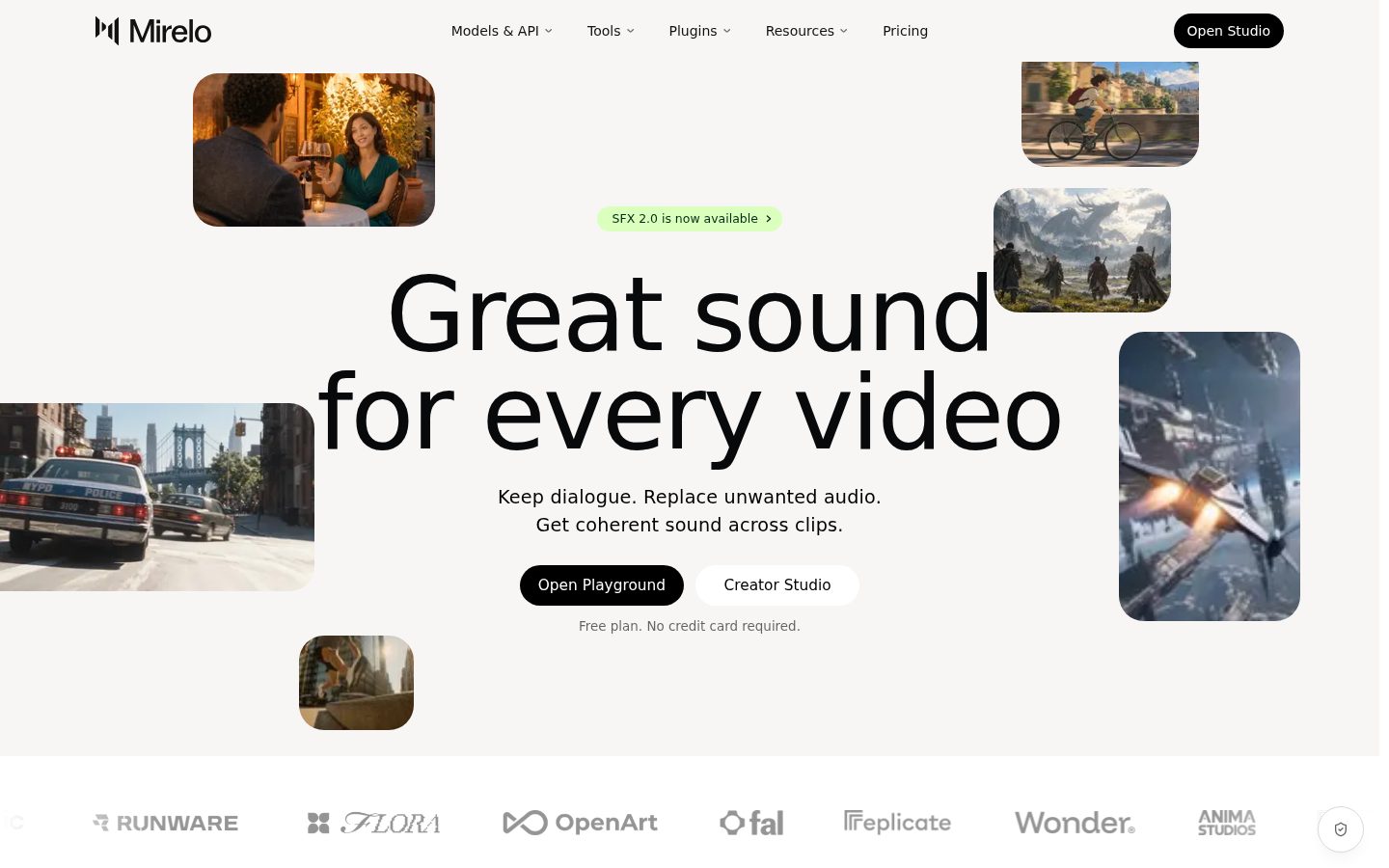
Mirelo is an AI sound generation platform for adding synced sound effects, Foley, and ambience to video.
AI Panel Score
6 AI reviews
Reviewed
Facts checked against mirelo.ai
AI Editor ApprovedApproved and published by our AI Editor-in-Chief after full panel analysis.The core workflow is video-to-sound: a user uploads a video clip into Mirelo Studio or sends it through the API, and the system generates sound effects, Foley, and ambience timed to the on-screen action. Mirelo SFX 2.0 is built to keep dialogue intact while adding synced audio, and to produce consistent sound across multiple clips from the same source. The product also supports iterative editing rather than one-shot generation, described on the site as a step toward letting users refine generated sound after the initial pass, with extend and inpaint endpoints available through the API.
Beyond the core SFX engine, Mirelo offers a set of adjacent tools. Gibberize is a free web tool that converts talking videos into lip-synced gibberish speech. Audio-to-MIDI Pro converts full music mixes into editable MIDI tracks and sheet music, and ships as a VST3/AU plugin for DAWs including Ableton Live, FL Studio, Cubase, Studio One, Bitwig Studio, REAPER, Reason, Logic Pro, and GarageBand. The hosted MCP server lets the sound-generation and editing functionality be called directly from AI coding and chat agents such as Cursor, Claude, and ChatGPT, and Mirelo SFX is also distributed through third-party platforms including Replicate, fal.ai, and Runware.
Mirelo is positioned for video editors, sound designers, and developers who need programmatic or in-app access to synced sound generation. Access is split across a Studio web application for manual workflows, a REST API with v2 and v3 OpenAPI specifications for integration, and editor/DAW plugins for in-app use.
Converts full mixes, MP3s, and songs into editable MIDI tracks and scores, including sheet music and timed lyric transcription.
A free web tool that turns talking videos into lip-synced gibberish speech.
Supports editing and refining already-generated sound rather than only one-shot generation, per the 'iterative editing' blog update.
Generates synced sound effects and ambience conditioned on uploaded video while preserving existing dialogue and keeping sound consistent across clips.
Converts uploaded video directly into matching sound effects, compared against text-to-SFX and native audio-video generation approaches.
A web app workflow for uploading video, generating video-to-SFX output, exporting results, and managing credits.
A VST3 and AU plugin that converts audio into editable MIDI inside DAWs such as Logic Pro, Ableton Live, FL Studio, Cubase, Studio One, Bitwig Studio, REAPER, GarageBand, and Reason.
Adds AI sound effects and music generation inside Adobe Premiere, DaVinci Resolve, and Roblox Studio without leaving the editor.
A hosted MCP server that lets agents like Cursor, Claude, and ChatGPT generate and edit video sound effects directly from those tools.
Provides video-to-sound, generation, extend, and inpaint endpoints documented via OpenAPI v2 and v3 specifications for developer integrations.
Offers how-to guides for API keys, text-to-SFX, video-to-SFX, and plugins, plus machine-readable OpenAPI v2 and v3 specifications for integration.
For your first real projects.
For individual creators.
For small studios.
For large studios or API for platforms.
For very large studios or API usage.
For teams, platforms, or high-volume production workflows. Custom pricing available via Contact Sales.
A narrow, well-built tool for one real problem: making video sound like it belongs.
“Mirelo generates synced sound effects and Foley from video while keeping dialogue intact. Five price tiers and plugin access to Premiere and Resolve make it easy to try and easy to scale.”
Video-to-sound is a specific, hard problem, and Mirelo SFX 2.0 is built for exactly that: generate Foley and ambience conditioned on picture, without touching existing dialogue. That's a real workflow gap for editors, not a repackaged text-to-audio demo.
The pricing ladder is honest. Free gets you 5,000 credits and 3 projects with a watermark. Creator at $17/month unlocks commercial use and 20,000 credits. Scale up to Business at $850/month for over a million credits. That's a transparent, usage-based climb, not a quote-only wall.
The plugin spread is the differentiator: Premiere, DaVinci Resolve, Roblox Studio, plus a hosted MCP server for Cursor and Claude. Few sound tools reach into agent workflows like that. Tradeoff: Gibberize and Audio-to-MIDI Pro are fun side tools but dilute focus on the core SFX engine.
Video-conditioned generation plus MCP agent access is a distinct architecture choice versus generic text-to-SFX tools.
Credit-based model and commercial-use gating are clear, but contract terms at Enterprise tier are custom and unverified here.
Free tier with 5,000 credits and direct Premiere/Resolve plugins mean usable output within a single editing session.
Automates a real post-production task (Foley/SFX) rather than just cutting cost on existing tooling.
Docs, changelog, and OpenAPI v2/v3 specs point to active, structured development.
Video editors and sound designers who need fast, synced Foley without leaving Premiere or Resolve.
Skip it if you need guaranteed fixed costs rather than a credit-metered usage model.
A Foley department built as an API, which is exactly the right shape for where post-production is heading.
“Mirelo treats sound design as a conditioning problem against picture rather than a generic audio generator. The craft ceiling is genuinely in the pipeline, not the demo reel.”
Most AI audio tools generate a clip and hope it lands near the cut. Mirelo conditions on the uploaded video itself, which is the architecturally correct approach for sync-dependent work like footsteps and impacts. The extend and inpaint endpoints matter more than they look: a sound designer's real job is revision, not generation, and one-shot tools from this category rarely survive contact with a real timeline.
The side bets worry me more than the core engine. Gibberize and Audio-to-MIDI Pro are clever, but a nine-DAW plugin lineup is a lot of surface area for a team whose SFX-2.0 model is still the actual product.
That said, shipping Premiere, Resolve, and Roblox Studio plugins alongside a REST API with v2/v3 specs tells me the team understands that sound designers live inside tools, not inside dashboards. That's the right instinct for a 3-year bet.
Positioned against text-to-SFX and native audio-video generation, but the Gibberize and MIDI side products blur the core identity.
Dialogue preservation and in-editor plugins for Premiere and DaVinci Resolve match how sound designers actually cut, not how demo videos are made.
REST API with OpenAPI v2/v3 specs plus a hosted MCP server for Cursor and Claude gives developers and agent-driven pipelines real entry points.
Credit-based pricing from $17 to $850 a month scales with output, but ties a studio's sound budget to a single vendor's model roadmap.
Video-conditioned generation plus extend/inpaint endpoints addresses real revision workflows, not just one-shot novelty.
Sound designers and video editors who want synced Foley generation inside their existing NLE rather than a separate audio app.
Avoid if you need a single-purpose SFX tool and don't want a product roadmap split across MIDI conversion and gibberish-speech side projects.
Credits scale cleanly from $17 to $850. The gap between them is where the math gets interesting.
“Five visible tiers, $17 to $850 monthly, each billed annually at a discount. Overage pricing drops as you climb tiers, which is the sign of an honest usage model, not a bait-and-switch one.”
$17/month gets 20,000 credits, 20 projects. $85/month gets 106,000 credits, unlimited projects. That's a 5x credit jump for 5x the price — flat scaling, no hidden tax for going unlimited. Annual billing saves roughly 0% to nothing obvious ($204/year at Creator is just 12x monthly), so the discount isn't the draw. Overage rates do improve with tier: $1.40/1,000 credits on Free down to $0.89/1,000 at Business. Heavy users get rewarded for committing.
TCO at 50-seat scale isn't the right frame here — this prices by credit volume, not seats. A small studio burning through 106,000 credits monthly on Studio tier ($85) that creeps to 150,000 will eat overage at $0.95/1,000, adding roughly $42/month. Manageable, trackable.
Enterprise is the one blind spot: custom credits, custom terms, no number. Everything below it is priced in public. Procurement won't need a call for anything under $850/month.
Self-serve signup across five priced tiers means no sales call until Business-scale or Enterprise needs arise.
Monthly plans exist alongside annual billing, but I couldn't find cancellation or renewal terms stated anywhere.
Five tiers with exact prices and credit counts are listed; only Enterprise is quote-only.
Credits-per-project and project caps give a usable unit to measure against, though no benchmark for 'credits per clip' is stated.
Credit-based overage from $0.89-$1.40/1,000 is visible, so growth cost is forecastable, not a surprise invoice.
Teams that can estimate monthly credit burn and want a self-serve tier that matches it without a sales call.
Avoid if you need contractual renewal terms spelled out before signing, since I couldn't find any.
Scrubbing a timeline for footstep sync beats typing a text prompt and hoping
“Video-to-SFX conditioning on the actual picture is a different pass than text-to-SFX guessing games. The Premiere and Resolve plugins mean I'm not round-tripping files through a browser tab every time a cut changes.”
Most SFX generators work from a text prompt and a vibe. Mirelo conditions on the uploaded clip itself, which matters the moment a cut shifts three frames and your old generated stem no longer lands on the foot strike. That's a real daily problem in Foley work and it's the one place this tool earns its keep.
The project cap on Free (3 projects, 5,000 credits, watermarked exports) means you're bumping into the ceiling before you've learned the tool's quirks, which pushes the real evaluation onto the $17 Creator tier. Fine for a solo editor, less fine if you wanted a few weeks of unhurried testing first.
Roblox Studio support is an odd inclusion next to Premiere and Resolve, and it tells me the roadmap is being pulled in more than one direction by Gibberize and the Audio-to-MIDI plugin sitting under the same roof. For a sound designer who just wants reliable synced Foley on a deadline, that diffusion is worth watching, not disqualifying.
Video-conditioned sync should hold up better than text-to-SFX once a cut changes, but the Free tier's 3-project cap forces a paid decision before real testing finishes.
OpenAPI v2 and v3 specs plus how-to guides for API keys and plugins read like they were written for someone actually wiring up the integration, not just browsing a features page.
Extend and inpaint endpoints reduce full-regeneration busywork, but a credit unit not tied to seconds of audio makes estimating a session's cost a guessing exercise.
The MCP server for Cursor, Claude, and ChatGPT opens a genuine power-user lane for scripted or agent-driven sound passes most SFX tools don't expose.
Premiere and DaVinci Resolve plugins put generation inside the timeline instead of a separate upload-and-export loop.
A video editor or sound designer doing Foley and ambience passes who wants synced generation without leaving Premiere or Resolve.
Skip it if you need to run a long, unhurried free evaluation before committing to a paid tier.
A tool that's clearly built for people who live inside a timeline, not a chat window.
“Mirelo's plugin-first approach to Premiere and Resolve means the daily workflow feels like it belongs in a studio, not a browser tab. Whether that first hour feels smooth depends on which door you walk in through.”
Start in Mirelo Studio and the first ten minutes feel fine — upload a clip, get SFX back, export, done. Start from the API or MCP server instead, and you're reading OpenAPI v2/v3 specs before you've heard a single sound. That split matters because the product is pitched at both editors and developers, and I couldn't tell from what's public whether either path gets equal onboarding love.
The credit system (5,000/month free, 20,000 at $17) is the kind of thing that feels generous day one and gets watched closely by month three, especially once you're exporting without the watermark and burning real credits on iterative revisions via the extend and inpaint endpoints.
No mobile app that I could find, which is a fair trade for a tool whose actual home is a DAW or an edit bay, not a phone. The plugin surface across Premiere, Resolve, and Roblox Studio suggests a team thinking about where editors actually sit, which is the harder, better call than building a pretty standalone app nobody opens twice.
Plugin integration into Premiere and DaVinci Resolve timelines beats a bolted-on web uploader for daily use.
Iterative editing and extend/inpaint endpoints mean skills built in week one keep paying off by month three instead of hitting a ceiling.
I couldn't find a mobile app; this reads as a deliberate studio/desktop focus rather than neglect.
Studio app looks approachable but the API/MCP path leans on OpenAPI docs, a rougher start for non-developers.
Consistent sound across clips from the same source suggests engineering discipline, though I found no public uptime or error-state detail.
Editors and sound designers who already work inside Premiere, Resolve, or an agent-driven dev workflow and want sound generation without leaving it.
Avoid if you need a mobile-first or no-code onboarding experience with minimal setup.
Credits, not seconds. Read the fine print before you build a budget.
“Mirelo's five public tiers from $17 to $850 a month look transparent until you realize the unit of sale is a credit with no stated conversion to seconds of audio. The video-to-SFX pitch is specific and plausible — the pricing model underneath it isn't.”
Video-conditioned Foley that preserves dialogue is a real, narrow claim. Not 'revolutionize your workflow.' That's the kind of specificity that tends to survive contact with actual use, unlike vaguer sound-generation pitches I've seen promise 'cinematic audio in one click' and quietly fold.
What worries me is the credit system. $17 gets you 20,000 credits and 20 projects at Creator tier, $850 gets you 1.13 million at Business. Fine on paper. But nothing ties a credit to a second of output, so you can't actually price out a real project before running it. Overage math (down to $0.89/1,000 at the top) only matters once you know the burn rate, and I can't see it.
Exit story is the open question. API and MCP access mean your integration isn't locked to a GUI, that's good. But credit-based pricing without a usage calculator is the kind of thing that looks generous until month two.
Video-to-SFX conditioning versus text-to-SFX is a real architectural distinction, not just a rebrand of the same approach.
REST API and MCP access reduce lock-in, but credits don't map to a portable unit like seconds, which muddies any migration cost comparison.
A changelog, blog, and dual OpenAPI versions point to active maintenance, though I couldn't confirm team size or funding.
The H1 is plain ('Great sound for every video') and the dialogue-preservation claim is specific, not superlative.
Named extend/inpaint endpoints and OpenAPI v2/v3 specs back the iterative-editing claim with real surface area, not just a promise.
Developers and studios comfortable integrating via API or MCP who can tolerate estimating credit usage empirically.
Avoid if you need to lock in a precise per-minute cost before committing budget.
Common questions answered by our AI research team
Mirelo generates sound effects, Foley, and ambience conditioned on uploaded video, including things like footsteps, impacts, and environmental sound that sync to picture.
Yes. Mirelo syncs generated sound to picture while preserving existing dialogue already present in the video.
Mirelo offers editor plugins for Adobe Premiere and DaVinci Resolve, plus a plugin for Roblox Studio.
Yes. Mirelo offers a hosted MCP server that lets agents like Cursor, Claude, and ChatGPT use it, in addition to a REST API.
The Enterprise plan includes custom credits each month, custom credits and volume pricing, unlimited projects, access to the latest Mirelo audio models, commercial use, custom API terms, and dedicated support.


Mirelo.ai is a developer of AI tools that generate sound effects and music for video content automatically.