Norm Ai logo

Norm Ai Review

Visit

Embedding law into AI agents for regulated industries

Norm Ai is an agentic law platform that embeds legal and compliance rules into AI agents for regulated institutions.

Norm AI·Founded 2023·Contact for pricingAI LegalAI Agents & AssistantsAI Compliance

AI Panel Score

6.8/10

6 AI reviews

Reviewed

AI Editor Approved

About Norm Ai

Norm Ai's core workflow centers on translating legal and regulatory text into machine-readable logic that AI agents can apply directly to compliance and legal tasks. Rather than using AI to summarize or search legal documents, the system embeds the substance of the law into agents so they can execute compliance checks, flag violations, or verify that other AI systems are operating within legal bounds. This process is carried out by what Norm Ai calls Legal Engineers, non-practicing attorneys who convert legal judgment into AI system logic.

The product is organized into three components. Norm Law is Norm Ai's affiliated law firm, described as the first fully AI-native law firm for global institutional clients, where legal work is practiced and simultaneously encoded into the system. Norm Technology refers to the AI agents themselves, built by domain experts for specific legal and compliance functions. Supervisory AI acts as a verification layer sitting above other AI agents, checking their actions and outputs against the embedded legal rules before those actions take effect. Norm Ai also participates in policy efforts, including a proposal with Delaware's Secretary of State to create a new legal entity type for AI agents, tested in a regulatory sandbox.

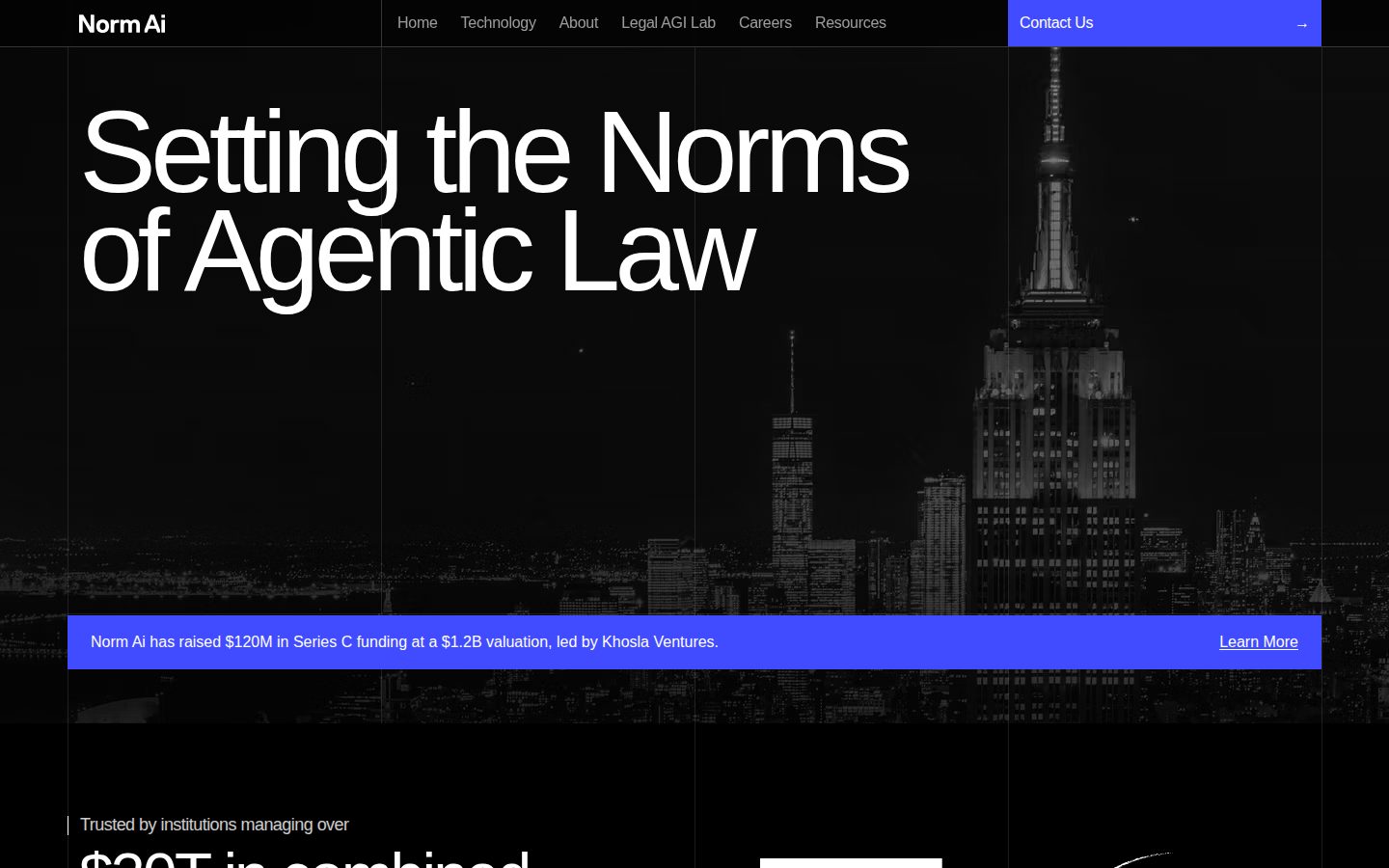
Norm Ai is built for large regulated institutions, including financial services firms, asset managers, and other organizations subject to compliance and legal oversight. The website states it is trusted by institutions managing over $30 trillion in combined assets, with investors including Vanguard, Blackstone, Bain Capital, Citi, and TIAA. Pricing is not published and is handled through direct sales contact. Norm Ai competes in an emerging category of legal and compliance AI tools, alongside vendors focused on AI-driven regulatory and legal automation for enterprise and institutional clients.

Features

AI

  • LEAP Agent Platform

    Norm Ai's LEAP platform lets legal and compliance teams build, evaluate, and deploy specialized AI agents for regulatory and firm-specific workflows.

  • Precedent-Based Determinations

    The platform applies firm-specific precedent and historical decisions to guide current determinations and keep positions consistent over time.

Analytics

  • Citation Mapping to Regulations

    Determinations are mapped directly to governing regulations and firm policies, creating structured citation trails for every decision.

  • Confidence Scoring & Recalibration

    Norm Ai quantifies reliability across determinations, governing execution thresholds and continuously recalibrating standards.

  • Explainable Decision Trails

    The platform generates transparent decision trails with mapped citations, explainability, and exportable governance records.

Automation

  • Real-Time Risk Monitoring

    Agents monitor high-volume interactions for low-latency automated interventions when potential compliance violations are detected.

Collaboration

  • Human-in-the-Loop Escalation

    Edge cases and low-certainty determinations are routed for human escalation based on configurable thresholds and risk signals.

  • Team Collaboration & Tagging

    Users can tag each other, comment, and view historical decisions, turning Norm into a system of record that centralizes compliance team collaboration.

Core

  • Regulatory Knowledge Encoding

    The platform autonomously processes regulatory documents into executable, computer-readable code so agents can apply rules consistently across workflows.

Customization

  • Legal Engineer-Built Agents

    Legal Engineers with legal training encode intricate regulations into AI agents so they understand and can act on complex rules.

Integration

  • Microsoft 365 Copilot Compliance Agent

    Norm Ai offers a compliance agent for Microsoft 365 Copilot that brings compliance review, policy intelligence, verification, and auditability into everyday enterprise workflows.

Security

  • Audit-Ready Record Keeping

    The system automatically organizes, logs, and stores decisions and supporting materials in audit-ready formats for compliance reviews.

Preview

Norm Ai desktop previewNorm Ai mobile preview

Pricing Plans

Contact Sales

Contact sales

Norm Ai serves institutions managing over $30T in combined assets with agentic law solutions, including Norm Law, Norm Technology, and Supervisory AI. No public pricing is listed; enterprises must contact the company for pricing and implementation details.

  • Norm Law - AI-native law firm services
  • Norm Technology - AI agents built by domain experts
  • Supervisory AI - verification layer for AI agents
  • Legal Engineering discipline for translating legal judgment into AI systems
  • Backed by institutional investors including Blackstone, Vanguard, Citi, TIAA

AI Panel Reviews

The Decision Maker

The Decision Maker

Strategic bet, vendor viability, timing, adoption approval
7.6/10

Compliance AI with real institutional backing, but pricing opacity and no track record on Delaware sandbox bets.

Norm Ai turns regulation into machine logic instead of just searching it. Blackstone, Vanguard, and Citi money buys credibility, but the model is unproven at scale.

$30 trillion in combined client assets. That's not a demo number, that's a board-level signal. Investors like Blackstone and TIAA don't write checks into vaporware, and the Microsoft 365 Copilot compliance agent shows real product integration, not just a pitch deck.

Two things give me pause. One: no published pricing means every deal is a negotiation, and that's fine for a $30T client, less fine if you're mid-market. Two: Legal Engineers encoding law into agent logic is a genuinely new discipline, competing loosely against Harvey and Ironclad, but nobody's run this through a decade of regulatory cycles yet.

The Delaware sandbox work on AI-agent entity types is smart positioning, not proven infrastructure. This is a category-definer if it works, and regulated institutions are exactly where legal risk kills fast. Pilot it in one compliance function before betting the whole audit trail on it.

Competitive Positioning7.6

Ahead of generic legal search tools like Harvey on execution depth, but the category itself is still forming.

Reputation Risk7.5

Institutional investor roster makes adoption defensible, but an unproven AI law firm model still raises board eyebrows.

Speed to Value6.8

No pricing page or self-serve trial means a long enterprise sales cycle before any measurable payback.

Strategic Fit8.0

Embeds law into agent logic rather than summarizing it, a genuine capability shift for compliance-heavy institutions.

Vendor Viability7.8

Backed by Blackstone, Vanguard, Citi, TIAA per the evidence, but time-in-market and team size aren't disclosed.

Pros

  • $30T in combined client AUM signals real institutional adoption
  • Supervisory AI adds a verification layer most legal AI tools lack
  • Microsoft 365 Copilot integration fits existing enterprise workflows

Cons

  • No published pricing forces a slow, opaque sales process
  • Delaware sandbox work is policy experimentation, not proven scale
  • Legal Engineer model is unproven against a full regulatory cycle

Right for

Large regulated institutions with dedicated compliance budgets and appetite for a new legal-AI category.

Avoid if

You need transparent pricing or a fast self-serve pilot before committing budget.

The Domain Strategist

The Domain Strategist

Craft and strategy in the product's domain — adapts identity per category, same lens
7.6/10

Serious infrastructure for regulatory risk, but the affiliated-law-firm structure needs its own diligence memo.

Norm Ai encodes regulatory text into executable agent logic with a supervisory verification layer on top. That's the right architecture for regulated institutions, but the Norm Law affiliation and opaque pricing demand a hard look before signature.

Encoding regulations into executable logic, then layering Supervisory AI to check other agents against that logic, is the correct shape for compliance work. It mirrors how I actually think about risk: rules first, execution second, audit trail always. The Legal Engineer role — non-practicing attorneys translating judgment into code — is a sound answer to the 'who's accountable for the encoding' question I'd otherwise ask in diligence.

My real concern is structural. Norm Law is an affiliated law firm co-located with the vendor building the software that automates its own work product. I'd want a clean memo on privilege, conflicts, and malpractice exposure before this touches anything client-facing — that's not a feature gap, it's a governance question with no public answer here.

Three years in, if the Delaware AI-entity sandbox proposal matures, early adopters gain regulatory standing competitors like traditional GRC vendors won't have. If it stalls, you're locked into a no-pricing-page, contact-sales vendor with $30T in claimed institutional AUM backing it but no published SLA.

Category Positioning8.0

Investor backing from Citi, Vanguard, Blackstone, and TIAA signals institutional trust ahead of most GRC-adjacent competitors.

Domain Fit7.5

Human-in-the-loop escalation and audit-ready record keeping match how compliance teams actually need sign-off documented.

Integration Surface7.5

Microsoft 365 Copilot compliance agent is a genuine integration point into workflows lawyers already use daily.

Long-term Implications7.0

Delaware sandbox involvement is forward-looking, but the Norm Law affiliation creates an unresolved conflicts question I'd flag in any MSA review.

Strategic Depth8.0

Confidence scoring, citation mapping, and a dedicated verification layer show real regulatory craft, not a chatbot wrapper.

Pros

  • Supervisory AI layer gives an independent check on agent outputs, not just self-attestation
  • Explainable decision trails with citation mapping support real audit defense
  • Backed by institutional capital and clients managing $30T+ in assets

Cons

  • No public pricing — every deal starts as a custom enterprise negotiation
  • Affiliated law firm structure raises conflicts and privilege questions with no public resolution
  • No free trial, so evaluation depends entirely on vendor-run demos

Right for

Large regulated institutions with in-house compliance counsel ready to negotiate a custom enterprise contract.

Avoid if

Avoid if your general counsel needs clean separation between the law firm advising you and the vendor building your compliance software.

The Finance Lead

The Finance Lead

Money, total cost of ownership, contracts, procurement math
5.8/10

Zero published pricing. $30 trillion in client AUM. No sticker for anyone else.

Contact-sales only, no tiers, no published rate card. Procurement gets nothing to model until legal signs an NDA.

No pricing page. One plan: Contact Sales. That's the whole rate card.

Compare to Harvey, the other AI-native legal platform courting enterprise — also sales-gated, also no sticker. Norm Ai adds Norm Law, an affiliated law firm, plus Supervisory AI as a verification layer. Three components, one invoice, unknown blend. At $30T in client AUM, this isn't a self-serve SMB tool — it's built for firms that RFP everything anyway. Legal Engineers encoding regulations by hand suggests a services-heavy cost structure, not a flat seat price.

Confidence scoring and citation mapping give you something to point to for ROI — audit trails, explainability, exportable governance records. That's real. But without published tiers or overage terms, year-3 TCO is a guess. Budget for a negotiation, not a quote.

Billing & Procurement5.0

Sales-led onboarding with $30T AUM client base suggests long procurement cycles typical of enterprise compliance software.

Contract Flexibility5.0

No published term length or renewal terms — category norm for enterprise legal AI is annual with negotiation room.

Pricing Transparency2.0

Single 'Contact Sales' plan, no published rate — pricing-page=N per the scrape.

ROI Clarity6.5

Confidence scoring and citation mapping give auditable outputs, a real measurement hook most legal AI lacks.

Total Cost of Ownership4.5

Legal Engineers, Norm Law services, and Supervisory AI likely bundle into a custom enterprise fee with no visible floor.

Pros

  • Confidence scoring and citation mapping give auditable, measurable outputs
  • Backed by Vanguard, Blackstone, Citi, TIAA — institutional credibility for procurement
  • Human-in-the-loop escalation limits blind-automation risk

Cons

  • No published pricing anywhere — zero tiers, zero rate card
  • Legal Engineer-built agents suggest heavy services cost baked into contracts
  • No public term length, renewal, or cancellation terms

Right for

Large regulated institutions with existing enterprise procurement teams and budget for custom contracts.

Avoid if

You need a comparable rate card before your first sales call.

The Domain Practitioner

The Domain Practitioner

Daily hands-on reality in the product's domain — adapts identity per category, same lens
7.1/10

Citation mapping and audit trails look great in the demo. No docs page tells me how to actually work in it day-to-day.

Norm Ai builds compliance logic straight into agents instead of just summarizing regs, which is a real architectural difference from tools like Harvey. But with no published docs, no API, and no pricing page, I can't tell what my Tuesday actually looks like.

Citation Mapping and Explainable Decision Trails are the features I'd actually live in — every determination tied back to a regulation, exportable for audit season. That's the right instinct for compliance work where you need a paper trail, not just an answer.

But the site shows docs=N, API=N, blog=N. No public walkthrough of the LEAP platform, no sandbox to poke at tagging or escalation thresholds before a six-figure sales call. Human-in-the-Loop Escalation sounds right for edge cases, but I can't see the configuration screen or judge how much tuning a compliance team needs before thresholds are trustworthy.

Contrast with Harvey or Thomson Reuters CoCounsel, both of which at least let you trial workflows. Norm Ai's pitch — $30T in assets under client management, Legal Engineers instead of prompt engineers — is impressive on paper. Whether tagging a colleague on a flagged determination feels like Slack or feels like fighting a legacy GRC tool, nobody outside a pilot institution actually knows yet.

Day-3 Reality6.0

No trial or sandbox exists, so day-3 friction is unverifiable from public evidence.

Documentation Practitioner-Fit5.0

Site shows docs=N and no changelog, leaving practitioners with marketing copy only.

Friction Surface6.5

Confidence Scoring and escalation thresholds imply configuration overhead before a team trusts outputs.

Power-User Depth7.8

Legal Engineer-built agents and Supervisory AI layer suggest real depth beyond basic document search.

Workflow Integration7.5

Microsoft 365 Copilot compliance agent suggests real integration into existing enterprise workflows.

Pros

  • Citation Mapping ties every determination to a specific regulation, useful for audit prep
  • Supervisory AI adds a verification layer over other agents, not just one-shot outputs
  • Backed by institutional-scale clients (Vanguard, Citi, TIAA) signals enterprise-grade rigor

Cons

  • No docs, API, or pricing page — impossible to evaluate hands-on before a sales call
  • No free trial, so day-3 friction is entirely a guess
  • Norm Law's AI-native law firm structure raises questions about ethics-wall and privilege handling not addressed publicly

Right for

Large compliance teams at regulated institutions who can commit to a sales cycle and pilot before seeing the product.

Avoid if

You want to test drive a compliance workflow before your Legal Engineer counterpart signs a six-figure contract.

The Power User

The Power User

Daily human experience, onboarding, polish, learning curve, reliability
6.3/10

No pricing page, no docs, no trial — just a sales call and a $30 trillion flex.

Norm Ai's actual product might be sharp, but there's nothing here to test-drive it. Everything about the buying experience says enterprise procurement, not day-to-day tool.

Look, I can't tell you what this feels like on day three because there's no way in short of a sales call. No docs, no API reference, no pricing page, no free trial. That's normal for enterprise legal tools selling to banks managing $30 trillion combined, but it means the everyday-use question I usually answer is basically unanswerable from outside.

The feature list reads well on paper: confidence scoring, citation mapping, human-in-the-loop escalation, a Microsoft 365 Copilot compliance agent so it lives where compliance teams already work. Team tagging and comment threads suggest someone thought about the collaboration layer, not just the AI trick.

But 'Legal Engineers' encoding regulations by hand is a slow, expensive onboarding model dressed up in fancy language, and that's the real learning curve here — it's the vendor's, not yours. Compared to something like Harvey, which at least publishes some product texture, Norm Ai's whole front door is a contact form.

Daily Polish5.5

Feature set (audit trails, confidence scoring) sounds thoughtful but no public UI evidence to judge micro-details.

Learning Curve6.0

Legal Engineer-built agents mean heavy setup lift, though Human-in-the-Loop escalation should ease adoption for compliance teams.

Mobile Parity3.0

Platform listed as web-only; category norm for enterprise compliance tools, but still a gap.

Onboarding Experience4.0

No docs, no trial, no pricing page — onboarding is a sales call, full stop.

Reliability Feel6.5

Explainable decision trails and citation mapping suggest real engineering, but nothing public to verify uptime or error handling.

Pros

  • Microsoft 365 Copilot integration puts compliance checks in existing workflows
  • Backed by Vanguard, Blackstone, Citi, TIAA — serious institutional credibility
  • Supervisory AI layer adds a verification step most competitors skip

Cons

  • Zero public pricing, docs, or trial to evaluate before a sales call
  • Legal Engineer model means onboarding is bespoke and likely slow
  • No mobile presence at all

Right for

Large regulated institutions like asset managers or banks with budget for a direct sales relationship.

Avoid if

You want to try before you buy or need something a small compliance team can self-serve.

The Skeptic

The Skeptic

Contrarian. Watch-outs, deal-breakers, broken promises, category patterns
6.4/10

$30 trillion in assets under management, zero dollars on the pricing page.

Norm Ai bundles a law firm, an AI vendor, and a verification layer into one pitch. That's either a moat or a conflict-of-interest question nobody's asked yet.

Norm Law being both practitioner and encoder of the rules it sells you is a structure I haven't seen work cleanly anywhere else — Big Four tried something similar with audit and consulting, got split up by regulators. Maybe this is different. Maybe not.

The $30T-in-assets number moved to $35T in the buyer Q&A. Small thing. Worth noting when 'trusted by' is the entire trust signal, since there's no pricing page, no docs, no changelog, no case study with a name attached.

Competes loosely with Harvey and Eve on the legal-AI side, but Norm's Supervisory AI angle — policing other agents — is a real wedge, not a copycat feature. Investors like Blackstone and Citi are strategic buyers as much as backers, which cuts both ways. No public churn signal either way.

Competitive Differentiation7.5

Supervisory AI checking other agents is a genuine gap versus Harvey or Eve, which stay in drafting/research lanes.

Exit Portability4.5

No docs, no API listed publicly; encoded rules and decision trails likely locked into their format.

Long-term Viability7.0

Vanguard, Blackstone, Citi, TIAA as investors signals real capital; no funding round size or headcount disclosed.

Marketing Honesty6.0

'First fully AI-native law firm' is the kind of superlative that ages poorly; asset figure shifted between site and Q&A.

Track Record Match6.5

Legal-engineer-as-translator model echoes early Harvey positioning; unproven at scale beyond named logos.

Pros

  • Named backers (Blackstone, Citi, TIAA) suggest serious institutional vetting
  • Supervisory AI verification layer is a real differentiator, not a rebrand of search-and-summarize
  • Microsoft 365 Copilot compliance agent shows actual enterprise integration, not just a demo

Cons

  • No pricing page, docs, or changelog to verify claims independently
  • Asset-under-management figure inconsistent across the site's own materials
  • Law firm + rule-encoder + verifier under one roof raises unaddressed conflict questions

Right for

Large regulated institutions with budget for direct-sales enterprise contracts and no urgency to see public pricing first.

Avoid if

You need self-serve pricing, public docs, or a clean exit path before committing.

Buyer Questions

Common questions answered by our AI research team

Features

What are the three core components of Norm Ai?

Norm Ai operates across three connected functions: Norm Law, an affiliated law firm where legal rules are practiced and encoded; Norm Technology, AI agents built by domain experts; and Supervisory AI, the verification layer for every AI agent.

Features

What does Supervisory AI actually check?

Supervisory AI checks the outputs of other AI agents against encoded legal and regulatory rules, acting as the verification layer for every AI agent Norm Ai builds.

Security

Who verifies the AI agents' legal outputs?

Supervisory AI verifies AI agent outputs, working alongside Norm Law, where legal rules are practiced and encoded by attorneys and Legal Engineers who translate legal judgment into AI systems.

Features

What is Norm Law and how does it relate to Norm Ai?

Norm Law is Norm Ai's affiliated law firm, described as the world's first fully AI-native law firm for global institutional clients, where law is practiced and encoded for use in Norm Ai's AI agents.

Integration

What kind of institutions currently use Norm Ai?

Norm Ai is trusted by institutions managing over $35 trillion in combined assets, and has been backed by financial and institutional investors including Vanguard, Blackstone, Bain Capital, Citi, and TIAA.

Product Information

  • Company

    Norm AI
  • Founded

    2023
  • Pricing

    Contact for pricing

Platforms

web

About Norm AI

Norm AI, based in New York, builds AI software that embeds legal reasoning into AI agents to automate compliance and legal tasks.

Also in AI Legal