All-in-one AI studio for images, video, and consistent characters
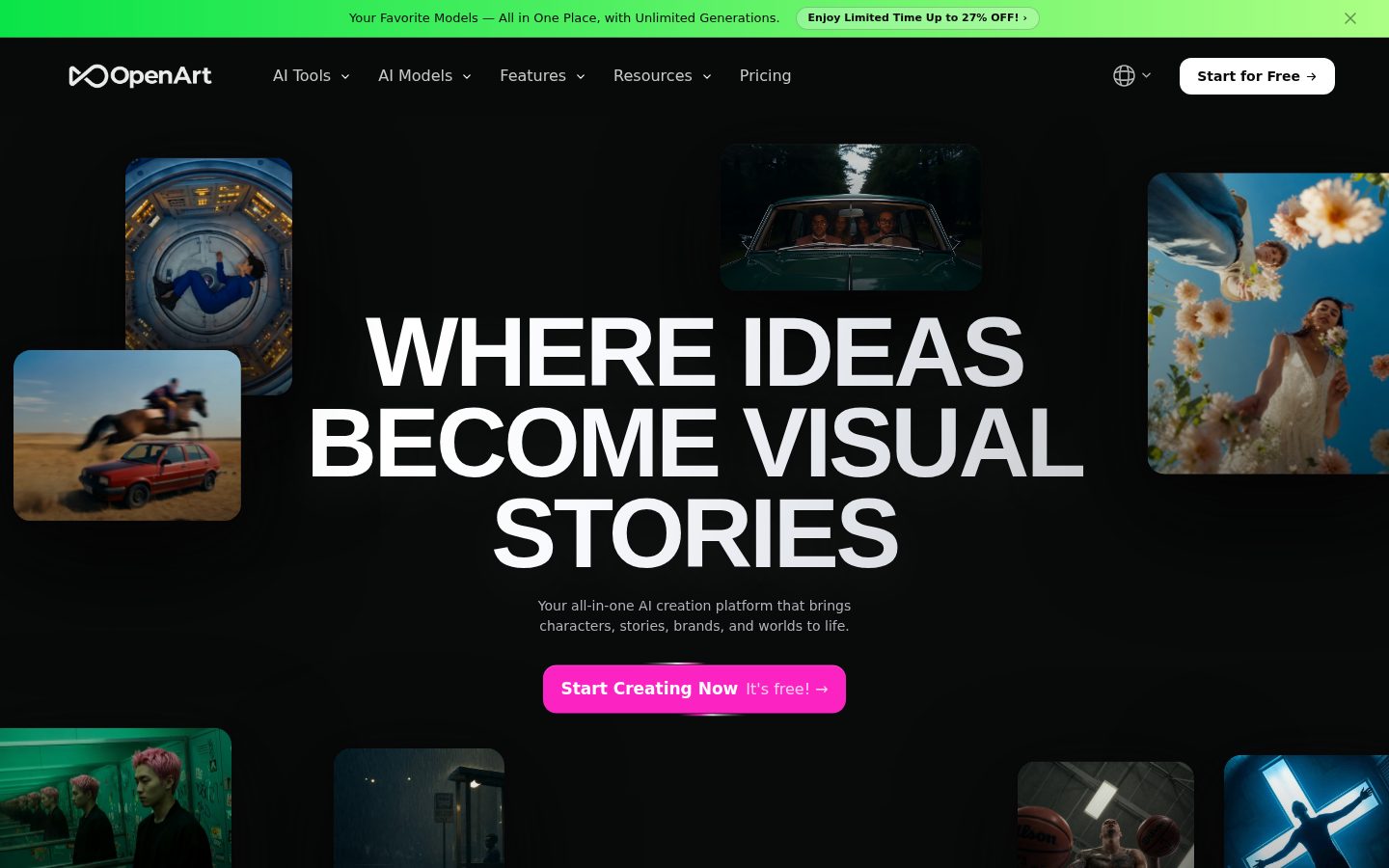
OpenArt is an AI creative platform for generating images, videos, audio, and consistent characters from text and reference images.
AI Panel Score
6 AI reviews
Reviewed
AI Editor ApprovedApproved and published by our AI Editor-in-Chief after full panel analysis.OpenArt is an all-in-one AI creation platform for generating images, videos, audio, and consistent characters from text or reference images. It is built for content creators, marketers, filmmakers, and social media teams who want studio-grade visuals without editing software. New users get 40 free trial credits to test it, and paid subscriptions start at $14 per month for the Essential plan, scaling to Advanced at $29, the popular Infinite at $56, and Wonder at $240 for high-volume work. Core capabilities include the Director storyboard tool for multi-shot video, a Character Builder that keeps characters consistent across scenes, One-Click Story Creation, an in-canvas Image Editing Suite, AI voiceover and music, and OpenArt MCP for generating from Claude, ChatGPT, and Cursor. It draws on 100+ models such as Sora 2, Kling, Veo 3, and Nano Banana 2. OpenArt fits creators comparing Midjourney, Leonardo AI, and Runway for combined image and video work.
OpenArt starts from a text prompt or a reference image and turns it into finished visuals inside one browser workspace. You generate images, animate them into video, edit on an in-canvas board, and layer in voiceover, music, and sound effects without switching tools. The Director view lets you lay out a multi-shot storyboard, refine individual shots, and keep audio and lip-sync in step across the sequence.
The platform routes every request across 100+ models, including Sora 2, Kling, Veo 3, and Seedance for video and Nano Banana 2 and GPT Image 2 for stills. A Character Builder locks a character's face and style so it stays consistent across scenes, One-Click Story Creation drafts an entire narrative from a single idea, and Personalized Models let you train the platform on your own subjects. Smart Shot, Motion Sync Video, Camera Angle Control, and 4K upscaling handle finer cinematic edits.
OpenArt suits creators, marketers, and small studios producing short films, UGC ads, music videos, and social content. It sells on monthly subscriptions from $14 (Essential) to $240 (Wonder), with commercial-use rights from the Advanced tier and 40 free trial credits to start. Creators typically weigh it against Midjourney, Leonardo AI, Adobe Firefly, and Runway, with OpenArt's pitch being image, video, character, and audio work in a single account.
For automation, OpenArt MCP connects the same generation engine to Claude, ChatGPT, and Cursor, so agents can create images, run image-to-video workflows, and pull from your asset library through one connection.
Generate voiceovers in 30+ languages, original music, and sound effects, including voice cloning.
Generate a full multi-scene story from a single idea or prompt in one step.
Create characters that stay visually consistent across every image and video in a project.
Train custom models on your own subjects or style for repeatable, on-brand outputs.
Reframe and rotate shots with camera angle sliders while preserving continuity.
Erase, expand, swap backgrounds, and restyle images directly on an in-canvas board.
Upscale generated images and video to 4K resolution.
Generate images and run image-to-video workflows from Claude, ChatGPT, and Cursor through one connection.
Retarget motion from a reference video onto your generated character or subject.
Auto-generate multi-angle cinematic cuts from a single scene.
Produce clips up to 15 seconds at 4K using models like Sora 2, Kling, Veo 3, and Seedance.
Storyboard multi-shot videos, refine individual shots, and keep audio and lip-sync aligned across the sequence.
For individuals starting out with AI image and video creation.
For creators who need higher volume, more control, and commercial rights.
For professional creators who want full-speed, uninterrupted creation.
For power users and teams producing at the highest volume.
OpenArt bundles image, video, and voice generation into one $14 login, but owns none of its models.
“OpenArt consolidates a full creative stack — image, video, character, and audio — into one subscription starting at $14, backed by a fresh $30M Series A. The strategic risk is that its models come from OpenAI, Google, and Kuaishou, making orchestration its only real moat.”
Most teams already pay for a video generator, an image tool, and a voiceover app on three separate cards. OpenArt folds all of it into one login that starts at $14 a month.
The vendor math looks sound. Founded 2022 by two ex-Google engineers, with a $30M Series A led by Canaan Partners this January. That's a defensible 36-month bet on a fast-moving vendor, though the category resets every quarter.
The catch is dependency: OpenArt routes to Sora 2, Veo 3, and Kling rather than owning models, so its edge is orchestration, not research. Against Runway, which owns its stack, that's a real strategic question. Pilot Character Builder and Director on the $29 Advanced tier for a quarter before you standardize.
Breadth beats single-purpose rivals like Runway, though it owns none of its models.
Commercial-use rights from the Advanced tier help, but consumer-grade branding and model dependency add risk.
Browser app, 40 free credits, and One-Click Story Creation produce output almost immediately.
Consolidates image, video, audio, and character work into one workspace for lean teams.
A $30M Series A led by Canaan Partners and ex-Google founders signal solid runway.
Lean creative teams who want one account instead of four separate AI subscriptions.
Enterprises who need vendor-owned models and signed SLAs.
OpenArt's Character Builder gives brand teams a real consistency library, but leans on models it doesn't own.
“For a creative director, OpenArt's strength is consistency at scale: named characters, trained Personalized Models, and Director-sequenced storyboards under one roof. The strategic caveat is that its output quality lives or dies with third-party models like Sora 2 and Veo 3.”
Character Builder holds up to 353 consistent characters on the top tier and 40 on Advanced. In a category where Midjourney still fights face drift shot to shot, that's a brand-asset library, not a party trick.
The craft ceiling is real. Personalized Models let you train on your own subjects, and Director sequences multi-shot storyboards with audio and lip-sync in step — that's editorial control most single-image tools never reach. Someone who has run a real production pipeline designed this.
However, the strategic exposure sits in the model layer. OpenArt's quality tracks Sora 2, Veo 3, and Nano Banana 2, so your house style is only as durable as third-party APIs it doesn't control. Against Adobe Firefly's owned, indemnified model, that's the long-term bet you're making.
Breadth positions it between Midjourney's stills and Runway's video.
Consistency and multi-shot control are exactly what creative teams lack in single-purpose tools.
OpenArt MCP wires generation into Claude, ChatGPT, and Cursor through one connection.
Output quality is hostage to the roadmaps of third-party models like Sora 2 and Veo 3.
Director, Character Builder, and Personalized Models form a genuine production pipeline, not a demo.
Creative directors who need one character to stay on-model across scenes.
Brand teams who require an owned, legally indemnified generation model.
OpenArt spans $14 to $240 a month, but credit burn makes the real invoice hard to predict.
“Sticker pricing is transparent across four tiers from $14 to $240, with commercial rights landing at $29. The unpredictable variable is credit consumption, which shifts per model and has no published per-generation rate.”
Forty free trial credits get you in the door. They won't get you a finished video. Real evaluation starts at $14 a month for 4,000 credits — roughly 50 videos on Essential.
The math scales on volume, not seats. A small studio on Advanced pays $29 for 12,000 credits, about 150 videos, plus commercial rights. Push to daily output and Infinite at $56 or Wonder at $240 for 106,000 credits is where heavy users land. Year one on Advanced runs $348.
The catch is the credit itself. Every model burns a different rate, and there's no published per-generation price, so the invoice moves with your prompt mix. Nano Banana 2 Lite Unlimited on Infinite caps one line item; the rest float. Against Runway's clearer per-second billing, procurement gets less to forecast.
Self-serve tiers clear procurement, though overage rates aren't published.
Month-to-month subscriptions with add-on credits and no visible annual lock-in.
Four tiers show prices and credit counts with no sales call required.
Credit-to-video estimates help, but real cost depends on prompt mix.
Credit burn varies by model, making year-three spend hard to model.
Studios who can forecast their monthly output volume.
Finance teams who need a fixed, predictable per-generation cost.
OpenArt gives designers slider-based camera control and an in-canvas editor, but stops short of pixel-final precision.
“OpenArt earns its keep for designers with slider-driven Camera Angle Control, an in-canvas Image Editing Suite, and up to 32 parallel generations. It trades away layer-level precision and caps video at 15 seconds, so it's a storyboard-and-ship tool, not a pixel-final editor.”
Camera Angle Control ships as sliders, not another round of prompt roulette. For a designer, reframing a shot by dragging instead of re-describing it is the difference between control and gambling. The Image Editing Suite keeps erase, expand, and background-swap on one in-canvas board, which is where the day-to-day happens.
Throughput holds up — 8 parallel generations on Essential, 32 on Infinite, so you're not queued behind your own renders. Smart Shot auto-cuts angles from one scene, and Motion Sync retargets motion from a reference clip onto your subject. That's depth Leonardo AI doesn't try to match.
The friction is the ceiling on precision. Video caps at 15 seconds, exports finish at 4K, and there's no layer stack or vector control — restyle happens to a whole image, not a selected path. However, for storyboard-to-social output rather than pixel-final art, that's a fair trade against a dedicated editor like Krea.
Slider controls and in-canvas editing hold up well past the demo.
Feature depth is clear, though deep practitioner docs aren't evidenced.
The 15-second cap and missing layer stack limit precise work.
Smart Shot, Motion Sync, and 32 parallel generations reward heavy use.
One board covers generate, edit, and animate without tool-switching.
Designers who storyboard and ship social video fast.
Illustrators who need layer stacks and vector precision.
OpenArt crams images, video, and voice into one tab, but the credits and missing mobile app sting.
“OpenArt's real appeal is doing image, video, character, and voice work in one browser tab instead of juggling four apps. The daily friction is a credit meter that drains fast and no proper mobile app to match Canva.”
Most AI tools make you pick a lane — images, or video, or voiceover. OpenArt does all of it in one browser tab, and that changes how a creative afternoon feels. One-Click Story Creation is the flashy front door; you type an idea and get a multi-scene draft back.
Day one, the demo glow carries you. The real test is day thirty, and the credit system is the quiet mood-killer — 40 free credits vanish fast, and heavy sessions eat your monthly 4,000 before you notice. Director and Character Builder are the parts you'd keep coming back for.
The catch is there's no real mobile app — it's a browser on any device, which on a phone means pinching around a laptop-sized canvas. Next to Canva's mobile flow, that's a gap if you create on the go. On desktop, though, it feels built by people who actually make things.
The one-tab workflow across media feels genuinely cohesive.
Templates ease entry, but the full toolset takes time to master.
No dedicated app, just a browser that's awkward on a phone.
One-Click Story Creation and 40 free credits get you moving fast.
Parallel generations suggest stability, though model routing adds variance.
Solo creators who want one tab for everything visual.
People who create mostly from their phone.
OpenArt owns none of its 100+ models, but a $30M Series A buys real staying power.
“OpenArt is a well-funded router over other companies' models, which makes orchestration its moat rather than the models themselves. The fundamentals are solid — a $30M Series A and ex-Google founders — but exit and model dependency are the things to watch.”
OpenArt doesn't own a single model it sells. Sora belongs to OpenAI. Veo to Google. Kling to Kuaishou. It's a router with a good interface, and the '100+ models' headline is '100+ other people's models.'
That's not fatal, and the fundamentals are stronger than the pitch. Founded 2022, a $30M Series A led by Canaan Partners this January, ex-Google founders. The Character Builder and Personalized Models are things they actually built, not just resold. Higgsfield is chasing the same space.
The watch item is exit. Your trained characters live inside OpenArt, and if a model provider pulls access — the way it shifts in this category — your house style can move without warning. Leonardo AI got absorbed by Canva; consolidation is the pattern. The catch: you're renting the engine, so decide whether the interface alone is worth the lock-in.
Orchestration and Character Builder differentiate, but wrappers are many.
Trained characters and library are locked inside OpenArt.
A $30M Series A and ex-Google founders signal staying power.
The '100+ models' claim is real but glosses over that none are owned.
Features match the pitch, and a $30M raise backs the claims.
Skeptical buyers who value one polished interface over owned models.
Teams who need portable output and provider-independent generation.
Common questions answered by our AI research team
OpenArt runs on paid subscriptions: Essential is $14/month for 4,000 credits, Advanced $29, Infinite $56 (the most popular tier), and Wonder $240 for 106,000 credits. New users get 40 free trial credits, plus 50 more for joining the Discord.
Yes. The Character Builder locks a character's face and style so it stays consistent across images and videos. Essential covers about 13 consistent characters, Advanced 40, and Infinite 80, so you can reuse the same character throughout a story.
Yes. OpenArt MCP connects your account to Claude, ChatGPT, and Cursor, letting you generate images and run image-to-video workflows without leaving the chat. It exposes the full model catalog and your creative library through one connection.

OpenArt gives access to 100+ models, including Sora 2, Kling, Veo 3, and Seedance for video, plus Nano Banana 2 and GPT Image 2 for images. Video generations run up to 15 seconds at 4K with native audio and lip-sync.
No. OpenArt is a browser-based web app that runs on any device with no download, and 40 free trial credits let you start immediately. For automation, agents connect through OpenArt MCP instead of a local install.


OpenArt is a San Francisco-based platform for generating and editing AI images, videos, audio, and consistent AI characters from a single subscription.