Embedded integrations for SaaS products, built without the overhead
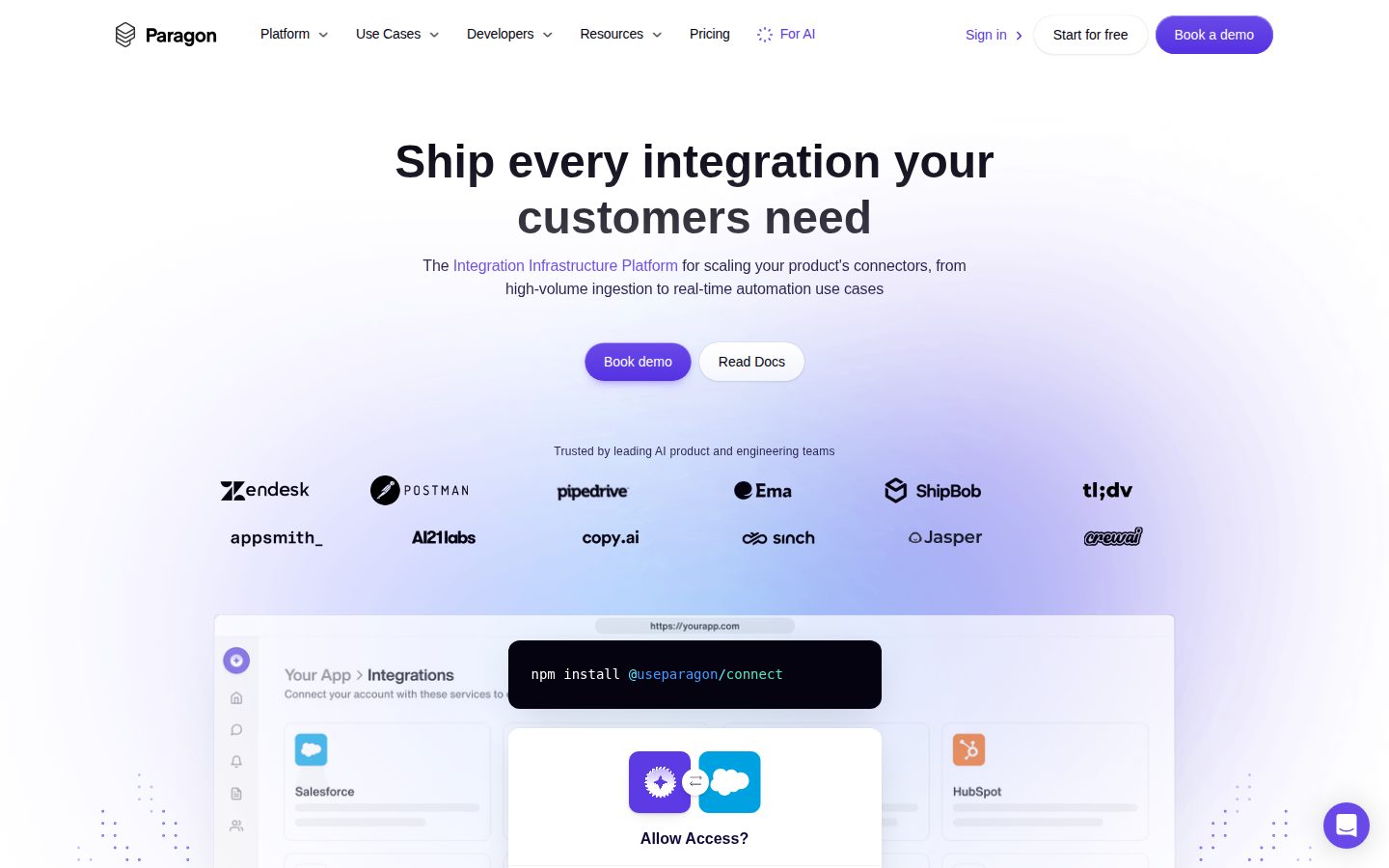
Paragon is an embedded integration platform that lets SaaS companies add native user-facing integrations to their products.
AI Panel Score
6 AI reviews
Reviewed
AI Editor ApprovedApproved and published by our AI Editor-in-Chief after full panel analysis.Paragon is an embedded integration platform as a service (iPaaS) that enables SaaS companies to offer native, user-facing integrations within their own products. Rather than building and maintaining integrations from scratch, development teams use Paragon's SDK and infrastructure to connect their application to hundreds of third-party services such as CRMs, marketing tools, file storage platforms, and communication apps.
The platform is aimed primarily at product and engineering teams at B2B SaaS companies that need to deliver integrations as a product feature. It abstracts away the complexity of managing OAuth flows, API versioning, token refresh, and webhook handling, allowing developers to focus on building the core product rather than maintaining integration infrastructure.
Paragon offers a visual workflow builder that product teams can use to define integration logic, as well as a white-labeled Connect portal that end users see when they authenticate and configure their own integrations inside a host application. This means the integration experience feels native to the SaaS product rather than pointing users to a separate tool.
Key capabilities include a catalog of pre-built app connectors, event-triggered workflows, real-time sync, and user-level credential management. Teams can also build custom integrations using Paragon's API and SDK for cases not covered by the pre-built catalog.
Paragon competes in the embedded iPaaS market alongside products like Merge, Apideck, and Prismatic. It is positioned for mid-market and growth-stage SaaS companies that need to scale their integration offering without building and operating the full infrastructure themselves.
Allows AI agents to run synchronous actions to read, write, or delete data in third-party apps through natural language commands.
Builds data pipelines that continuously ingest customers' external data from third-party sources into a retrieval-augmented generation (RAG) application.
Provides event logs for all integration activity — including task executions, syncs, and webhook triggers — with the ability to forward events to external observability platforms.
Provides an event-driven workflow engine for building automations between the host application and users' third-party apps.
Allows developers to make requests to any third-party API endpoint via the Connect API, enabling custom integration actions beyond pre-built connectors.
Enables normalized, continuous ingestion pipelines of users' external data and permissions from third-party sources into the application.
Lets developers build their own custom connectors for any third-party API, leveraging Paragon's managed authentication and embedded UX components.
Provides a catalog of over 130 pre-built connectors covering CRM, file storage, project management, documents, and more, allowing developers to integrate third-party APIs without building from scratch.
An embeddable and white-labeled UI component that allows end users to connect and configure their third-party integrations directly within the host SaaS application.
Uses Paragon's webhook listening infrastructure to subscribe to real-time changes in any third-party application.
Manages OAuth and other authentication flows for third-party integrations so developers do not need to implement auth separately per connector.
Supports cloud deployment, self-hosting, or forward-deployment options to meet enterprise compliance requirements, including air-gapped environments.
For SaaS companies building and scaling native integrations with full platform access
For enterprise-scale teams requiring advanced security, self-hosting, and dedicated support
Inspired Capital-backed embedded iPaaS shipping ActionKit for AI agents — a credible build-vs-buy answer for B2B SaaS.
“Paragon is a Los Angeles embedded integration platform that lets B2B SaaS teams ship native user-facing integrations in weeks instead of quarters. The vendor question is whether $16.5M cumulative funding holds while Merge and Prismatic grind for the same mid-market accounts.”
Paragon's marketing leans on a 70% less engineering claim, and the evidence behind it is concrete. Founded 2019 by Ishmael Samuel and Brandon Foo, $13M Series A from Inspired Capital in 2022 on top of seed money. That's a defensible three-year bet for a Pro-tier customer.
ActionKit is the move worth watching, one API that lets an AI agent execute synchronous CRUD against 130+ third-party apps. That's the right shape for the agent era and pulls Paragon into a different conversation than Merge's read-only sync pipelines. The Connect portal handles OAuth and looks native inside the host product, which is what your customers actually want.
However, pricing is custom on both Pro and Enterprise, and Connected Users billing punishes you for landing a big tenant. Prismatic competes hard on self-hosting. Pilot it with two integrations for one quarter, watch the quote behavior at renewal, then decide whether to standardize.
Holds its own against Merge and Prismatic with a clearer agent story than either.
Named investors and public customer testimonials make this an easy choice to defend to the board.
130+ pre-built connectors plus the white-labeled Connect portal compress months of OAuth and webhook work.
ActionKit positions Paragon at the center of the AI-agent integration moment.
Series A of $13M from Inspired Capital in 2022 plus six years operating, but not yet at Series B scale.
B2B SaaS product teams who need native integrations without owning the auth stack.
Solo developers who only need a one-off Zapier-style automation.
Paragon is the build-vs-buy decision for SaaS integration teams, with ActionKit as the AI-era wedge.
“Paragon's three-product split — Managed Sync, Workflows, ActionKit — gives B2B SaaS teams a credible build-vs-buy alternative for native user-facing integrations. The catalog depth and ActionKit's MCP server position it well for the AI-agent shift, but Custom-only Connected Users pricing keeps procurement leverage on the vendor side.”
A VP of Engineering at a Series B SaaS company shouldn't read Paragon's "70% less engineering" claim as marketing copy. Two engineers maintaining 30 OAuth flows, webhook listeners, and token-refresh logic costs roughly $600K a year loaded — that's the real comparable.
The three-product split — Managed Sync for ingestion, Workflows for async orchestration, ActionKit for synchronous AI-agent calls — matches how 2026 SaaS products actually consume integrations. ActionKit exposing one API and an MCP server to hundreds of CRUD actions is the AI-era wedge Merge and Prismatic are still building toward.
But pricing is the strategic catch. Connected Users billing is quoted as "Custom" on both Pro and Enterprise with no published floor, which shifts procurement leverage to the vendor once you're embedded. Self-hosting and SAML SSO stay Enterprise-only — a known iPaaS upsell pattern.
Founded 2019 with $13M Series A from Inspired Capital in August 2022, competing credibly with Merge and Prismatic.
Embedded SDK, Connect Portal, and Custom Integration Builder match how SaaS engineering teams actually ship native integrations.
TypeScript Workflows, Git Repo Sync, CI/CD pipelines, and an MCP server fit modern engineering review processes.
Custom-only Connected Users pricing and Enterprise-gated self-hosting create real vendor leverage once embedded.
Three purpose-built products — Managed Sync, Workflows, ActionKit — show real architectural intent beyond a connector catalog.
B2B SaaS engineering teams who ship native user-facing integrations.
Solo developers who need a one-off internal sync.
Sales-only pricing on every tier, with usage scaling per Connected User on a metric the buyer cannot forecast.
“Paragon publishes three tiers — Platform, Pro, Enterprise — and zero sticker prices. Usage scales per Connected User, a tenant-count meter that procurement cannot model without a call.”
Paragon raised a $13M Series A in July 2022, led by Inspired Capital, on $16.5M total. Healthy runway for an iPaaS founded in 2019, but the embedded-integration segment has consolidation risk. Workato, Prismatic, and Merge hunt the same B2B SaaS buyer.
Pricing is the headache. Every tier lists Connected Users as "Custom." No published rate per tenant, no task ceiling, no overage table. A 50-customer pilot scaling to 500 tenants is a quote, not a forecast. ActionKit and Managed Sync are bundled across plans, which avoids the SSO-tax trap — but SAML lives behind Enterprise, a category norm with a real line item.
ROI is legible. The marketing claim is 70% less integration engineering. Even at 40%, two FTEs saved at $180K loaded beats a six-figure contract. The tradeoff is procurement friction: no sticker means no fast pilot.
Sales-only pricing on every tier means procurement cycle starts at first call, not at evaluation.
No published auto-renewal or term length; category norm is annual with quote-driven negotiation room.
Three tiers visible, zero sticker prices, every Connected Users figure is "Custom."
The 70% engineering reduction claim maps to two FTEs saved at roughly $360K loaded — legible payback math.
ActionKit, Sync, and Workflows bundled across plans avoids add-on creep, but tenant scaling is unforecastable.
Mid-market SaaS engineering teams shipping native integrations as a paid product feature.
Buyers who need a published rate card before booking a sales call.
ActionKit and Connect Portal make Paragon real embedded-iPaaS infra, but pricing hides behind a custom quote.
“The Connect Portal lets your users authenticate and configure integrations without leaving your app, and ActionKit gives AI agents synchronous CRUD across the same connector catalog. The catch is opaque pricing — every tier routes through sales.”
Embedded iPaaS shows its shape in how the auth handoff feels to end users. Paragon's Connect Portal embeds a white-labeled OAuth flow inside the host app, so a customer wiring up Salesforce or Slack never sees a useparagon.com URL. 130+ pre-built connectors is table stakes — what matters daily is how cleanly token refresh, webhook retries, and rate-limit backoff get managed.
Workflows ships TypeScript authoring with Git Repo Sync and Dev/Staging/Prod release environments — suggests someone on the team runs CI against integration logic. ActionKit, one API plus an MCP server, opens synchronous actions for AI agents without rebuilding the connector layer. Merge wins read-sync; Paragon spans more verbs.
Friction is pricing. Both Pro and Enterprise list every meter as 'Custom' — Connected Users, task history, SSO sits Enterprise-only. Docs read like engineers wrote them, however founded 2019 on a $13M Series A means trusting a venture-stage vendor with your integration plumbing.
Connect Portal and managed auth lift the daily integration ops that usually rot first.
Docs, changelog, blog, and tutorials for Salesforce/HubSpot/Slack are all live and active.
Opaque Custom pricing and Enterprise-gated SAML SSO add procurement friction before the first deploy.
Custom Integration Builder, Connect API to hit any endpoint, and an MCP server for ActionKit cover the long tail.
TypeScript Workflows with Git Repo Sync and Dev/Staging/Prod environments slot into existing engineering CI.
Engineering teams who need to ship white-labeled native integrations without operating the OAuth and webhook plumbing.
Startups who want public per-seat pricing before talking to sales.
Paragon takes the integration grunt work off your roadmap, but pricing is a phone call away
“Embedded integrations your users actually configure inside your app, with OAuth and token refresh handled. The catch is both Pro and Enterprise are quote-only, so you cannot budget without a sales call.”
Integration backlogs are where SaaS roadmaps go to die. Every customer wants Salesforce, then HubSpot, then their own niche CRM, and someone ends up babysitting OAuth refreshes on a Friday night. Paragon takes that pile off the desk with 130+ pre-built connectors and a Connect Portal that drops a native-feeling auth modal into the host app. Founded 2019, $13M Series A from Inspired Capital.
ActionKit aged well into the AI moment. It exposes hundreds of third-party CRUD actions through one MCP server, which is what agents need. Workflows lets you author logic in TypeScript with Git Repo Sync, not just a low-code canvas — the docs indicate Dev/Staging/Prod ship on Pro.
But Connected Users pricing is custom on both tiers, so there is no published number to compare against Merge or Prismatic without a call. SAML SSO and self-hosting sit behind Enterprise too. Solid platform, opaque price tag.
Connect Portal is white-labeled and embeddable, which signals the team sweated the customer-facing surface.
TypeScript authoring plus Git Repo Sync and Release Environments scale from first sprint to month three without rebuilding.
Backend integration infrastructure — neutral on mobile since end users hit it through the host SaaS, not a Paragon app.
Docs, changelog, and TypeScript Workflows are all present, but Connected Users pricing being quote-only adds friction to evaluation.
Managed Sync, webhook listening, and event logs with external forwarding are exactly the plumbing you want handled for you.
B2B SaaS engineering teams who need to ship a real integration catalog without hiring for it
Solo developers or early-stage startups who need a public price before talking to sales
Real shipping team in a category that compresses fast — wedge is workflow plus the Connect Portal.
“Paragon has a credentialed team, named investors via Inspired Capital, and an actual orchestration layer that differentiates it from pure unified-API plays like Merge. The catch is opaque 'contact us' pricing on both tiers and a squeeze between Merge below and Workato above.”
Honest take: the embedded iPaaS category looks more durable than I expected. Bearer got absorbed, Cloud Elements folded into UiPath, but Merge, Prismatic, and Paragon are all still shipping. Paragon's wedge is the Connect Portal plus a Workflows orchestration engine — actual logic, not just unified APIs.
Receipts hold up. Founded 2019 by Ishmael Samuel and Brandon Foo. $13M Series A in July 2022 led by Inspired Capital. 130+ connectors, ActionKit for AI agents, and a changelog that shows shipping. Pricing is 'contact us' on both Pro and Enterprise — category norm, but it makes ROI math opaque.
The catch is positioning. Merge owns unified APIs, Prismatic owns mid-market workflow. Paragon sits in the squeeze. Exit is decent — Workflows author in TypeScript with Git sync, so migration isn't a trap. Viability rides on whether ActionKit lands before the AI-agent rush moves on.
Connect Portal plus Workflows orchestration is a real wedge, but Merge and Prismatic crowd the space.
Workflows author in TypeScript with Git Repo Sync and CI/CD, so migration logic is portable.
$13M Series A in July 2022 from Inspired Capital plus active shipping, but no recent disclosed round.
Landing page makes a specific '70% less engineering' claim, but contact-only pricing hides real cost.
Six-year-old company with named founders, real Series A, and a public changelog cadence.
B2B SaaS engineering teams who need native user-facing integrations.
Solo developers who need a couple of one-off API connections.
Common questions answered by our AI research team
Connected Users are defined as tenants (customer organizations) using integrations, and usage costs scale based on the number of Connected Users. Both Pro and Enterprise plans list Connected Users as 'Custom', meaning pricing is customized based on your specific number of connected tenants. There is a 'Get Custom Quote' option for Connected Users pricing.
Managed Sync is purpose-built for high-volume data ingestion and access control, ActionKit provides one API and MCP server for hundreds of synchronous integration CRUD actions, and Workflows is the embedded iPaaS for orchestrating asynchronous integration logic. All three products are included on every plan — the pricing page states 'You will get access to all three of Paragon's purpose-built products, with default usage built-in based on the number of Connected Users you have.'
SAML-based SSO is listed as an Enterprise-only feature, and On-Premise / Single-Tenant Options are listed under Security as an add-on for Enterprise (not included in Pro). The Pro plan does not include SAML-based SSO or self-host/forward-deploy options, which are explicitly listed under the Enterprise tier.
Yes, Workflows supports authoring integration logic in TypeScript or a low-code editor. The platform includes Git Repo Sync and is 'Fully integrated with CI/CD pipelines', with Release Environments (Dev, Staging, Prod) available on both Pro and Enterprise plans.
Google Drive, SharePoint, Jira, Salesforce, HubSpot, and Slack are all referenced in the content — Google Drive and SharePoint are mentioned in a customer testimonial, Jira in another, and Salesforce, HubSpot, and Slack appear as 'Popular Tutorials' in the site navigation. Custom connectors are supported via an 'Unlimited Integrations & Custom Connectors' feature, and the FAQ notes there is an option if a needed integration isn't supported.
Company
ParagonFounded
2019Pricing
Contact for pricingFree Trial
AvailableParagon is a San Francisco-based embedded integration platform that helps SaaS companies build native product integrations faster.