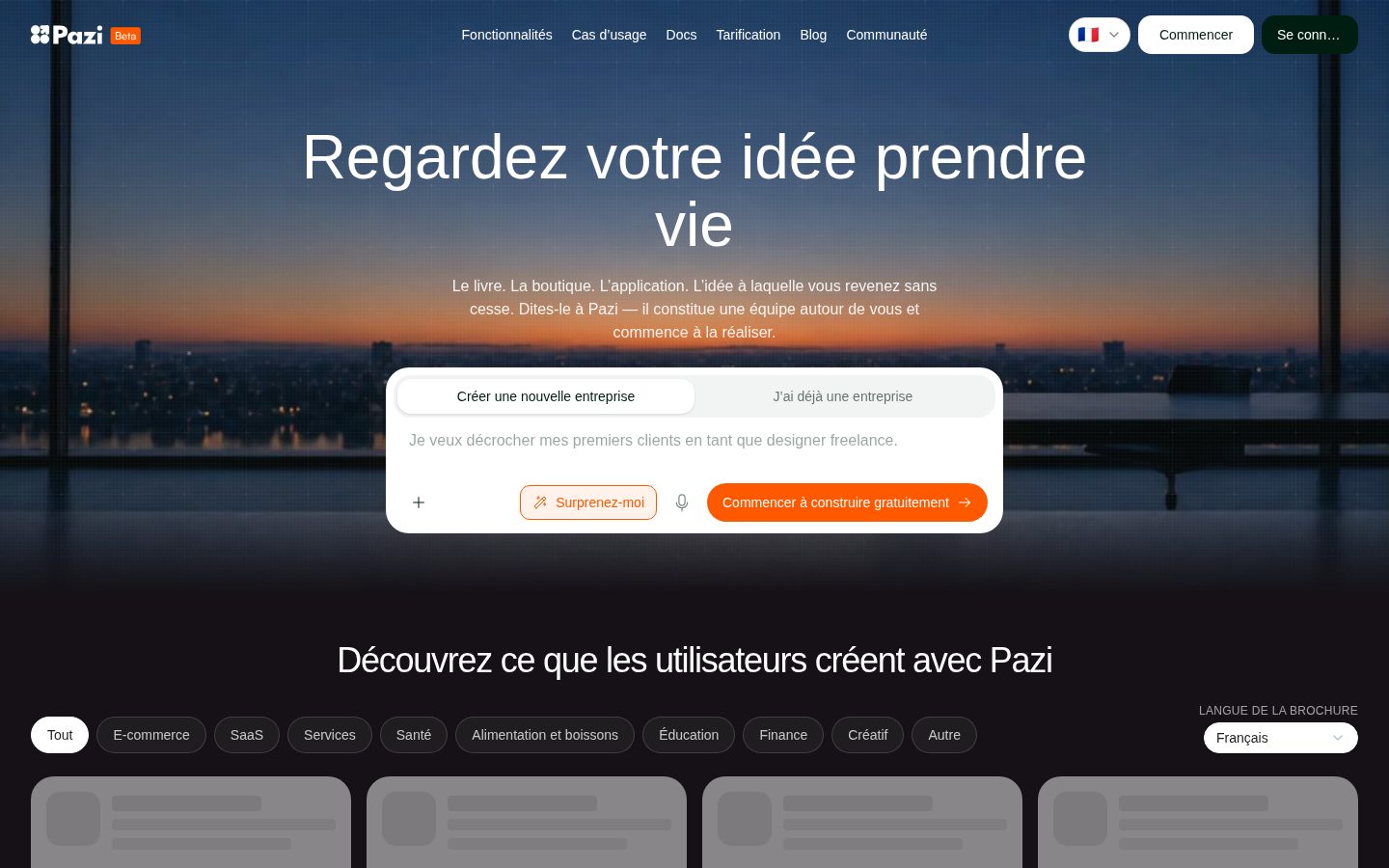
AI operating officer and specialist agents that launch and run a small business
Pazi is an AI agent platform for entrepreneurs and small teams that turns a business idea into work carried out by a team of AI agents.
AI Panel Score
5 AI reviews
Reviewed
Facts checked against pazi.ai
Pazi is an AI agent platform in which an AI operating officer turns a business idea into a main goal and a roadmap of work, then delegates that work to specialist agents. It is built for entrepreneurs, freelancers and small teams, from print-on-demand brands and consultants to bakers and local service businesses. A Free plan gives $10 of one-time funding and one active business with no card required, and Pro starts at $25 per month, with funding levels up to $500 that agent work draws down. Agents research the market, publish a website or online store with checkout, run Meta ad campaigns, send email outreach and publish to more than 10 connected social channels. TopReviewed's six-seat AI review panel scored it 7.9/10, praising the owner-approval step before any Meta ad spend while noting that files download one at a time, with no one-click export. It fits solo founders who want agents to carry their launch work while they approve spending.
You sign in with an account such as Google, Outlook, Apple, GitHub, LinkedIn or X and describe the business you want to build or grow, ideally with an existing website or brand source for Pazi to reuse. A protected operating officer agent asks for the details it needs, and questions or brainstorming can stay a conversation. Once the direction is actionable and you tell it to proceed, it records the main goal, lays out a Business Roadmap of milestone stages with five or six opportunities each, and hands substantial work to specialist agents. You start opportunities from the roadmap and keep chatting in the business's single Main Chat while the work runs in the background; a specialist that needs an answer marks its opportunity Awaiting input. Finished work lands in Files as HTML reports, documents, spreadsheets, images, code or data that can be previewed, downloaded, or shared privately or by public link.
The platform covers the main launch and growth jobs of a small business. Market research scans competitors, customer language and market signals and compares possible positions before the direction is set. Pazi then shapes the brand and copy and publishes a website or online store with products and checkout, with eligible sales proceeds withdrawn through Stripe. It creates and runs Meta ad campaigns without a Meta Ads Manager account, asking for approval of the creative, audience and budget before launch; handles prospecting and follow-ups from the business's me.pazi.ai email address; and plans, creates and publishes social posts across more than 10 connected channels from one content calendar, with approval settings per account. Analytics bring paid ads, organic traffic, email, social and website activity together with recordings of website sessions. The Pazi heartbeat has the operating officer review the whole business on a cadence from every five minutes to once a day and email the owner an update, while Tasks & Calendar runs one-off or recurring agent work.
Pazi is aimed at entrepreneurs and small teams who need more execution capacity, and its use-case pages cover print-on-demand and handcraft brands, consultants and freelancers, SaaS founders, bakers, restaurants, podcasts, newsletters and local services such as plumbers, movers and dog walkers. Pricing is based on funding that agent work draws down. The Free plan gives $10 of one-time funding ($8 for AI work and $2 reserved for ads), one active business and 5 business emails a month, with no card required and no team invites, and a Free business's idea and generated assets may appear in Pazi's public showcase. The single Pro plan is sold at monthly funding levels of $25, $50, $100, $200 or $500, each adding that amount to a Cash Balance shared across the owner's businesses and including multiple private businesses, team invites and 25 to 200 business emails a month. Yearly billing is 20% off, and Pro levels from $50 up can buy one-time top-ups of $20 to $500.
Each conversation runs in its own isolated cloud computer with a browser, filesystem and command-line tools, and Live View lets you watch the browser and take over when a site needs you to log in. Agents keep Markdown memory, private per agent and shared per business, plus custom skills for repeatable workflows, and connect to services such as Figma, GitHub, Slack, Linear and Sentry, with saved credentials encrypted and scoped to one business. The Pazi Agents Slack app gives individual agents handles in approved channels. Work runs on models from Anthropic, OpenAI or Amazon Bedrock, Pazi states that it does not use project data to train models, and the interface is available in English, German, Dutch, Simplified Chinese, Russian, Spanish and French. Opportunity execution is designed for desktop; on phones and tablets the operating-officer chat still works.

Agents can spawn new peer agents at runtime through a create_agent tool, with the dashboard updating immediately to reflect new agents.
Each agent generates its own multi-step plan toward a stated outcome rather than following single-trigger automation rules.
Pazi proposes new opportunities for validation, growth, branding, automation, and customer acquisition to keep a project moving forward.
Users can create AI agents mapped to specific company roles, each assigned a concrete objective to pursue autonomously.
A central dashboard tracks every project, opportunity, and AI task, showing what's completed, in progress, and awaiting user input.
Multiple agents can run different workstreams simultaneously, enabling concurrent progress across business functions.
Agents can be scheduled to run recurring tasks, with a multi-tier delivery fallback ensuring output still reaches the dashboard if a channel or run fails.
Workspace owners can grant other users view-and-run access to their workspace so teammates can use the agents inside it.
Agents can collaborate directly inside Slack and send or receive email as part of completing assigned work.
Users can select the interface and documentation language from options including English, German, Dutch, Simplified Chinese, Russian, Spanish, or French.
The platform connects with more than twenty business tools, including Slack and Microsoft Teams, for agents to act within.
Founders and team owners retain control over what agents are allowed to do, with oversight and approval checkpoints built into the workflow.
Entry-level plan with no monthly funding added to business balance
For businesses needing a small amount of monthly funding
Recommended plan for businesses needing moderate monthly funding
For businesses needing higher monthly funding
For businesses needing substantial monthly funding
For businesses needing maximum monthly funding
An AI operating officer that runs your Meta ads and website, with your money as the fuel gauge.
“Pazi turns a business idea into an agent-run roadmap, with real execution — websites, Stripe checkout, Meta ads, social posts. The pricing model ties agent capability directly to cash funding, which is honest but makes the real cost unpredictable.”
Pazi doesn't just draft content, it runs campaigns. The operating officer agent builds a roadmap, hands work to specialists, and those specialists publish a storefront with Stripe checkout, launch Meta ads after your approval, and post to more than 10 social channels. The Business Pulse dashboard and Live View, where you can watch and take over a browser session, suggest this is built by people who've thought about the trust gap in autonomous execution.
The pricing is the real story. Free gives $10 one-time, mostly eaten by ad spend. Pro starts at $25/month and that number is your funding balance, not a seat fee — so cost scales with how much work you ask for, not how many people use it.
That's clever and risky. Clever because you're not paying for idle seats. Risky because a board can't forecast spend the way they can with a flat SaaS line. The isolated cloud computer per agent and encrypted scoped credentials are reassuring; the lack of a visible changelog isn't disqualifying, just unverified.
Running Meta campaigns without a Meta Ads Manager account and spawning specialist agents per function is a sharper pitch than a generic chatbot assistant.
Credentials are encrypted and scoped per business, and Pazi states it doesn't train on project data, but a shared funding balance across businesses needs clear cancellation terms I couldn't fully verify.
A described idea becomes a roadmap, website, and live ad campaign within one flow — fast if you trust the approvals.
This replaces hired execution capacity, not just a software subscription — a real capability shift for a small team.
Docs and a detailed pricing page exist; I couldn't find a changelog to confirm shipping cadence.
A solo founder or small team that wants an AI team to actually launch and run marketing, not just draft copy.
Skip it if you need predictable flat monthly costs rather than a spend-linked funding balance.
Isolated cloud agents per business is sound architecture; the credential and model lock-in is the real three-year bet.
“Pazi's per-conversation cloud compute with scoped encrypted credentials is a defensible security model. The deeper question is whether you want your business's operating logic living inside someone else's agent orchestration layer.”
Each conversation getting its own isolated cloud computer with browser, filesystem and CLI is the right call architecturally — that's containment done properly, not agents sharing a blast radius. Saved credentials encrypted and scoped to one business is a sane security boundary for something touching Stripe payouts and Meta ad spend.
The integration list — Figma, GitHub, Slack, Linear, Sentry, plus a Slack app giving agents their own handles — reads like a platform built by people who've shipped dev tooling before, not a wrapper. But routing everything through Anthropic, OpenAI or Amazon Bedrock underneath means your business's operating memory sits on top of three vendors you don't control and one orchestration layer you also don't control.
Three years in, the Markdown memory system — private per agent, shared per business — is your actual data asset, and I found no mention of export tooling for it. If Pazi's roadmap stalls, you're not migrating a database, you're migrating institutional memory that lives in a proprietary format.
Funding-based pricing from $25 to $500 monthly positions it as infrastructure spend rather than a seat license, a different mental model than most agent tools.
Human-in-the-loop approval on ad spend and creative matches how a small operator actually wants to delegate, not full autonomy.
Connections to Figma, GitHub, Slack, Linear and Sentry plus a dedicated Slack app give it real reach into an existing dev stack.
Business memory and roadmap logic live inside Pazi's Markdown store with no export path I could find, which is a lock-in surface worth pricing in.
Isolated cloud compute per conversation plus agents that can spawn peer agents at runtime is genuine systems thinking, not a chat wrapper.
Technical founders comfortable delegating execution to a sandboxed agent layer in exchange for not building that orchestration themselves.
Avoid if you need guaranteed portability of your operational data out of a vendor's proprietary memory format.
Agent orchestration looks solid on paper; the CLI-and-filesystem layer is the part worth stress-testing
“Each conversation gets its own cloud box with a browser, filesystem and command-line tools — that's real sandbox architecture, not a chat wrapper. The question for week two is whether the 'create_agent' spawning and Markdown memory system stay debuggable once a business has a dozen live opportunities running at once.”
The isolated-cloud-computer-per-conversation setup with filesystem and CLI access is the detail that tells me someone building this actually thinks about blast radius, not just chat UX. Agents that spawn peer agents at runtime via a create_agent tool is a neat primitive — but it's also exactly the kind of feature that's fun in a demo and a nightmare to debug when three agents spawn five more and you're trying to figure out which one left an opportunity stuck.
Integrations with GitHub, Linear and Sentry suggest this isn't purely a marketing-ops tool wearing an 'agent' label. Scheduled runs with multi-tier delivery fallback is sensible engineering, but 'unlimited agents' on every tier, paired with funding-based pricing, means your real ceiling is dollars burned per run, not a concurrency number you can plan around.
Multilingual interface across seven languages is nice breadth. I'd want runtime logs or trace output per agent before trusting this with anything production-adjacent — couldn't confirm that's exposed.
Sandboxed cloud computers per conversation plus Live View handoff suggest the architecture survives beyond the first session, but opportunity tracking across many spawned agents is untested territory from what's shown.
The docs I found cover setup and plan mechanics clearly; I couldn't confirm deeper technical references like an API reference exist publicly.
Awaiting-input states and approval checkpoints before ad spend or publish reduce surprises, but funding-balance-driven unlimited agents leaves run-to-run cost unpredictable.
Custom skills, per-agent Markdown memory and role-based agent creation give a real path from default operating-officer flow to custom orchestration.
GitHub, Linear and Sentry connections plus a Slack app with agent handles fit existing dev and ops channels rather than forcing a new surface.
Technical founders comfortable watching a browser-driven agent work and stepping in via Live View when it stalls.
Avoid if you need predictable per-run cost or deep audit logs before trusting autonomous agents with live ad spend.
A roadmap that builds itself, but you'll be at a desk watching it happen.
“Pazi wants to be your whole first hire, from market research to a live Shopify-style storefront. The first ten minutes feel like a real conversation, not a form, but the real test is whether that roadmap still makes sense in week three.”
Signing in and just describing your business idea instead of clicking through a setup wizard is a good first move. The operating officer agent asking clarifying questions before committing to a roadmap means day one doesn't feel like filling out a form, it feels like a meeting. That's rare.
But the Business Pulse dashboard has to carry a lot of weight long-term: every opportunity, blocker, and balance in one place, across possibly multiple businesses on the $50/mo tier. That's a lot of surface area for one screen, and I didn't see evidence of how it handles density once you've got a dozen opportunities stacked up and three awaiting input at once.
Mobile only running the chat, not opportunity execution, is a real gap if you're the type who checks in from your phone between other jobs. And the five-to-six-opportunities-per-stage structure is tidy in a demo, less clear whether it stays legible once your business has history and not just a fresh idea behind it.
The single Main Chat plus Files pattern is coherent, but I couldn't see how it holds up once a business has months of generated reports and documents piling up.
Unlimited agents and a 5-to-6-opportunity roadmap structure are easy to grasp at first, but the create_agent spawning behavior adds complexity I'd want to see managed well by month three.
Opportunity execution is desktop-only; the phone experience is limited to the operating-officer chat.
Describing an idea and letting the operating officer ask questions before committing feels like conversation, not a setup wizard.
Scheduled runs with delivery fallback and isolated per-conversation cloud computers suggest the team thought about failure, not just the happy path.
Someone starting a new small business or storefront who wants to describe an idea and watch a roadmap take shape before diving in.
Avoid if you need full agent control and execution from a phone rather than a desktop.
An AI operating officer that holds your Meta ad budget. Read that twice.
“Pazi wants to run your market research, your storefront, and your ad spend from one dashboard. The ambition is real, but the surface area is the risk.”
Watch your idea come to life is the H1. That's the kind of line that ages badly if the roadmap stalls on opportunity three. The individual pieces, Stripe checkout, Meta campaigns with approval gates, a shared me.pazi.ai inbox, are concrete and specific enough to be more than vaporware marketing copy.
What I can't verify from outside: how the operating officer behaves when its own roadmap is wrong. Autonomous re-planning across market research, ad spend and outreach is a lot of surface area for one agent to own, and I found no stated error-recovery or rollback story if a specialist agent publishes something bad.
Funding-based pricing at $25 to $500 a month is at least honest about aligning cost to work done, unlike flat seats that hide usage caps. The free $10 grant is a real way to kick the tires before trusting it with ad budget.
Bundling market research, storefront, ads and outreach under one operating officer agent is a wider claim than most single-purpose AI assistants make.
Files export as HTML, docs and spreadsheets, which is fine, but the business logic lives in the roadmap and agent memory, not in anything you can take with you.
Integrations with GitHub, Linear and Sentry plus seven supported languages suggest ongoing build-out, though I couldn't confirm a release cadence.
The H1 promises a business that builds itself; the features listed, roadmap, approvals, Business Pulse, are more grounded than that line suggests.
Named capabilities like Meta campaign approval flows and the operating officer's roadmap are specific, but no visible error-handling story for when agents get it wrong.
A solo founder comfortable handing ad budget and storefront setup to an agent they'll supervise closely.
You need predictable monthly costs or a clear audit trail before trusting an agent with real ad spend.
Common questions answered by our AI research team
Pazi uses a single plan where you choose how much monthly funding your business needs, with options at Free, $25, $50, $100, $200, or $500. That funding amount is added to your business balance each month and is shared across all your businesses, with yearly billing saving 20%.
The $50/month plan adds $50 to your business balance monthly and includes multiple businesses, unlimited agents, a private business, up to 50 business emails sent per month, team member invites, a business roadmap, automated social posts and content calendar, the ability to order product samples (paid separately), prioritized support, and funding top-ups.
Yes. Pazi's specialist agents can run Meta ad campaigns once the owner approves the creative, audience, and budget.
Pazi publishes to more than 10 connected social channels.
Business Pulse is the single dashboard where progress, blockers, balances, and the roadmap sit together, keeping every project, opportunity, and AI task in sync so you can see what's done, in progress, and what needs your attention.
Who Pazi competes with, and how each one differs
Enterprise-first "AI workforce" platform (Invent) sold with a white-glove deployment team that stands up agent teams for ops/GTM functions over several weeks, versus Pazi's self-serve, founder-run agent roster.
General-purpose AI teammate that lives in Slack and automates individual workflows across 1,000+ app integrations on a per-seat subscription (roughly $30-200/user/month), rather than staffing named business-role agents.
Developer- and platform-team-facing multi-agent build-and-runtime layer (open-source core plus a governed enterprise runtime) used by large enterprises to build and govern agents in code, versus Pazi's out-of-the-box role agents aimed at founders.
No-code visual workflow/agent builder scoped to revenue and GTM teams (Salesforce, HubSpot, Gong connectors), narrower than Pazi's cross-functional agent roster spanning dev, DevOps, sales and marketing roles.
Pazi is a Y Combinator-backed platform that lets founders build autonomous companies staffed by AI agents assigned to roles such as developer, DevOps, and sales.