Customer insights programs built to drive action, not just reports
PeopleMetrics is a customer insights and research platform for organizations that need feedback programs tied to measurable business action.
AI Panel Score
6 AI reviews
Reviewed
AI Editor ApprovedApproved and published by our AI Editor-in-Chief after full panel analysis.PeopleMetrics is a customer insights and research platform for organizations that need feedback programs tied to measurable business action. It runs NPS programs, customer advisory boards, and custom research engagements using verified customer feedback rather than third-party panels. Its distinguishing capability is Interactive Avatar technology, which converts research findings into a conversational AI interface employees can query directly instead of reading static reports. The platform also covers real-time feedback collection, a native text analytics engine, Voice of the Customer and Voice of the Employee programs, anonymous online focus groups, and industry benchmarking. Pricing is quote-based, with no free plan or trial. TopReviewed's six-seat AI review panel scored it 6.9/10, praising the Interactive Avatar for giving non-analysts direct access to findings while noting zero pricing transparency means every deal requires a sales cycle. It best fits mid-to-large enterprises in healthcare or financial services running managed VoC programs.
In practice, organizations work with PeopleMetrics to design and run structured feedback programs — relationship and transactional NPS surveys, customer advisory boards, or custom research studies. Collected responses are sourced exclusively from verified customers rather than third-party panels. Once research is complete, findings are made accessible through the platform's dashboard and, notably, through an Interactive Avatar that stakeholders can talk to in natural language to extract relevant insights.
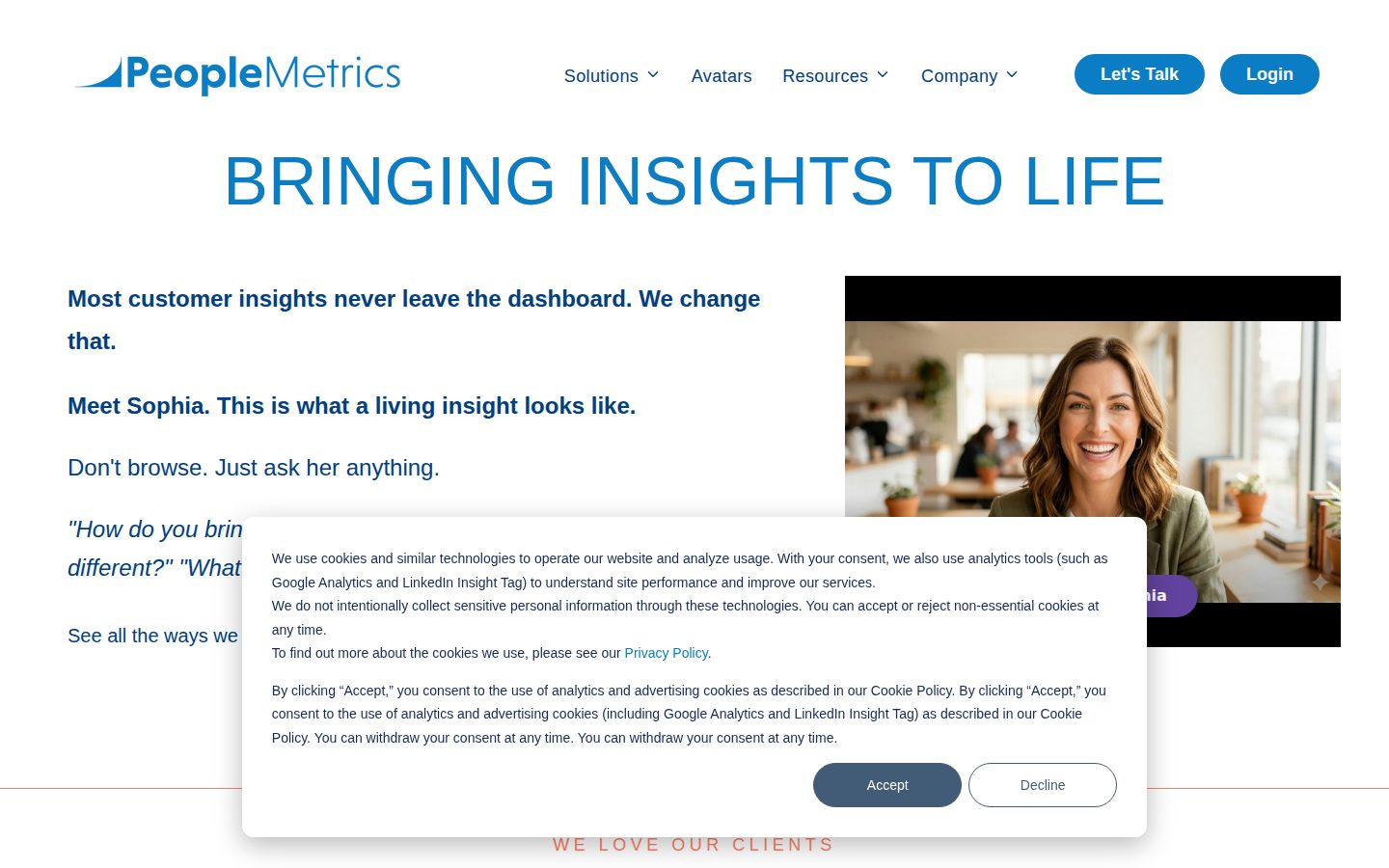
The Interactive Avatar is the product's most prominently featured capability. Rather than delivering a final PowerPoint deck or a static dashboard, PeopleMetrics converts research outputs into a living, queryable interface. Internal teams — such as sales, product, or marketing — can ask the avatar questions about customer sentiment, key drivers, or specific segments without needing to interpret raw data themselves. This is positioned as the mechanism for closing the gap between insight generation and organizational action.
PeopleMetrics appears aimed at mid-to-large enterprises in regulated or relationship-heavy industries, with clients cited in financial services and healthcare sectors. Pricing is not published on the website; all engagements appear to be scoped through direct sales contact, indicating a custom or project-based pricing model. Comparable services in the customer insights and research space include Qualtrics XM, Medallia, InMoment, and traditional market research firms.
The platform includes a real-time results dashboard accessible to internal stakeholders. PeopleMetrics also produces written content resources including a blog, a Substack newsletter, and published books by its founder focused on customer experience methodology.

Uses machine learning to analyze open-ended survey responses, surfacing the biggest themes, topic frequency, and positive, neutral, and negative sentiments from unstructured feedback.
Offers custom reporting capabilities that allow users to slice, dice, and view survey and text analytics results in ways that suit their organization's specific needs.
Provides a fully customizable self-service dashboard solution that lets users choose from multiple data visualization options and tailor views for each user role.
Provides access to industry benchmark data based on standardized survey questions, including benchmarks approved by legal teams in the pharmaceutical sector.
Triggers configurable alerts based on survey responses, customer segments, and keywords so teams can act quickly on at-risk customers and coordinate follow-ups.
Enables organizations to conduct anonymous online focus groups with employees or customers to gain deeper qualitative insights alongside quantitative survey data.
Supports embedded survey forms that can be deployed within digital touchpoints to capture feedback at the moment of interaction.
Collects customer and employee feedback in real time via surveys distributed across multiple channels including phone calls and embedded forms.
Delivers end-to-end Voice of the Customer programs that collect, analyze, and surface actionable insights to improve customer satisfaction and loyalty.
Gathers employee feedback at a regular cadence (weekly, monthly, quarterly, bi-annually, or annually) to gauge employee perceptions and drive engagement improvements.
Enables organizations to personalize each customer or employee interaction based on collected feedback data to drive more meaningful engagement.
Sets up real-time connections between existing business systems and the PeopleMetrics platform to report on customer feedback data alongside operational metrics.
PeopleMetrics is a sales-led customer experience (CX) and research platform. No public list pricing is available on their website or any third-party aggregator (G2, Capterra, Vendr). Pricing requires contacting the vendor directly or requesting a demo at peoplemetrics.com.
Solid CX research platform with one genuinely interesting AI trick.
“PeopleMetrics runs verified NPS programs and custom research for mid-to-large enterprises, particularly in healthcare and financial services. The Interactive Avatar — queryable AI over research findings — is the real differentiator against static Qualtrics decks.”
No published pricing, no API docs, no changelog. That's a sales-led company that's been around long enough to know exactly what it's doing. The Interactive Avatar converts research outputs into something internal teams can literally question — sales asks about churn signals, product asks about feature sentiment — without needing an analyst in the room. That's a real workflow improvement over Qualtrics XM delivering a 60-slide deck.
The tradeoff is speed and transparency. No free trial, no self-serve, no pricing signal anywhere. Every engagement is scoped through a sales call, which means procurement cycles measured in quarters, not weeks. For regulated industries like pharma — where they've built legal-approved benchmarks — that friction is acceptable. For a scrappy mid-market team, it won't be.
Vendor viability is the honest unknown. No public funding data, founder-written books as content marketing, Substack newsletter. This reads as a mature, bootstrapped shop. Not a rocket ship. Probably durable. Pilot one research engagement before committing to a platform contract.
The Interactive Avatar is a concrete differentiator versus Medallia and Qualtrics, which still default to static dashboards and slide exports.
Healthcare and pharma client base with legal-approved benchmarks reads as credible; not a flashy brand but defensible to a board.
No self-serve, no trial, sales-led scoping means months before first insight — real-time survey alerts won't help if onboarding takes a quarter.
Interactive Avatar turns research into a queryable internal resource — that's genuine capability advancement, not just cost substitution.
No public funding data and a founder-content-heavy presence suggests bootstrapped and stable, but no visibility into runway or team size.
Mid-to-large enterprises in healthcare or financial services that need verified customer research with a built-in distribution layer for internal teams.
You need fast self-serve deployment or transparent pricing before board approval.
Verified-first feedback with a conversational AI layer that solves real last-mile adoption problems.
“PeopleMetrics is a managed CX research platform built around verified customer data and an Interactive Avatar that lets non-analysts query findings conversationally. It's purpose-built for regulated industries where data provenance matters and insight activation is the chronic failure point.”
The Interactive Avatar isn't a chatbot wrapper on a dashboard — it's a deliberate answer to the graveyard of unread research decks. If your VoC program dies in PowerPoint, this architecture makes sense. No public pricing means every engagement is scoped custom, which signals a services-heavy delivery model closer to a research firm than a SaaS platform.
The feature set — real-time alerts, role-based dashboards, pharma-approved industry benchmarks, operational data integration — reads like someone who has run enterprise CX programs and knows where they break. No API docs visible in the evidence, which is a real constraint for any data team trying to pipe insights into a lakehouse or BI layer. Qualtrics XM and Medallia both publish API surface; PeopleMetrics doesn't, based on available evidence.
If we adopt this, in 3 years we have deep verified-feedback history and an AI query layer employees actually use — but we're also dependent on a vendor relationship with opaque pricing and limited self-serve integration options. Right team, right industry, meaningful ceiling on the engineering side.
Sits between enterprise platforms like Medallia and traditional research firms — a defensible niche, but a narrower TAM than full-suite CX competitors.
Real-time alerts, closed-loop follow-up, and role-based reporting match how CX and insights teams actually operationalize feedback programs.
Operational data integration is listed as a feature, but no API docs are public, making stack connectivity a conversation rather than a given.
No documented API and a sales-led model create dependency risk; data portability and integration paths are unclear from available evidence.
Verified-only data sourcing plus the Interactive Avatar reflects genuine methodology thinking, not just feature assembly.
Mid-to-large enterprises in regulated industries that need managed VoC programs with verified data and strong internal activation.
Your data team needs deep API access to pipe feedback data into an existing lakehouse or BI infrastructure.
No published price, no free trial, no API docs — budget blind before demo 1.
“PeopleMetrics is a sales-led CX research platform with no public pricing. Year-3 cost is completely opaque until contract signature.”
Zero pricing on the website. No tiers, no ranges, no ballpark. Custom-scoped engagements in regulated industries — healthcare, pharma, financial services — typically land $50K–$200K annually based on category norms. At a 3-year horizon, that's $150K–$600K with no published ceiling and no published overage structure.
The Interactive Avatar is the differentiator worth watching. Verified customer data feeding a queryable AI interface is a real step past Qualtrics XM static dashboards. No response caps and no user caps are procurement-friendly claims — if they hold in the contract. The docs indicate no API, which limits operational data integration despite that feature being listed.
The tradeoff: deep white-glove research programs with genuine AI delivery, but zero procurement visibility pre-call. No free trial, no changelog, no self-service path. Finance teams will spend 3–4 weeks scoping before seeing a number. That's cost too.
Sales-only onboarding, no self-service, no free trial — procurement friction is high by design.
No auto-renewal terms, cancellation policy, or term lengths published; custom-scoped deals typically favor vendor.
No published pricing anywhere — not on site, not on G2 or Capterra per the evidence.
Interactive Avatar and closed-loop NPS alerts give measurable action triggers, but ROI benchmarks aren't published.
No cap disclosures, no overage rates, no integration fees listed; category norms suggest $50K+ annually minimum.
Mid-to-large enterprises in pharma or financial services that need managed CX research programs and can absorb a $50K+ annual engagement.
Your procurement team needs published pricing, self-service evaluation, or a sub-$20K annual budget.
Interactive Avatar is a genuine differentiator, but opacity on pricing and docs creates real friction
“PeopleMetrics targets mid-to-large enterprises running structured VoC programs, with a conversational AI layer that actually changes how stakeholders consume research. No public pricing, no API docs, no changelog — the analyst workflow relies entirely on the vendor relationship.”
The Interactive Avatar isn't vaporware positioning. Converting NPS and advisory board findings into a queryable interface that sales or product can talk to directly — rather than waiting for the insights deck — is a workflow-level change, not a feature checkbox. Qualtrics XM dashboards are powerful; they're also read by analysts and ignored by everyone else. That's the gap PeopleMetrics is targeting.
The feature set is legitimately broad: real-time survey alerts for closed-loop follow-up, operational data integration, industry benchmarking with pharma-legal-approved questions, anonymous online focus groups. No response or invitation caps on the pricing tier, which matters at enterprise volume. But there's no API documentation surfaced, no changelog, no public pricing. Every engagement is scoped through sales. For an analyst trying to evaluate fit before a procurement cycle, that's a wall.
The tradeoff is straightforward: verified customer data plus a conversational query layer is a real differentiator, but you're buying a managed program, not a self-serve platform. Day-3 reality is vendor-dependent in ways that Medallia or InMoment aren't.
No free trial, no self-serve onboarding, and no changelog means post-implementation experience is opaque until you're already contracted.
Blog and founder-published books signal thought leadership output, not practitioner documentation — no evidence of technical docs or use-case guides for analysts.
No API docs and zero public documentation mean analysts can't pre-validate integrations or automation possibilities without a sales call.
Custom reports, flexible self-service dashboards, text analytics engine, and anonymous focus groups indicate genuine depth for experienced VoC practitioners.
Real-time survey alerts, operational data integration, and role-based dashboard access suggest genuine workflow hooks rather than standalone reporting.
Mid-to-large enterprises in financial services or healthcare that want a full-service VoC partner with AI-queryable outputs, not a self-serve analytics platform.
Your team needs self-serve deployment, API access, or transparent pricing before starting a vendor evaluation.
The Interactive Avatar is clever, but no pricing page is a real ask
“PeopleMetrics does something interesting with research delivery — turning findings into something employees can actually talk to. But it's fully sales-gated, no trial, no public pricing, which means it's not built for you to evaluate it yourself.”
The Interactive Avatar is the whole pitch here. Instead of a PowerPoint deck sitting in someone's Downloads folder, research findings become a queryable interface that sales, product, or marketing can ask real questions. That's genuinely different from how Qualtrics XM or Medallia typically hand off research. Whether it works as advertised you can't know until you're already in a sales process.
The feature list is solid for mid-market and enterprise — relationship and transactional NPS, real-time alerts, role-based dashboards, operational data integration, even pharma-specific benchmarks. No caps on responses or users is a meaningful claim. But there's no pricing page, no free trial, no changelog, no API docs. That's a lot of 'trust us' for a platform asking you to wire your customer feedback programs into it.
The tradeoff is pretty plain: this is a managed-service product dressed in platform clothing. If you want hands-on partnership and a research team doing the heavy lifting, that's probably fine. If you want to self-serve and iterate fast, this isn't your tool.
No changelog and missing H1 on the homepage suggests frontend care isn't the priority; the avatar concept is innovative but polish evidence is thin.
The Interactive Avatar and flexible self-service dashboards are designed to lower the interpretation burden for non-analysts, which should help month-three adoption across internal teams.
Listed as web-only with no mobile platform support mentioned; for a feedback tool that tracks customer interactions in real time, that's a noticeable gap.
No free trial and fully contact-gated means the first experience is a sales call, not a product — that's homework before you've even seen the tool.
Real-time alerts and operational data integration suggest production-grade infrastructure, but no public uptime data or changelog to verify consistency over time.
Mid-to-large enterprises in financial services or healthcare that want a managed research partner, not a self-serve survey tool.
You need to move fast, self-evaluate before buying, or want pricing transparency before the first vendor call.
Interactive Avatar is interesting — but no changelog, no pricing, no API is a lot of missing.
“PeopleMetrics fills a real gap between insight generation and organizational action using its Interactive Avatar. But the evidence gaps — no pricing, no changelog, no API — make a multi-year commitment hard to justify on paper.”
Three tells before I dig in. One: no pricing page. Two: no changelog. Three: no API. That pattern shows up constantly in services businesses quietly coasting. Doesn't mean they're failing. Means I can't verify shipping cadence from the outside.
The Interactive Avatar is genuinely differentiated. Qualtrics and Medallia flood stakeholders with dashboards nobody opens. Conversational queries on verified customer data — not panel garbage — is a real workflow improvement. The pharma-approved benchmarking is a specific, credible claim. Those two things aren't nothing.
The exit story worries me most. No API, no docs, no stated data export format. If this goes sideways in 18 months, your research corpus lives inside their system. Custom sales-led pricing compounds that lock-in. Narrow fit: regulated industries that already use research firms and want the insights activated, not archived.
Conversational AI on top of verified customer data (not third-party panels) is a clear wedge vs. Qualtrics XM and Medallia, both of which deliver static dashboards as default.
No API, no docs, no stated export format — your verified customer data and research corpus appear to live entirely within a closed, sales-contracted system.
No public funding data, no changelog, no API — based on visible signals, this reads more as a services firm with software tooling than a scaling SaaS vendor.
Tagline 'drive action, not just reports' is specific enough to be falsifiable — the Interactive Avatar actually backs it up rather than being vaporware.
Founder has published books on CX methodology, and pharma/healthcare client references are credible signals, but no public funding data and no changelog makes longevity hard to assess.
Mid-to-large enterprises in financial services or healthcare that want verified NPS and advisory board research delivered as an activated, queryable asset rather than a PDF.
You need transparent pricing, API integrations, or clean data portability before signing a multi-year research commitment.
Common questions answered by our AI research team
Interactive Avatar technology converts research findings into a conversational AI interface that employees can query directly, rather than reading static reports or dashboards. It is woven into all of PeopleMetrics' services—NPS, advisory boards, and custom research.
PeopleMetrics works exclusively with verified customer feedback and does not use external panels. This verified data is what makes their insights trustworthy and actionable.
PeopleMetrics offers both relationship and transactional NPS programs, designed to change how teams act rather than simply report a score.
Yes. The Interactive Avatar technology turns research into something teams can literally talk to, enabling employees to ask questions conversationally instead of browsing static reports.
PeopleMetrics provides NPS programs, customer advisory boards built on verified customer voices, and custom research engagements that turn findings into decisions.


PeopleMetrics is a customer experience research firm in Fort Washington, PA, that delivers NPS programs, advisory boards, and custom research using verified customer feedback.