AI-powered personal finance management platform for banks and financial institutions
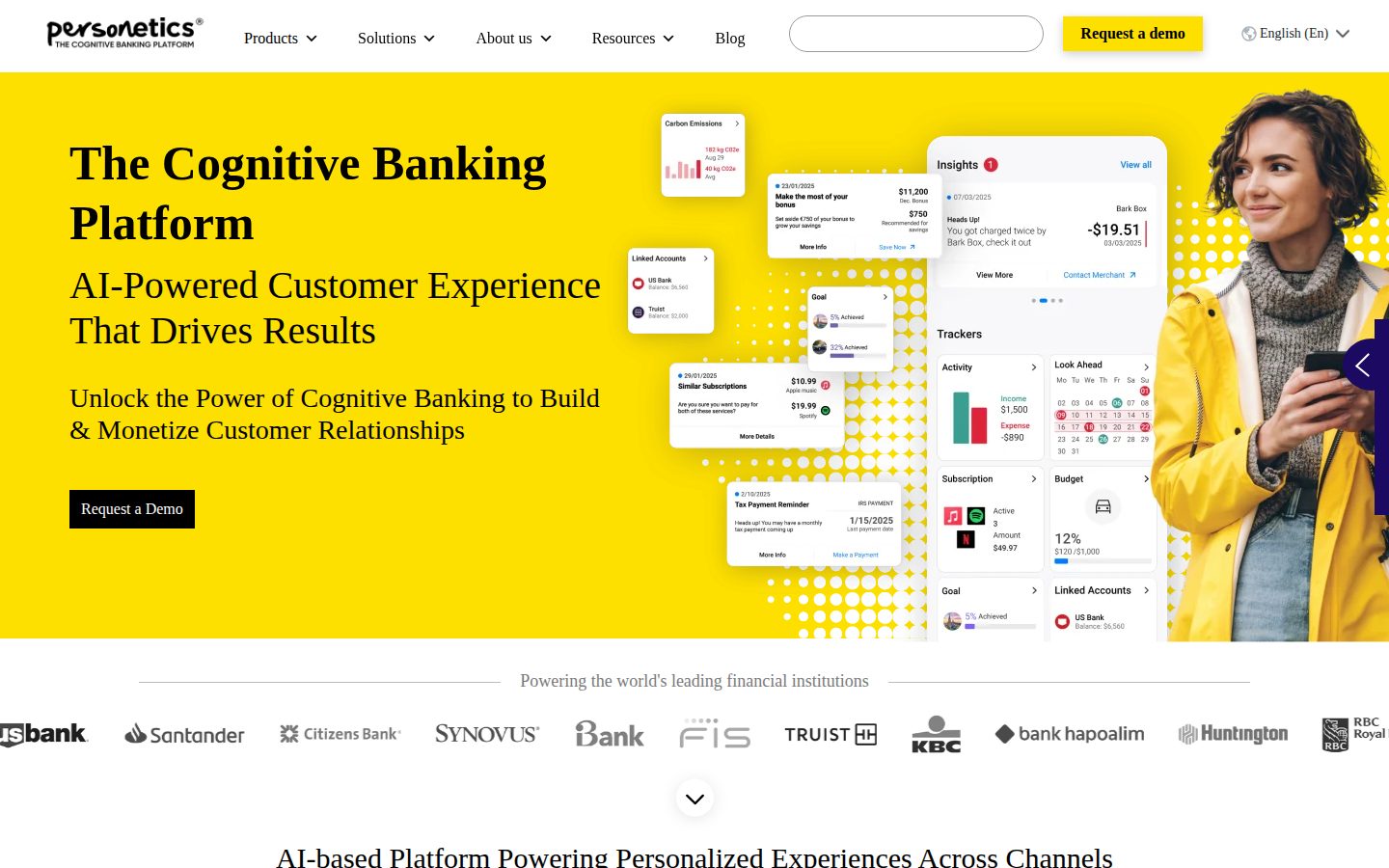
Personetics is a cognitive banking platform for banks and financial institutions that delivers AI-driven personalized financial insights and money management tools to their customers.
AI Panel Score
6 AI reviews
Reviewed
AI Editor ApprovedApproved and published by our AI Editor-in-Chief after full panel analysis.Banks integrate Personetics into their mobile and online banking platforms, where it processes customer transaction histories to surface contextual alerts, spending summaries, budget tracking, and automated savings triggers. End customers interact with the output through their bank's existing app or web interface, seeing personalized financial tips, cash flow forecasts, and goal-based savings journeys without leaving the banking experience they already use.
The platform offers several distinct capability areas: personal financial management (PFM) with data cleansing, enrichment, and categorization; hyper-personalized insights and advice designed to increase product engagement and cross-sell; goal-based savings automation including auto-save features; and a dedicated small business suite covering cash flow forecasting for both customers and relationship bankers. Personetics also provides what it calls Self-Driving Finance capabilities, which trigger automated financial actions on behalf of customers based on detected patterns. The system is delivered as a SaaS model, allowing banks to continuously receive new insight content without custom development.
Personetics is built exclusively for financial institutions — retail banks, credit unions, and digital banks — rather than end consumers directly. Pricing is not publicly listed; prospective customers are directed to request a demo, indicating an enterprise contract model. The company operates in a category that includes competitors such as MX Technologies, Bud Financial, Meniga, and Backbase, all of which offer varying degrees of transaction data enrichment and personalized banking experiences.
The platform supports deployment across web and mobile banking channels and is available in multiple languages including English, Italian, Portuguese, Spanish, Japanese, French, and German. Personetics has published integrations with Microsoft Azure infrastructure and Q2 Innovation Studio, and clients include Scotiabank, U.S. Bank, Huntington Bank, Santander, UOB, Erste Group, KBC, BMO, Ally, and Akbank, among others. The company reports serving 150 million monthly users across 30 global markets.

Analyzes individual customer transaction data to generate hyper-personalized, actionable insights covering expenses, budget management, and cash flow delivered at scale.
Uses transaction intelligence and context-driven financial strategies to proactively prompt customers toward deposit growth actions such as savings transfers and account openings.
Deciphers consumers' external banking relationships to provide a personalized, proactive approach that drives greater share of wallet for the bank.
Cleanses, enriches, and categorizes raw bank transaction data to make it actionable for downstream personalization and insight generation.
Enables customers to set savings goals and automates deposit journeys, including features like Auto-Save and Pay Yourself First, to grow and retain deposits.
Delivers proactive, automated financial guidance tools such as Heads-Up alerts and Money-Scout recommendations that act on the customer's behalf to improve financial wellness.
Provides advanced PFM and money management solutions including spending visibility, smart budgets, and savings opportunity identification embedded within the bank's digital channels.
Provides a SaaS-based model that allows banks to continuously add new insight content and improve existing insights, leveraging Personetics' global library built from experience across worldwide bank deployments.
Delivers a comprehensive suite of tools for small businesses and their bankers to monitor and forecast cash flow using transaction intelligence.
Allows banks to create custom financial trackers tailored to specific customer segments or use cases, as featured in the Spring Release highlights.
Enables banks to embed personalized marketing offers within customer financial insights journeys, as highlighted in the Spring Release product updates.
Surfaces real-time, personalized financial insights and automated saving plans within the bank's online and mobile banking platforms as customers interact with their accounts.
Enterprise-grade Cognitive Banking Platform for financial institutions. Personetics does not list public pricing; all engagements are custom and sales-led via a demo request.
Proven cognitive banking platform with 150M users and serious client logos.
“Personetics is an enterprise B2B2C play — banks buy it, customers use it. The client list includes Scotiabank, U.S. Bank, and Santander, which tells you this isn't a pilot-stage vendor.”
150 million monthly users across 30 markets isn't a vanity metric when it's backed by BMO, Ally, and Huntington Bank. No public funding data, but clients at that scale imply a vendor that's past survival mode. They've been at this long enough to build a global insight library banks can pull from without custom dev work.
The Self-Driving Finance capability — automated actions triggered by detected transaction patterns — is the differentiator versus MX Technologies or Meniga. The SaaS content model means banks aren't rebuilding insight logic from scratch every cycle. The tradeoff: pricing is fully opaque, and implementation timelines at banks are never fast.
This is a strategic bet, not a cost-save play. Auto-Save, Pay Yourself First, and the small business cash flow suite move the needle on deposit growth — that's revenue, not efficiency. If the board's asking why peers are winning on digital engagement, this is a defensible answer.
Self-Driving Finance automation and a global SaaS insight library differentiate it from Bud Financial and MX on depth.
The client roster — Santander, BMO, Ally, Erste Group — makes this an easy board conversation.
Embedding into existing digital channels reduces dev lift, but bank procurement and compliance cycles will stretch any payback timeline.
Goal-based savings automation and deposit growth tools advance revenue — this isn't just digitizing what banks already do.
No public funding data, but 150M users across 30 markets with Scotiabank and U.S. Bank as clients suggests durable commercial footing.
Retail or digital banks that want to move deposit growth and customer engagement through their existing app without rebuilding the underlying experience.
Your bank can't commit the integration bandwidth or procurement timeline a true enterprise implementation requires.
Enterprise-grade deposit intelligence for banks ready to monetize transaction data at scale.
“Personetics converts raw transaction data into revenue-driving engagement across 150 million monthly users in 30 markets. For banks evaluating MX Technologies or Meniga, this is the most scaled deployment footprint in the category.”
The client roster — Scotiabank, U.S. Bank, Huntington, Santander, BMO — isn't decorative. That's tier-1 validation across North America, Europe, and Asia-Pacific. The SaaS content library model means banks receive new insight logic without custom dev cycles, which keeps ongoing operating cost predictable versus bespoke builds.
The Self-Driving Finance capability and Auto-Save automation represent genuine revenue infrastructure, not just UX polish. Proactive deposit growth and share-of-wallet intelligence tied to external banking relationships are the CFO-relevant features here — they convert engagement spend into measurable deposit retention. Small business cash flow forecasting extends the ROI case into a segment most PFM platforms ignore.
The constraint is real: no public pricing, fully sales-led, no free trial. Budget cycle planning requires early vendor engagement, and switching costs post-integration are high. Banks should negotiate SLA terms and data portability clauses before signing — exit optionality on transaction data enrichment is the leverage point you won't recover later.
150 million monthly users dwarfs most competitors' disclosed scale; Meniga and Bud Financial operate at lower market reach with comparable feature sets.
Built exclusively for financial institutions — PFM, SMB cash flow forecasting, and banker-facing tools map precisely to retail banking's revenue and retention priorities.
Documented integrations with Q2 Innovation Studio and Microsoft Azure infrastructure indicate serious enterprise deployment patterns, not pilot-grade connectivity.
SaaS delivery reduces maintenance burden, but deep transaction data integration means switching costs are substantial after year one.
Hyper-personalized insights, Self-Driving Finance automation, and the SaaS insights library collectively represent library-grade depth built from 30-market deployments.
Retail banks and credit unions with 500K+ customers that want to monetize transaction data through deposit growth and engagement without building proprietary AI infrastructure.
Your institution needs transparent upfront pricing or a proof-of-concept environment before committing integration resources.
150 million users, zero public pricing — procurement starts blind here
“Personetics is enterprise-only, sales-led, no published rates. TCO is unknowable until you're already in the room.”
No pricing page. No tiers. No floor number. The demo request is the door, and the contract is behind it. Competitors MX Technologies and Meniga operate the same model — but opacity at this scale (150 million monthly users, 30 markets) suggests seven-figure ACV territory for any mid-size bank deployment. Year 3 TCO for a regional bank likely includes integration fees, SaaS subscription, and relationship banker tooling for the small business cash flow suite. None of that is estimable from public materials.
The SaaS content library model is the one legitimate TCO relief — banks don't rebuild insights custom, they pull from Personetics' global library. That reduces internal dev spend. But no changelog is published, so version cadence and what triggers renegotiation is opaque.
Auto-renewal terms, cancellation windows, and overage rates are undisclosed. No termination-for-convenience language visible. Client list includes Scotiabank, U.S. Bank, and Santander — these aren't SMB deals. Budget owners should assume 60-90 day notice windows and multi-year lock-in as category norm.
Sales-led only, no self-serve, no trial — procurement friction is high and vendor onboarding cost is unquantifiable.
No public contract terms; enterprise client roster (Scotiabank, Santander) implies multi-year lock-in as category norm.
Zero public pricing; no tiers, no floor, no ceiling — demo-only model with no signals.
Deposit growth and share-of-wallet metrics are named outputs, giving procurement a measurable hook — but bank-side attribution is complex.
SaaS model reduces custom dev cost, but integration, onboarding, and ACV are fully opaque based on their pricing page.
Regional or global banks with dedicated procurement and legal resources willing to negotiate a multi-year enterprise contract.
Your institution needs price discovery before a sales cycle or lacks bandwidth for a complex enterprise onboarding.
Serious B2B2C cognitive banking infrastructure — but implementation opacity is a real blocker
“Personetics is purpose-built enterprise infrastructure for banks, not a consumer app. 150 million monthly users across 30 markets signals real deployment scale, but zero public pricing, no public docs, and no changelog means due diligence runs almost entirely on trust.”
The client roster tells the story: Scotiabank, U.S. Bank, Santander, BMO, Ally. These aren't pilot customers. Banks at that tier don't run AI personalization at scale on vendors with weak integration stories. The Q2 Innovation Studio and Microsoft Azure hooks suggest the integration surface is real, not marketing copy. Transaction enrichment feeding into Self-Driving Finance automation — Auto-Save, Pay Yourself First, Heads-Up alerts — is a coherent capability stack, not feature soup.
The daily fight for any analyst evaluating this is information asymmetry. No pricing page, no changelog, no public API docs. MX Technologies publishes integration depth. Bud Financial publishes data model documentation. Personetics directs everyone to a demo request. That's a procurement timeline problem — budget conversations can't begin without contract engagement.
The tradeoff is straightforward: depth of personalization capability versus implementation opacity. Banks with dedicated fintech partnership teams can absorb that friction. Regional credit unions probably can't. The Small Business Cash Flow Forecasting suite is a genuine differentiator — most PFM competitors stop at retail.
SaaS content library model means banks get ongoing insight updates without custom dev, but no changelog evidence makes it hard to assess cadence or regression risk.
Website evidence shows blog but no docs, no changelog, and no API reference — what's public reads as marketing, not implementation guidance.
No public docs, no API reference, and contact-only pricing create procurement friction before a single line of integration work starts.
Custom Trackers, Integrated Marketing Offers, and External Banking Relationship Intelligence suggest genuine configuration depth for banks that can staff it — the Small Business suite adds a vertical layer competitors like Meniga don't match.
Embeds into existing bank digital channels rather than replacing them — the Q2 Innovation Studio integration confirms real channel-native deployment, not a bolt-on iframe.
Tier-1 and Tier-2 banks with dedicated fintech partnership teams that can absorb a long sales and integration cycle.
Your institution needs transparent pricing, public API documentation, or rapid proof-of-concept timelines before committing budget.
150 million users can't be wrong, but you'll never see a price tag
“Personetics is a serious B2B platform that embeds AI-driven financial guidance inside banks' existing apps. It's well-proven at scale — Scotiabank, U.S. Bank, Huntington — but it's entirely opaque to anyone without a sales meeting.”
Scotiabank. U.S. Bank. Santander. BMO. Ally. That's not a reference list you fake. Personetics has 150 million monthly users across 30 markets, which means the core engine — transaction enrichment, hyper-personalized insights, Self-Driving Finance nudges — has been stress-tested at a scale that MX Technologies and Meniga are still chasing. The SaaS content library is smart architecture: banks get new insight content without custom dev cycles, which is exactly what a product team at a mid-size credit union needs to hear.
The daily experience lives or dies inside whatever bank app the customer already uses, so Daily Polish and Mobile Parity aren't really Personetics' problem to own directly — and that's both the genius and the ceiling. If your bank's app is beautiful, the Auto-Save journeys and Heads-Up alerts feel seamless. If the bank's app is 2014 webview gray, Personetics can't save it.
No public pricing. No free trial. No changelog. Demo-request-only enterprise model means the onboarding experience for a prospective buyer is: fill out a form and wait. For a small bank or credit union evaluating this against Backbase, that friction is real.
Real-time personalized insights and goal-based savings journeys suggest careful UX thinking, but the experience is always mediated through the bank's own interface, limiting what Personetics directly controls.
The SaaS content library with continuous insight updates reduces the ongoing lift for bank product teams, but custom trackers and integrated marketing offers suggest real configuration complexity at implementation.
The platform deploys across iOS and Android inside bank apps, with real-time personalized insights and automated savings plans surfaced in mobile channels — not a read-only afterthought.
No free trial, no pricing page, and a demo-only sales model means institutional buyers face a long runway before seeing anything real — that's a lot of homework before the welcome mat.
150 million monthly users across 30 global markets with named enterprise clients like Scotiabank and U.S. Bank is strong evidence of production-grade reliability.
Mid-to-large financial institutions that want AI-driven engagement and deposit growth inside their existing digital channels without building it from scratch.
You're a startup, fintech, or small credit union that needs transparent pricing and a self-serve evaluation path.
150 million users is a real number. The rest needs scrutiny.
“Personetics has genuine enterprise traction — Scotiabank, U.S. Bank, Santander aren't vanity logos. But no public pricing, no changelog, no API docs, and a tagline ('Cognitive Banking') that smells like a rebrand waiting to happen.”
Three tells upfront. One: 'pioneer' is in the meta description — the kind of word companies use when they're worried about being called a fast follower. Two: no changelog visible. SaaS vendor with no public shipping cadence is a yellow flag. Three: the Self-Driving Finance label is the kind of superlative that ages poorly.
What's real: 150 million monthly users across 30 markets, named clients including BMO and Ally, and Q2 Innovation Studio integration. That's not vapor. Transaction data enrichment and categorization is genuinely hard to do well, and MX Technologies and Meniga have both struggled to scale globally. Personetics has.
The exit story is rough. You're embedded in core digital banking channels, custom-contracted, no public API docs. Migration off this isn't a weekend project — it's a bank procurement cycle. That's the real lock-in, and they know it.
Global multilingual deployment across 30 markets with named enterprise clients edges past Meniga and Bud Financial, though MX Technologies competes hard on enrichment quality.
Deep embedding in bank digital channels, enterprise-only contracts, and no public API documentation means exit cost is high and migration timeline is long.
No public funding data, no changelog, blog only — team signals are thin, but the enterprise contract base and global footprint suggest real operational stability.
'Cognitive Banking' and 'pioneer' are aspirational labels; no pricing transparency and no changelog undermines the SaaS credibility claim.
Client list includes Scotiabank, Santander, and U.S. Bank — category survivors, not pilot logos — and 150 million monthly users is a hard number to fake.
Mid-to-large financial institutions that want proven PFM and engagement tools embedded in existing digital channels without building in-house.
Your bank needs transparent pricing, fast procurement, or a clean exit path within 18 months.
Common questions answered by our AI research team
Personetics sits inside a bank's existing digital channels, embedding directly rather than replacing them.
Personetics analyzes customer transaction data, converting raw transactions into categorized, enriched, actionable guidance delivered as individualized insights, savings nudges, and financial wellness recommendations.
Yes, Personetics delivers personalized insights and guidance at scale across a bank's entire customer base.
Cognitive Banking is Personetics' AI-powered platform that builds and monetizes customer relationships by unlocking data-driven engagement between banks and their customers.
Personetics analyzes customer transaction data to generate individualized insights and savings nudges, turning raw data into actionable financial guidance that drives customer engagement.