Pipedream logo

Pipedream Review

Visit

Automate workflows and deploy AI agents across 3,000+ APIs

Pipedream is a workflow automation and AI agent platform for developers building integrations across APIs.

AI Panel Score

8.0/10

6 AI reviews

Reviewed

AI Editor Approved

About Pipedream

In practice, users create workflows through a visual builder or code editor that chains together triggers and actions across connected services. A workflow might watch for a new GitHub issue, then automatically create a corresponding Linear ticket, or pull emails into a categorization pipeline. Workflows can run on schedules ranging from every second to every quarter, or fire on webhooks and API events. The AI Agent Builder lets users describe what they want in plain text and generates runnable agent code from that prompt.

Pipedream highlights several distinguishing capabilities on its platform. It offers over 3,000 pre-built app integrations with managed authentication, meaning developers do not handle OAuth flows manually. An MCP (Model Context Protocol) server exposes more than 10,000 pre-built tools so AI agents can call external APIs directly. Built-in services include queues, key-value data stores, and one-click private networking. Pipedream Connect provides an end-to-end SDK for embedding any of these integrations into a third-party app or agent.

Pipedream targets developers at companies ranging from early-stage startups to Fortune 500 enterprises, claiming over one million developer users. It competes directly with Zapier, Make (formerly Integromat), Workato, Tray.ai, and AWS Lambda for workflow and integration use cases. The platform offers a free tier and paid subscription plans; specific paid pricing was not disclosed on the homepage.

Pipedream is a web-based platform with SOC 2 Type II, HIPAA, and GDPR compliance certifications. It has joined Workday, though it continues to operate under the Pipedream brand. Developers interact with the platform via a browser-based UI or through its SDK and API for programmatic access.

Features

AI

  • AI Agent Builder

    Allows users to prompt, run, edit, and deploy AI agents in seconds directly from the platform.

  • AI Code Generation

    Generates code for any API to help users build and deploy agents faster using AI-assisted prompting.

  • MCP Servers

    Provides access to 3,000+ APIs with 10,000+ tools that can be added to AI agents via Pipedream's MCP server.

Automation

  • Workflow Builder

    Enables building and automating processes that connect APIs using a visual workflow interface.

Core

  • Built-in Queue, Data Stores, and Private Networks

    Provides one-click built-in services including queues, data stores, and private networks to accelerate agent creation.

  • Managed Authentication

    Provides built-in managed authentication across 3,000+ integrated apps for use in agents and workflows.

Integration

  • Pipedream Connect

    An end-to-end developer SDK that enables embedding integrations into external apps or AI agents in minutes.

  • Pre-built Tools (Triggers and Actions)

    Offers 10,000+ pre-built triggers and actions that can be embedded directly in applications or AI agents.

Security

  • GDPR Compliance

    Platform is fully GDPR compliant and includes a DPA agreement to meet data privacy requirements.

  • HIPAA Compliance

    Platform is HIPAA compliant, supporting development teams that handle sensitive healthcare data.

  • SOC 2 Type II Certification

    Platform holds SOC 2 Type II certification as part of its security and compliance architecture.

Preview

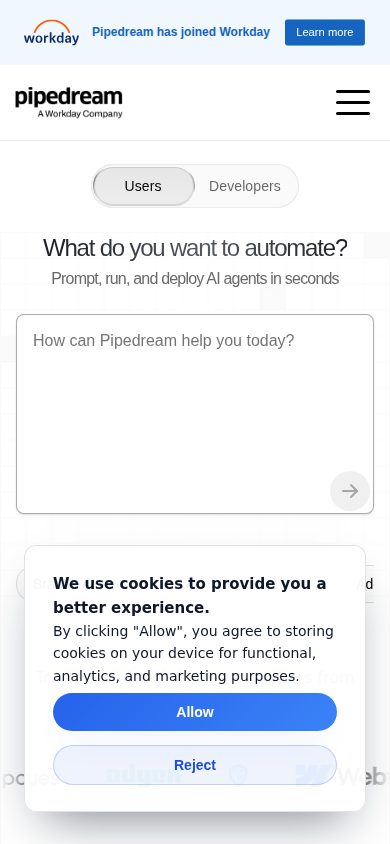
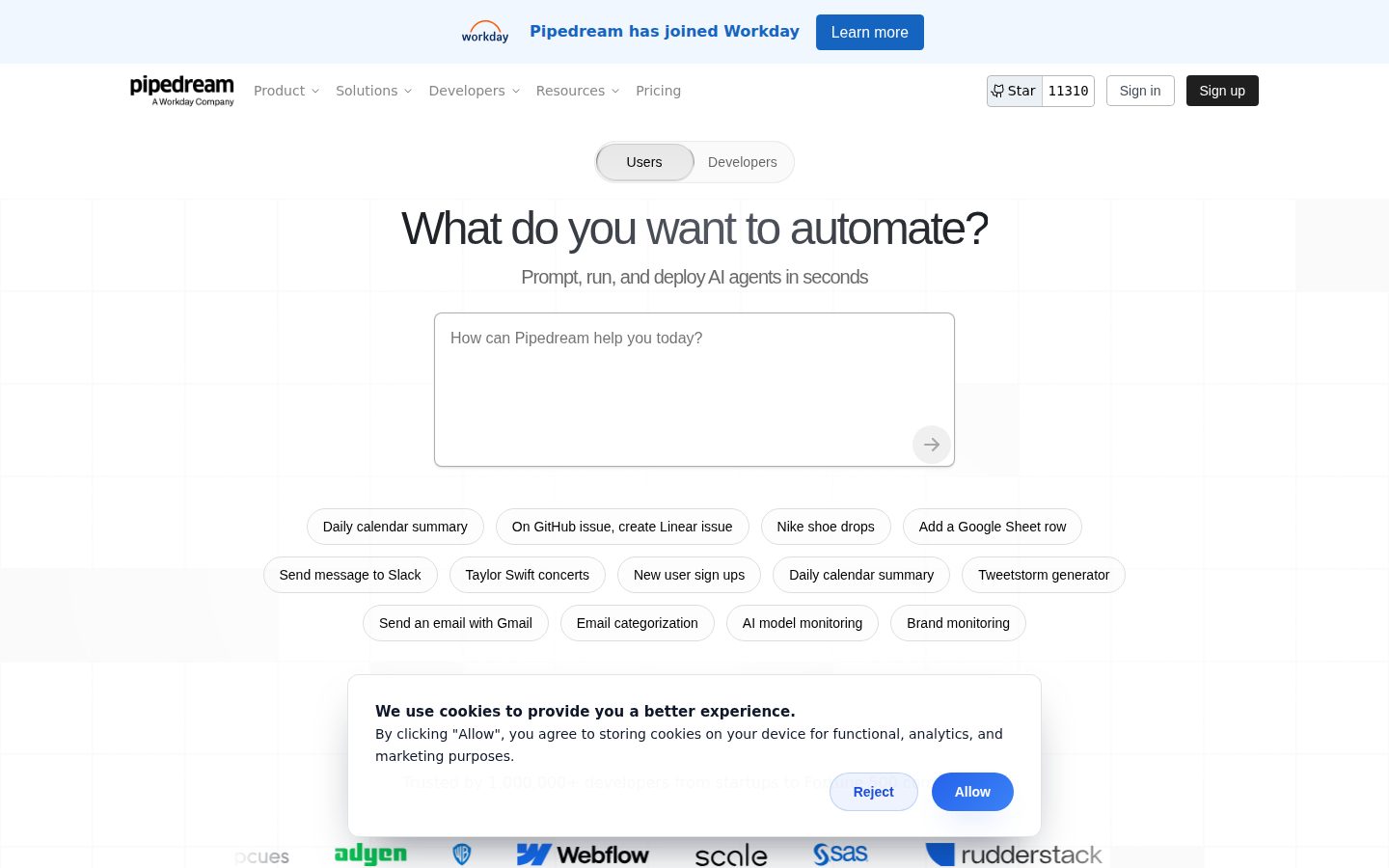
Pipedream desktop previewPipedream mobile preview

Pricing Plans

Free

Free

Generous free tier for individual developers building workflow automations. Includes daily credits, 3 active workflows, and access to all 3,000+ integrations.

  • 100 daily credits
  • 3 active workflows
  • Unlimited testing
  • All 3,000+ integrations
  • Custom code support
  • Public sharing

Basic

$19/month

Entry paid tier for individual developers running production workflows. Adds dedicated workers, longer execution windows, and access to private workflows.

  • 10,000 monthly credits
  • Unlimited active workflows
  • 30-second execution timeout
  • Dedicated worker
  • Private workflows
  • Email support
Popular

Advanced

$49/month

Mid-tier for serious workflow developers and small teams. Adds longer execution windows, more credits, and team workspace features.

  • 20,000 monthly credits
  • 5-minute execution timeout
  • Concurrent worker scaling
  • Team workspaces
  • Webhook history retention
  • Priority support

Business

$99/month

Top published tier for production teams running mission-critical automations. Includes SSO, audit logs, and priority worker scaling.

  • 50,000 monthly credits
  • 15-minute execution timeout
  • SSO and SAML
  • Audit logs
  • Priority worker scaling
  • SLA support
  • Dedicated infrastructure options

AI Panel Reviews

The Decision Maker

The Decision Maker

Strategic bet, vendor viability, timing, adoption approval
8.1/10

Developer-grade workflow automation with 3,000+ integrations and serious AI agent chops.

Pipedream is a strong bet for engineering teams that outgrew Zapier but won't build Lambda infrastructure. The Workday acquisition adds enterprise credibility without killing the brand.

One million developers. 3,000+ integrations. SOC 2 Type II, HIPAA, GDPR. That's not a scrappy startup pitch — that's a platform that's earned production trust. The Workday acquisition is the viability signal I'd show the board: this thing isn't getting pulled next quarter. Pricing starts at $19/month for Basic, with Business at $99/month including SSO and audit logs — defensible at every tier.

The MCP server exposing 10,000+ tools for AI agents is genuinely differentiated. Zapier can't touch that for developers who want code-level control. Pipedream Connect letting you embed integrations into your own product is a different category of value than workflow automation — that's a revenue-enabling capability. The tradeoff: the free tier caps you at 3 active workflows, so teams will hit the wall fast and face the upgrade conversation early.

Pilot it with one integration-heavy engineering team for 60 days. The $49/month Advanced tier is where the real capability lives.

Competitive Positioning7.8

Beats Zapier on code flexibility and AI agent depth; the MCP server with 10,000+ tools is a real differentiator competitors haven't matched publicly.

Reputation Risk8.0

Workday-backed, compliance-certified, developer-beloved — no board member will raise an eyebrow at this vendor choice.

Speed to Value8.3

AI Agent Builder deploys agents in minutes per their docs, and 10,000+ pre-built triggers mean teams aren't starting from scratch.

Strategic Fit8.2

Pipedream Connect and the AI Agent Builder advance product capability, not just internal cost savings — that's a different conversation with the board.

Vendor Viability8.5

Workday acquisition plus SOC 2 Type II certification and one million reported users makes the 36-month survivability question easy.

Pros

  • 10,000+ pre-built tools via MCP server puts AI agent development miles ahead of Zapier
  • Pipedream Connect SDK turns integrations into a product feature, not just internal glue
  • SOC 2 Type II, HIPAA, GDPR — compliance stack is complete for regulated industries
  • Managed OAuth across 3,000+ apps removes real developer pain

Cons

  • Free tier limits to 3 active workflows — teams hit the ceiling fast
  • Paid pricing isn't fully transparent on the homepage beyond the four published tiers
  • Workday ownership could slow product velocity or shift roadmap priorities over time

Right for

Engineering teams that need code-level API control and want to ship integrations into their own product without building OAuth infrastructure.

Avoid if

Your automation needs are purely no-code and owned by a non-technical ops team.

The Domain Strategist

The Domain Strategist

Craft and strategy in the product's domain — adapts identity per category, same lens
8.1/10

Developer-grade integration infrastructure with serious enterprise compliance already built in.

Pipedream has graduated from workflow toy to operational backbone — 3,000+ integrations, SOC 2 Type II, HIPAA, and a Workday acquisition signal durability. The ceiling question is whether credit-based execution pricing holds up under production load at scale.

10,000+ pre-built tools exposed via MCP server is not a demo feature — that's infrastructure depth that takes years to build and maintain. Managed OAuth across 3,000 apps means ops teams stop fielding tickets about broken token refreshes. Pipedream Connect as an embeddable SDK is the move that separates this from Zapier: you're not just automating internal workflows, you're shipping integrations as a product capability. The Workday acquisition adds institutional credibility without (so far) killing the developer-first posture.

The credit model at $99/month for 50,000 credits is the number I'd pressure-test before committing. High-volume production pipelines can burn through credit budgets faster than ops teams anticipate, and opaque overage pricing is where automation platforms quietly become expensive. Zapier has the same problem. If your team is running mission-critical, high-frequency workflows, get the enterprise quote before you're renegotiating mid-contract.

For a COO evaluating a 3-year operational bet, the compliance stack — SOC 2 Type II, HIPAA, GDPR — means legal won't block rollout, and the Workday backing means the vendor isn't disappearing. If you adopt this, in 3 years you have a standardized integration layer that developer teams can extend without spinning up dedicated infra. The risk is workflow sprawl: 3,000 integrations means ungoverned automation creep if you don't establish ownership norms early.

Category Positioning8.0

Sits above Zapier on developer capability, below Workato on enterprise sales motion — a strong default for dev-forward companies that aren't yet at Workato budgets.

Domain Fit8.0

Code-level control plus visual builder matches how developer-led ops teams actually split work between engineers and ops generalists.

Integration Surface8.5

3,000+ managed integrations with built-in queues, key-value stores, and private networking removes four categories of infrastructure ops teams otherwise hand-roll.

Long-term Implications7.8

Workday acquisition provides runway, but credit-based pricing and potential workflow sprawl are 18-month operational risks worth planning for now.

Strategic Depth8.3

MCP server with 10,000+ tools and Pipedream Connect SDK signal platform-grade thinking, not point-solution depth.

Pros

  • SOC 2 Type II, HIPAA, and GDPR compliance out of the box — legal and security reviews don't become blockers
  • Pipedream Connect SDK turns integrations into a shippable product feature, not just internal plumbing
  • Managed OAuth across 3,000+ apps eliminates an entire category of recurring ops maintenance
  • Workday acquisition signals vendor stability without (yet) compromising the developer-first product direction

Cons

  • Credit-based execution model at $99/month tier needs pressure-testing before high-frequency production commitment
  • Pricing page doesn't disclose enterprise or overage rates — budget predictability is unclear at scale
  • 3,000 integrations with no stated governance tooling creates real workflow sprawl risk for larger teams

Right for

Developer-led companies that need compliant, embeddable integration infrastructure without building and maintaining it themselves.

Avoid if

Your ops model runs extremely high-frequency, high-volume automations where credit-based pricing will compound unpredictably against fixed budgets.

The Finance Lead

The Finance Lead

Money, total cost of ownership, contracts, procurement math
7.8/10

$99/month gets SSO — rare in this category at that price

Four tiers, all published without a sales call. Credit-based billing introduces overage ambiguity at scale.

$0 free, $19 Basic, $49 Advanced, $99 Business. SSO included at $99 — Zapier charges enterprise rates for equivalent access. Three tiers visible without procurement involvement. That's clean.

50 users on Business: $99 × 12 = $1,188/year. But that's the seat-free model — credits are the variable. 50,000 monthly credits at Business. No public overage rate published. Year 3 cost depends entirely on workflow volume, and there's no invoice-predictable ceiling. That's the real exposure.

Pipedream Connect and the MCP server with 10,000+ tools are genuine differentiation — embedding integrations into external apps changes the build-vs-buy math for dev teams. Workato charges enterprise multiples for equivalent capability. Tradeoff: no published contract terms, auto-renewal window unclear from public docs. Procurement will ask. Plan for the conversation.

Billing & Procurement7.8

Monthly billing, self-serve up to $99 — procurement friction is low until enterprise custom pricing enters the picture.

Contract Flexibility6.5

Auto-renewal terms and cancellation windows aren't visible in public docs — Workday acquisition may complicate enterprise terms.

Pricing Transparency8.5

All four tiers published with credit counts and feature lists — no sales call required, SSO tier visible at $99.

ROI Clarity7.5

Credit-per-workflow model lets teams instrument usage, but no published benchmarks on credits-per-workflow type.

Total Cost of Ownership6.8

No published overage rate for credits makes year-3 modeling speculative for high-volume teams.

Pros

  • SSO at $99/month — no add-on tax
  • Four tiers fully published, no sales gate
  • 3,000+ integrations with managed auth included at every tier
  • Pipedream Connect SDK adds embedded-integration value unavailable at Zapier price points

Cons

  • No published overage rate for credit exhaustion
  • Auto-renewal and cancellation terms not visible publicly
  • Workday acquisition introduces long-term pricing risk
  • 3 active workflow cap on free tier limits real evaluation depth

Right for

Developer teams building API-heavy automations who need embedded integration capability without enterprise contract overhead.

Avoid if

Finance teams need a hard monthly ceiling — unpublished overage rates make budget commitments difficult.

The Domain Practitioner

The Domain Practitioner

Daily hands-on reality in the product's domain — adapts identity per category, same lens
8.1/10

3,000 integrations, managed auth, and no OAuth headaches — ops teams will notice.

Pipedream punches above its price point for ops teams running multi-system automations. The credit-based execution model is the one thing worth stress-testing before committing.

The 3-workflow cap on the free tier will hit you by Tuesday. But the $19 Basic plan unlocks unlimited active workflows with dedicated workers — that's the real starting point for anyone running production automations. Managed auth across 3,000+ apps is the feature that quietly earns its keep. No OAuth token juggling, no credential rotation incidents, just connected services. Compared to Zapier, where auth failures are a weekly ops ritual, that's a meaningful difference.

The credit system is the daily friction point. Every execution burns credits, and at 10,000 monthly credits on Basic, a high-frequency webhook workflow can chew through that fast. The 30-second execution timeout on Basic also creates real constraints for anything touching slow APIs or sequential processing. Advanced at $49 extends that to 5 minutes — which is probably where most serious ops workflows actually land.

The AI Agent Builder and MCP server with 10,000+ pre-built tools are genuinely useful scaffolding, not demo-ware. Pipedream Connect for embedding integrations into external apps is a different product category — that's for builders, not ops practitioners running internal automations. SOC 2 Type II and HIPAA compliance mean this clears procurement for most regulated environments without a fight.

Day-3 Reality7.8

Unlimited workflows on paid tiers and managed auth reduce daily maintenance, but credit burn monitoring becomes a new operational habit.

Documentation Practitioner-Fit8.0

Changelog and API docs are public-facing signals that the team builds in the open — docs=Y and changelog=Y both present on the platform.

Friction Surface7.5

Credit limits and execution timeouts create ceiling friction on Basic; the 5-minute timeout on Advanced at $49 is where real workflows breathe.

Power-User Depth8.4

Code editor alongside visual builder, custom code support on free tier, and concurrent worker scaling on Advanced shows a genuine progression path.

Workflow Integration8.3

Webhooks, schedules down to every second, and 10,000+ pre-built triggers map naturally to how ops automation actually gets triggered.

Pros

  • Managed auth across 3,000+ apps eliminates a whole category of credential maintenance work
  • Execution scheduling from every second to quarterly covers the full ops automation range
  • SOC 2 Type II, HIPAA, and GDPR clears procurement in regulated industries without custom negotiation
  • Visual builder and code editor coexist — ops generalists and developers can share the same workflows

Cons

  • Credit-based execution model requires monitoring — high-frequency workflows can exhaust 10,000 monthly credits faster than expected
  • 30-second timeout on $19 Basic is a real constraint for workflows hitting slow third-party APIs
  • Paid pricing beyond the four published tiers isn't disclosed, making enterprise budget planning opaque
  • Workday acquisition creates organizational uncertainty for teams making multi-year platform bets

Right for

Ops teams at developer-led companies running multi-system automations who need managed auth and compliance without building infrastructure.

Avoid if

Your automation volume is high-frequency enough that credit limits become a weekly budgeting exercise rather than a background concern.

The Power User

The Power User

Daily human experience, onboarding, polish, learning curve, reliability
8.1/10

Developer-first automation that finally doesn't treat you like a Zapier tourist

Pipedream packs 3,000+ integrations, an AI agent builder, and managed OAuth into a stack that actually respects how developers work. The free tier is real, the paid tiers are honest, and the code-level control is the point.

The thing that'll hook you fast is managed authentication across 3,000+ apps. No OAuth juggling, no credential headaches. You just connect and build. The AI Agent Builder — describe what you want, get runnable code — is exactly the kind of shortcut that feels like cheating until you realize it just works. At $49/month for the Advanced tier you're getting 5-minute execution windows, concurrent workers, and team workspaces. That's a real production setup, not a demo.

Three months in, the credit system is where you'll feel friction. Daily and monthly credit caps mean you're occasionally watching a number instead of shipping. Zapier has similar pain but different packaging — Pipedream's ceiling feels higher before you hit it.

Mobile is basically read-only. For a tool that runs your infrastructure, that's fine — but don't expect to debug a broken workflow from your phone. Web-only is the honest shape of this product, and it doesn't pretend otherwise.

Daily Polish7.8

The visual workflow builder plus code editor toggle suggests someone thought about the daily dev rhythm, though pricing page omits specifics that power users need quickly.

Learning Curve7.5

AI code generation lowers the floor, but 10,000+ pre-built tools means month three discovery is a real activity — the breadth takes time to map.

Mobile Parity4.5

Web-only platform — monitoring a live agent from a phone isn't a use case Pipedream supports, which stings when something breaks at 9pm.

Onboarding Experience8.2

Free tier includes all 3,000+ integrations and unlimited testing — that's a real sandbox, not a crippled demo, which makes day one feel generous.

Reliability Feel8.0

SOC 2 Type II, dedicated workers at $19/month, and built-in queues and data stores signal infrastructure the team actually thought through.

Pros

  • Managed auth across 3,000+ integrations — no OAuth plumbing required
  • AI Agent Builder generates runnable code from a plain-text prompt
  • Pipedream Connect SDK lets you embed integrations into your own app
  • SOC 2 Type II, HIPAA, and GDPR — compliance box fully checked

Cons

  • Credit-based limits (100 daily on free, 20,000 monthly on Advanced) add cognitive overhead
  • Paid pricing details weren't on the homepage — you have to dig
  • Mobile experience is basically nonexistent for active monitoring
  • Acquired by Workday, which introduces long-term product direction uncertainty

Right for

Developers who need real API control, managed auth, and agent deployment without babysitting infrastructure.

Avoid if

Your team is non-technical and expects a no-code experience closer to Zapier's point-and-click simplicity.

The Skeptic

The Skeptic

Contrarian. Watch-outs, deal-breakers, broken promises, category patterns
7.8/10

3,000 integrations, Workday's money — two green flags, a few open questions

Pipedream has real infrastructure depth and a credible acquirer behind it. The Workday acquisition cuts both ways: stability plus the quiet risk of enterprise drift away from its developer roots.

Three quick tells. One: 'fastest way to build' is in the meta — the kind of superlative that ages poorly. Two: specific paid pricing wasn't on the homepage; I had to find it via the plans data. Three: the Workday acquisition is mentioned almost in passing. That's a lot to bury.

The actual feature set is solid. 10,000+ pre-built tools, managed OAuth across 3,000+ apps, built-in queues and key-value stores — that's not vaporware. Pipedream Connect as an embeddable SDK genuinely differentiates from Zapier, which has no equivalent for embedding into your own product. $19/month Basic gets you unlimited workflows; $49 Advanced unlocks team workspaces. Pricing ladder is reasonable and visible, which I'll credit.

The exit story is mixed. Workflows are code-friendly, which helps portability versus Make or Tray.ai. But managed auth and Connect integrations create real lock-in. If Workday redirects roadmap toward enterprise and abandons the developer tier, migration gets ugly fast. Worth watching the changelog cadence over the next two quarters.

Competitive Differentiation8.1

Pipedream Connect's embeddable SDK and 10,000+ MCP tools for AI agents are a real gap vs. Zapier and Make, which have no equivalent developer-embedding story.

Exit Portability6.5

Code-based workflows help, but Pipedream Connect SDK and managed auth create meaningful lock-in that complicates any migration off-platform.

Long-term Viability7.5

Workday acquisition provides runway stability, but enterprise parent priorities could erode the developer-first roadmap — could go either way over 36 months.

Marketing Honesty7.2

Claims are mostly grounded — 3,000 integrations and SOC 2 Type II are verifiable — but 'fastest way to build' and buried Workday ownership are minor trust dents.

Track Record Match7.8

One million developer users claimed, SOC 2 Type II certified, changelog present — pattern matches survivors like Zapier at early scale, not the acqui-hires that went quiet.

Pros

  • 10,000+ pre-built tools with managed auth — no manual OAuth wiring
  • Pipedream Connect SDK is a genuine differentiator for teams building their own products
  • SOC 2 Type II, HIPAA, and GDPR all present — compliance box is real, not performative
  • Visible, reasonable pricing ladder from $0 to $99/month with clear tier logic

Cons

  • Workday acquisition introduces enterprise roadmap risk — developer tier could deprioritize fast
  • Managed auth and Connect create stickier lock-in than the code-first pitch implies
  • Free tier caps at 3 active workflows and 100 daily credits — narrow for real testing
  • No public funding history visible; Workday ownership opacity is a flag worth tracking

Right for

Developers who need embeddable integrations inside their own product and want to skip OAuth infrastructure entirely.

Avoid if

Your team needs predictable vendor independence — the Workday ownership and Connect lock-in make exit planning harder than it looks.

Buyer Questions

Common questions answered by our AI research team

Security

Is Pipedream HIPAA compliant?

Yes, Pipedream is HIPAA compliant, along with SOC 2 Type II and full GDPR compliance.

Integration

How many apps does Pipedream integrate with?

Pipedream integrates with 3,000+ apps, offering 10,000+ pre-built tools (triggers and actions).

Features

Can I embed Pipedream integrations into my own app?

Yes, Pipedream Connect is an SDK that embeds integrations directly into your app or agent in minutes.

Setup

How quickly can I deploy an AI agent?

AI agents can be prompted, run, edited, and deployed in minutes or seconds using the AI Agent Builder.

Pricing

Does Pipedream have a free trial?

Yes, both the AI Agent Builder and Workflow Builder offer a "Try for free" option.

Product Information

  • Founded

    2019
  • Pricing

    Freemium
  • Free Trial

    Available
  • Free Plan

    Available

Platforms

web

About Pipedream, Inc.

Pipedream is a developer-focused integration platform based in San Francisco that enables connecting APIs, building event-driven workflows, and automating processes with code or pre-built components.

Resources

Documentation
API
Blog
Changelog

Also in AI Workflow Automation