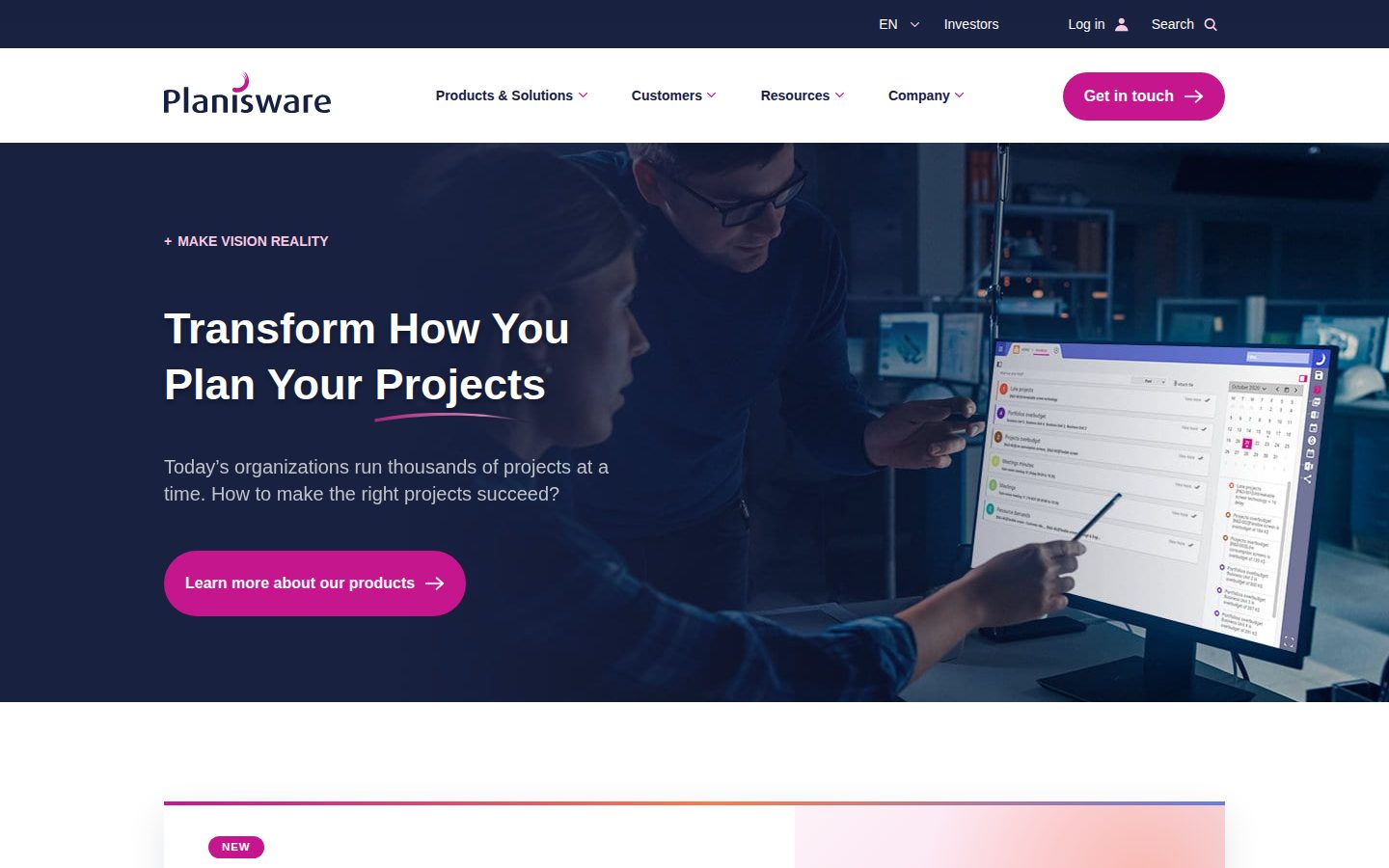
Strategic portfolio management software for enterprise project decisions
Planisware is a strategic portfolio management platform for organizations running large-scale project portfolios.
AI Panel Score
6 AI reviews
Reviewed
AI Editor ApprovedApproved and published by our AI Editor-in-Chief after full panel analysis.Planisware brings project portfolio data into a single system where teams score and prioritize initiatives, plan resources and capacity, track budgets and actuals, and run scenario models before committing to strategic decisions. Users interact with dashboards and reporting tools to monitor project status, resource utilization, and financial performance across programs, and can run what-if scenarios to compare potential outcomes before allocating funds or staff to new work.
The platform includes Prisma, a conversational AI layer that connects large language models to live Planisware data, letting users ask questions about their portfolio in natural language, generate reports and decks from a single prompt, and request updates to costs or schedules that go through an approval gate before being applied. Other named capabilities include context-aware digital agents that automate reporting, scheduling, and data validation workflows; predictive AI modeling for assessing project risk and likely outcomes; and a Particle Swarm Optimization algorithm that computes resource and timing tradeoffs across an entire portfolio in seconds. Planisware is packaged into several product lines: Planisware Enterprise for large-scale portfolio and resource management, Planisware Orchestra as a preconfigured PPM solution for PMOs, Planisware Horizon for IT strategic portfolio management, and Planisware Nova for product development portfolios, alongside offerings for professional services and engineering/construction firms.
Planisware is built for large and mid-size organizations with formal project management offices (PMOs) or portfolio management functions, particularly in industries like pharma, biotech, IT, engineering, construction, and professional services. It competes in the project and portfolio management (PPM) and strategic portfolio management (SPM) software category alongside vendors such as Broadcom (Clarity PPM), ServiceNow SPM, Planview, and Microsoft Project. Pricing is not published on the website and is provided on request through a sales demo.

An optimization engine that balances resources, timing, and constraints across an entire portfolio in seconds.
Uses AI predictive modeling to assess likely project outcomes, timing, and risks to build confidence in plans.
An AI-native layer that connects frontier AI models to live Planisware data, letting users ask questions in natural language, generate reports and decks from live data, and update costs and schedules with approval-gated changes.
Integrates reporting, analytics, and scenario modeling to give leaders actionable insights into portfolio performance, resource utilization, and risk exposure before committing to strategic moves.
Offers real-time visibility into resource availability, skills, and workloads across projects, programs, and portfolios to optimize utilization.
Context-aware agents that automate reporting and scheduling, run workflows, answer questions, and validate project data.
Serves as a centralized repository for project data, tasks, documentation, and status updates to foster transparency and accountability among team members.
Provides forecasting capabilities, AI-driven trend analysis, and flexible planning tools that let teams pivot as priorities shift.
Centralizes budgets, forecasts, schedules, resources, and actuals at the enterprise level to support financial planning across the project portfolio.
Centralizes project information and standardizes processes to help organizations deliver more projects on time, within scope, and with higher stakeholder satisfaction.
Structured methods to score, compare, and prioritize initiatives so portfolios reflect organizational vision and maximize return.
Offers tailored product editions such as Planisware Enterprise, Orchestra, Horizon, and Nova, plus Professional Services and Engineering & Construction solutions, configured for specific organizational needs like IT strategic portfolio management or product development.
Planisware does not publish official list pricing; it is sold via custom enterprise quotes based on organization size, number of users, and deployment scope. Planisware's pricing is not readily available as a fixed amount and is custom-quoted based on the specific needs and scale of the organization.
Multiple independent software-comparison sites report a starting reference price per user/month, though this figure does not come from Planisware's own pricing page (which is not public). Actual enterprise deployments can be much higher — one analysis estimates a typical enterprise might spend $100,000+ annually, while a smaller deployment could still start around $30,000-$50,000.
Old-guard PPM vendor with real staying power, priced like it knows it.
“Planisware has decades in pharma and engineering portfolios, not a startup story. The AI layer is new paint on a proven engine.”
No IPO, no funding rounds in the evidence, no headcount numbers. That's usually a red flag. Here it reads differently — this is a company that's been quietly running enterprise portfolios for years without needing venture money to survive, which competitors like Planview and Broadcom's Clarity PPM can't all claim.
The Particle Swarm Optimization engine and Prisma AI layer are genuinely named, specific capabilities, not vague AI-washing. But $30K-$50K minimum, scaling past $100K annually per third-party estimates, means this isn't a pilot-and-see purchase. No free trial, no public pricing — you're committing before you've touched it.
Boards don't blink at PPM spend for pharma or construction firms. They ask why it took this long to centralize budgets and resourcing.
Sits alongside Planview and ServiceNow SPM as a credible SPM pick, not a fringe alternative.
Established in regulated industries like biotech and engineering, a safe, unsurprising pick for a board.
No free trial and custom implementation typical of enterprise PPM tools mean a slow, quote-driven ramp.
Centralizes budgets, scenarios, and resourcing into one system rather than just trimming cost on existing spreadsheets.
Long-standing category presence across pharma, IT, and construction suggests real staying power despite no public funding data.
Large organizations with a formal PMO managing hundreds of projects across pharma, IT, or construction.
You're a mid-size team without a dedicated portfolio function or budget for six-figure PPM software.
This is a multi-year operating decision, not a software purchase, and the budget confirms it.
“Planisware is built for organizations that already run formal PMOs and need portfolio-level financial control, not task tracking. The cost and implementation lift are real, but so is the strategic ceiling versus lighter PPM tools.”
Third-party estimates put enterprise deployments at $100,000+ annually, smaller ones at $30,000-$50,000, with no published pricing on the site itself. That's a board-level line item, and I'd want a 3-year TCO model before signing, not a demo afterglow. The Particle Swarm Optimization engine and Prisma AI layer are genuinely differentiated versus Microsoft Project or generic Planview implementations, but that depth is wasted if our PMO isn't mature enough to feed it clean actuals.
The four product lines (Enterprise, Orchestra, Horizon, Nova) tell me they've productized for different portfolio maturity levels, which matches how real organizations actually segment IT, pharma, and construction portfolios. Once budgets, resourcing, and scenario models live here, switching costs compound fast. That's the tradeoff: strategic control today, vendor dependency for years.
Against Broadcom Clarity and ServiceNow SPM, Planisware reads as the specialist's choice, not the safe enterprise-suite default. Approval-gated AI updates to costs and schedules are the right governance instinct for auditability.
Sits above Microsoft Project and general PPM tools, competing directly with Broadcom Clarity and ServiceNow SPM.
Four tailored editions (Enterprise, Orchestra, Horizon, Nova) match how PMOs actually segment by maturity and industry.
Positioned as system of record for budgets, actuals, and resourcing, but no public API or docs evidence to assess.
Deep financial and resource data lock-in; estimated $30K-$100K+ annual spend raises switching costs materially.
PSO optimization engine and scenario modeling go beyond typical PPM reporting dashboards.
Organizations with an established PMO managing large, multi-project portfolios across finance, resourcing, and scenario planning.
Avoid if your team needs lightweight task tracking or lacks the budget and PMO maturity to justify enterprise SPM.
No published pricing. Third parties peg it at $30K-$100K+ a year. Believe the higher number.
“Planisware sells exclusively through custom quotes. Third-party estimates put a typical enterprise deployment north of $100K annually — no sticker on the site to check that against.”
No pricing page. Zero. Starting price of $45 in this listing comes from third-party comparison sites, not Planisware. That's a signal, not a number.
TCO math, best guess: smaller deployments cited at $30K-$50K/year. Typical enterprise: $100K+/year. Add implementation, configuration, training — the evidence flags 'custom implementation typically required.' Multi-year contract, custom-quoted, means your renewal terms are whatever your rep negotiated in year one. No visibility into auto-renewal windows or termination clauses from public materials.
Compare to Planview or Broadcom's Clarity PPM — same category, same opacity problem. Microsoft Project undercuts all three on sticker but lacks the Particle Swarm Optimization engine and Prisma AI layer here. Feature depth is real. Procurement friction is real too — budget owners walk in blind and negotiate against a black box.
Sales-demo-gated quoting means procurement cycle starts with zero price anchor.
No public data on renewal terms or cancellation; enterprise SPM category norm is multi-year lock-in.
No public pricing; even the $45 figure cited here is third-party, not vendor-published.
Particle Swarm Optimization and scenario modeling give measurable planning outputs, but no published benchmark data.
Estimates range $30K-$100K+/year before implementation and training costs are added.
Large organizations with a formal PMO and budget authority to negotiate six-figure enterprise contracts.
Avoid if your finance team needs a comparable number before booking a sales call.
Built for the steering committee, not the Monday status update grind.
“Planisware nails portfolio-level scenario planning and financial roll-up for PMOs juggling hundreds of projects. Whether the day-to-day project manager enjoys living in it is a separate question the demo won't answer.”
Every SPM tool demos beautifully at the portfolio level — dashboards, what-if scenarios, the Particle Swarm Optimization engine crunching resource tradeoffs in seconds. My question is always what Tuesday looks like for the PM entering actuals and chasing status updates. That layer is thinner in the evidence than the strategic layer.
Prisma's natural-language querying and approval-gated schedule updates are the right instinct — most PMOs still fight Excel exports for this. But four product lines (Enterprise, Orchestra, Horizon, Nova) means the actual day-3 workflow depends entirely on which edition you're quoted, and pricing being contact-only (with third-party estimates ranging $30K-$100K+ annually) makes it hard to know what you're actually buying into before a sales cycle.
Compared to Planview or ServiceNow SPM, Planisware's financial rigor for pharma and engineering PMOs is a real differentiator. It's built for the PMO director's chair, not the individual contributor's weekly update — that's a fine tradeoff if you know which seat you're buying for.
Strong at portfolio scenario modeling; no evidence of how individual contributors log time or status day-to-day.
No docs, API, or blog surfaced in the evidence — capability audit shows docs=N across the board.
No published pricing or free trial means friction starts before the tool is even touched — demo-gated from day one.
PSO optimization engine and Prisma's approval-gated schedule/cost updates indicate real depth for power users managing complex portfolios.
Four separate editions (Enterprise, Orchestra, Horizon, Nova) suggest workflow fit varies heavily by which one you're sold.
Enterprise PMOs in pharma, IT, or engineering running formal portfolio governance across hundreds of projects.
You're a lean team wanting self-serve pricing, a free trial, or lightweight task tracking rather than portfolio strategy.
A powerhouse for PMOs, but you'll need a badge to get in the building.
“Planisware is built for people who live in spreadsheets of spreadsheets, not people who open a tool for five minutes between meetings. It's deep, it's serious, and it makes you work for it.”
No pricing page, no free trial, platforms: web only. Everything about the setup says 'talk to sales,' and third-party estimates put real deployments at $30,000 to $100,000+ a year. That's not a knock, that's just what enterprise SPM software costs — same ballpark as Planview or Broadcom's Clarity PPM.
The feature list is genuinely deep. Particle Swarm Optimization crunching portfolio tradeoffs in seconds is a real capability, not vaporware buzzwording, and Prisma letting you ask your portfolio questions in plain English with approval-gated changes is smart design — somebody thought about audit trails, which matters when you're moving budget line items.
But this is homework-first onboarding. Four product lines (Enterprise, Orchestra, Horizon, Nova), industry-specific editions, custom implementation — you're not exploring this on a Tuesday afternoon, you're scheduling a demo and a project plan just to get started. Web-only means your PMO director checks it from a desk, not a hallway. Three months in, if your org has the PMO muscle to feed it, it probably earns its keep. If you don't, it'll feel like driving a freight train to the corner store.
Feature depth (scenario modeling, Gantt charts, financial tracking) suggests care, but no evidence of UI refinement or empty-state thoughtfulness.
Four distinct product lines and industry editions mean real depth but a steep climb from first hour to competence.
Platforms listed as web only — no mobile story at all for an always-on portfolio tool.
No free trial, no public pricing, sales-gated access — first ten minutes is a phone call, not a product tour.
Approval-gated changes in Prisma and audit-friendly architecture signal a system built for governance, not casual use.
Large enterprises with an established PMO managing hundreds of projects across budgets and resources.
You're a mid-size team wanting quick setup, mobile access, or transparent pricing.
No pricing page, no docs, no API listed. Sales-led all the way down.
“Planisware's been around since the 90s doing PPM for pharma and construction — that's real staying power. But the AI layer feels grafted on top of a legacy platform, and everything about buying it says enterprise lock-in.”
Planisware isn't new. Pharma, biotech, engineering firms have run portfolios on this for decades — that's the kind of track record you can't fake. Broadcom's Clarity PPM and Planview have survived the same era. Good company to be in.
Prisma is the tell to watch. 'Ask anything in natural language,' approval-gated updates, model-agnostic — that's the current PPM industry script, and everyone's running it now including ServiceNow SPM. Doesn't mean it's bad. Means I'd want a demo, not a landing page, before believing it.
Zero public pricing. Third-party estimates put it at $45/user/month reported, but real deployments run $30K-$100K+ annually per the evidence. No docs, no API, no changelog listed. That's normal for enterprise PPM — but it also means you're fully sales-led and re-implementation off this is a multi-quarter project, not a export button.
PSO engine is a real technical differentiator, but Planview and Clarity PPM offer comparable scenario modeling.
No API or docs listed publicly; enterprise PPM migrations are typically multi-quarter, custom-configured efforts.
Decades of enterprise deployment in regulated industries beats most SPM entrants, though no public funding/team data given.
Prisma's AI claims read aspirational; 'in seconds' PSO optimization is unverifiable from public evidence.
Long-standing pharma/engineering PMO base and four product lines suggest a mature, surviving vendor, not a hype cycle entrant.
Large PMOs in pharma, construction, or IT that need enterprise-grade scenario modeling and can absorb a long sales cycle.
You want transparent pricing or a self-serve trial before committing budget.
Common questions answered by our AI research team
Prisma is Planisware's AI native operating layer that connects frontier AIs to your live Planisware data. It lets you ask questions about your portfolio in natural language, generate reports and decks from live data with one prompt, and update costs and schedules with every change approval-gated, all in a governed, auditable, model-agnostic system.
The Particle Swarm Optimization engine balances resources, timing, and constraints across an entire portfolio in seconds, helping automate portfolio optimization decisions.
Yes. Prisma lets you ask anything about your portfolio in natural language and connects frontier AIs to your live Planisware data so you can get answers and generate reports without navigating menus.
Planisware Enterprise is built for business transformation at scale, integrating budgets, forecasts, schedules, resources, and actuals at the enterprise level. Planisware Orchestra is a turnkey PPM solution designed for PMOs to quickly streamline project decision-making, foster collaboration, and enforce best practices.
Yes. Planisware Horizon is built for IT Strategic Portfolio Management, integrating projects and IT information to shape and align investments, reduce technical debt, and accelerate transformation.


Planisware is a France-based provider of project portfolio management and strategic planning software for enterprises.