Smartsheet logo

Smartsheet Review

Visit

Work management platform with AI-powered workflows and project automation

Smartsheet is a work management platform for teams that need to plan, track, and automate projects and workflows.

AI Panel Score

7.9/10

6 AI reviews

Reviewed

AI Editor Approved

About Smartsheet

In practice, users work within grid, card, Gantt, or calendar views to manage tasks, timelines, and team assignments. Workflows can be automated to trigger notifications, update rows, or move data between sheets based on defined conditions. Templates are available for common use cases, reducing setup time for new projects.

Smartsheet highlights its AI layer as a core differentiator, positioning it to predict outcomes and adapt to how individual teams work. The platform supports cross-sheet reporting, dashboards for real-time visibility, and integrations with tools such as Microsoft 365, Google Workspace, Salesforce, and Slack. Enterprise-grade controls including permissions, audit logs, and admin management are available at higher tiers.

Smartsheet targets teams ranging from small groups to large enterprises, with particular positioning around enterprise scalability. Paid plans start at a per-user monthly subscription. It competes directly with Monday.com, Asana, Wrike, and Microsoft Project, and overlaps with general-purpose tools like Notion and Airtable in certain use cases.

Smartsheet is delivered as a web application with companion iOS and Android mobile apps. Its API allows programmatic access to sheets and data, enabling custom integrations and automation beyond the native connector library.

Features

AI

  • Smartsheet AI

    Embedded AI that helps users write formulas, summarize sheet data, generate project briefs, surface status insights, and build automation logic directly within the platform.

Analytics

  • Dashboards & Reporting

    Real-time dashboards that aggregate data across sheets to display live KPIs, project health, capacity, and risk for stakeholder visibility.

Automation

  • Bridge: Intelligent Workflows

    Advanced multi-system workflow builder that connects Smartsheet to third-party tools and APIs without code for complex cross-platform automation.

  • Workflow Automation

    No-code automation engine that triggers approvals, alerts, record updates, and row actions based on time or data changes without writing code.

Core

  • Brandfolder Digital Asset Management

    Enterprise DAM platform for storing, organizing, sharing, and analyzing brand assets, connected to Smartsheet workflows for creative operations teams.

  • Control Center

    Portfolio management add-on that automates the setup of new projects from templates and rolls up data across an entire portfolio for enterprise PMOs.

  • Gantt Chart View

    Displays project timelines with dependency management, critical path analysis, and milestone tracking in a visual Gantt interface.

  • Multiple Work Views

    Allows teams to view and manage work in grid, card, Gantt, or calendar views to match different working styles and project needs.

  • Resource Management

    Provides capacity planning and utilization visibility across people and projects at the portfolio level.

Customization

  • WorkApps

    Lets teams build custom, role-based portals on top of Smartsheet data so different stakeholders get a tailored experience without accessing raw sheets.

Integration

  • Integrations

    Natively connects with Microsoft 365, Google Workspace, Salesforce, Jira, Slack, Adobe Creative Cloud, and ServiceNow, plus a REST API and Zapier/webhook support.

Security

  • Dynamic View

    Provides controlled, need-to-know access to sheet data so different users see only the rows and columns relevant to them for vendor, client, or internal request workflows.

Preview

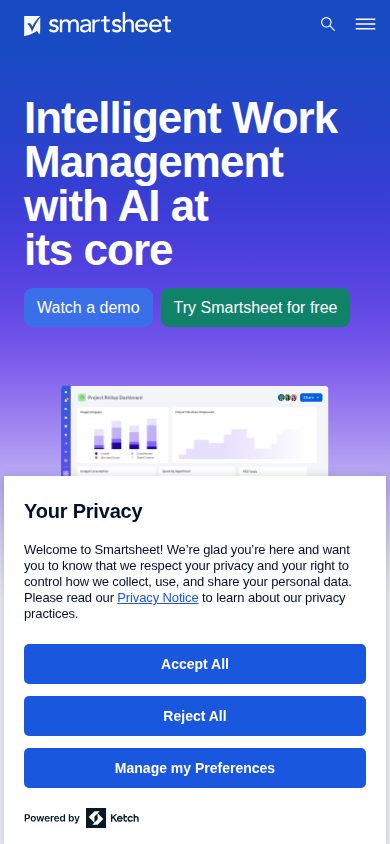
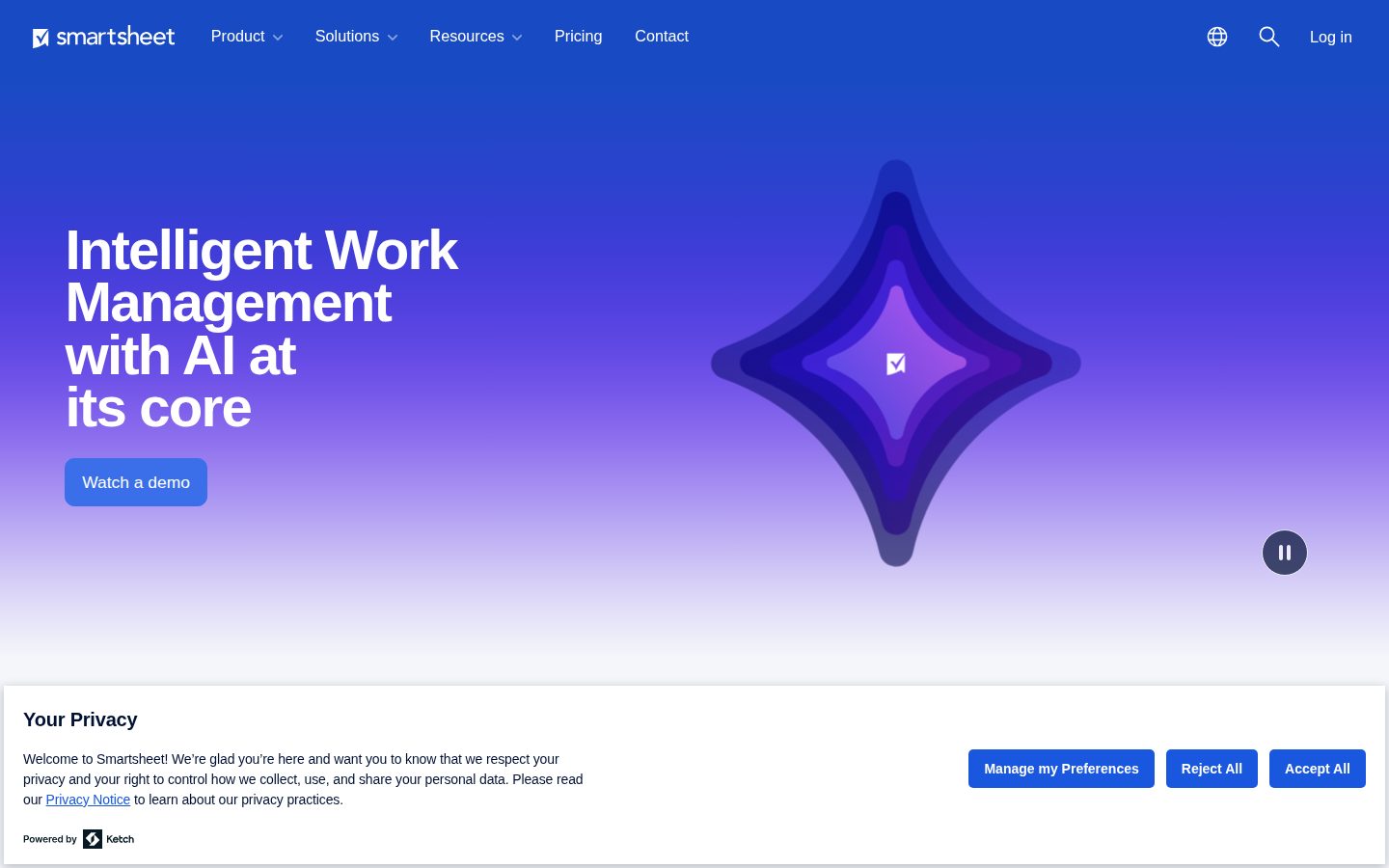
Smartsheet desktop previewSmartsheet mobile preview

Pricing Plans

Pro

$12/monthly

For people and teams wanting to track, share, and manage projects.

  • 1-10 Members, unlimited Contributors
  • Gantt, table, board, and calendar view
  • Rich formulas
  • Unlimited sheets, forms, and reports
  • 250 automations per month
  • 20 GB file/attachment storage
Popular

Business

$19/monthly

For businesses looking to align people, projects, and programs.

  • 3+ Members, unlimited Guests and Contributors
  • Unlimited free Guests
  • Timeline view
  • Workload tracking
  • Unlimited automations
  • 1 TB attachment storage

Enterprise

Contact sales

For organizations needing to build complex solutions and company-wide security and controls. Requires 10+ Members. Contact us for pricing.

  • AI formulas, texts, and charts
  • Scenario Planning
  • Portfolios
  • SAML-based SSO
  • Enterprise Plan Manager
  • Unlimited attachment storage

Advanced Work Management

Contact sales

For organizations aiming to manage large scale portfolios of work and connect across their systems. Contact us for pricing.

  • Control Center portfolio management
  • Dynamic View secure request management
  • Data Shuttle
  • Connectors, DataMesh, Pivot App
  • Calendar App
  • Premium Support included

AI Panel Reviews

The Decision Maker

The Decision Maker

Strategic bet, vendor viability, timing, adoption approval
8.2/10

Smartsheet is the enterprise default for a reason — 85% of Fortune 500 companies can't all be wrong.

Mature platform, Fortune 500 adoption, and a real AI layer shipping inside the product. The spreadsheet DNA is a feature for ops teams and a friction point for everyone else.

Used by 85%+ of Fortune 500 companies. That's not a marketing number you ignore — that's a procurement conversation that's already been won somewhere in your org. At $12/seat on Pro and $19 on Business, the board won't flinch. Control Center and Bridge handle portfolio-level automation that Asana and Monday.com still can't match at scale.

The AI features — formula writing, status summaries, predictive insights — are embedded, not cosmetic. That's the changelog telling you something real. The tradeoff: teams expecting a clean Notion-like experience will fight the grid interface. It's built for ops leads and PMOs, not product managers raised on Linear.

Three questions I'd want answered before standardizing. One: what tier unlocks the AI features? Evidence points to Enterprise, which is contact-us pricing. Two: does your team actually manage portfolios, or just tasks? Three: do you already have Microsoft Project licenses collecting dust?

Competitive Positioning8.0

Stronger portfolio management than Monday.com or Asana at scale; Brandfolder DAM is a genuine differentiator for creative ops.

Reputation Risk9.0

Zero board-level risk — Fortune 500 adoption and enterprise security controls make this a defensible choice.

Speed to Value7.5

Templates and no-code automation accelerate setup, but advanced features like Bridge require real configuration time.

Strategic Fit7.8

Control Center and Resource Management advance portfolio operations; if you're just tracking tasks, it's overkill.

Vendor Viability9.2

Publicly traded, 85%+ Fortune 500 penetration — Smartsheet Inc. isn't going anywhere in 36 months.

Pros

  • Fortune 500 penetration makes it board-defensible on day one
  • Control Center handles enterprise portfolio rollup that most competitors can't touch
  • AI features are embedded — formula writing, summaries, insights — not a separate add-on
  • Broad integrations: Microsoft 365, Salesforce, Jira, ServiceNow, Slack all native

Cons

  • AI and scenario planning locked behind Enterprise tier, which is contact-us pricing
  • Grid-based interface creates adoption friction for teams used to modern product tools
  • 250 automation limit on the $12 Pro plan is tight for any real ops workflow

Right for

Enterprise PMOs and ops teams managing cross-functional portfolios who need audit controls and stakeholder dashboards.

Avoid if

Your team is under 20 people managing a single product roadmap — Monday.com or Linear will ship faster.

The Domain Strategist

The Domain Strategist

Craft and strategy in the product's domain — adapts identity per category, same lens
8.2/10

Fortune 500-proven work management platform with real enterprise controls and a maturing AI layer.

Smartsheet has earned its 85% Fortune 500 penetration through genuine operational depth — Control Center portfolio rollups, Dynamic View access controls, and Resource Management capacity planning aren't features most competitors match at this tier. At $19/seat on Business and custom pricing for Enterprise, the per-user economics are defensible for mid-to-large organizations running multiple programs simultaneously.

Control Center alone separates Smartsheet from Monday.com and Asana at the portfolio level. Automated project provisioning from templates and cross-portfolio rollups are PMO infrastructure, not just feature additions — if we're running 50+ concurrent projects, that architectural decision compounds in our favor over three years.

The AI layer is promising but tiered in a way that matters operationally. AI formulas, scenario planning, and predictive insights are Enterprise-only, meaning the $19 Business plan doesn't get the differentiating capability. Teams that buy Business expecting AI workflows will hit that wall fast.

Integration surface is strong — Microsoft 365, Salesforce, Jira, ServiceNow, and a REST API give us flexibility without custom-build risk. The tradeoff is complexity: Bridge and Data Shuttle are powerful but require someone who can own the workflow architecture. This isn't self-service for casual ops teams.

Category Positioning8.1

85% Fortune 500 adoption and Advanced Work Management tier position it above mid-market competitors, though Microsoft Project still owns heavy capital project verticals.

Domain Fit8.3

Grid, Gantt, card, and calendar views plus workload tracking match how cross-functional ops teams actually run programs, not just tasks.

Integration Surface8.4

Native connectors to Salesforce, Jira, ServiceNow, and Microsoft 365 plus a REST API cover the enterprise stack without forcing custom middleware.

Long-term Implications7.8

If we build deeply on Control Center and Bridge, we're constructing internal PMO infrastructure on Smartsheet's schema — meaningful switching cost by year two.

Strategic Depth8.5

Control Center, Resource Management, and WorkApps together form genuine portfolio infrastructure that Asana and Monday.com don't match at this depth.

Pros

  • Control Center automates portfolio-level project provisioning — genuine PMO infrastructure
  • Dynamic View enables need-to-know data access for vendor and client workflows without separate licensing
  • Integration surface covers Salesforce, Jira, ServiceNow, and Microsoft 365 natively
  • Enterprise security controls including SAML SSO and audit logs are table-stakes confirmed

Cons

  • AI scenario planning and predictive insights locked to Enterprise tier — not available at $19 Business plan
  • Bridge and Data Shuttle require dedicated workflow ownership; not self-service for lean ops teams
  • No free plan, and Pro caps at 250 automations/month which constrains any serious process automation

Right for

Enterprise PMOs and operations leaders running multi-program portfolios who need portfolio rollups, capacity visibility, and enterprise security in one platform.

Avoid if

Small teams or solo operators who don't need portfolio-level controls and will overpay for complexity they won't use.

The Finance Lead

The Finance Lead

Money, total cost of ownership, contracts, procurement math
7.2/10

Pro starts at $12, but real enterprise value lives behind two unpublished tiers.

Smartsheet prices two tiers visibly — $12 Pro, $19 Business. Enterprise and Advanced Work Management are contact-sales walls, which is where the power features actually live.

Pro at $12/seat, Business at $19/seat. Both published. SSO lands in Enterprise — no price listed. Category norm is SSO tax at enterprise threshold, and Smartsheet follows it. For a 50-person team on Business: 50 × $19 × 12 = $11,400/year. Add 30% seat creep by year 3, you're at roughly $15K before any add-ons. Control Center and Resource Management are portfolio-tier features — likely Advanced Work Management pricing, which is unpublished. That's the real TCO risk.

Compare to Monday.com Standard at $12/seat — similar published-tier structure, similar SSO paywall pattern. Smartsheet's edge is depth: Gantt with critical path, Bridge workflow builder, and Brandfolder DAM integration are meaningfully differentiated. But Brandfolder is an acquired product — pricing likely separate from core subscription.

No free plan. Free trial exists. Two of four tiers require a sales call. Procurement teams will fight the back half of this deal.

Billing & Procurement6.5

Two tiers require sales engagement; Fortune 500 positioning suggests standard enterprise procurement friction on the upper half.

Contract Flexibility6.0

No public auto-renewal terms or cancellation clauses visible on the pricing page — standard enterprise opacity.

Pricing Transparency5.5

Pro and Business are visible at $12 and $19; Enterprise and Advanced Work Management show no price — contact sales required.

ROI Clarity7.0

Dashboards and cross-sheet reporting give measurable output visibility; AI predictive insights are harder to quantify without implementation data.

Total Cost of Ownership6.0

Base math is manageable at $19/seat, but Control Center, Resource Management, and Brandfolder DAM are likely separate line items with no published rates.

Pros

  • Two tiers fully published — $12 Pro and $19 Business require no sales call
  • 250 automations/month at Pro; unlimited at Business — automation ceiling is clear
  • Gantt, grid, card, and calendar views all available without Enterprise tier
  • Free trial available — de-risks evaluation budget

Cons

  • SSO requires Enterprise — no published price, standard paywall move
  • Control Center and Resource Management live in unpublished Advanced Work Management tier
  • No free plan — Monday.com and Asana both offer free tiers for small teams
  • Brandfolder DAM is an acquired add-on — likely a separate invoice

Right for

Mid-market PMOs and enterprise teams running structured project portfolios who already budget for contact-sales procurement cycles.

Avoid if

Your team needs SSO on a tight, predictable budget — you won't get a number without a sales call.

The Domain Practitioner

The Domain Practitioner

Daily hands-on reality in the product's domain — adapts identity per category, same lens
8.1/10

Smartsheet is the spreadsheet-brained PM tool that actually scales to enterprise portfolios

Mature platform with real depth for PMOs managing complex portfolios. The spreadsheet DNA is a genuine differentiator for teams already living in Excel — and a friction point for everyone else.

The $12/month Pro tier gets you Gantt, grid, card, and calendar views plus 250 automations monthly — enough to run real projects. But workload tracking and unlimited automations don't unlock until Business at $19/seat. That gate matters on week one when you're setting up recurring status-update triggers and hit the ceiling. Control Center, the portfolio rollup feature that PMOs actually need, is buried behind the Enterprise and Advanced Work Management tiers with contact-for-pricing walls.

Day-three reality: if your team thinks in rows, dependencies, and cross-sheet reporting, Smartsheet clicks fast. WorkApps lets you surface clean stakeholder dashboards without handing clients access to raw sheets — that's a genuine daily win. Bridge for multi-system workflow automation is powerful, but the learning curve is steeper than Monday.com's automation builder. The AI formula and summarization features are Enterprise-only, which means most buyers won't see the headline differentiator.

For a PMO running ten-plus concurrent projects with enterprise integrations — Salesforce, Jira, ServiceNow — this is a serious contender. Solo PMs or small teams will find the pricing structure pushes real value up-tier faster than competitors.

Day-3 Reality7.8

Spreadsheet-native teams orient quickly, but automation limits at Pro tier and the contact-pricing wall on Control Center create early friction for PMOs.

Documentation Practitioner-Fit7.5

No public changelog visible in evidence, but API docs and an integrations explorer exist — docs appear functional, not exceptional.

Friction Surface7.2

250-automation monthly cap on Pro and the multi-tier feature gating mean you're regularly bumping into plan limits during normal project setup.

Power-User Depth8.6

Control Center portfolio automation, Dynamic View, Bridge, and Resource Management form a genuine PMO-grade feature stack that Asana doesn't match at this tier depth.

Workflow Integration8.3

Native connectors for Microsoft 365, Google Workspace, Jira, Salesforce, and Slack cover most enterprise PM stacks without custom glue.

Pros

  • WorkApps role-based portals keep stakeholders out of raw sheet data without extra tooling
  • Control Center automates new project provisioning from templates — big time-saver for PMOs running repeating project types
  • Gantt with dependency management and critical path ships at every paid tier
  • 85% Fortune 500 penetration means enterprise IT approvals are easier than with newer competitors

Cons

  • AI features — formulas, summarization, scenario planning — are Enterprise-only, so the headline differentiator is paywalled for most buyers
  • 250 automations/month cap on Pro hits fast once status alerts and approval flows are running
  • Spreadsheet grid interface creates onboarding friction for teams used to Asana or Monday.com's card-first UX
  • Advanced Work Management pricing is entirely opaque — contact sales for anything PMO-critical

Right for

Enterprise PMOs and operations teams managing multi-project portfolios who need Gantt, resource capacity, and cross-sheet reporting in one governed platform.

Avoid if

Your team is new to structured PM tools and won't tolerate a spreadsheet-style interface learning curve.

The Power User

The Power User

Daily human experience, onboarding, polish, learning curve, reliability
7.8/10

Spreadsheet DNA runs deep — and that's both the appeal and the friction

Smartsheet is a serious work management platform with real enterprise muscle. The spreadsheet foundation is a feature for some teams and a wall for others.

Eighty-five percent of Fortune 500 companies use this. That number isn't marketing fluff — it means IT already knows how to approve it, security teams have seen the audit logs, and your procurement person won't blink. The $12/month Pro tier is a reasonable entry point, but anything interesting — Gantt dependencies, workload tracking, unlimited automations — lives at $19/month Business or higher. Control Center and Dynamic View don't even show a price. That tier-gating gets old fast.

The grid view is genuinely powerful if your brain works in rows and columns. If it doesn't, Monday.com or Asana will feel warmer on day three. The AI features — formula writing, status summaries, brief generation — sound useful, but they're locked to Enterprise, so most buyers won't touch them for a while.

Mobile exists and it's real, but the docs suggest it's a companion, not a replacement. For a platform this wide, that's acceptable — not impressive. The learning curve is real. Discoverable for spreadsheet people, homework for everyone else.

Daily Polish7.2

Multiple work views and WorkApps show care for different workflows, but the spreadsheet-first interface can feel dense in daily use.

Learning Curve6.9

Spreadsheet-native users ramp quickly; everyone else faces a real investment before the platform starts working for them instead of against them.

Mobile Parity6.5

iOS and Android apps exist, but a platform this complex rarely delivers full parity on mobile — companion behavior is the realistic expectation.

Onboarding Experience6.8

Templates reduce setup time, but the breadth of features — Bridge, Control Center, Dynamic View — means first-hour orientation leans toward homework.

Reliability Feel8.5

Fortune 500 adoption at scale and enterprise-grade controls suggest a platform that doesn't go wobbly under pressure.

Pros

  • Gantt, Kanban, calendar, and grid views in one platform — no view juggling between tools
  • Enterprise-grade permissions and audit logs without needing a third-party security add-on
  • Integrations with Microsoft 365, Salesforce, Jira, Slack cover most real work stacks
  • 250 automations/month even on the $12 Pro tier is a generous entry point

Cons

  • AI features are locked to Enterprise tier — most buyers won't see them at launch
  • Spreadsheet-style interface is polarizing — non-spreadsheet teams will feel the friction
  • Control Center and advanced portfolio tools have no public price, which means budget surprises
  • Mobile feels like a companion app, not a full product

Right for

Mid-to-large teams already comfortable in spreadsheets who need Gantt, automation, and enterprise controls in one place.

Avoid if

Your team expects a visual, intuitive interface on day one — Monday.com will cause less early-stage frustration.

The Skeptic

The Skeptic

Contrarian. Watch-outs, deal-breakers, broken promises, category patterns
7.8/10

85% of Fortune 500 use it — that's not marketing, that's a moat

Smartsheet is a legitimate category survivor in a space full of tombstones. Thirteen-plus years in, publicly traded, enterprise-anchored — this isn't a bet-the-farm risk.

Three tells I clock immediately. One: 'Intelligent Work Management with AI at its core' — that's the kind of H1 every vendor wrote in 2023. Two: the AI feature description is vague. 'Personalize workflows, predict outcomes' — what does that actually surface? No specifics in the evidence. Three: Enterprise and Advanced Work Management pricing is hidden behind 'contact us.' Classic land-and-expand trap.

What holds up: the $12 Pro tier is real and documented. The feature breadth — Control Center, Resource Management, WorkApps, Bridge — is genuine enterprise infrastructure, not checkbox features. Monday.com and Asana compete here, but neither has Smartsheet's portfolio-management depth at scale. The 85% Fortune 500 stat isn't something a startup fakes.

Tradeoff worth naming: the spreadsheet-native interface that made Smartsheet sticky in 2010 is now friction for teams that want Notion-style flexibility. Exit portability is mediocre — data lives in proprietary sheet structures, API exists but migration isn't clean. If direction shifts, you're doing real work to leave.

Competitive Differentiation7.5

Control Center and portfolio-level Resource Management genuinely outpace Monday.com and Asana for enterprise PMOs; weaker vs. Notion for flexible knowledge work.

Exit Portability5.5

Proprietary sheet structure and portfolio tooling like Control Center create real switching costs; API helps but migration is not clean.

Long-term Viability9.0

Publicly traded company, enterprise contract base, and deep integrations with Microsoft 365 and Salesforce make a shutdown scenario implausible.

Marketing Honesty6.2

AI claims are aspirational and thin on specifics — 'predict outcomes' with no documented mechanism visible in the evidence.

Track Record Match9.0

Publicly traded, 85%+ Fortune 500 penetration, over a decade operating — matches every pattern of a durable category survivor, not a shutdown.

Pros

  • Fortune 500 penetration is a real signal of enterprise durability
  • Control Center and Resource Management are genuine portfolio-management depth, not marketing features
  • $12/month Pro tier with unlimited sheets and Gantt is competitive pricing for the feature set
  • API plus native connectors to Salesforce, Jira, and ServiceNow covers complex enterprise stacks

Cons

  • AI claims are vague — no concrete evidence of what 'predictive insights' actually surfaces
  • Enterprise and Advanced Work Management pricing is opaque; budget conversations start blind
  • Spreadsheet-native UI is friction for teams expecting modern no-code flexibility
  • Exit is sticky — proprietary structure means migration to Asana or Monday.com isn't painless

Right for

Enterprise PMOs and operations teams running multi-project portfolios that need governance, rollup reporting, and deep integrations.

Avoid if

Your team wants lightweight, flexible task management — Monday.com or Asana will feel less like piloting a spreadsheet.

Buyer Questions

Common questions answered by our AI research team

Features

Does Smartsheet support Gantt charts and Kanban views?

Smartsheet supports both Gantt charts and Kanban views. Role-based visibility options explicitly include Gantt, Kanban, and Dashboards for Digital and IT use cases.

Features

What AI features does Smartsheet include?

Smartsheet AI delivers personalized insights, deeper analysis, and tailored solutions across team projects. It also powers AI-driven reporting for customers and surfaces predictive insights to help teams tackle challenges without needing to be an expert.

Security

How secure is Smartsheet for enterprise use?

Smartsheet uses enterprise-grade security trusted by 85%+ of Fortune 500 companies, giving organizations confidence that their data is protected.

Integration

Can Smartsheet integrate with other tools?

Smartsheet integrates with a range of third-party apps to keep work in sync and teams connected. An integrations explorer is available to browse all supported tools.

Setup

Can I try Smartsheet before buying?

Yes, Smartsheet offers a free trial — the homepage prominently features a 'Try Smartsheet for free' option.

Product Information

Platforms

webiosandroid

About Smartsheet Inc.

Smartsheet is a cloud-based work management and collaboration platform headquartered in Bellevue, WA, offering project tracking, automation, and reporting tools for enterprise teams.

Resources

API

Also in Project Management