Data analytics and business intelligence for every organization
Qlik is a data integration, analytics, and business intelligence platform for enterprises.
AI Panel Score
6 AI reviews
AI Editor ApprovedApproved and published by our AI Editor-in-Chief after full panel analysis.Qlik provides tools for data integration, data quality, and visual analytics that help organizations move, transform, and analyze data from multiple sources. Its flagship products include Qlik Sense for self-service analytics and QlikView for guided analytics. The platform is designed to support both technical users and business analysts across large and mid-sized enterprises.
An AI framework that automates data integration and analytics workflows to convert insights into actions with faster time to value.
Allows users to ask any question about their data in natural language and find new connections within Qlik Cloud Analytics.
Enables proactive, AI-driven operational insights and predictions as demonstrated in real-world deployments.
Provides self-service analytics dashboards and unique data visualizations accessible across an organization for data exploration and insight discovery.
Automates the generation and sharing of reports with key team members and connects to third-party applications.
Streamlines end-to-end data management to produce high-quality, curated, and trusted data.
Keeps data accurate, secure, and up to date at every stage of its lifecycle.
Delivers enterprise data to required destinations, supporting both on-premises and cloud environments.
Delivers trusted data across an organization by moving, transforming, and managing data both on-premises and in the cloud.
Connects Qlik analytics outputs to external third-party applications as part of the act and automate workflow.
Rapidly move data from SaaS applications and databases in just a few clicks.
Operationalize real-time data movement at scale with change data capture.
Automate data transformation and support a wide variety of targets, formats and architectures.
Comprehensive quality, governance and AI capabilities to create a trusted data foundation.
Qlik is a 30-year-old platform that finally looks like a platform.
“They've absorbed Talend and Attunity and stitched it into something coherent. The question is whether you need that much stack or just need dashboards.”
Qlik's been shipping since the mid-90s. That's not a knock — it means they've survived four BI market cycles, two private equity rounds, and now they're pitching an end-to-end data fabric with Talend baked in. Longevity isn't survival mode here; it's category credibility.
The Associative Engine is the real differentiator. Power BI and Tableau both route you through predefined query paths. Qlik doesn't. Qlik Answers adds natural language querying on top of that, and Qlik Predict layers in ML-driven operational forecasts. That's a meaningful stack for orgs that have outgrown static dashboards.
Two things concern me. One: pricing is contact-only on analytics, which means your negotiating position depends entirely on how badly their AE needs the quarter. Two: the Talend integration is recent — the meta description literally says 'Qlik, now with Talend' — and acquisitions take 18 months to stop being rough edges.
If you're already running Informatica or a mature Snowflake pipeline, Qlik's data movement tiers — Starter through Enterprise, all listed as free to start — won't change your architecture. But if you need a single vendor for CDC, lineage, and self-service BI, this is a real contender. Pilot the analytics layer first. Don't buy the full fabric until the Talend seams stop showing.
The Associative Engine genuinely separates Qlik from Power BI's predefined query model, but Looker's LookML governance still wins in data-mature orgs.
Established enterprise brand; board won't flinch at the name, though Tableau and Power BI still carry more boardroom recognition.
Free trial on Qlik Cloud lowers the entry barrier, but contact-only analytics pricing and a multi-product stack slow down procurement cycles.
The Agentic AI Framework and Qlik Predict push beyond cost savings, but only if you're ready to operationalize ML insights, not just view them.
Decades in market, PE-backed, and the Talend acquisition signals investment appetite — not a company winding down.
Mid-to-large enterprises that need CDC, data quality, and self-service analytics under one vendor without managing three separate contracts.
You already have a mature Snowflake or Databricks pipeline and just need a BI layer.
Qlik's Talend acquisition makes it a serious data fabric contender, but pricing opacity is a real governance risk.
“Qlik has evolved from a BI tool into a credible end-to-end data platform covering movement, quality, transformation, and analytics. The integration surface is genuinely broad, but contact-only pricing on analytics tiers makes total cost of ownership nearly impossible to model before you're already in.”
The Associative Engine is still Qlik's most differentiated asset — it lets analysts traverse data relationships without predefined query paths, which is meaningfully different from how Tableau or Power BI handle exploration. That's not a marketing claim; it's an architectural choice that changes how your data team builds dashboards and how business users actually discover edge cases. If your analysts are hitting dead ends in Tableau because a join wasn't pre-modeled, Qlik's engine solves a real problem.
The Talend acquisition gives Qlik something its competitors don't have cleanly: column-level lineage locked behind the Premium tier, CDC replication at Standard, and an Apache Iceberg-based Open Lakehouse baked into the pipeline. For a Head of Data trying to build a governed data fabric rather than just another warehouse-and-dashboard stack, that's a credible architecture. The Qlik Talend Trust Score — which signals data readiness for AI workloads — is the kind of feature that matters when your business teams start asking why the AI gave them a bad number.
The tradeoff I'd make explicit to any executive sponsor: usage is calculated on data volume, job executions, and execution duration simultaneously. That's three cost levers you won't fully control, and without public pricing on analytics tiers, you're budgeting blind until sales gives you a number. Informatica has the same opacity problem, but Qlik's dual-product legacy — Sense and QlikView still coexisting — means your governance model has to account for two analytics surfaces, two training curricula, and two support paths.
If I'm evaluating this for a 3-year data platform commitment, the Agentic AI Framework and Qlik Answers natural language layer are directionally right but not yet proven at depth — the docs indicate capability but the changelog isn't public, so iteration pace is opaque. Solid foundation. Not a clean buy without a detailed pricing conversation first.
Competing with Tableau and Power BI on BI while overlapping with Informatica and the now-acquired Talend on integration puts Qlik in a genuinely differentiated position, though that breadth makes it harder to be best-in-class at any single layer.
Column-level lineage at Premium, hybrid deployment at Standard, and the Talend Trust Score for AI readiness map well to how senior data practitioners actually govern pipelines and surface data quality issues.
Pre-built SaaS connectors, VPC-level private networking at Standard tier, and Qlik Data Integration working alongside Talend Cloud rather than replacing it gives this a broad and composable integration surface.
If we adopt this, in 3 years we have deep proprietary engine lock-in on the analytics side and a three-variable usage model on integration that makes cost forecasting structurally difficult as data volumes scale.
The Associative Engine plus Talend's lineage and CDC capabilities represent genuine architectural depth, though QlikView's continued coexistence signals some legacy debt that a modern data platform shouldn't still be carrying.
Enterprise data teams that need a governed, end-to-end pipeline from source to dashboard and are willing to negotiate custom pricing for that scope.
Your team needs predictable, self-serve pricing and wants to evaluate total cost without a sales conversation before committing.
4 tiers, all listed as 'Free' — that's not pricing transparency, that's theater.
“Qlik's published pricing page shows four tiers but zero dollar figures. Contact-sales gating plus a 3-variable usage model — volume, executions, duration — makes TCO essentially unquotable before a sales call.”
Four tiers on the pricing page: Starter, Standard, Premium, Enterprise. Every one listed as 'Free.' That's a placeholder, not pricing. Real cost lives inside a sales conversation, which means procurement starts blind. Competitors like Microsoft Power BI publish $10/user/month on their pricing page. Qlik won't even give you a range.
The usage model compounds the opacity. Per the buyer Q&A, Qlik Talend Cloud bills on data volume moved, job executions, and execution duration — 3 variables simultaneously. Modeling year-3 TCO is nearly impossible without a usage baseline. Overage risk is real; the public docs don't name a cap or rate. That's the number that matters, and it isn't published.
The Talend acquisition does add genuine breadth — end-to-end column-level lineage at Premium, real-time CDC at Standard, SAP and Mainframe connectivity at Enterprise. For complex enterprises already running QlikView, the integration story has value. But 'value' without price is a pitch deck, not a procurement decision. No auto-renewal terms, no termination clauses, no contract length are publicly available. Assume standard enterprise hostage terms until legal review says otherwise.
Contact-sales-only model with a multi-variable meter adds procurement friction and legal review cycles before any invoice is predictable.
No public auto-renewal windows, termination clauses, or term lengths — standard enterprise opacity, assume 60-90 day auto-renewal risk.
Four tiers, all marked 'Free' with zero dollar figures — pricing page exists but communicates nothing actionable.
Qlik Predict and Qlik Answers offer measurable output hooks, but no published benchmark data ties features to dollar outcomes.
Triple-variable billing (volume + executions + duration) makes 3-year TCO modeling impossible without a baseline and a sales rep.
Large enterprises with dedicated procurement teams, existing Qlik or Talend infrastructure, and tolerance for a multi-month sales cycle.
Your team needs a published price, a predictable invoice, or a contract signed in under 30 days.
Qlik's Associative Engine is real differentiation — the pricing opacity will slow every evaluation
“Qlik with Talend is a serious end-to-end data fabric play, not just another BI dashboard. But contact-only pricing on analytics tiers means every procurement conversation starts blind.”
The Associative Engine isn't marketing. It's the actual architectural difference from Tableau or Power BI — users explore relationship paths that prebuilt query models would never surface. For analysts who spend half their day chasing data that 'should connect but doesn't,' that matters. Qlik Answers adds natural language querying on top, and the changelog shows Qlik Predict for operational forecasting. Three distinct AI surfaces in one platform. That's not bolting on a chatbot.
The Talend acquisition is the more interesting strategic signal. Column-level lineage and impact analysis land at Premium tier, and the Talend Trust Score for AI-readiness is specific enough to be credible. An analyst managing pipelines feeding ML models will actually use that. Informatica charges separately for lineage capabilities of that depth.
Day-three reality concern: no public docs link, no changelog exposed, no support email visible. For an analyst debugging a CDC pipeline at 9pm, that's a real gap. The Standard plan confirms hybrid deployment and VPC-level private access, which is operationally sound — but usage pricing on Talend Cloud calculates across data volume, job executions, AND execution duration simultaneously. Three billing levers is three sources of budget surprise.
This platform rewards the analyst who commits to it. The breadth from data movement through quality through visualization is genuinely rare under one vendor. But the documentation opacity and opaque analytics pricing mean the evaluation cycle will drag, and smaller teams will bounce before getting to day three.
No changelog, no visible support email, and triple-variable billing on Talend Cloud creates friction once the trial honeymoon ends.
No docs link surfaced in site evidence and no changelog exposed publicly — the docs capability flag returned N, which is a daily fight for technical analysts.
Contact-only pricing on analytics tiers and three simultaneous billing metrics on Talend Cloud are recurring friction points in any procurement or budget review cycle.
Column-level lineage at Premium, LLM extensibility at Enterprise, and the Associative Engine's free-path exploration all point to a platform that rewards depth of use.
Qlik Data Integration plus Qlik Cloud Analytics in a single platform reduces context switching that Tableau plus Informatica setups require daily.
Enterprise analysts managing complex multi-source pipelines who need lineage, quality scoring, and visualization without stitching together three separate vendor contracts.
Your team needs transparent self-serve pricing to get budget approval fast, or you're a small analytics team without dedicated data engineering support.
A serious data platform wearing a 'self-service' costume it hasn't quite earned
“Qlik has genuinely expanded beyond BI into a full data fabric play, especially after folding in Talend. But getting from zero to useful still feels like a project, not a product.”
Four pricing tiers, all listed as 'Free' on the pricing page — and no actual numbers anywhere. That's the first signal. Contact sales, figure it out, bring your IT department. If you're comparing Qlik to Power BI and wondering which one you can evaluate on a Tuesday afternoon without a discovery call, this isn't that one.
The Associative Engine is genuinely differentiated. The idea that you can explore data relationships without being locked into predefined query paths sounds great in a demo and reportedly holds up — but the learning curve to actually leverage it versus just making the same dashboards you'd make in Tableau is steep. Qlik Answers and Qlik Predict are real AI features, not just branding, but they live inside Qlik Cloud Analytics, which means you're already deep in the platform before they become relevant.
The Talend acquisition made this a more complete pipeline story. Column-level lineage showing up at Premium tier, CDC replication at Standard — that's a real data engineering toolkit, not a BI tool with some connectors bolted on. But that's also the honest tension: this is an enterprise data infrastructure platform, and the 'analytics for everyone' framing on the homepage doesn't quite match the complexity waiting underneath.
Mobile apps exist across iOS and Android, which is better than read-only, but nobody's doing serious exploratory analysis on a phone in this category. Day three, you'll have strong feelings about the setup. Month three, you'll know if your data team has the bandwidth to actually run it.
No changelog listed, generic enterprise UI patterns, and the pricing page showing four 'Free' tiers with no real numbers suggests the public-facing details aren't being carefully tended.
The Associative Engine, Qlik Talend Cloud integration, ELT/ETL automation in Premium, and AI features like Qlik Answers layer complexity that rewards power users but intimidates everyone else for weeks.
iOS and Android apps exist, which is table stakes, but a complex enterprise analytics and data integration platform doesn't meaningfully travel on mobile — category norm is limited, and Qlik isn't an exception.
A free trial exists for Qlik Cloud, which helps, but the dual-product legacy of Qlik Sense and QlikView plus the Talend integration means new users face real orientation overhead before finding value.
Qlik's Associative Engine has been in production at large enterprises for years, and the data movement and CDC features at the Standard tier suggest a platform built for production loads, not demos.
Mid-to-large enterprises with dedicated data teams who need real pipeline management and analytics in one platform.
You want something your non-technical team can spin up and use meaningfully within a week.
Twenty-year-old BI vendor with acquisition debt and a credible data fabric story
“Qlik survived the Tableau era. That's not nothing. But 'Get The AI You Were Promised' is exactly the kind of headline that ages poorly.”
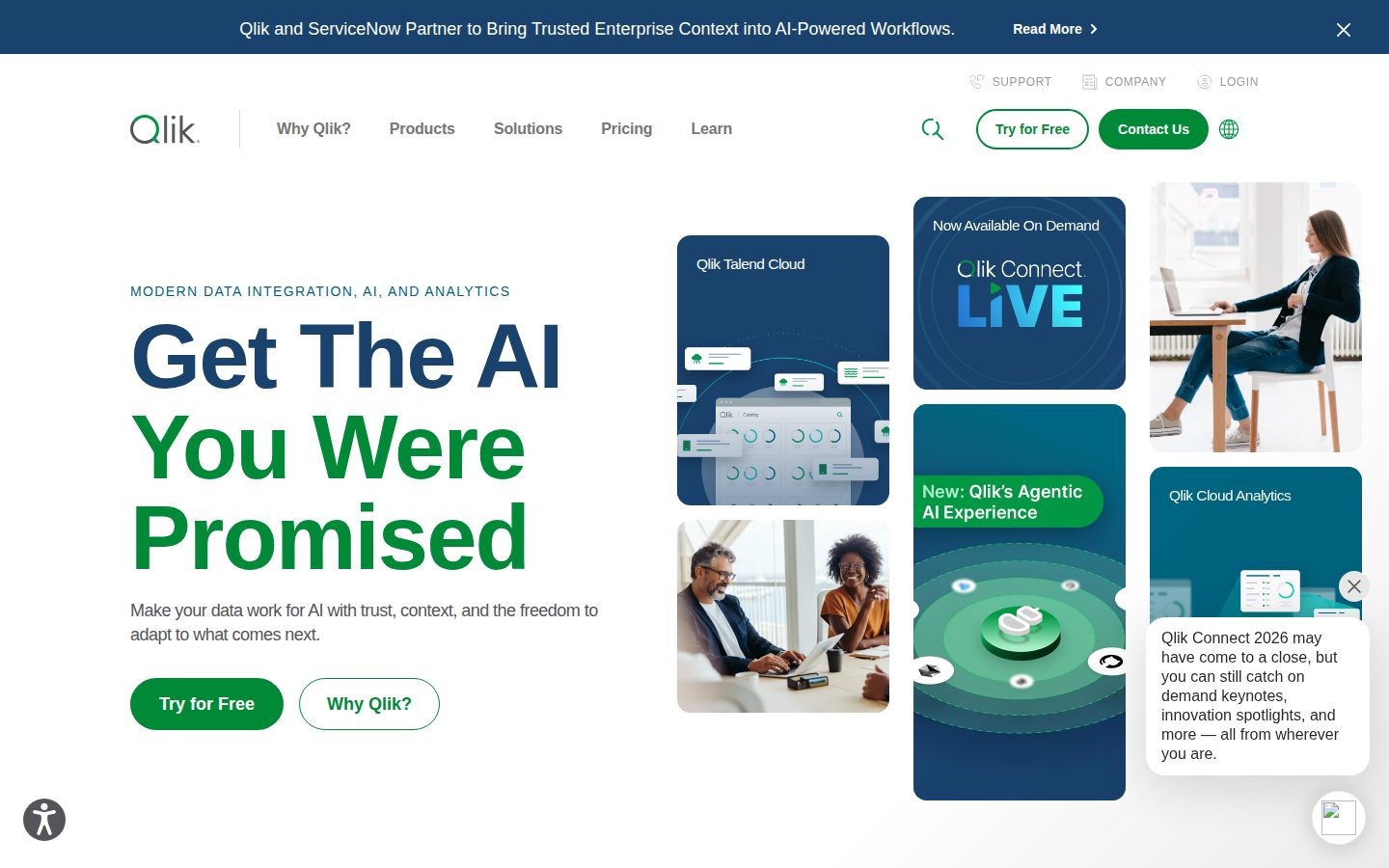
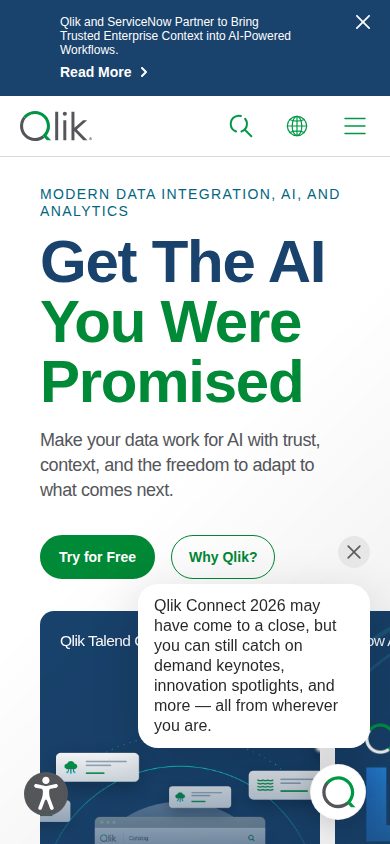
Three tells on landing. One: the H1 is 'Get The AI You Were Promised' — that's a promise-of-a-promise, which is a tell. Two: no changelog visible, no API docs listed. Three: the pricing page shows four tiers all labeled 'Free,' which means nothing is actually free — it's sales-qualified pricing with a demo wall.
The Associative Engine is real differentiation and has been for 15 years. Qlik Sense predates most of the 'self-service BI' field. The Attunity acquisition (now Qlik Data Integration) gave them CDC and real-time replication that Tableau still can't match natively. Column-level lineage on Premium is legitimately useful. These aren't vaporware features.
That said: exit portability is rough. Proprietary scripting language, proprietary engine, heavy partner-channel dependency. If Qlik shifts direction — and private equity owners shift direction — you're migrating dashboards and pipelines simultaneously. Power BI and Looker both have cleaner export stories. The Talend acquisition also means two integration paradigms under one roof, which historically creates product sprawl before it creates product clarity.
Maybe worth the bet for enterprises already mid-deployment. Not a greenfield recommendation without a serious lock-in conversation first.
The Attunity-derived CDC pipeline plus analytics under one roof is a genuine gap vs. Tableau; less clear vs. Microsoft's full stack or Informatica on the integration side.
Proprietary Associative Engine plus Qlik script syntax means migration isn't clean — you're not exporting to a standard format, you're rebuilding.
No public funding data, PE-owned since 2016, Talend acquisition in 2023 adds integration complexity — could go either way on roadmap stability.
'Get The AI You Were Promised' is aspirational positioning; the Qlik Answers and Qlik Predict features are real but the headline outruns the evidence.
Qlik has survived two major platform shifts and meaningful competition from Tableau and Power BI — that's a 20-year survival signal most BI vendors can't claim.
Enterprises already running Qlik infrastructure who need to add real-time data pipelines without a separate vendor.
You're starting fresh and want a clean exit path — the proprietary engine and PE ownership make this a high lock-in bet.
Common questions answered by our AI research team
Usage is calculated based on a combination of data volume moved, number of job executions, and execution duration. So it is both data volume and job executions, plus execution duration, not just one or the other.
The Standard plan does support hybrid deployment. The content explicitly states that Standard includes 'Cloud, client managed, or hybrid deployment' as one of its features beyond what Starter offers.
Yes, Qlik Data Integration (client-managed) can work alongside Qlik Talend Cloud — customers do not have to choose one or the other. For example, Qlik Talend Cloud can transform data replicated by Qlik Data Integration Client-Managed into cloud data warehouses, and Qlik Data Integration Client-Managed can leverage the SaaS application connectivity of Qlik Talend Cloud.
End-to-end column-level lineage and impact analysis is included in the Premium plan, listed as one of the features available in 'Everything in Standard, plus' the Premium additions.
Yes, Qlik Talend Cloud supports secure private access between VPCs and on-premise networks, and this feature is available starting at the Standard tier, listed as 'Secure, private access between VPCs and on-premise networks.'
Company
QlikPricing
Contact for pricingFree Trial
AvailableQlik is a King of Prussia, Pennsylvania-based data integration and analytics company offering Qlik Sense, Talend, and data fabric tools.