HR software connecting engagement, performance, development, and recognition
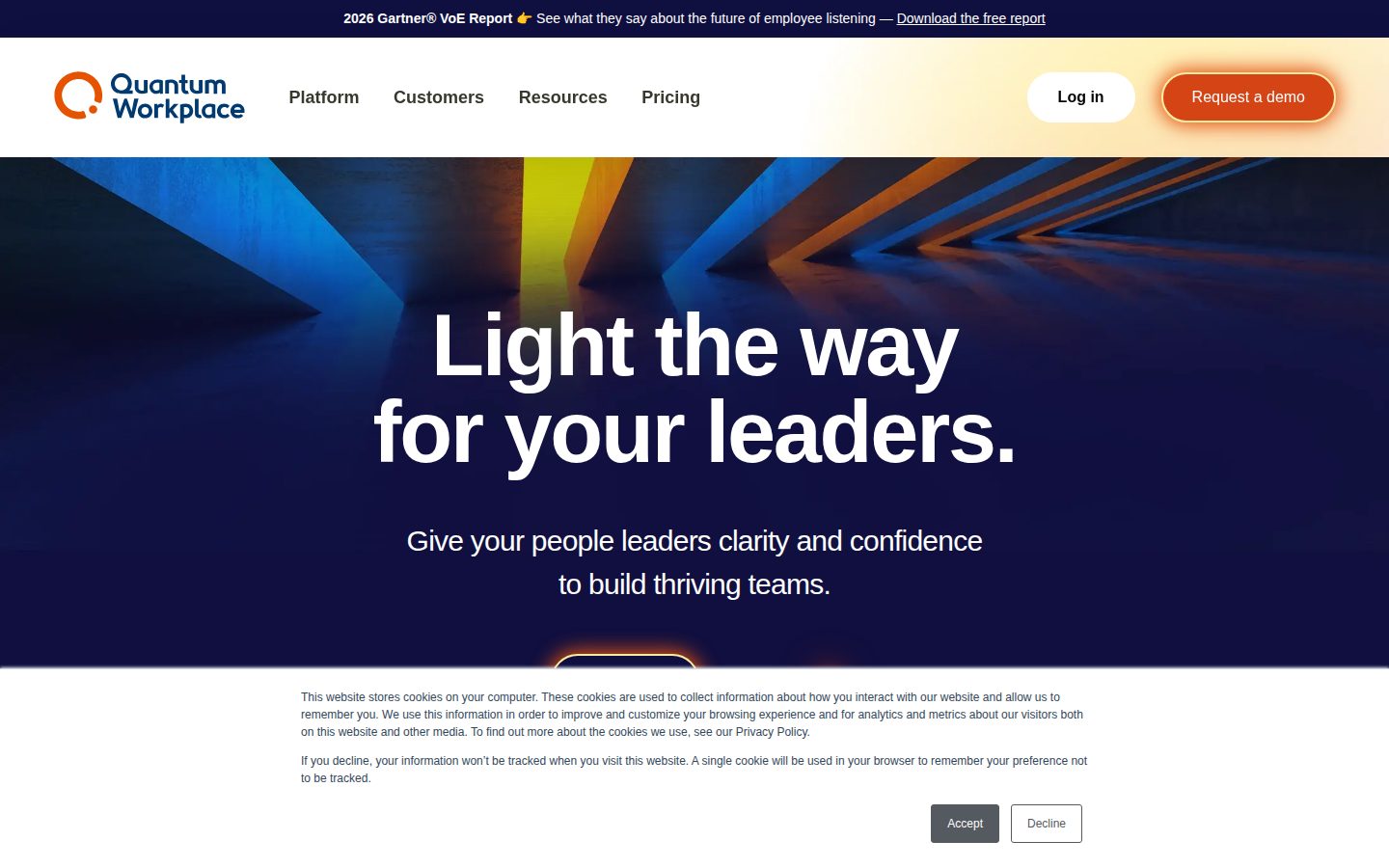
Quantum Workplace is an all-in-one HR software platform for HR leaders and people managers at growing organizations.
AI Panel Score
6 AI reviews
Reviewed
AI Editor ApprovedApproved and published by our AI Editor-in-Chief after full panel analysis.Quantum Workplace is an all-in-one HR software platform for HR leaders and people managers at growing organizations. It connects employee engagement, performance management, development, and recognition data in a single platform so HR teams can act on consolidated talent insights — team health, performance trends, and flight risks — rather than scattered data. The platform fits mid-market HR teams replacing three or more disconnected talent tools with one system. Pricing is quote-based, with no free plan or trial. Key capabilities include engagement, pulse, and lifecycle surveys; goals and OKRs; performance reviews and 1-on-1 tools; succession planning and talent reviews; Retention Radar predictive analytics that surface flight risk inside engagement data; and AI-powered comment summaries, plus HRIS and SSO integrations. TopReviewed's six-seat AI review panel scored it 7.4/10, praising two decades of benchmarking history that newer platforms cannot replicate while noting there is no trial or sandbox to pressure-test before committing.
In practice, users access Quantum Workplace through a web-based platform where HR administrators configure and launch engagement surveys, pulse surveys, and lifecycle surveys, then route results to managers alongside action planning tools. Managers conduct 1-on-1s, set goals and OKRs, write performance reviews, and deliver feedback within the same environment where survey results live—so context is connected rather than siloed across separate tools. Employees interact with recognition features, development plans, and career pathing tools.
The platform highlights several specific capabilities: AI-powered comment summaries that synthesize open-ended survey responses into themes, AI-assisted action planning tools that suggest next steps from feedback data, predictive analytics designed to surface retention risks before they become turnover, and a succession planning and talent review module. Quantum Workplace holds SOC 2 Type II certification, operates on dedicated instances per customer, and integrates with leading HRIS systems and supports SSO for user management and authentication.
Quantum Workplace is used by HR leaders, CHROs, people managers, and executives at mid-market and enterprise organizations across industries including financial services, logistics, retail, and professional services. Pricing is subscription-based, scaled by organization size and the specific modules selected, with multi-year options available; the website indicates a public pricing page exists but does not publish specific tier prices. Competitors in this space include Glint, Qualtrics EmployeeXM, Lattice, 15Five, and Culture Amp.
The platform supports HRIS integrations to automate user management and keep employee data synchronized, SSO for credential-based access, and integrations with workplace communication tools. It is delivered as a cloud-based web application with dedicated data instances per customer rather than a shared multi-tenant environment.
Automatically summarizes open-ended survey comments to help HR teams quickly identify key themes across large volumes of employee feedback.
Surfaces patterns in engagement and performance data to identify flight risks early and give HR leaders insight into turnover drivers before they escalate.
Provides structured 1-on-1 meeting tools and continuous feedback capabilities to help managers maintain consistent coaching rhythms with their teams.
Guides managers and HR teams through AI-powered action planning steps tied directly to survey and feedback insights to drive measurable follow-through.
Collects employee feedback through annual engagement surveys to surface key engagement signals and understand the overall employee experience.
Captures feedback at key moments across the employee journey, such as onboarding and exit, to identify patterns in engagement and turnover.
Allows employees and managers to recognize and celebrate meaningful contributions to build a culture of appreciation and improve top-performer retention.
Enables teams and individuals to set, track, and align goals and OKRs so managers can monitor progress and keep teams focused on shared priorities.
Facilitates structured performance review cycles that allow managers and employees to assess contributions, set expectations, and document performance outcomes.
Sends shorter, frequent surveys to track employee sentiment and team health between full engagement survey cycles.
Helps HR leaders identify high-potential employees, conduct talent reviews, and build leadership pipelines to reduce succession risk.
Connects with leading HRIS systems and supports single sign-on so employee data stays accurate, user management is automated, and login friction is reduced.
Quantum Workplace offers flexible pricing based on organization size and the tools selected. No public list prices are available — custom quotes are provided by the sales team.
Twenty-year-old engagement platform now bundling AI — credible, but price is opaque.
“Quantum Workplace has real category tenure and a feature set that covers the full talent lifecycle. No public pricing and no free trial means every evaluation starts with a sales call.”
Twenty years in market. That's not a startup bet — that's a category survivor. Retention Radar, AI comment summaries, and succession planning in one platform is a genuine consolidation play against owning Glint for surveys, Lattice for performance, and Culture Amp for engagement separately. The dedicated-instance architecture and SOC 2 Type II certification will clear most enterprise security reviews without drama.
The tradeoff is opacity. No published pricing, no free trial, no changelog, no API docs surfaced publicly. You're flying into a custom quote with no anchor. That's a procurement slog and it hands your CFO nothing to benchmark against.
Strategically, this fits HR teams drowning in disconnected point tools. If your managers are toggling between three platforms to run a 1-on-1, this closes that gap. But if you already run a tight stack — Workday plus one engagement tool — the consolidation story shrinks fast.
Competes credibly against Qualtrics EmployeeXM and Culture Amp on breadth; the all-in-one angle is a real differentiator for mid-market buyers who don't want point solutions.
Long-tenured vendor with SOC 2 Type II and enterprise HRIS integrations — the board won't flinch at the name.
No free trial and contact-only pricing means time-to-contract is slow; AI action planning and Retention Radar could surface insights fast post-launch, but you won't know until you're in.
Consolidating engagement, performance, development, and recognition into one platform advances HR ops maturity, not just cost reduction.
Twenty-plus years in market with thousands of named organizational customers signals durable, cash-flow-stable business — not a Series A gamble.
Mid-market HR teams running three or more disconnected talent tools who need a credible consolidation platform.
You want to pilot before buying or need transparent per-seat pricing to build a business case.
Twenty years of engagement data architecture, now with AI layered on top.
“Quantum Workplace connects the full talent lifecycle — surveys, performance, development, recognition — in one data environment rather than forcing HR to reconcile four separate tools. The opaque pricing is a procurement friction point, but the platform's depth puts it squarely in mid-market enterprise consideration.”
Retention Radar is the feature I'd bring to an exec conversation first. Predictive flight-risk surfacing inside the same platform where your engagement surveys and 1-on-1s live means HR isn't manually joining signals across spreadsheets — the context is already connected. Twenty-plus years of category building gives Quantum Workplace benchmarking depth that newer entrants like 15Five can't match yet.
The full module set — engagement surveys, pulse, lifecycle, goals/OKRs, performance reviews, succession planning, recognition — covers everything a mid-market Head of People actually runs. Dedicated data instances per customer and SOC 2 Type II certification matters for financial services and healthcare buyers who can't share infrastructure. AI-powered comment summaries on open-ended survey responses is a genuine time saver when you're processing thousands of responses quarterly.
The real constraint: no public pricing means every evaluation starts with a sales cycle, which slows internal business cases. Compared to Culture Amp or Lattice, where buyers can self-qualify quickly, Quantum Workplace asks for more upfront commitment. If your organization runs multiple disconnected point solutions today, the consolidation ROI is obvious. If you're already on Qualtrics EmployeeXM, the switching costs deserve hard scrutiny.
Sits above point-solution competitors but faces real pressure from Lattice and Culture Amp, who've invested heavily in manager-experience and AI roadmap visibility.
The survey-to-action-planning workflow with manager routing matches how senior HR practitioners actually close the loop on engagement data.
HRIS sync and SSO are confirmed, but no public API docs limits visibility into custom workflow extensibility for complex enterprise stacks.
Consolidating engagement, performance, and recognition on one platform builds a three-year talent data asset, but deep module adoption creates meaningful switching costs.
Succession planning, talent reviews, and Retention Radar together suggest real people-strategy infrastructure, not just survey tooling.
Mid-market HR teams running three or more disconnected talent tools who need a single data environment for engagement, performance, and succession.
Your org is already deep on Qualtrics EmployeeXM or needs transparent self-serve pricing to build an internal business case quickly.
No published price, no free trial, no anchor — budget blind until sales calls back.
“Zero list prices on a 20-year-old platform. Custom quotes only, with no public tier structure to benchmark against Lattice or Culture Amp.”
No price on the page. Contact Sales only. That's the whole procurement story upfront. Category norm for enterprise HR platforms, but Lattice publishes $11/person/month starting tiers. Quantum gives you nothing to anchor a budget against.
TCO is genuinely opaque. Dedicated instances per customer suggest higher infrastructure cost than multi-tenant competitors. Module-based pricing means a full stack — engagement surveys, Retention Radar, succession planning, performance reviews, recognition — likely stacks fees per module. 50 users at mid-market rates, rough comp to Culture Amp at ~$5-8/person/month, lands $3K-4.8K/year. But add AI features, HRIS integration setup, and implementation? Year 3 all-in could double that estimate easily.
SOC 2 Type II and dedicated instances are real procurement positives. Multi-year options exist, which usually means discounts exist — but also means auto-renewal risk. No public contract terms. No trial, no freemium. Procurement will run a full RFP cycle before signing anything here.
No trial, no freemium, no self-serve — full sales cycle required before a single invoice number appears.
Multi-year options are mentioned but no public auto-renewal windows, cancellation terms, or termination-for-convenience language exists in evidence.
No list price, no tiers, no per-seat anchor — contact sales is the only path, per the pricing page.
Retention Radar and predictive analytics tie directly to turnover cost reduction, giving HR a measurable story — but only if the baseline data is clean.
Module-based pricing plus dedicated instances plus implementation cost makes 3-year TCO genuinely unpredictable without a custom quote.
Mid-market HR teams running formal RFP cycles with budget already allocated for an all-in engagement and performance suite.
You need pricing visibility before engaging sales or want a trial before committing budget.
20 Years of Engagement Data Experience Packaged Into One Platform Recruiters Will Actually Use
“Quantum Workplace consolidates engagement surveys, performance reviews, succession planning, and Retention Radar into a single environment — so flight risk conversations happen before you're already backfilling. No public pricing and no free trial means you're committing to a sales call before you see anything.”
Retention Radar is the feature I'd demo first. Predictive flight risk surfacing tied directly to engagement and pulse survey data means HR isn't waiting for a resignation letter to act. That's the daily win for recruiters who are also trying to hold talent, not just source it. AI comment summaries on open-ended survey responses save the hours of manual theme-spotting that usually falls on the people team.
The workflow integration story is genuinely strong. 1-on-1s, goals, OKRs, performance reviews, and survey results live in the same environment — no tab-switching between Lattice for performance and Culture Amp for engagement. Managers who actually log in consistently will give HR better signal. The HRIS and SSO integrations suggest the data hygiene story is real, not an afterthought.
The friction point is the buying process. No pricing, no trial, contact-only. For a mid-market HR leader trying to build a business case, that's a slower evaluation than competitors who publish tiers. Documentation accessibility from public evidence is thin — no visible changelog, no public API docs.
Connected survey-to-action-planning workflow and dedicated data instances suggest low daily chaos, but no trial means day-3 reality is invisible until you're already contracted.
No public docs, API reference, or changelog visible — the evidence suggests documentation is gated behind the sales process, not built for self-serve practitioners.
HRIS sync and SSO reduce login and data entry friction, but no public docs and contact-only pricing adds friction to the evaluation and renewal conversation.
Succession planning, talent reviews, Retention Radar, and AI-assisted action planning indicate genuine depth beyond basic survey tools — 20 years of product iteration shows.
Engagement, performance, development, and recognition in one environment matches how HR leaders actually manage — closer to Lattice's unified model than Glint's standalone surveys.
Mid-market or enterprise HR teams that need engagement, performance, and retention risk in one place and have budget for a full platform.
You need transparent pricing to build an internal business case quickly or want a self-serve trial before involving procurement.
Twenty years of engagement data in one place, finally connected.
“Quantum Workplace bundles surveys, performance, recognition, and succession into one consolidated platform that mid-market HR teams have actually been asking for. No public pricing means every conversation starts with a sales call.”
Quantum Workplace has been building this category for over 20 years — longer than Lattice, longer than 15Five. That matters. The Retention Radar feature, which flags flight risks before they become resignations, is the kind of thing that takes real data history to get right. AI-powered comment summaries on open-ended surveys are genuinely useful at scale when you've got 800 employees and 600 of them typed three paragraphs each.
The connected platform story is the real sell here. Survey results sitting next to 1-on-1 notes, sitting next to performance reviews, sitting next to succession planning — that's not the norm. Culture Amp does engagement well. Lattice does performance well. Quantum Workplace's argument is that you shouldn't be tab-switching between them. That argument holds if the integrations between modules actually feel native, which the dedicated-instance architecture suggests they might.
The tradeoff is opacity. No public pricing, no free trial, no free plan. Web-only delivery means mobile parity is an open question. First 10 minutes probably isn't self-serve — it's onboarding with a customer success rep. That's fine for a CHRO buying for 2,000 employees. Less fine for anyone who wanted to kick the tires first.
The connected-module design suggests intentional UX thinking, but no changelog or public docs makes it hard to know if micro-details get iterated on.
Twelve distinct feature areas across four modules means month-three users will find depth, but the first hour probably needs hand-holding.
Web-only platform listed on supported platforms — no mobile app evidence, which is a real gap for managers doing 1-on-1s in the field.
No free trial and contact-only pricing means onboarding starts with a sales call, not a product moment.
SOC 2 Type II certification and dedicated instances per customer signal serious infrastructure investment, not shared multi-tenant corners cut.
Mid-market or enterprise HR teams tired of running engagement, performance, and succession out of three separate tools.
You need mobile-first manager tools or want to evaluate the product without talking to sales first.
20-year-old category vet with solid bones and zero pricing transparency
“Quantum Workplace has real longevity in a space that chews through startups — 20+ years and thousands of customers is not nothing. But contact-only pricing, no public changelog, and no API docs make due diligence harder than it should be.”
Three tells before I dig in. One: no published pricing. Two: no changelog visible. Three: 'powerfully connected' is exactly the kind of superlative that ages poorly. That said — 20 years and SOC 2 Type II matters in this category. Glint got absorbed by LinkedIn. Betterworks stumbled. Quantum is still standing.
Retention Radar is a named, concrete feature — not just 'AI-powered insights.' AI comment summaries on open-ended survey data is legitimately useful at scale. Dedicated instances per customer is a real differentiator vs. shared-tenant competitors like Culture Amp and 15Five. The connected engagement-to-action-planning loop is the actual value prop, and it's coherent.
The exit story is the soft spot. No API docs visible, no data export SLA, custom pricing with multi-year options — that's a lock-in stack. Migration off this in 18 months would hurt. Tradeoff is real: you get a mature integrated suite, but you're handing leverage to their sales team from day one.
Dedicated instances and the engagement-to-action-planning loop are real gaps vs. Lattice and 15Five, but the module breadth looks comparable to Culture Amp at a glance.
No public API, no visible data export docs, multi-year contract options, and contact-only pricing — every signal points toward stickiness engineered on vendor terms.
No public funding data, but 20 years of operation without obvious distress signals and enterprise HRIS integrations suggest a sustainable business, not a venture-runway story.
'Light the way for your leaders' is pure aspiration — but the feature list itself is grounded and specific with named modules like Retention Radar and Goals/OKRs.
20+ years in the category, thousands of org deployments, and SOC 2 Type II — this matches the survival pattern, not the shutdown pattern.
Mid-market HR teams that want a mature, integrated engagement-plus-performance suite and can negotiate a fair exit clause upfront.
You need transparent pricing, a self-serve trial, or clean data portability before signing.
Common questions answered by our AI research team
Yes, Succession Planning is included under the Development module, alongside Growth and Talent Reviews.
Yes, 1-on-1s is a dedicated feature within the Performance module, alongside Goals, Feedback, and Performance Reviews.
Yes, Retention Radar is a feature within the Engagement module designed to spot talent risks early and support proactive rather than reactive HR practices.
Yes, Seamless Integrations is listed as a platform capability under the Powered By section.
Yes, Recognition and Rewards are both available in the platform under the Recognition module, helping employees feel valued.


Quantum Workplace is an Omaha, Nebraska HR software company founded in 2002 that offers employee engagement, performance management, and recognition software.