AI teammates that automate hospital operations
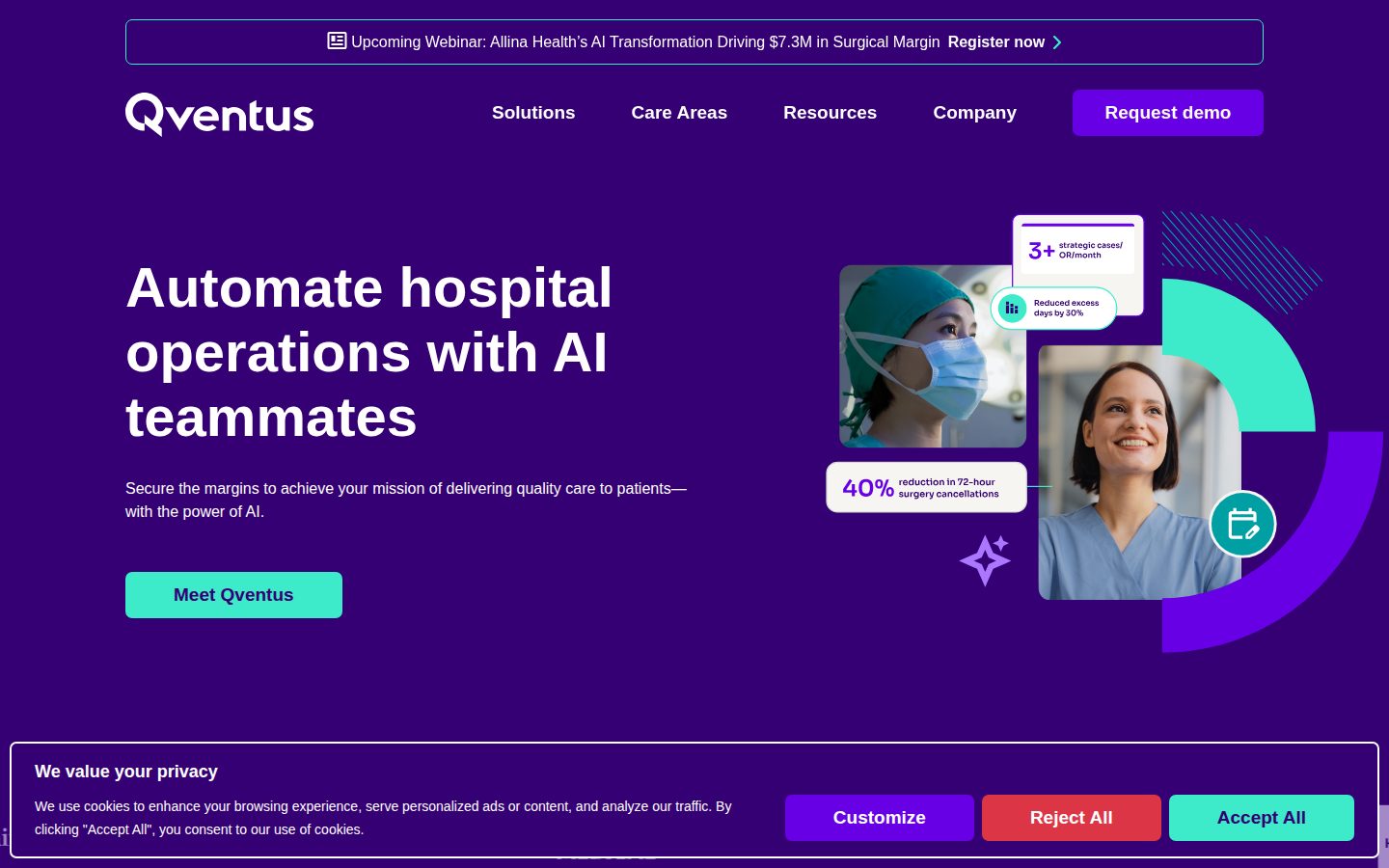
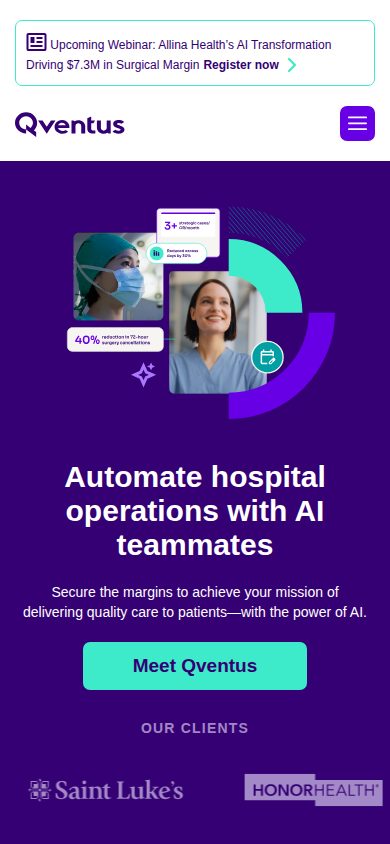
Qventus is an AI operations platform for hospitals that automates administrative and coordination tasks.
AI Panel Score
6 AI reviews
Reviewed
Qventus works as an AI layer embedded into existing hospital systems, primarily the EHR, to automate tasks that otherwise consume staff time. Rather than only flagging issues or generating recommendations, the platform's AI teammates take action directly on administrative tasks such as pre-admission testing coordination, surgical case scheduling, and discharge planning. Care teams interact with these AI Operational Assistants as an extension of their staff, with the system surfacing interventions and executing on them across the patient journey.
The platform is organized into four named solutions: Surgical Growth, which aligns OR scheduling with service line growth strategy and aims to add strategic cases per OR; Perioperative Care Coordination, which gives pre-admission testing teams an AI assistant to complete administrative work and reduce surgery cancellations; Inpatient Capacity, which populates expected discharge dates and dispositions by the first morning after admission and coordinates ancillary resources to close gaps in discharge readiness; and the Care Gap and Coding Automation Suite, launched in February 2026, whose first module, Malnutrition Care Automation, mines charts to identify at-risk patients in real time and pre-populates nutrition consult orders and diagnosis documentation. Qventus reports client results including up to 40% fewer surgery cancellations, 15-30% reductions in excess inpatient days, and up to 50% increases in staff productivity. The company also references a KLAS rating of 92.5 and an "AI Solution Factory" model that lets health systems co-develop AI assistants with Qventus.
Qventus is built for hospital and health system leadership, surgical services departments, and inpatient care teams at mid-to-large healthcare organizations, including named customers such as HonorHealth, Boston Medical Center, and Allina Health. Pricing is not published and is handled through direct sales contact. It competes with EHR-native workflow tools (such as those built into Epic or Cerner/Oracle Health) and other healthcare operations AI vendors like LeanTaaS.
The platform is delivered as a cloud-based, web-accessed system that integrates with a hospital's existing EHR infrastructure rather than replacing it, functioning as an add-on automation and coordination layer across surgical and inpatient care settings.

AI teammates that take direct action on below-license administrative tasks rather than just surfacing recommendations, freeing staff to focus on patient care.
Populates aggressive but achievable expected discharge dates (EDDs) and dispositions by the first morning after admission to enable early, accurate discharge planning.
Uses machine learning models to help hospitals maximize operating room utilization and add strategic cases per OR per month.
Powered by AI Operational Assistants, gives each pre-admission testing team member a virtual admin that completes administrative tasks to optimize more patients for surgery and reduce cancellations by up to 40%.
Helps reduce length of stay and excess inpatient days by 15-30% through improved discharge planning and patient flow.
Identifies and addresses upstream issues in pre-admission testing to reduce surgery cancellations by up to 40%.
Orchestrates ancillary resources and closes care gaps to help get patients home sooner.
Automates below-license administrative processes across surgical, perioperative, and inpatient workflows to reduce staff burden and burnout.
Increases staff productivity by up to 50% by offloading tedious administrative tasks that contribute to burnout.
Aligns surgical growth strategy with day-to-day operations to help fill ORs with the cases that matter most and boost service line and robotic utilization growth.
Allows health systems to co-develop AI Operational Assistants with Qventus at unmatched velocity, tailoring solutions to specific institutional needs.
Seamlessly embeds into a hospital's EHR to manage pre-admission testing, surgical scheduling, and discharge planning workflows.
Qventus sells its AI-powered healthcare operations platform (patient flow, capacity management, perioperative, and inpatient/outpatient solutions) directly to hospitals and health systems via custom enterprise contracts. Pricing is not publicly listed and requires contacting Qventus sales for a quote based on facility size, modules selected, and deployment scope.
AI that actually clicks the buttons in your EHR, with named customers and hard numbers.
“Qventus takes action on scheduling and discharge tasks instead of just flagging them. Named customers and a KLAS score of 92.5 back the claims, but pricing is a black box.”
Three named hospital customers — HonorHealth, Boston Medical Center, Allina Health. That's not a pilot deck, that's an install base. The KLAS rating of 92.5 is the kind of third-party number that's hard to fake in healthcare IT.
The pitch is specific: 40% fewer cancellations, 15-30% fewer excess inpatient days, 50% productivity gains. Those are aggressive numbers from a vendor page, not audited results, but they're concrete enough to hold the sales team to.
Two concerns. No pricing page means every deal is a negotiation, which favors Qventus, not the hospital. And EHR embedding is powerful but it's also lock-in — once your discharge workflow lives inside their layer, ripping it out is a project, not a settings change. Competes against EHR-native tools from Epic and Oracle Health, which is a real moat to unseat.
Taking direct action versus recommending is a stated differentiator against EHR-native tools like Epic and Oracle Health.
Deep EHR embedding across surgical and inpatient workflows raises lock-in and data portability questions the site doesn't address.
Discharge dates populated by first morning after admission suggests fast operational impact, though ramp time for EHR integration isn't disclosed.
Automates below-license tasks directly rather than surfacing dashboards, which is a different operating model than most hospital analytics tools.
No public docs or pricing page, but named enterprise customers and a KLAS 92.5 rating signal real deployments, not vaporware.
Mid-to-large hospital systems with surgical volume problems who can commit to a custom enterprise contract.
Skip if you can't get discharge and OR-scheduling data portability terms in writing before signing.
This automates below-license work well; the real question is who owns the discharge decision three years from now.
“Qventus takes action on administrative tasks instead of just flagging them, which is the right design for OR scheduling and discharge planning. The governance question — who signs off when the AI teammate acts autonomously in the EHR — isn't answered in the material I have.”
Below-license task automation is the correct clinical target. Pre-admission testing coordination and discharge date population are exactly the workflows that eat nursing and case management time without touching clinical judgment, and a 15-30% excess days reduction, if it holds across a payer mix, moves real bed capacity. A KLAS score of 92.5 is a credible third-party signal in a market where most vendors cite their own case studies.
My concern as CMO is escalation logic. Direct action inside the EHR on discharge disposition and OR scheduling means the AI teammate is making operational calls that ripple into clinical flow — I need to see the override and audit trail, not just the automation rate.
Three named health systems (HonorHealth, Boston Medical Center, Allina Health) and named EHR-native incumbents as the alternative suggest this is enterprise-grade, sales-cycle-heavy, and built for systems already past basic EHR workflow tools.
Positioned against EHR-native tools (Epic, Cerner/Oracle) and other ops AI vendors like LeanTaaS, with a KLAS rating of 92.5 as differentiation.
Targeting below-license administrative tasks — pre-admission testing, EDD population — matches how perioperative and case management teams actually lose time.
EHR embedding is explicitly named as core architecture, avoiding a separate bolt-on system, per the buyer Q&A.
Embedding AI teammates directly into EHR workflows for scheduling and discharge creates deep operational dependency with no published exit or portability details.
Four named solutions (Surgical Growth, Perioperative Care Coordination, Inpatient Capacity, Care Gap and Coding Automation) show a mature, segmented operational model rather than a single dashboard.
Mid-to-large health systems with surgical services and inpatient capacity strain who already run a mature EHR and need action, not just alerts.
Avoid if your organization needs transparent, auditable override controls in place before granting an AI system direct write access to discharge and scheduling decisions.
Zero pricing data. Enterprise EHR embed. ROI numbers are vendor-reported, not audited.
“Qventus sells four solution lines — Surgical Growth, Perioperative Care Coordination, Inpatient Capacity, and the Care Gap and Coding Automation Suite — through custom contracts only. No price floor, no tier table, no published term length.”
No pricing page. Contact sales, get quoted by facility size and module count. That's standard for enterprise health IT, but it means procurement starts blind.
TCO math is unknowable from public materials. Four solution lines, EHR integration work, and an unnamed implementation timeline all factor in. A 500-bed system buying the full solution set is a different number than a single-site perioperative deal — and Qventus won't tell you which bucket you're in until legal's involved.
ROI claims are specific: 40% fewer cancellations, 15-30% fewer excess days, 50% productivity gain, KLAS score of 92.5. Good numbers, but they're client-reported results, not your contract's guaranteed outcomes. Compare to LeanTaaS, also selling hospital ops AI on a direct-sales model — neither vendor publishes rate cards. Budget for a long procurement cycle and get cancellation terms in writing before signing.
Named enterprise customers (HonorHealth, Boston Medical Center, Allina Health) suggest it clears health-system procurement, but the process itself isn't documented.
Evidence is silent on term length or auto-renewal — category norm for enterprise health IT is 3-year minimums.
No pricing page, no tiers, no starting price — quote-only via sales contact.
40% cancellation reduction, 15-30% excess day reduction, and 50% productivity gains are specific, though vendor-reported.
Multi-module EHR integration at hospital scale implies real implementation cost, but none of it is itemized publicly.
Mid-to-large health systems with surgical and inpatient volume large enough to justify a custom enterprise contract.
You need a comparable price point before starting procurement conversations.
AI teammates that actually touch the EHR — but nurses and schedulers will be the ones vetting every action
“Qventus goes further than typical dashboard analytics by executing below-license tasks like PAT coordination and EDD population directly in the EHR. The daily question for staff is trust calibration: when do you let the assistant act, and when do you double-check it.”
Pre-admission testing coordinators live in checklists and phone tag. An assistant that completes below-license tasks instead of flagging them addresses that directly — but it also means someone on the perioperative team now has to build trust in an AI teammate's judgment before letting go of manual verification. The 40% cancellation reduction and 15-30% excess-days figures are client-reported, not independently audited, so charge nurses and OR directors should expect a validation period, not day-one confidence.
EHR embedding is the right call architecturally — no bolt-on portal for staff to check separately, no second login for the discharge planner. That's a real workflow win over generic dashboard tools. The tradeoff: deep EHR embedding means go-live and IT security review timelines that hospital IT and compliance will drive, not clinical staff.
No public docs, no API reference, no pricing page — everything routes through sales. For a nurse manager wanting to see exactly how EDD population handles edge cases before committing, that's a real gap. KLAS rating of 92.5 is reassuring but not a substitute for seeing the assistant handle your unit's actual discharge complexity.
Direct action on PAT and discharge tasks is a genuine time-saver, but staff need a trust-building period before relying on it unsupervised.
No docs and no API reference anywhere on the site; a blog exists but nothing indicates practitioner-authored guidance for edge cases.
No published pricing or self-serve trial means every rollout question — module scope, deployment timeline — routes through a sales cycle rather than a docs page.
The AI Solution Factory co-development model suggests real customization headroom for health systems like HonorHealth and Allina Health, though depth is unverifiable without docs.
EHR embedding across surgical, perioperative, and inpatient workflows avoids a separate portal, which matters for already-overloaded schedulers and discharge planners.
Mid-to-large hospital systems with dedicated perioperative or inpatient capacity teams and the IT bandwidth for EHR-level integration.
Avoid if you need transparent pricing or self-serve evaluation before committing to a sales-led enterprise contract.
AI teammates that actually do the paperwork, not just flag it — if your hospital can get past sales.
“Qventus automates the boring-but-critical hospital admin work like discharge dates and pre-admission testing. Real numbers, real named customers, zero pricing transparency.”
No demo, no trial, no pricing page. You call sales, you get a quote based on 'facility size and modules selected.' That's normal for enterprise health IT, but it means there's no ten-minute test drive here. Day one for a nurse using this is whatever the hospital's IT department decided it should be, not something Qventus designed for a casual first look.
What's actually interesting is the 'takes action, not recommendations' pitch. Most hospital software just nags you with a dashboard. This one populates expected discharge dates the morning after admission and coordinates the ancillary stuff to close gaps — that's a real workflow difference if the KLAS 92.5 rating and the 40% cancellation-reduction number hold up in practice, which I can't verify beyond what they report.
The EHR-embedded model beats fighting with a separate login, but it also means you're at the mercy of Epic or Cerner integration quality, which varies wildly hospital to hospital. Named customers like HonorHealth and Boston Medical Center suggest this isn't vaporware. Just don't expect a self-serve trial to check the fit yourself.
EHR embedding avoids a bolt-on feel, but no public UI evidence beyond marketing copy.
AI Solution Factory lets health systems co-develop assistants, implying real ramp-up but real customization depth.
Platform listed as web-only; evidence is silent on mobile, so no penalty beyond category norm.
No free trial, no self-serve start — onboarding is a sales call, not a first-hour experience.
KLAS rating of 92.5 and named enterprise clients like Allina Health suggest production-grade trust.
Mid-to-large hospital systems with surgical and inpatient capacity headaches and budget for enterprise contracts.
Avoid if you need to see pricing or test the product before committing a health system to a sales cycle.
KLAS score of 92.5 is real signal. The rest is percentage soup.
“Named customers and a third-party rating give this more weight than most enterprise health-tech pitches. But 'up to 40%' shows up three times and pricing is nowhere.”
KLAS 92.5 is the kind of number you can't fake easily. That's the strongest thing I found anywhere here. HonorHealth, Boston Medical Center, Allina Health — real named customers, not logos-as-decoration.
But the case studies lean on 'up to' constantly. Up to 40% fewer cancellations. Up to 50% productivity. Up to reads best-case, not baseline. No docs, no API, no pricing page — enterprise sales motion, fine for this category, but it means no self-serve way to sanity-check claims before a contract.
Competes with EHR-native tools from Epic and Cerner, and with LeanTaaS. Differentiation is real: 'AI teammates that take action' versus dashboards that flag issues. Exit story is the concern — this sits deep in EHR workflow logic. Ripping it out after 18 months means rebuilding scheduling and discharge processes your staff now depends on.
Action-taking vs. recommendation-only is a real distinction against Epic/Cerner-native tools and LeanTaaS.
Deep EHR embedding across scheduling and discharge workflows means high switching cost if Qventus direction shifts.
No changelog or docs page visible; blog exists but maintenance signals are thin.
KLAS 92.5 is grounded; 'up to 40%/50%' repeated across the solution lineup is the kind of superlative that ages poorly without ranges.
Named customers (HonorHealth, Boston Medical Center, Allina Health) back the claims better than most enterprise health AI pitches.
Mid-to-large hospital systems with dedicated surgical services and capacity teams ready for a long enterprise sales cycle.
Avoid if you need transparent pricing or a low-commitment pilot before deep EHR integration.
Common questions answered by our AI research team
Qventus reduces surgery cancellations by up to 40% through its Perioperative Care Coordination Solution, which optimizes pre-admission testing to get more patients cleared for surgery.
Yes. Qventus embeds directly into a hospital's EHR to manage pre-admission testing, surgical scheduling, and discharge planning without requiring separate bolt-on systems.
It gives every pre-admission testing team member their own AI Operational Assistant that completes administrative tasks, optimizing more patients for surgery and cutting surgery cancellations by up to 40%.
The Inpatient Capacity Solution populates aggressive but achievable estimated discharge dates and dispositions by the first morning after admission, then orchestrates ancillary resources and closes gaps to get patients home sooner, reducing excess days by 15-30%.
Qventus takes direct action rather than just recommending tasks. Its AI teammates complete below-license administrative work themselves across surgical, perioperative, and inpatient workflows, freeing staff to focus on patient care.


Qventus develops AI-powered software for hospitals and health systems, based in Mountain View, California, to optimize operations across surgical, inpatient, and emergency care.