Unstructured logo

Unstructured Review

Visit

Open-source platform for preprocessing unstructured data for LLM applications

Unstructured is a data preprocessing platform that converts documents into structured formats for AI applications.

AI Panel Score

8.0/10

6 AI reviews

Reviewed

AI Editor Approved

About Unstructured

Unstructured is an open-source platform designed to preprocess unstructured data for artificial intelligence and machine learning applications. The platform specializes in converting documents, images, and other unstructured content into structured, machine-readable formats that can be efficiently processed by large language models and other AI systems.

The platform supports a wide range of input formats including PDFs, Word documents, PowerPoint presentations, emails, HTML pages, images, and various other file types. Unstructured applies advanced document parsing, optical character recognition (OCR), and natural language processing techniques to extract text, tables, metadata, and structural elements from these sources. The processed data is then formatted into structured outputs like JSON, which can be easily ingested by downstream AI applications.

Unstructured targets data scientists, AI engineers, and developers building retrieval-augmented generation (RAG) systems, document processing pipelines, and other AI-powered applications that require high-quality structured data. The platform offers both open-source libraries that can be self-hosted and cloud-based APIs for scalable document processing.

The platform competes in the growing market of AI data preprocessing tools, positioning itself as a comprehensive solution for organizations looking to leverage their unstructured data assets for AI initiatives. By providing both open-source flexibility and managed cloud services, Unstructured aims to serve organizations of various sizes and technical capabilities in their AI data preparation workflows.
Features

AI

  • Chunking, Enrichment, and Embedding

    Parses, chunks, embeds, and enriches data as part of the transformation pipeline to prepare it for AI and analysis workflows.

Automation

  • 24/7 Pipeline Maintenance

    Automatically maintains and monitors data pipelines around the clock to ensure connections remain reliable as systems evolve.

  • ETL Pipeline Orchestration

    Orchestrates the full extract, transform, and load process so teams can run continuous data preprocessing workflows at scale.

Core

  • 64+ File Type Support

    Processes and transforms over 64 different file types including PDFs, CSVs, and newsletters into clean, structured output.

  • API Access

    Offers a full API that gives engineers direct flexibility and control over data processing workflows.

  • Drag and Drop File Processing

    Allows users to drag and drop files directly into the interface to instantly transform unstructured data into structured output.

  • UI Interface

    Provides a no-code UI that allows teams to process and transform data without heavy coding.

Integration

  • 30+ Source and Destination Connectors

    Connects to 30+ data sources and destinations including databases, data lakes, and enterprise systems with 1,250+ pipelines.

  • OpenAI and Anthropic Integrations

    Integrates with OpenAI, Anthropic, and other AI providers as part of the data transformation and enrichment pipeline.

Security

  • Role-Based Access Control

    Handles role-based access permissions as a built-in feature to manage user authorization across the platform.

  • Security and Compliance

    Includes built-in security and compliance capabilities to meet enterprise requirements without additional configuration.

Preview

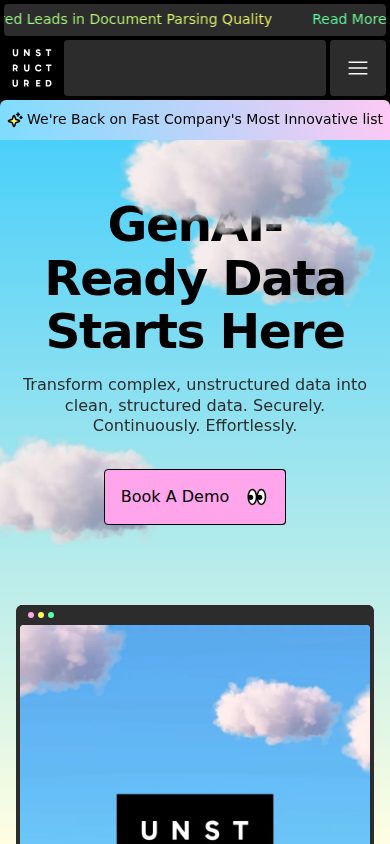
Unstructured mobile preview

Pricing Plans

Free

Free

For curious individuals who want to explore the platform with no commitment.

  • 15,000 free pages (no expiration)
  • No minimums, completely free
  • All features included
  • Full access to every connector and transform strategy
Popular

Pay-As-You-Go

$0/per page

For users who want to pay only for what they process with no minimums or commitments.

  • $0.03 per page flat rate
  • No minimums, no maximums, no commitment
  • No hidden fees
  • All features included
  • Flat rate for any file type and any pipeline

Business

Contact sales

Built for teams of any size that need privacy, control, and security with dedicated infrastructure.

  • Custom pricing
  • Multi-user accounts
  • Dedicated instance, VPC or multi-tenant SaaS
  • Full data isolation
  • Dedicated technical support
  • Custom enrichments and in-VPC only features

AI Panel Reviews

The Decision Maker

The Decision Maker

Strategic bet, vendor viability, timing, adoption approval
8.1/10

CIA-trained founder, $65M raised, big-three AI customers — the enterprise pick for RAG data prep through 2027.

Menlo Ventures led a $40 million Series B in March 2024, with NVIDIA, Databricks, and IBM all writing checks. Chunk by Similarity plus 30+ connectors and In-VPC deployment make this the enterprise default, though $0.03 per page adds up at production scale.

Brian Raymond came out of the CIA and Primer AI to start Unstructured in 2022. Menlo Ventures led a $40 million Series B in March 2024, total raised $65 million. NVIDIA, Databricks, and IBM all wrote checks — that's the customer base telling you who matters.

Chunk by Similarity is the lever. It handles semantic boundaries across 64+ file types and feeds Pinecone or Snowflake without a glue layer. LlamaParse competes at the API level, but the 30+ connectors and In-VPC deployment make Unstructured the enterprise pick.

However the catch is the per-page math. $0.03 a page is fine for pilots, at production RAG scale it compounds fast and Business is quote-only. SOC 2 Type II and HIPAA check the board boxes. Pilot one team for 90 days.

Competitive Positioning7.8

Connector breadth and In-VPC deployment beat LlamaParse at enterprise, though LLM platforms encroach on the prep layer.

Reputation Risk8.3

IBM Ventures, Menlo, and NVIDIA backing makes this a defensible choice in any board review.

Speed to Value7.8

15,000 free pages and a no-code UI shorten pilots, but production scale requires engineering investment.

Strategic Fit8.2

RAG preprocessing is the load-bearing layer for enterprise GenAI, not a cost-saver on existing workflows.

Vendor Viability8.0

Series B with $65M raised, founder-led since 2022, NVIDIA and Databricks on the cap table signal durability.

Pros

  • Backed by NVIDIA, Databricks, and IBM Ventures — the buyers are also the investors.
  • 64+ file types and 30+ connectors cover the messy enterprise data surface.
  • In-VPC deployment on AWS, Azure, or GCP with SOC 2 Type II, HIPAA, and Zero Data Retention.
  • Free tier offers 15,000 pages with no expiration — a real pilot, not a teaser.

Cons

  • $0.03 per page is predictable for pilots but compounds quickly at production RAG volumes.
  • Business plan is custom-quote only, which slows procurement for mid-market teams.

Right for

Engineering teams who need enterprise-grade RAG preprocessing across many file types.

Avoid if

Solo builders who just need a quick PDF parser for prototypes.

The Domain Strategist

The Domain Strategist

Craft and strategy in the product's domain — adapts identity per category, same lens
8.2/10

Brian Raymond's $40M Series B in 2024 funded the ETL layer between enterprise documents and RAG.

Unstructured raised $40M Series B in March 2024 from Menlo Ventures, Databricks Ventures, IBM Ventures, and NVIDIA's NVentures, bringing total funding to $65M since its 2022 founding. For a Head of AI Data Infrastructure picking a document-preprocessing substrate through 2029, the call is whether vendor depth on 64+ file types beats stitching LlamaIndex parsers in-house.

Brian Raymond came out of the CIA and Primer to ship Unstructured in 2022, and Menlo Ventures led the $40M Series B in March 2024 alongside Databricks Ventures, IBM Ventures, and NVIDIA's NVentures. Total raised sits at $65M.

The platform ships 64+ file-type support, 30+ source-and-destination connectors, and Chunk by Similarity alongside Contextual Chunking. SOC 2 Type 2, HIPAA, and Zero Data Retention plus In-VPC deployment on AWS, Azure, or GCP — that's the enterprise shape. Pay-As-You-Go at $0.03 per page with 15,000 free pages is rare in this segment.

But LlamaIndex parsers are free and in-process, and Databricks has its own ingestion story. The tradeoff is whether per-page billing beats homegrown maintenance cost. For a 3-year RAG-substrate call, connector breadth and compliance are the moat — not the parsing primitives.

Category Positioning8.0

$65M raised and Menlo plus Databricks plus NVIDIA backing positions it as a specialist next to the warehouse.

Domain Fit8.4

Built specifically for RAG and LLM data prep — matches senior AI-infra workflow shape.

Integration Surface8.3

30+ connectors, OpenAI and Anthropic integrations, Snowflake as source and destination, Pinecone destination.

Long-term Implications7.8

Per-page billing creates real switching math at scale, but open-source library limits hard lock-in.

Strategic Depth8.2

64+ file types, multiple chunking strategies, SOC 2 Type 2, and Zero Data Retention show craft depth.

Pros

  • 15,000 free pages with no expiration on the free tier is unusually generous for enterprise ETL.
  • SOC 2 Type 2, HIPAA, ISO 27001, GDPR plus Zero Data Retention covers regulated-industry requirements.
  • In-VPC deployment on AWS, Azure, or GCP on the Business plan addresses enterprise data-residency.
  • Investor stack — Menlo, Databricks Ventures, IBM Ventures, NVIDIA NVentures — signals warehouse-adjacent positioning.

Cons

  • $0.03 per page Pay-As-You-Go can outrun in-house LlamaIndex parsing cost at high volume.
  • In-VPC deployment is Business-plan only, raising the floor for compliance-sensitive smaller teams.
  • Pinecone is destination-only — bidirectional vector-store sync still requires custom plumbing.

Right for

AI platform leads building enterprise RAG pipelines who need compliant managed ingestion.

Avoid if

Solo developers who can stitch LlamaIndex parsers and skip per-page billing.

The Finance Lead

The Finance Lead

Money, total cost of ownership, contracts, procurement math
8.2/10

$0.03 flat per page beats LlamaParse's premium tier and ships with 15,000 free pages.

Per-page flat pricing with no minimums makes Unstructured the cleanest unit economics in document AI preprocessing. The catch is that In-VPC deployment and full enterprise security only unlock on the custom-priced Business tier.

Per-page pricing is rare in document AI, and Unstructured publishes it: $0.03 flat across every file type. LlamaParse charges $0.003 per page for fast mode but climbs to $0.045 for premium. Unstructured's flat rate wins on predictability.

Run the math on a RAG pipeline ingesting 500K pages monthly. 500,000 × $0.03 × 12 = $180K/year on Pay-As-You-Go. The free tier covers 15,000 pages with no expiration — useful for prototypes, not production. In-VPC deployment on AWS, Azure, or GCP only unlocks on Business.

The catch is the security bundle. HIPAA, SOC 2 Type 2, and Zero Data Retention sit on the cloud API, but VPC isolation requires Business. Menlo Ventures led $40M Series B in March 2024. Procurement won't push back on the per-page line.

Billing & Procurement8.0

Flat-rate invoicing with no hidden fees; only friction is Business-tier custom pricing for VPC buyers.

Contract Flexibility8.5

No minimums, no maximums, no commitment on Pay-As-You-Go per their pricing page — rare in this category.

Pricing Transparency8.5

Free and Pay-As-You-Go tiers fully published with $0.03 flat per page; only Business hides behind sales.

ROI Clarity7.5

Page-count metering is measurable, but downstream RAG quality value depends on the chunking strategy chosen.

Total Cost of Ownership8.0

Predictable unit cost across 64+ file types, though VPC and enterprise security gate to custom Business pricing.

Pros

  • Flat $0.03 per page across every file type — rare unit economics in document AI.
  • 15,000 free pages with no expiration is a real prototype budget, not a marketing teaser.
  • No minimums, no maximums, no commitment on Pay-As-You-Go — procurement-friendly.
  • HIPAA, SOC 2 Type 2, GDPR, and Zero Data Retention available on the standard tier.

Cons

  • In-VPC deployment on AWS, Azure, or GCP only unlocks on custom-priced Business tier.
  • Business pricing requires a sales call — no published floor for enterprise buyers.
  • No published overage or volume-discount schedule for high-volume RAG pipelines.

Right for

Data teams who need predictable per-page costs for RAG pipelines.

Avoid if

Buyers who require VPC isolation on a published price.

The Domain Practitioner

The Domain Practitioner

Daily hands-on reality in the product's domain — adapts identity per category, same lens
8.0/10

Unstructured's $0.03 per page meter parses 64+ file types — the cleanest preprocessing pipe a RAG engineer can wire.

Unstructured ships an open-source library plus a managed pipe at $0.03 per page, with 15,000 free pages and Chunk by Similarity baked in alongside Chunk by Title, Page, and Character. The catch is that In-VPC deployment is Business-plan only — solo builders get the cloud meter or the self-host slog, no middle tier.

What a RAG engineer cares about is what comes out of the parser when the PDF is messy. Unstructured publishes the partitioning library on GitHub and exposes the same engine through the API — 64+ file types, table extraction, OCR included. LlamaParse charges per page too, but ships fewer connectors.

The meter is honest: $0.03 flat per page, no minimums, 15,000 pages free with no expiration. But In-VPC deployment on AWS, Azure, or GCP is Business-plan only — a startup processing sensitive contracts eats the public API or self-hosts the open-source stack. Zero Data Retention covers the cloud path; HIPAA and SOC 2 Type 2 are confirmed.

Chunk by Similarity earns its keep over Chunk by Title for retrieval quality, and the docs read like someone tuned them against a real pipeline. Snowflake works both directions; Pinecone is destination-only — small detail that bites at architecture-review time.

Day-3 Reality8.0

Honest $0.03 flat meter, 15,000 free pages, OCR and table extraction included in the partitioner.

Documentation Practitioner-Fit8.0

Five chunking strategies and connector matrices documented at the depth an ingestion engineer needs.

Friction Surface7.6

In-VPC deployment is Business-plan only and Pinecone is destination-only — both pinch real architectures.

Power-User Depth8.2

Open-source library plus managed API on the same engine, with OpenAI and Anthropic enrichment in the pipeline.

Workflow Integration8.2

30+ source and destination connectors with 1,250+ pipelines; Snowflake works as both source and destination.

Pros

  • Open-source partitioning library plus managed API on the same engine — no lock-in on the parsing layer.
  • $0.03 per page flat with 15,000 free pages and no expiration is honest metering for an ingestion tool.
  • Five chunking strategies including Chunk by Similarity ship in the box.
  • HIPAA, SOC 2 Type 2, GDPR, ISO 27001, and Zero Data Retention all covered on the cloud meter.

Cons

  • In-VPC deployment locked to Business plan — no middle tier between self-host and enterprise.
  • Pinecone is destination-only; round-trip retrieval needs a second connector.
  • No public changelog page makes it hard to track what shipped when.

Right for

AI engineers who build RAG pipelines on mixed document corpora.

Avoid if

Solo builders who need in-VPC deployment without Business pricing.

The Power User

The Power User

Daily human experience, onboarding, polish, learning curve, reliability
8.0/10

Open source plus a paid API, 15,000 free pages, and Chunk by Similarity does the RAG seam.

Unstructured ships an open-source parser and a $0.03 per page API with 15,000 free pages and no expiration. The Free tier is real runway, but per-page billing swings with document type.

Open source library on GitHub plus a paid API when you need it. That's the shape. 15,000 free pages with no expiration is generous for a category where LlamaParse bills per credit. The Free tier isn't a teaser — it's runway.

Chunk by Similarity does what most RAG pipelines stitch together manually — semantic grouping inside the parsing step, not a downstream cleanup pass. 64+ file types into one JSON shape means PDFs, PowerPoints, and emails stop being three problems. The drag-and-drop UI is a thoughtful nod to non-engineers.

The catch is pricing predictability. $0.03 per page is honest, but pages aren't a stable unit — scanned PDFs versus clean HTML swing costs. Brian Raymond's team raised $40M Series B in March 2024 with NVIDIA and Databricks on the cap table, so the runway is real.

Daily Polish7.8

Drag-and-drop UI and a clean JSON output shape across 64+ file types show real attention to the boring parts.

Learning Curve7.6

Two surfaces — Python library and managed API — so day-three depends on which one you picked, but docs are solid.

Mobile Parity7.5

Data pipeline tooling; mobile is a non-question for this category, so neutral score.

Onboarding Experience8.2

15,000 free pages with no expiration means you can prototype a full RAG pipeline before you ever see a bill.

Reliability Feel7.9

HIPAA, SOC 2 Type 2, GDPR, ISO 27001 and a Zero Data Retention policy — the trust signals are stacked.

Pros

  • 15,000 free pages with no expiration on the Free tier — generous for the category.
  • Chunk by Similarity bakes semantic chunking into parsing, not a downstream cleanup step.
  • 64+ file types collapse into one JSON shape — PDFs, PowerPoints, emails stop being three problems.
  • HIPAA, SOC 2 Type 2, and Zero Data Retention out of the box — enterprise-ready trust signals.

Cons

  • $0.03 per page swings unpredictably with document type — scanned PDFs cost very differently from clean HTML.
  • In-VPC deployment on AWS, Azure, or GCP is Business plan only — no self-serve path to private hosting.

Right for

Data scientists who build RAG pipelines on mixed document types.

Avoid if

Solo developers who process only clean HTML or plain text.

The Skeptic

The Skeptic

Contrarian. Watch-outs, deal-breakers, broken promises, category patterns
7.5/10

Menlo, Databricks, IBM, and NVIDIA all wrote checks — but pay-as-you-go runs 10x LlamaParse on per-page price.

Unstructured raised $40M Series B in March 2024 with Menlo leading and Databricks Ventures, IBM Ventures, and NVIDIA participating, putting $65M lifetime behind 64+ file-type parsing and 30+ connectors. The catch is per-page pricing at $0.03 — 10x LlamaParse — and a Databricks-shaped competitor sitting on the cap table.

Menlo led the Series B in March 2024. Databricks Ventures, IBM Ventures, and NVIDIA wrote alongside — $40M total, $65M lifetime. Brian Raymond came out of Primer AI. The cap table reads like a buyer wishlist.

Pay-As-You-Go is $0.03 per page. LlamaParse charges $0.003 — that's 10x, before quality comparison. What you're buying is the 64+ File Type Support and 30+ Source and Destination Connectors, not just parsing. Free tier exists. Business is custom-priced.

The catch is positioning. Unstructured wants to be the RAG data plane, but Databricks is both investor and category competitor. If Mosaic absorbs this layer, the moat thins fast. Exit is clean — outputs are JSON, the library is open source. Worth piloting on hard PDFs.

Competitive Differentiation6.8

Connector breadth is real, but LlamaParse, Reducto, and Docling crowd the document-parsing layer.

Exit Portability8.2

Open-source parsing library and JSON outputs mean no proprietary lock-in if the platform shifts direction.

Long-term Viability7.4

$65M raised over three rounds with strategic investors, but Databricks Ventures sits on the cap table while Mosaic competes.

Marketing Honesty7.8

GenAI-Ready Data tagline is restrained, and the 64+ file-type and 30+ connector counts are concrete claims.

Track Record Match7.5

Series B led by Menlo with Databricks, IBM, and NVIDIA strategics matches funding patterns of category survivors.

Pros

  • Series B closed March 2024 at $40M with Menlo Ventures leading and Databricks Ventures, IBM Ventures, and NVIDIA all on the cap table.
  • 64+ File Type Support and 30+ Source and Destination Connectors give a credible enterprise breadth pitch.
  • Open-source library and JSON outputs make exit migration straightforward if direction shifts.
  • Founder Brian Raymond brings Primer AI and intelligence-community provenance, not a first-time GenAI bet.

Cons

  • Pay-As-You-Go at $0.03 per page is roughly 10x LlamaParse's $0.003 list rate.
  • Databricks is both an investor and a category competitor through Mosaic, which complicates the long-term position.
  • Business tier pricing is custom-only, which usually means six-figure commits and slow procurement.

Right for

Teams who need broad file-type parsing for enterprise RAG pipelines.

Avoid if

Developers who only need fast PDF parsing at scale.

Buyer Questions

Common questions answered by our AI research team

Pricing

What's included in the free tier — how many pages can I process, and does it expire?

The free tier includes 15,000 free pages with no expiration date. There are no minimums and it includes full access to every feature in the platform, completely free.

Features

Does Unstructured support chunking by semantic similarity, and what other chunking strategies are available?

Yes, Unstructured supports chunking by similarity (Chunk by Similarity). Other available chunking strategies include Chunk by Character, Chunk by Title, Chunk by Page, and Contextual Chunking.

Security

Is the platform HIPAA and SOC 2 Type 2 compliant, and does data get retained after processing?

Yes, Unstructured is both HIPAA compliant and SOC 2 Type 2 certified, along with GDPR and ISO 27001 compliance. The platform has a Zero Data Retention policy, meaning data is not retained after processing.

Setup

Can I deploy Unstructured inside my own AWS or Azure VPC, and is that only available on the Business plan?

Yes, Unstructured supports In-VPC deployment on Azure, AWS, or GCP. This deployment option is marked as 'Business Plan Only,' confirming it is exclusively available on the Business plan.

Integration

Does Unstructured integrate with Snowflake and Pinecone as both a source and a destination connector?

Snowflake appears as both a source connector and a destination connector. Pinecone, however, only appears as a destination connector in the content — it is not listed as a source connector.

Also in AI Data Tools