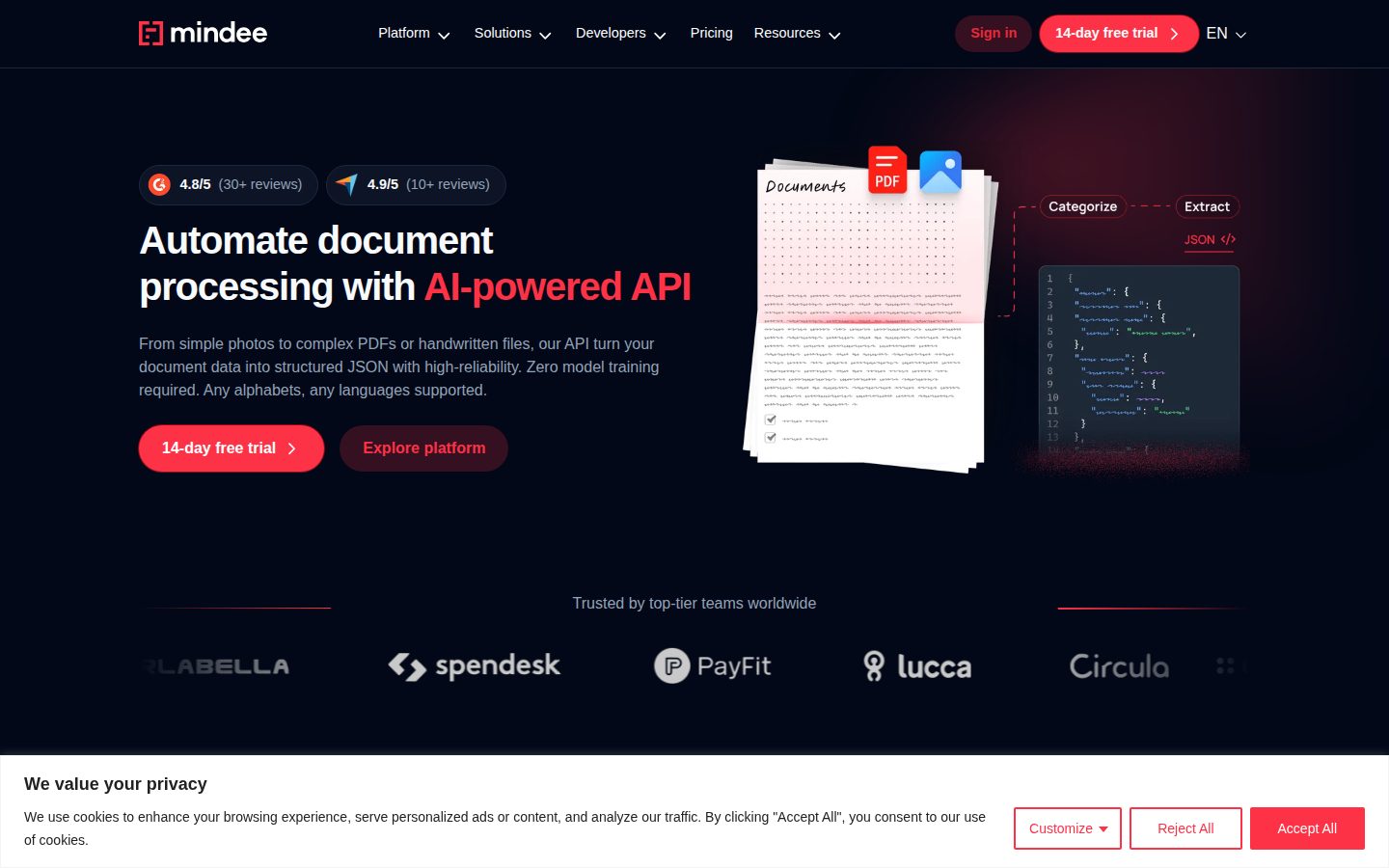
Extract structured data from any document via API, no ML expertise required
Mindee is a document OCR and data extraction API platform for developers and businesses processing structured documents at scale.
AI Panel Score
6 AI reviews
Reviewed
AI Editor ApprovedApproved and published by our AI Editor-in-Chief after full panel analysis.Users interact with Mindee primarily through its REST API or official SDKs available in Python, JavaScript, and Java. The typical workflow involves uploading a document—either programmatically or via the browser-based API Playground—and receiving a structured JSON response containing extracted fields such as vendor names, dates, totals, line items, tax rates, or identity fields depending on the document type. Human-in-the-loop validation can be layered into document workflows for cases requiring review before downstream processing.
Mindee's distinguishing capability is its custom document parser, called Docti, which allows users to build a tailored OCR model by writing natural language prompts that describe the fields to extract. This removes the need for annotated training datasets or ML pipelines. The platform also incorporates Retrieval-Augmented Generation (RAG) to improve parsing accuracy and reduce hallucinations on complex or variable document layouts. Prebuilt APIs cover receipts, invoices, financial documents (payslips, W-2s, bank statements), and international IDs from over 200 countries including MRZ and barcode reading. Mindee holds SOC 2 Type II certification and offers a GDPR-compliant Data Processing Agreement.
Mindee targets developers building document automation into applications and operations teams handling high-volume document intake across use cases such as accounts payable, expense management, customer onboarding, insurance claims, loan processing, and fraud detection. The free tier includes 500 pages per month. Paid plans scale by volume, though specific pricing tiers are not publicly detailed beyond that baseline. Competitors in the document AI space include AWS Textract, Google Document AI, Microsoft Azure Form Recognizer, and Rossum.
Mindee is delivered as a cloud API with no self-hosted deployment option mentioned publicly. Integration happens via HTTP REST calls or the provided SDKs, and the platform exposes a live API Playground at app.mindee.com for testing models against real documents without writing code. The developer community can be reached via a dedicated Slack workspace.

Automatically detects document inconsistencies and anomalies to flag potentially fraudulent submissions.
Applies Retrieval-Augmented Generation to document parsing to improve accuracy and reduce hallucinations in extracted data.
Automates document flows using flexible API building blocks combined with human-in-the-loop validation steps.
Parses payslips, W-2s, and bank statements to extract structured financial data.
Reads identity documents and passports from 200+ countries, including MRZ zones and barcodes.
Captures invoice metadata, line items, tax rates, and payment details automatically from submitted invoice documents.
Production-ready APIs for common document types including receipts, invoices, IDs, and passports that return structured JSON data without any model training.
Extracts vendor name, date, total amount, VAT, and line items from paper or digital receipts.
Lets users build and deploy their own document parser by writing natural language prompts instead of building or training a machine learning pipeline.
Provides official client SDKs for Python, JavaScript, Java, and other languages to simplify API integration.
Mindee holds SOC 2 Type II certification and follows GDPR-compliant data processing practices.
A browser-based tool that lets users upload documents and test OCR models live before integrating via API.
Entry-level plan for individuals or small teams getting started with document processing.
Most popular plan for growing teams needing more credits and RAG capabilities.
For larger teams requiring high credit volumes and unlimited RAG document processing.
For larger organizations using 250k+ credits yearly with custom needs. Contact Sales for pricing.
Solid document AI API that ships fast and skips the ML headache entirely.
“Mindee's Docti custom parser and prebuilt APIs cover the 80% case without a data science team. SOC 2 Type II and 200+ country ID coverage make it defensible at the board level.”
500 free pages, $44 to start, and no model training required. That's a low-risk entry point against AWS Textract or Google Document AI, both of which demand more infrastructure lift to get going. The API Playground lets developers validate before a single line of code gets written.
Docti is the real differentiator. Natural language prompts instead of annotated datasets means a developer can stand up a custom extractor in hours, not sprints. The RAG layer on Pro and above adds hallucination control on messy document layouts — that's the thing that usually breaks document AI in production.
The tradeoff: no self-hosted option, and RAG is capped at 20 documents on the $179/month Pro plan before you jump to $584. For high-volume ops teams, that credit math needs a hard look before you standardize.
Docti's no-training-required approach is a genuine leg up on Azure Form Recognizer for teams without ML staff, though hyperscaler breadth remains a consideration at scale.
SOC 2 Type II and GDPR DPA are table stakes the board will ask for, and Mindee has both documented.
Prebuilt Invoice and Receipt OCR APIs return structured JSON within seconds — a developer can hit production-ready extraction in days, not quarters.
If your roadmap touches accounts payable, onboarding, or claims processing, this advances those workflows materially — it's not just a cost swap for existing OCR.
No public funding data, but SOC 2 Type II certification and a structured four-tier pricing model with an Enterprise tier suggest an operating business with real customers — not a side project.
Developer teams building document automation into products who can't afford a data science hire.
Your compliance posture requires on-premises deployment or air-gapped processing.
SOC 2 Type II, 200-country ID coverage, and no ML team required — serious operational infrastructure.
“Mindee is a production-grade document extraction API that removes the ML bottleneck from high-volume document workflows. The Docti custom parser and RAG layer mean ops teams can extend coverage without spinning up data science resources.”
The prebuilt API coverage is operationally complete for the most common intake workflows — invoices, receipts, payslips, W-2s, international IDs across 200+ countries. That's accounts payable, expense management, and customer onboarding covered out of the box. SOC 2 Type II plus a GDPR DPA means procurement conversations won't stall on compliance.
Docti is the strategic differentiator. Natural language field definition instead of annotated training pipelines means an ops team can build a custom parser in days, not quarters. If we adopt this, in 3 years we have a document automation layer that grows with business needs without creating ML debt or headcount dependency.
The constraint worth naming: no self-hosted option and opaque enterprise pricing beyond the $584/month Business tier. For any organization with data residency requirements or 250k+ annual volume, you're negotiating blind until you call sales. AWS Textract and Azure Form Recognizer both offer on-premises paths — Mindee doesn't, based on public docs.
Sits credibly between enterprise behemoths like AWS Textract and lightweight tools, with Docti and RAG giving it differentiation the hyperscalers haven't matched in ease of use.
Prebuilt APIs map directly to the highest-volume ops workflows — AP, expense, onboarding — with human-in-the-loop validation built into the architecture.
Python, JavaScript, and Java SDKs plus REST API and a live API Playground at app.mindee.com cover most engineering team configurations cleanly.
No self-hosted option creates a cloud dependency that may conflict with data residency requirements as organizations scale or enter regulated markets.
RAG-augmented parsing plus natural language model building via Docti signals genuine ML investment, not just wrapper-layer OCR.
Operations teams automating high-volume document intake who need compliance coverage without building ML infrastructure.
Your organization has data residency mandates that require on-premises or private-cloud deployment.
$44/month entry, but overage in euros and no public Enterprise rate — read carefully
“Mindee publishes 3 tiers with real numbers. Enterprise wall at 250K credits is where pricing goes dark.”
$44/month Starter gets you 500 credits. $179 Pro gets 2,500 plus RAG capped at 20 documents — that cap matters. $584 Business unlocks unlimited RAG and 10,000 credits monthly. Three tiers, all visible without a sales call. Procurement won't fight the paperwork here.
TCO math for a mid-size AP team: 50 users processing ~2,000 invoices/month lands on Pro at $179. Overages at €0.04/credit — that's a currency mismatch on a USD-billed product. Year 1: ~$2,150. Apply 20% volume creep by year 3: closer to $3,100/year. Modest against AWS Textract, which charges per page with no monthly floor.
No self-hosted option. Data leaves your environment every call — SOC 2 Type II and GDPR DPA exist, but regulated industries need to confirm that's sufficient. No public auto-renewal or cancellation terms found. That's the real gap, not the sticker.
Self-serve signup, live API Playground, and published tier pricing minimize procurement friction for sub-Enterprise buyers.
No public auto-renewal window, cancellation terms, or termination-for-convenience clause found in available evidence.
Three paid tiers fully published with credit counts and overage rates; Enterprise pricing requires a sales call.
Credit-per-document model ties cost directly to volume processed — ROI is measurable against invoice or receipt throughput.
Overage rate published (€0.04-0.05/credit) but currency mismatch on a USD product introduces invoicing unpredictability at scale.
Developer teams automating AP or onboarding workflows who want usage-based pricing without building ML pipelines.
Your organization requires on-premise deployment or has zero tolerance for opaque Enterprise contract terms.
Docti kills the ML bottleneck — but pricing opacity and no self-host will slow enterprise adoption
“Mindee's prebuilt OCR APIs return structured JSON in seconds with zero model training required. Docti's natural-language field definition is the real differentiator against AWS Textract and Google Document AI.”
The API Playground at app.mindee.com is the right first move — drop a real invoice in, get JSON back, no code written. That's a good day one. Day three is when you notice RAG is gated to Pro at $179/month and capped at 20 documents. For any knowledge worker processing variable-layout documents at volume, that cap surfaces fast and the jump to Business at $584/month is steep.
Docti is genuinely useful. Natural language prompts to define extraction fields removes the annotated-dataset grind that makes Azure Form Recognizer painful for non-ML teams. Confidence scores and polygon coordinates ship on every tier. That's the kind of detail that tells you developers actually use the output.
No self-hosted deployment is the hard stop for regulated environments. SOC 2 Type II and GDPR DPA help, but operations teams in finance or insurance will still hit procurement friction. 200+ country ID support is a real breadth win that most competitors don't match at this price point.
API Playground accelerates first contact, but RAG's 20-document cap on Pro surfaces quickly for variable-layout document workflows.
Docs and live Playground suggest practitioner authorship; the Slack community provides a real escape hatch when docs fall short.
Pricing tiers create mid-workflow decisions — hitting RAG limits or overage credits at €0.04/page adds budget management overhead that AWS Textract bundles differently.
Docti's natural-language model building and confidence scores reward advanced usage, but unlimited RAG is locked to Business at $584/month.
Python, JavaScript, and Java SDKs plus REST mean minimal integration lift; structured JSON output drops cleanly into existing downstream systems.
Operations or dev teams automating high-volume invoice, receipt, or ID intake who want JSON output without touching an ML pipeline.
Your procurement team requires on-premise deployment or your document volume makes the jump from Pro to Business a budget conversation.
No ML degree required, just an API key and a document
“Mindee does one thing and does it well: gets structured data out of documents fast. Developers building invoice automation or ID verification will feel the value within the first test call.”
The API Playground is the right first move. Upload a receipt, get back structured JSON in seconds — no model training, no annotated datasets, no fighting a config file. That's the pitch working exactly as advertised. The Docti custom parser is genuinely interesting; natural language prompts to define extraction fields is a real shortcut compared to building your own pipeline or wrestling with AWS Textract's training requirements.
Pricing is honest. $44/month for 500 credits is a real entry point, and the Pro tier at $179 includes RAG — though capping RAG at 20 documents on Pro feels tight if you're processing anything variable-layout. That's the moment you realize Business at $584 exists for a reason.
The tradeoff is the platform is cloud-only, no self-hosted option, and it's built for developers first. Non-technical ops teams will need someone to wire it up. Mobile parity is basically irrelevant here — this is an API product — but the web tooling looks clean enough to not get in the way.
API Playground with live document testing and confidence scores on every extracted field suggests someone actually thought about the daily debug loop.
SDKs in Python, JavaScript, and Java plus natural language prompts for custom models means the on-ramp stays gentle even as use cases get complex.
This is an API-first developer tool — mobile parity isn't the point, but there's no evidence of a real mobile workflow for ops teams.
No model training required plus a live browser playground means the first 10 minutes is a working extraction, not documentation homework.
SOC 2 Type II certification and sub-second JSON responses suggest production-grade infrastructure, not a prototype.
Developers building document automation into apps where fast, accurate JSON extraction beats training a custom model.
Your ops team needs a no-code interface and nobody on staff wants to touch an API.
Solid API play, but no changelog and opaque pricing above $584 are yellow flags
“Mindee does what it says — structured JSON from documents, no ML pipeline required. Docti and 200-country ID coverage are real differentiators. But no self-hosted option, no public changelog, and RAG gated behind $179+ give me pause.”
Three things before I dig in. One: no changelog visible. A document AI platform with no public shipping cadence is either shipping nothing or hiding it. Two: RAG is locked to Pro at $179/month — the Starter at $44 gets none of it. Three: 'industry-leading accuracy' on the meta description. The kind of superlative that ages poorly.
The differentiated piece is real though. Docti — natural language prompts instead of annotated training data — is a pattern AWS Textract and Azure Form Recognizer don't match cleanly. Rossum does, roughly. International ID coverage across 200+ countries with MRZ and barcode reading is a genuine moat for onboarding use cases. SOC 2 Type II and a GDPR DPA matter for enterprise buyers.
Exit portability is decent. It's a REST API returning JSON — you can swap to Google Document AI without losing your data. The lock-in is workflow logic, not proprietary format. Main tradeoff: no self-hosted option means your documents leave your infra. For regulated industries, that's a conversation, not a footnote.
Docti's natural language prompt approach and 200-country ID coverage are concrete gaps vs. AWS Textract and Azure Form Recognizer.
REST API with structured JSON output means migration to Textract or Google Document AI is a rewrite of API calls, not a data hostage situation.
No public funding data visible, no changelog, Enterprise tier exists suggesting real customers — could go either way on a 3-year horizon.
'Industry-leading accuracy' on the meta page with no benchmark citation is a tell; the feature descriptions are otherwise grounded.
SOC 2 Type II, SDK breadth in Python/JS/Java, and tiered pricing suggest an operating business — but no changelog makes cadence opaque.
Developer teams building document automation into applications who want prebuilt APIs for invoices or IDs without standing up an ML pipeline.
Your compliance requirements prohibit third-party cloud document processing or you need a self-hosted deployment option.
Common questions answered by our AI research team
No model training is required. Mindee lets you define extraction fields using natural language prompts, and prebuilt APIs for common document types work out of the box.
Prebuilt APIs cover receipts, invoices, passports, and IDs. A custom document parser handles additional document types by letting users define extraction fields via natural language prompts.
Extracted data is returned as structured JSON, typically within seconds of submitting a document via API.
Yes, handwritten files are supported alongside simple photos and complex PDFs.
Yes, Mindee offers a 14-day free trial.