Networked note-taking with AI, backlinks, and end-to-end encryption
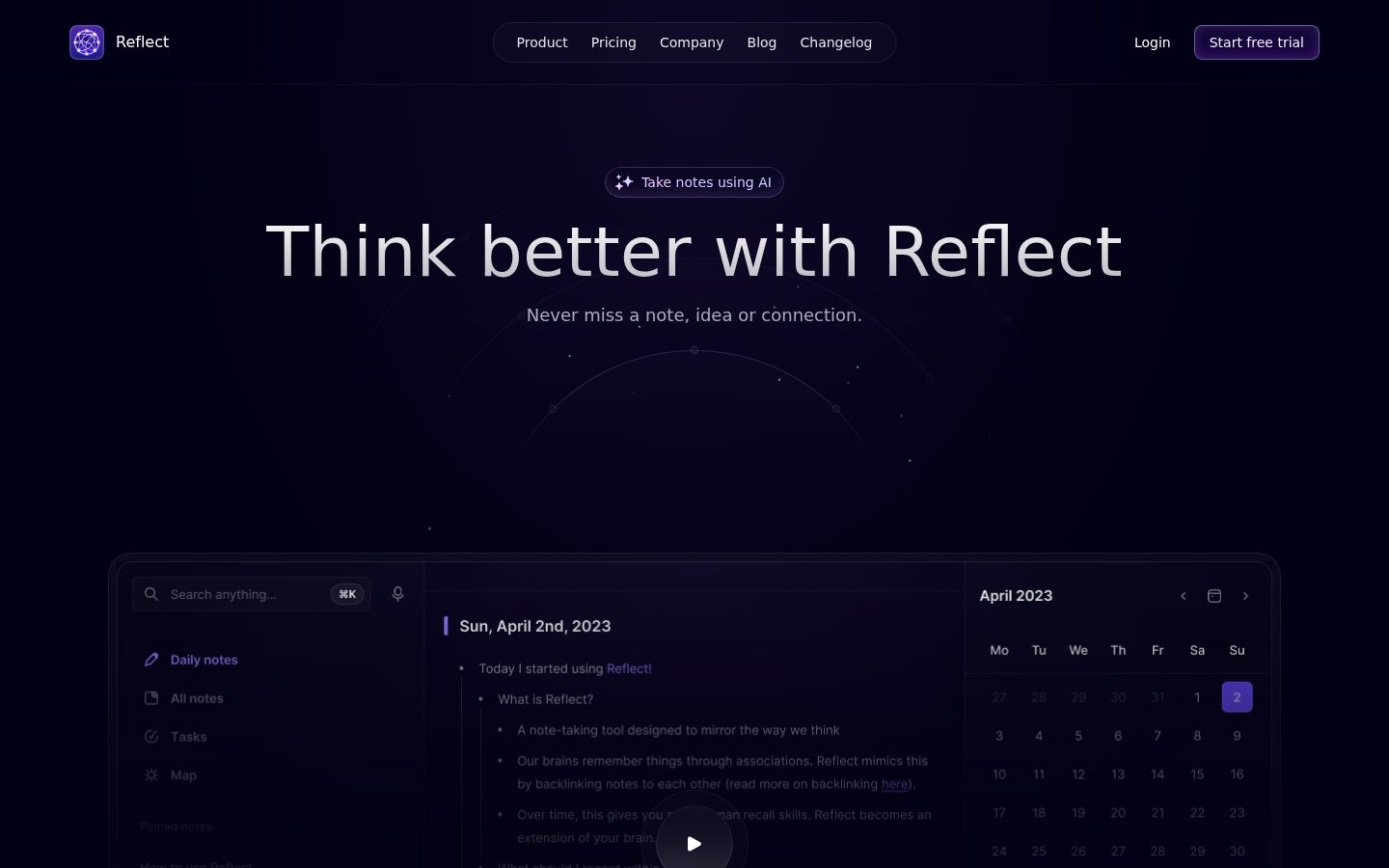
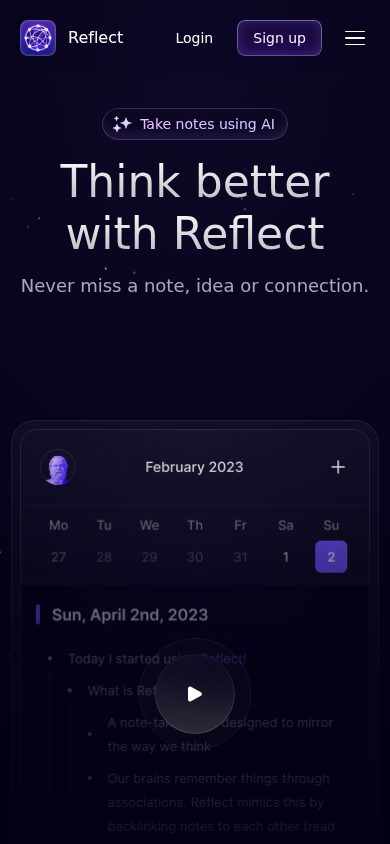
Reflect is a networked note-taking app for individuals who want to organize and connect their thoughts using backlinks and AI assistance.
AI Panel Score
6 AI reviews
Reviewed
In practice, users create notes in a fast, minimal editor and connect them to other notes via backlinks, forming a navigable graph of related ideas. Notes sync in real-time across desktop and mobile, and the iOS app supports offline capture. A browser clipper for Chrome and Safari lets users save web snippets directly into the app, while a Kindle integration pulls in highlights automatically.
Reflect's AI features are built on OpenAI's GPT-4 and Whisper models. Specific capabilities include voice note transcription, article outline generation from rough notes, extraction of action items from meeting notes, and a chat interface that queries the contents of your existing notes. Users can also save custom prompts for repeated tasks. Calendar integration with Google Calendar and Outlook imports meeting events so notes can be associated with specific appointments.
Reflect is aimed at knowledge workers, writers, and researchers who want a personal note-taking system rather than a team collaboration tool. It competes with tools like Obsidian, Roam Research, Notion, and Bear. Pricing is a single plan at $10 per month billed annually, with a 14-day free trial. There is no permanently free tier.
The app is available on web, iOS, and presumably macOS and other desktop platforms given the sync and offline references. Notes are end-to-end encrypted, meaning Reflect cannot read note contents. The product offers a public API, data export, and a Zapier integration for connecting with third-party applications, as well as a native Readwise integration for syncing reading highlights.
Allows users to save their own custom prompts for repeated use within the AI assistant.
Lists key takeaways and action items automatically from meeting notes using AI.
Uses GPT-4 to improve writing, generate article outlines from scattered thoughts, answer questions, and chat with your notes to find and organize information.
Uses OpenAI Whisper to transcribe voice notes with human-level accuracy.
Connects Reflect with dozens of third-party applications without requiring code via Zapier.
Links notes together through backlinks to form a navigable graph of connected ideas that mirrors associative thinking.
Indexes all past notes and ideas so users can instantly recall and retrieve information from any device.
Shares any note publicly with a single click.
Imports Google Calendar and Outlook events into Reflect so users can keep track of meetings and agendas alongside their notes.
Syncs reading highlights and notes from Readwise into Reflect.
Browser extension for Chrome and Safari that saves web snippets and syncs Kindle highlights directly into Reflect.
Native iOS app that lets users capture and access notes on the go, even without an internet connection.
Encrypts the contents of notes end-to-end so that only the user can read them, with even Reflect staff unable to access the data.
The single Reflect plan for individuals — $10/month billed annually, with a 14-day free trial and no permanent free tier.
$10/month, one plan, founder-run, and shipping — that's a clean individual bet.
“Reflect is a focused personal knowledge tool with GPT-4 AI, backlinks, and end-to-end encryption at a flat $10/month. It won't replace Notion for teams, but for individual knowledge workers it's genuinely well-built.”
Semi-bootstrapped, founded by Alex MacCaw, shipping a changelog. No funding dependency means no Series C implosion risk. Obsidian gives it away free — Reflect charges $10 and bets you'll pay for the AI and sync experience instead.
Two things make this interesting. One: GPT-4 plus Whisper transcription plus calendar integration in a single flat plan is strong value at $10. Two: end-to-end encryption means even Reflect staff can't read your notes — that's a real differentiator if your work is sensitive.
The tradeoff: this is a solo tool. No team workspaces, no collaboration, no enterprise tier. If your use case expands beyond one person, you'll hit the ceiling fast. Pilot it for individual researchers or executives who need a private thinking layer.
Sits between Obsidian (free, local-first, no AI) and Notion (team-focused, complex) — owns a real middle lane but won't move market perception the way an enterprise platform would.
End-to-end encryption and a known founder (Alex MacCaw) make this a credible, defensible pick — no board member will raise an eyebrow.
One plan, 14-day trial, Readwise and calendar integrations out of the box — a knowledge worker is productive within the first session.
Advances individual knowledge capture with GPT-4 AI and backlinked notes — a genuine capability upgrade, not just cost substitution for something like Bear or Apple Notes.
Semi-bootstrapped with a small founding team — sustainable but limited capacity to absorb a bad quarter; no public funding data suggests intentional restraint, not weakness.
Individual knowledge workers or executives who need a private, AI-assisted thinking system on a flat budget.
Your use case requires team collaboration or an enterprise security review.
$10 flat, zero team seats, but the personal knowledge system is genuinely well-built.
“Reflect is a single-user knowledge tool, not an operational system. For a COO evaluating personal workflow infrastructure, it's a strong individual bet — not a team deployment.”
At $10/month, one plan, no tiers, the procurement story is trivially simple. The end-to-end encryption means IT won't flag it, and the public API plus Zapier integration means it can connect to existing workflow stacks without an engineering ask. Semi-bootstrapped with a stated focus on profitable growth — that's a vendor that won't pivot to enterprise and abandon the core product.
The GPT-4 assistant querying your own notes, combined with calendar integration pulling Google Calendar and Outlook events, makes this a legitimate meeting-to-action-item pipeline. That's the daily ops loop for most senior leaders. Voice transcription via Whisper for mobile capture rounds out the capture surface.
The hard constraint: this is built for one person. No shared workspaces, no team permissions, no delegation layer. If the use case expands beyond personal knowledge management to team documentation, Reflect won't carry that weight — Notion owns that territory. Adopt it knowing the scope is intentional and fixed.
At $10 flat against Obsidian's free tier and Notion's broader footprint, Reflect carves a credible premium-personal niche with encryption as a real differentiator.
Calendar-to-meeting-notes pipeline and action item extraction match senior leader workflows, but the absence of any delegation or sharing capability limits operational utility.
Readwise, Google Calendar, Outlook, Zapier, and a browser clipper cover the core personal stack — no native Slack or linear integration documented.
Public API and data export mean you're not locked in; semi-bootstrapped stability reduces sunset risk over a 3-year horizon.
Backlinked graph plus GPT-4 query layer on personal notes is genuinely differentiated — closer to Roam Research's vision but with a cleaner execution and a real encryption story.
A senior leader who wants an encrypted, AI-assisted personal knowledge system that connects meeting notes, reading, and ideas in one place.
You need shared documentation, team permissions, or a tool that doubles as operational infrastructure.
$10/seat flat, no SSO tax, no tiers — rare pricing honesty in this category
“Single plan at $10/month annually. No upsells, no team seats, no hidden AI add-on.”
$10/seat × 12 = $120/year. That's the whole number. No per-feature unlocks, no enterprise tier hiding GPT-4 access. AI assistant, voice transcription via Whisper, backlinks, E2E encryption — all in. Year 3 TCO for a solo knowledge worker: $360. That's it.
Compare to Obsidian at $0 base but $8/month for sync plus Notion at $16/seat with AI add-on at $8 extra. Reflect wins on all-in simplicity. Readwise integration and Calendar sync with Google and Outlook ship in the base plan — no bolt-on fee.
Tradeoff: individual-only pricing. No team plan means no volume discount, no centralized billing, no PO process. Procurement can't negotiate. Also, no public pricing page confirmed by the scrape — that's a gap. Contract terms and auto-renewal window aren't published. Verify the cancellation clause before annual commit.
Clean invoicing for individuals; no PO-friendly team billing exists, which blocks corporate procurement workflows.
Annual billing confirmed, but auto-renewal window and cancellation terms aren't publicly documented.
Single plan, single price, no hidden tiers — but the pricing page isn't confirmed live per the scrape.
Individual productivity ROI is inherently unmeasurable — no team analytics, no usage dashboards per the evidence.
$360 over 3 years, all-in, no AI surcharge, no sync add-on — lowest TCO in the networked notes category.
Solo knowledge workers who want a predictable $120/year all-in note-taking cost with no pricing surprises.
Your team needs centralized billing, a PO process, or any form of volume pricing.
Reflect nails the daily capture loop that Obsidian makes you configure yourself
“$10/month for backlinks, GPT-4 chat over your own notes, E2E encryption, and a Whisper voice transcription layer. Single-plan pricing means no decision fatigue.”
The setup friction that kills Obsidian adoption — plugin research, vault configuration, sync wrestling — isn't here. Backlinks work on day one. The graph forms as you write, not after you've spent a weekend watching YouTube tutorials. Calendar integration pulling Google Calendar and Outlook events directly into note context is the kind of workflow glue that actually changes daily behavior.
The AI layer is genuinely useful rather than decorative. Custom prompts for repeated tasks means your weekly review template stops living in a separate doc. Meeting notes summarization extracts action items automatically. Querying your own note history through the GPT-4 chat interface is the feature Roam Research users have wanted for years. E2E encryption is meaningful here — most knowledge workers aren't comfortable with a vendor reading their thinking.
The real tradeoff: no collaboration model at all. This is a personal thinking tool, not a team workspace. Notion users expecting shared databases won't find them. No permanent free tier means a 14-day trial window before committing.
Minimal editor with real-time sync and offline iOS capture means the capture habit forms fast without configuration overhead.
Changelog exists which signals honest shipping cadence, but docs capability is listed as N, so depth of practitioner guidance is unclear.
Single pricing plan and backlinks-by-default removes daily decision points, though no Android app is a gap for non-iOS users based on listed platforms.
Custom AI prompts, public API, Zapier integration, and Readwise native sync give power users meaningful surface area beyond basic note capture.
Calendar integration, Readwise sync, and the web clipper cover the main knowledge worker intake channels without requiring manual transfer.
Individual knowledge workers who want a fast, private thinking system with AI that actually touches their own notes.
You need team-shared notes, commenting, or any collaborative workspace features.
Reflect is the quiet, fast, private note-taker Obsidian users wish they had on day one.
“At $10/month flat, Reflect delivers a genuinely polished networked note-taking experience with real AI woven in. It's a personal tool through and through — no team seats, no free tier, no apologies.”
One plan, one price, no free tier. That's a statement. Reflect isn't trying to upsell you or lock you into a freemium trap — the changelog shows a team that's been quietly shipping: GPT-4 for outlines, Whisper for voice transcription, calendar sync with Google and Outlook, Readwise integration, a web clipper for Chrome and Safari. That's a real feature surface for $10. Compared to Obsidian, which hands you a file system and says good luck, Reflect feels like someone actually finished the product.
The end-to-end encryption is the kind of thing you forget about until you remember it matters. Even Reflect staff can't read your notes. For a knowledge worker putting real thinking in here, that's not a footnote — that's the whole deal.
The tradeoff is focus. This is a solo tool. No collaboration, no team workspace, no permanent free tier to share with a curious colleague. If you want Notion's flexibility or Roam's cult-following power features, you'll feel the constraints. But if you want fast, private, and connected — Reflect mostly delivers that.
The minimal editor, custom AI prompts, and frictionless search suggest a team that's sweated the daily feel — the meta copy calls it 'beautifully minimalist' and the feature set backs that up.
Backlinked graph thinking is intuitive once it clicks, but the Kindle integration, Readwise sync, custom prompts, and Zapier layer take time to discover and wire up.
The iOS app supports offline capture, which puts it ahead of most competitors — but the evidence only confirms iOS, with Android nowhere mentioned.
The 14-day free trial and single-plan simplicity lower the entry barrier, but backlinks and graph navigation have a conceptual learning curve that first-timers will feel.
Real-time sync across devices plus iOS offline support is a strong reliability signal — the docs indicate notes are available even without a connection.
Knowledge workers and writers who want a fast, private, AI-assisted thinking tool and are done fighting with Obsidian plugins.
You need team collaboration, a free tier to evaluate slowly, or an Android app.
3 green flags, 2 watches — Obsidian killer it isn't, but solid individual bet
“Clean single-plan pricing at $10/month, real E2E encryption, and a GPT-4 layer that isn't cosmetic. Semi-bootstrapped means no VC runway pressure — but also no safety net.”
Three tells on first pass. One: 'Think better' headline — the kind of aspirational framing that covers a lot of sins. Two: no pricing page detected despite a public price. Three: 'semi-bootstrapped' is either confidence or a warning, depending on what happens in year three.
What's actually here is defensible. End-to-end encryption is real differentiation — Notion and Roam can't say that. Backlinks plus a Whisper-powered voice-to-note loop plus GPT-4 chat-with-your-notes is a coherent stack, not features stapled together. Readwise and Calendar integrations suggest someone thought about the actual workflow.
The watch: no team collaboration story means ceiling is hard. Obsidian stays free forever. If the bootstrapped model stalls, no acqui-hire runway. Export and public API exist — migration is cleaner than most. That matters when I'm sizing the downside.
E2E encryption is real and rare; GPT-4 integration is table stakes now, but the Whisper voice-to-note plus custom prompts combo is a credible edge over Bear and Obsidian.
Public API plus data export makes this one of the cleaner exits in the category — no lock-in architecture visible.
Semi-bootstrapped with no public funding data — changelog activity is positive, but a three-year bet on a solo-product, no-free-tier SaaS carries real runway uncertainty.
'Think better' is vague aspiration, but the feature list is specific and the $10 single-plan structure doesn't hide gotchas.
Roam Research had the same networked-notes pitch and stagnated; Reflect's shipping cadence (changelog confirmed) and encryption angle differentiate it slightly.
Individual knowledge workers who want encrypted networked notes with real AI integration and don't need team collaboration.
You need team sharing, a free tier, or aren't comfortable betting on a bootstrapped single-product company.
Common questions answered by our AI research team
Reflect costs $10/month, billed annually. There is one plan at one price.
Yes, the iOS app supports capturing ideas online or offline.
No one can read your notes — not even Reflect staff. Notes are end-to-end encrypted, meaning only you can access them.
Yes, Reflect integrates with both Google Calendar and Outlook to import events and keep track of meetings and agendas.
Yes, Reflect uses OpenAI's Whisper to transcribe voice notes with human-level accuracy.
Reflect is a networked note-taking app with end-to-end encryption, backlinking, and AI-assisted writing, built for personal knowledge management.