Cloud platform for running machine learning models via API
Replicate is a cloud platform that allows developers to run machine learning models through simple API calls.
AI Panel Score
6 AI reviews
Reviewed
AI Editor ApprovedApproved and published by our AI Editor-in-Chief after full panel analysis.Replicate is a cloud platform that lets developers run machine learning models through simple API calls, offering access to thousands of pre-trained open-source models or deployment of custom models without managing servers or GPU infrastructure. It targets developers and engineering teams who want AI features in production without running GPU servers. Pricing is usage-based pay-as-you-go with per-second GPU billing, so an idle inference service costs nothing and pilots start with zero upfront cost; a free plan and free trial are available. Key capabilities include a pre-trained model library, custom model deployment, model fine-tuning, and official Python and Node.js client libraries, with the open-source Cog tool packaging custom models to reduce lock-in risk. TopReviewed's six-seat AI review panel scored it 8.0/10, praising that one API call runs thousands of models while noting cold starts on infrequently used models can stall a first request for tens of seconds.
Replicate is a cloud platform that simplifies the deployment and execution of machine learning models. The service hosts thousands of open-source AI models that developers can access through straightforward API calls, eliminating the need to manage complex infrastructure or GPU hardware.
The platform caters to developers, startups, and businesses that need to integrate AI capabilities into their applications without the overhead of maintaining machine learning infrastructure. Users can run models for image generation, text processing, audio synthesis, and other AI tasks by making HTTP requests to Replicate's API endpoints.
Key features include a vast library of pre-trained models, the ability to deploy custom models, automatic scaling based on demand, and pay-per-use pricing. The platform handles model loading, GPU allocation, and scaling automatically, allowing users to focus on building applications rather than managing infrastructure.
Replicate operates in the Machine Learning Platform as a Service (MLPaaS) market, competing with services like Hugging Face Inference API and AWS SageMaker. The platform distinguishes itself by offering a simple API interface and a curated collection of popular open-source models that are ready to use immediately.

Fine-tune existing open-source machine learning models through the Replicate platform.
Access thousands of pre-trained open-source models such as black-forest-labs/flux-pro, google/nano-banana-pro, and bytedance/seedream-4.
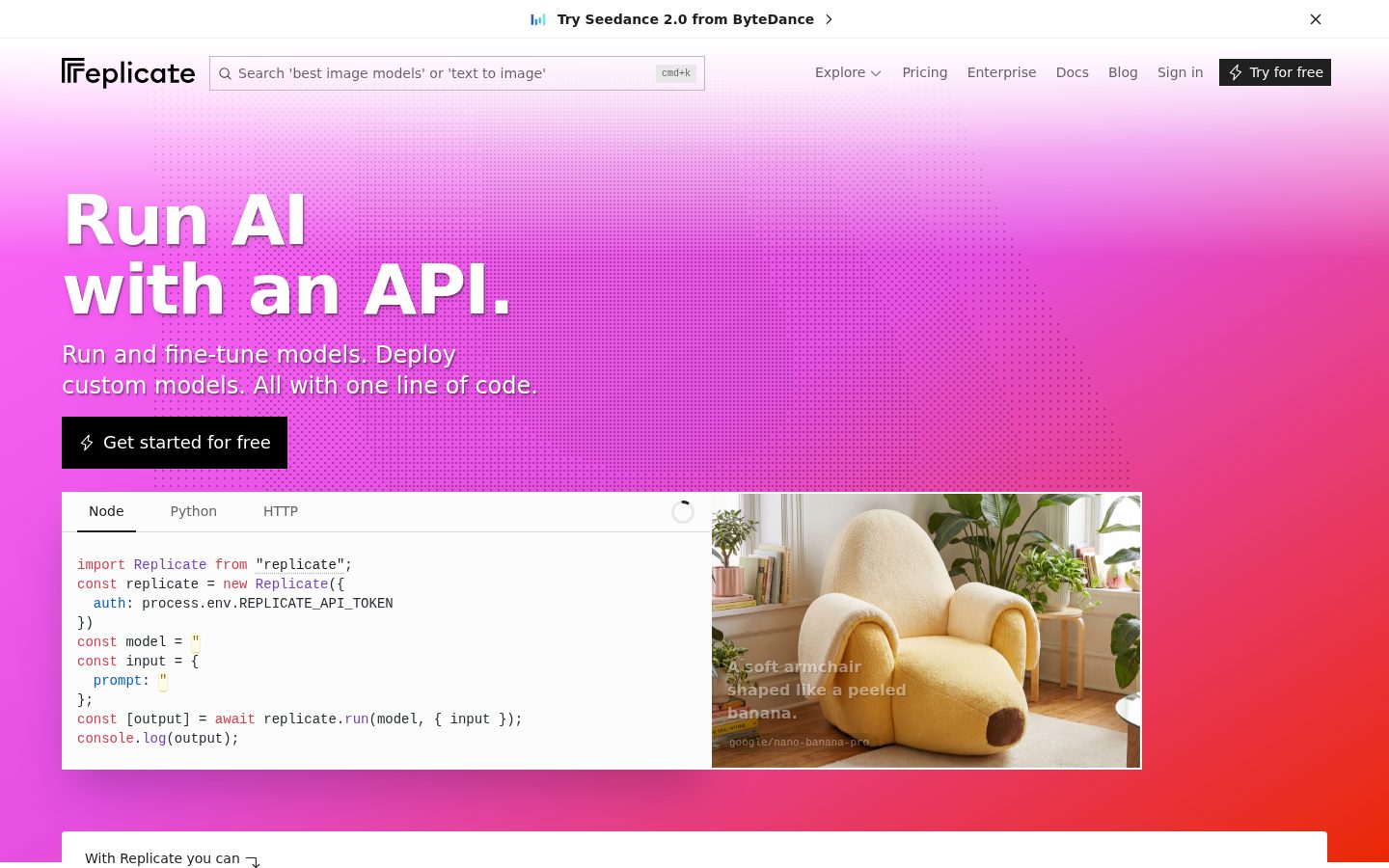
Run image generation models by passing a text prompt input and receiving image output via the API.
Run machine learning models via a cloud API with a single line of code without managing servers or GPU infrastructure.
Deploy custom machine learning models to the cloud using the Replicate infrastructure.
Direct HTTP API access enables running models from any language or environment without a dedicated SDK.
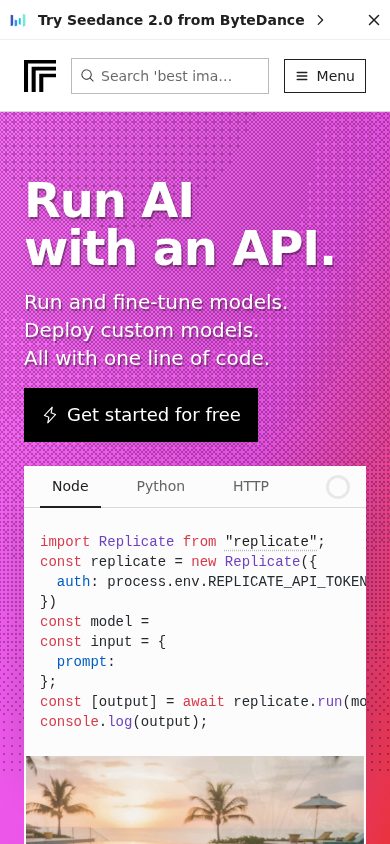
Official Node.js SDK allows running models by importing the Replicate package and authenticating with an API token.
Official Python SDK provides access to run and interact with models programmatically.
API requests are authenticated using a REPLICATE_API_TOKEN environment variable to secure model access.
For developers and teams who want to run AI models and only pay for what they use, with no upfront cost.
Replicate is a credible bet for shipping AI features fast without owning GPU infrastructure.
“Founded in 2019 and backed by a $40M Series B from a16z, Replicate is a stable vendor for a multi-year commitment. The catch is per-second billing with no committed-spend tier to cap costs.”
Replicate has been running models in the cloud since 2019, founded by Ben Firshman, the engineer behind Docker Compose. Andreessen Horowitz led a $40M Series B in January 2024, with NVIDIA's NVentures in the round. Six years in with that backing, this is a vendor a board signs a multi-year deal with.
The real question is whether this advances us or just rents GPUs we could rent elsewhere. The open-source Cog tool packages a custom model into a deployable container, and the Pre-Trained Model Library gives instant access to models like flux-pro. AWS SageMaker covers the same ground, but Replicate ships a working API call in minutes rather than a config project.
However, pay-per-second billing — an A100 80GB runs $0.0014 per second — gets hard to forecast at scale, and there is no committed-spend tier. Pilot one production workload for 60 days, watch the invoice, then decide.
Strong against SageMaker and Hugging Face on simplicity, though it competes in a crowded MLPaaS market.
a16z and NVIDIA backing plus a Docker Compose founder make this an easy choice to defend.
A single API call runs a model immediately, with no servers or GPU setup required.
Cog and the pre-trained model library let teams ship AI features without building infrastructure.
Founded 2019 with a $40M a16z-led Series B in 2024 and NVIDIA backing — durable runway.
Engineering teams who need AI features in production without managing GPU servers.
Finance teams who need a fixed monthly cost they can budget upfront.
Replicate makes Cog, an open packaging format, the substrate that keeps model deployment portable.
“Replicate runs ML models on a foundation of Cog, an open-source container format, rather than a closed runtime. The architecture keeps deployment portable, but the managed abstraction hands you cold starts and queue latency you cannot tune.”
Cog is the structural decision worth studying first. Replicate isn't a model catalog with an API stapled in front. It's a platform built on Cog, an open-source format that packages a model with its environment into a container. For a CTO weighing ML inference infrastructure through 2029, that's the call that matters: a Cog container runs on Replicate, but also anywhere Docker runs.
The craft ceiling is real. Thousands of pre-trained models like black-forest-labs/flux-pro sit one API call away, custom deployment and fine-tuning are first-class, and per-second GPU billing is honest — an Nvidia A100 80GB runs $0.001400/sec with no idle charge. Founded in 2019, the platform reads like infrastructure engineers built it.
But the catch is the abstraction itself. Replicate hides GPU allocation and autoscaling, which is the point, however it also means cold starts and queue latency you don't control. Against AWS SageMaker you trade tuning depth for speed; against Hugging Face Inference, the win is a cleaner deploy path.
Sits between AWS SageMaker and Hugging Face Inference as the simplest path to running open models in production.
Python and Node.js SDKs plus raw HTTP and per-second GPU billing match how engineering teams actually ship inference.
REPLICATE_API_TOKEN auth and standard SDKs drop cleanly into existing services across any language.
Cog's portability limits lock-in, though the managed abstraction still hides scheduling decisions you may later want back.
Building the platform on the open-source Cog container format is a deliberate architectural primitive, not a wrapper.
Engineering teams who need production AI inference without running GPU infrastructure.
Teams who need fine-grained control over GPU scheduling and cold-start behavior.
Replicate bills public models per request, but private deployments charge for idle time too.
“Replicate has no subscription and no seat fee, so spend starts at zero. The catch is private deployments, which bill for setup and idle seconds on dedicated hardware.”
No tiers. No seats. Pay As You Go starts at $0.000100/sec for CPU and $0.001400/sec for an A100 80GB. Public models bill only for request processing time, so a low-traffic app can cost cents a month.
The Pre-Trained Model Library hides the budget risk. Public models meter cleanly, but private models and Custom Model Deployment run on dedicated hardware. You pay for setup, idle, and active seconds. An A100 left warm 24/7 is roughly $120/day, $43K/year, before a single inference. The catch is forecasting: per-image rates like $0.025 for FLUX Dev are predictable, but a busy deployment with cold-start churn is not. Compare AWS SageMaker, which is harder to wire up but gives finance committed-use discounts Replicate doesn't publish.
ROI is legible for usage-based shops. There is no annual contract and no auto-renewal, so procurement friction is near zero. Cloudflare acquired Replicate in late 2025, which lowers vendor risk.
Pure pay-as-you-go on a card means minimal procurement friction and fast vendor onboarding.
No annual contract, no auto-renewal, and no termination window to negotiate.
Per-second hardware rates and per-image model rates are fully published with no sales call.
Usage maps directly to spend, though bursty deployment traffic makes per-month value harder to model.
Public-model cost is low, but private deployments bill idle and setup seconds that are hard to forecast.
Developers who run bursty inference and want to pay only for compute used.
Teams running steady high-volume traffic who need committed-use discounts.
Replicate makes calling an open-source model a one-liner, but cold-start latency is the daily friction.
“Replicate turns running FLUX or a custom model into a single API call from Python or Node. But a cold container can stall the first request for tens of seconds.”
An engineer judges an inference API by the request that timed out in production, not the demo. Replicate handles the happy path well. The Python and Node.js client libraries authenticate off REPLICATE_API_TOKEN, and running black-forest-labs/flux-pro is genuinely one line of code.
The workflow fit is real. Per-second GPU billing means an idle service costs nothing, and per-image pricing on FLUX models ($0.025 for Dev) makes cost forecasting simple. Custom Model Deployment uses Cog to containerize your own weights, so the same API shape covers public and private models. The docs read like engineers who ship with the tool wrote them.
The catch is cold starts. An infrequently hit model spins a fresh container, and that first call can stall for tens of seconds. Hugging Face Inference Endpoints lets you pin a warm instance for predictable latency; Replicate's pay-per-use model trades that away.
The one-line model call holds up, but cold-start latency surfaces once traffic is uneven.
Docs show real code paths like REPLICATE_API_TOKEN auth and Cog packaging, not marketing prose.
Cold containers and per-second billing math are the recurring small daily fights.
Custom Model Deployment and fine-tuning scale past the pre-trained library for advanced users.
Official Python and Node.js SDKs plus a raw HTTP option drop into any existing stack.
Developers who need open-source models behind an API without running GPUs.
Teams who need sub-second latency on every single request.
Replicate makes running an AI model feel like calling any other API.
“A cloud platform that runs thousands of open-source models behind one HTTP call. The catch is usage-based billing that quietly adds up if you do not watch it.”
Running an AI model used to mean wrestling GPUs and CUDA versions until you were tired by 3pm. Replicate skips all that. You import the Python or Node.js client, set REPLICATE_API_TOKEN, and call a hosted model in one line. The Pre-Trained Model Library has thousands of options, including black-forest-labs/flux-pro, ready the moment you sign up.
The daily feel is honest about what it costs. There is no flat plan, just Pay As You Go, and the meter is specific: FLUX Dev runs $0.025 per image, while FLUX Schnell drops to $0.003. That clarity is nice, but a runaway script can spend real money before you notice. Hugging Face Inference covers similar ground with a more familiar hub.
The learning curve is gentle on hour one and steeper at month three. Calling public models is easy. Fine-tuning and Custom Model Deployment ask you to package a model properly, which is where the friendly surface ends. Founded in 2019, it has had time to round off the rough parts.
The one-line client call and explicit per-image pricing show a team that sweated the everyday details.
Public model calls are trivial, but Custom Model Deployment and fine-tuning add real packaging work later.
A developer API has no real mobile use case, so this is scored neutral.
Set one token, import the SDK, and you are running a model within minutes of signing up.
Automatic scaling and GPU allocation are handled for you, though usage-based runs leave cost exposure visible.
Developers who want to ship AI features without managing GPUs.
Teams who need predictable flat-rate billing.
A 2019 ML-inference platform run by the person who built Docker Compose.
“Replicate was founded in 2019 by Ben Firshman and Andreas Jansson, backed by a $40M Series B from Andreessen Horowitz. The catch is per-second GPU billing that gets expensive fast at scale.”
The founder pedigree is the first thing I check, and here it is real. Ben Firshman built Docker Compose. That lineage shows in Cog, the open-source container format underneath the platform. Packaging logic you keep.
The pricing is honestly disclosed, which I do not always see. Pay-as-you-go, no upfront cost, an Nvidia A100 (80GB) at $0.001400 per second. But per-second GPU billing compounds quietly — sustained inference workloads can cost more than reserved capacity on AWS SageMaker. Against Hugging Face Inference API the differentiation is a curated model library and the one-line API, not a moat.
Exit is cleaner than most. Cog packages models as standard containers, so you can run them elsewhere if direction shifts. The yellow flag is concentration: $40M raised, one published tier, and a business tied to open-model demand staying hot.
Curated model library and simple API differentiate modestly versus Hugging Face Inference API and SageMaker.
Cog packages models as standard containers, so workloads move off Replicate without a rewrite.
A 40M raise and a16z backing help, but viability tracks ongoing open-model demand.
Per-second GPU rates are published openly and the one-line-of-code claim matches the documented SDKs.
Founded 2019 with shipping cadence and a 40M Series B places it among category survivors, not casualties.
Developers who need open-source models behind an API without managing GPUs.
Teams running sustained high-volume inference who would save with reserved capacity.
Common questions answered by our AI research team
FLUX Dev is billed per output image at $0.025 per image, while FLUX Schnell is also billed per output image but at a bulk rate of $3.00 per thousand output images (i.e., $0.003 per image). Neither is billed by the second of compute — both use a per-image pricing model.
Yes, the homepage code examples explicitly show Node.js and Python client options, and HTTP is listed as a third option alongside them.
Wan 2.1 i2v at 720p costs $0.25 per second of output video, while the 480p version costs $0.09 per second of output video. That makes 720p approximately 2.78x more expensive per second of output compared to 480p.
No, Replicate handles all server and GPU infrastructure management. The homepage states users can run models 'without managing servers or GPU infrastructure.'
Yes, the Node.js code example on the homepage shows authentication via an environment variable: the Replicate client is initialized with `auth: process.env.REPLICATE_API_TOKEN`, indicating API calls are secured using the REPLICATE_API_TOKEN environment variable.
Company
ReplicateFounded
2019Location
San Francisco, CAPricing
Usage-basedFree Trial
AvailableFree Plan
AvailableReplicate is a San Francisco-based company that offers a cloud platform for running and hosting open-source machine learning models via API.