AI voice cloning and speech synthesis for developers and creators
Resemble AI is a voice cloning and AI speech synthesis platform for generating realistic human-sounding audio.
AI Panel Score
6 AI reviews
AI Editor ApprovedApproved and published by our AI Editor-in-Chief after full panel analysis.Resemble AI enables users to create synthetic voices by cloning real human voices or building custom AI voices from scratch. The platform provides tools for generating speech, editing audio content, and integrating voice capabilities into applications via API. It targets developers, content creators, and enterprises needing scalable, customizable voice generation.
Offers cloud-based deployment as an alternative to on-premises hosting.
Supports on-prem deployment of the voice AI platform for enterprises requiring local infrastructure.
Generates synthetic AI voices for audio content on-prem or via cloud deployment.
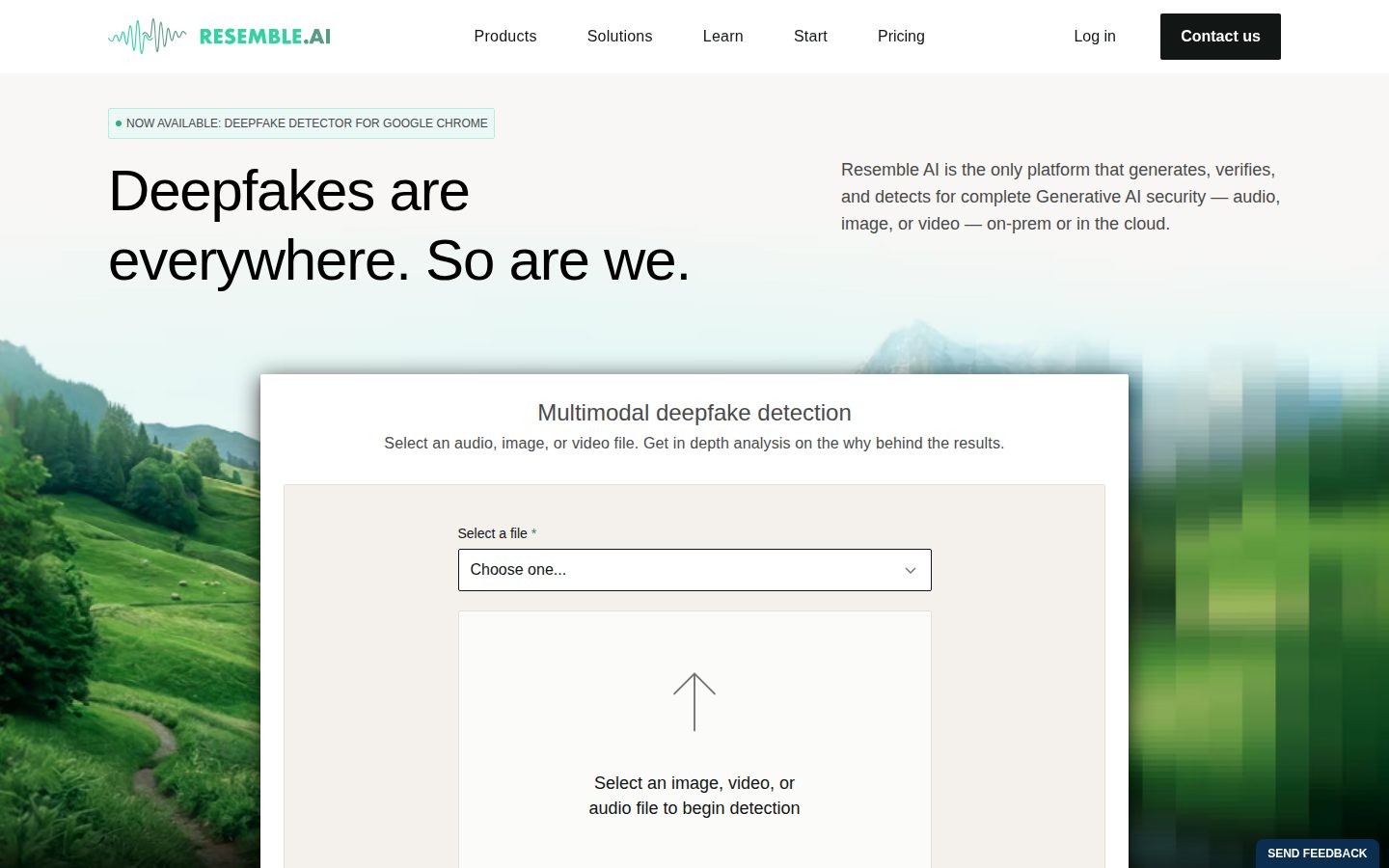
Detects deepfakes instantly across audio, image, or video media types.
Provides features designed to help enterprises meet EU regulatory compliance requirements for Voice AI.
Delivers a unified platform covering generation, verification, and detection for complete generative AI security across audio, image, and video.
Verifies proper usage of generated voices to ensure authorized and compliant use.
Pay as you go for individuals and teams who want to scale usage flexibly
Custom solutions for organizations with high-volume or advanced requirements
Solid API-first voice platform, but ElevenLabs has the brand and mindshare right now.
“Resemble AI has real technical depth: on-prem deployment, PerTh watermarking, deepfake detection, and a $500/month flex-to-enterprise trigger that's honest pricing. The positioning shift toward generative AI security is interesting but creates a story that's harder to defend in a single meeting.”
No public funding data. That's the first thing I'd chase before signing anything. The tech stack is WordPress and Bootstrap, which tells me nothing about engineering quality but does suggest the marketing org isn't the growth engine here. They've been in market long enough to build enterprise SLAs and SOC 2, which matters if you're in a regulated space.
Two things make Resemble genuinely differentiated. One: the PerTh Watermarker embeds imperceptible markers at generation time, before audio leaves your infrastructure. That's not table stakes — ElevenLabs doesn't lead with that. Two: on-prem deployment is available at Enterprise tier, which means regulated industries can actually use this without a legal fight.
The tradeoff worth naming: they're pivoting their front-door message toward deepfake detection and generative AI security, away from voice cloning. That could mean the core product is maturing and they need a second act. Or it could mean they found a bigger market. I don't know yet, and that uncertainty is real.
Flex Plan pricing at $2/month per Rapid Clone is approachable for a pilot. If your team hits $500/month, sales will call you. Run a 60-day API pilot, track actual per-second costs, and decide on Enterprise with real numbers in hand.
ElevenLabs has stronger brand recognition and creator adoption; Resemble wins on enterprise controls, but that differentiation only matters if your buyers care about compliance.
PerTh watermarking and EU compliance support give the board a responsible-use story, which is increasingly what legal will ask for before any voice AI sign-off.
Rapid Voice Clones at $2/month and full API access on the Flex Plan means a developer can have something running in days, not quarters.
API-first architecture plus on-prem deployment option means this can advance IVR, localization, or game audio pipelines rather than just replacing a recording budget line.
No public funding data, unknown team size, and a website messaging pivot toward security suggest a company in transition — not a red flag, but not a green one either.
Teams that need API-driven voice generation with audit trails and are working in regulated industries or enterprise environments.
You need a vendor with visible funding, a large public community, and a clear three-year roadmap before you can get legal sign-off.
Serious infrastructure play, but the creative surface stays thin for brand voice work.
“Resemble AI has made a hard pivot toward enterprise security and deepfake detection — the voice generation is the foundation, not the feature. If you're building a content pipeline that needs audit trails and on-prem sovereignty, this is worth a conversation. If you're shaping brand voice at scale, the craft ceiling shows.”
The PerTh Watermarker and Resemble Detect aren't creative tools — they're governance infrastructure. That's a deliberate architectural choice, and it tells you who's buying: legal-adjacent enterprise buyers who need to prove chain of custody on synthetic audio, not creative teams trying to build a consistent character voice across 200 episodes. The H1 leading with 'Deepfakes are everywhere' confirms the repositioning. This isn't ElevenLabs competing on voice quality finesse; this is a platform competing on compliance posture.
The two-tier voice cloning model — Rapid at $2/month versus Pro at $5/month — is the most revealing pricing signal in the evidence. That delta tells you they understand production fidelity as a distinct requirement, not just a marketing tier. Pro clones require more audio data and processing time, which means your voice talent investment and session planning matter. That's a real workflow consideration for any creative team running audiobook or character voice production.
On-prem deployment plus SOC 2 plus EU compliance support is a stack you'd spec for a healthcare or financial services client, not an indie studio. If we adopt this for enterprise content localization, in 3 years we have an auditable, secure voice pipeline — but we've also accepted that voice quality iteration will run through a sales conversation, not a self-serve model UI. The Localize dubbing and lip-sync feature is genuinely useful for global campaign work, but the docs don't reveal how much creative control lives in that layer versus automated output.
Resemble has carved a defensible security-plus-synthesis niche, though ElevenLabs and Murf own more of the creator and brand voice mindshare at this moment.
API-first and on-prem deployment fit developer and enterprise workflows; creative directors running brand voice systems will find the self-serve craft controls underdocumented.
Full API access on the Flex Plan including deepfake detection endpoints lowers the barrier for pipeline integration without hitting an enterprise paywall immediately.
On-prem plus SOC 2 plus EU compliance creates a durable compliance moat, but creative agility and model updates will likely require enterprise contract negotiation.
The governance and detection layer shows real architectural thinking, but public evidence on voice model depth and quality iteration tooling is thin compared to ElevenLabs.
Enterprise teams that need auditable, compliant synthetic voice pipelines with on-prem sovereignty options.
Your priority is iterating brand voice character with fine-grained creative controls across a large content library.
Usage-based with no published per-second rate — sticker is invisible.
“Flex Plan entry is credit-based with no published per-second cost on the pricing page. Enterprise unlocks 80% volume discounts, but you're calling sales to find the baseline.”
Credits never expire — that's buyer-friendly. Full API access on Flex, including deepfake detection, no feature gating below Enterprise. Rapid Voice Clone at $2/month, Pro at $5/month per voice. Those numbers are published without a sales call. Rare. But the core synthesis rate — cost per audio second — isn't visible. That's the number that matters at scale.
50 users generating moderate volume is hard to model blind. The $500/month threshold for an Enterprise conversation is the only anchor given. Below that, you're on Flex credits. Above it, discounts up to 80% are possible — meaning the spread between Flex and Enterprise pricing could be enormous. No published overage rate means no predictable Year 3 budget.
Compare to ElevenLabs, which publishes per-character rates and tier caps clearly. Resemble's SSO is Enterprise-only — category norm, but worth noting for teams with security requirements. On-prem deployment is a real differentiator for regulated industries, but that unlocks only at Enterprise with custom pricing. The PerTh Watermarker is a genuine compliance asset. The math, though, can't be closed without a sales call.
Credit-based Flex billing is simple; Enterprise requires a sales call and custom negotiation, adding procurement friction.
Credits never expire and Flex is pay-as-you-go — no term lock visible on the pricing page for entry tier.
Voice clone prices ($2/$5/month) are published, but per-second synthesis cost isn't visible on the pricing page.
Voice cloning for IVR or localization has measurable cost-per-minute savings versus studio production, but synthesis rate opacity muddies the model.
No published synthesis rate makes Year 3 TCO unmodelable without a sales engagement above $500/month.
Enterprises with regulated voice AI needs who can negotiate Enterprise pricing and justify on-prem deployment.
Your team needs a predictable monthly budget before talking to sales.
API-first voice cloning built for pipelines, not DAW sessions
“Resemble AI is a developer-oriented voice platform with serious enterprise security chops. Audio producers who live in Pro Tools or Reaper will feel the friction immediately — this tool wants to be in your code, not your session.”
The PerTh Watermarker tells you something about who built this. That's not a feature a content creator asked for — that's a feature a legal team asked for. Resemble is security-forward in a way ElevenLabs simply isn't, and the on-prem deployment option for enterprise signals they're chasing studios and broadcasters with compliance mandates, not solo voiceover producers. That positioning shapes everything about the workflow.
For production use, the Pro Voice Clone at $5/month per voice is the only realistic option. Rapid clones at $2/month are demo-room quality — useful for scratch tracks, not for a final mix. The docs indicate that Pro requires more audio data and processing time, which means your cloning pipeline has latency built in. That's a scheduling problem in a real production timeline.
The web-only platform is the daily fight. No DAW plugin, no standalone desktop app. Every audio edit round-trip goes through a browser. The changelog isn't public, so you can't track whether a synthesis model update quietly changed your established voice character mid-campaign. That's a real problem if you're managing a branded voice across 50 episodes.
The Flex Plan's full API access — including deepfake detection — is genuinely generous. At $500/month you're talking to enterprise sales. For developers building voice agents or IVR systems, that ceiling is workable. For a post-production house doing audiobook localization via the Localize feature, the usage-based model could spike unpredictably on long-form projects.
Web-only workflow and no public changelog mean voice model drift is invisible until it breaks a session.
Buyer Q&A answers are specific and technically honest, though the absence of a changelog is a gap for production teams tracking model behavior.
Pro Voice Clone latency and usage-based billing spikes on long-form content are predictable weekly friction points.
Full API access on Flex, custom model training on Enterprise, and on-prem deployment give genuine depth for technically oriented power users.
API-first design fits developer pipelines but offers no DAW integration, forcing browser round-trips for audio producers.
Developers and enterprise teams building voice-powered applications who need API integration, compliance controls, and scalable cloning infrastructure.
Your workflow lives inside a DAW and you need deterministic voice character across a long-running production without model drift surprises.
Serious voice AI infrastructure, but the daily experience is a black box
“Resemble AI is clearly built for developers and enterprises who need scalable voice generation, not casual creators poking around a web UI. The pricing transparency is decent, but the day-to-day feel of actually using this thing is almost impossible to verify from the outside.”
The homepage pivot is telling. The H1 is about deepfakes now, not voice creation. That's a brand repositioning happening in real time, and it means the product team's attention has shifted. If you came for voice cloning, you're now sharing the spotlight with enterprise security buyers. That doesn't break anything, but it changes the vibe.
The $2/month Rapid Voice Clone versus $5/month Pro Voice Clone distinction is actually useful and honest. Most competitors bury this kind of quality tiering. The Flex Plan structure — pay-as-you-go with credits that never expire — is the right call for anyone who doesn't know their volume yet. ElevenLabs does something similar, but the $500/month threshold before Resemble nudges you toward Enterprise is a real number worth knowing going in.
Onboarding is the gap I'd worry about. No free plan, no changelog, no public API docs link in the scraped evidence. The site runs on WordPress, which tells you something about where the engineering budget isn't going. For a tool with real-time synthesis and an audio editing interface, the surface area is large. That first hour could feel like assembling furniture without the picture on the box.
Mobile parity is a hard unknown, but a web-only platform with no stated mobile experience is almost always read-heavy on phone and do-nothing-useful. The watermarking feature — PerTh Watermarker — is genuinely interesting and the 'survives compression' claim is the kind of thing that earns trust slowly over time. That's the part worth watching.
No changelog visible, WordPress backend, and a brand pivot mid-homepage suggests the UI details aren't getting obsessive attention right now.
The Rapid versus Pro voice clone tier structure is clear, but the range of features — dubbing, agents, detection, cloning — makes the product surface wide enough to get lost in.
Web-only platform with no stated mobile experience; a developer API tool that lives in a browser is rarely a great phone experience.
Free trial exists but no free plan, and the docs availability marker is yes while API marker is oddly no — that friction adds up in the first ten minutes.
SOC 2 compliance, on-prem deployment option, and enterprise SLAs suggest the backend is taken seriously even if the front-end feel is harder to assess.
Developers building voice into applications who need API access and don't mind figuring out the UI as they go.
You want a polished, low-friction creative tool for occasional use without a learning tax.
Three green flags, two yellow ones — Resemble isn't dead yet
“The watermarking and deepfake detection angle is a real differentiator, not just feature parity with ElevenLabs. But the pricing page hides the actual dollar number behind 'load credits,' and the changelog is missing entirely.”
Two things made me look twice. First, the PerTh Watermarker — embedded at generation, claimed to survive compression and codec changes. Second, the pivot toward enterprise security framing. 'Deepfakes are everywhere. So are we.' That's a positioning bet, not just a feature add. Could go either way, but it's a sharper angle than Murf's 'studio quality' pitch.
Three tells I can't ignore. One: no changelog visible — can't verify shipping cadence. Two: starting price is listed as unknown, and 'load credits' tells me nothing about unit economics until you're already in. Three: WordPress and Bootstrap on the tech stack — not a dealbreaker, but not what you'd expect from a team betting on enterprise SLAs and SOC 2. The $500/month threshold for Enterprise conversations is at least a concrete number someone gave a real answer to.
The Rapid vs. Pro clone split — $2/month versus $5/month — is an honest tradeoff to surface. They're not pretending one-size-fits-all. Exit portability is medium. REST API means your audio pipeline isn't totally hostage, but cloned voice assets don't migrate cleanly to ElevenLabs. That's the lock-in they're banking on.
Deepfake detection plus voice generation in one platform is a real gap vs. ElevenLabs, which doesn't bundle detection — if the detection actually holds up under scrutiny.
REST API helps, but cloned voice assets are proprietary and won't port to Play.ht or ElevenLabs without re-recording.
No public funding data, no support email listed, no changelog — not enough public signal to call this a safe 3-year bet.
The deepfake detection pivot is real, but 'permanent, indestructible, and invisible' watermarks is the kind of superlative that ages poorly if a bypass surfaces.
No changelog, unknown company founding data, and no public funding signals — matches the pattern of mid-tier AI voice tools that quietly stall, not the ones that scaled.
Developers who need API-first voice generation and want deepfake detection in the same vendor relationship.
You need pricing transparency before signing up or plan to move voice assets across platforms in under two years.
Common questions answered by our AI research team
Rapid Voice Clones can be created quickly from a short audio sample, making them perfect for fast prototyping and general use cases. Professional Voice Clones require more audio data and processing time but deliver higher fidelity and more accurate voice reproduction, making them the better choice for production-quality applications. They are priced at $2/month and $5/month per voice, respectively.
According to the homepage, voices are synthesized or cloned and watermarked at the moment of creation, before the audio leaves your infrastructure. The watermarks are described as 'permanent, indestructible, and invisible' and travel with the file. The content also notes that Resemble Detect is resilient against compression, codecs, and more, suggesting watermarks can survive such changes, though explicit confirmation that watermarking survives compression is implied by the detection accuracy claims rather than stated directly for watermarking specifically.
Resemble AI recommends talking to sales if you are spending more than $500/month on the Flex Plan, as volume discounts could offer significant savings. Enterprise unlocks additional features including volume discounts up to 80%, higher concurrency limits, enterprise SLAs & SOC 2, custom model training, SSO/SAML authentication, dedicated support, and on-premise deployment.
The Flex Plan includes 'Full API access' and explicitly states that Deepfake Detection is now available on the Flex Plan, covering audio, video, and image detection as well as intelligence analysis features. Voice Agents are also listed as a usage-based product available on the Flex Plan. The content does not indicate any API endpoints are restricted to Enterprise only.
Resemble AI is a Toronto-based voice AI company offering custom voice cloning, synthesis, and deepfake detection tools.