ScrapeAtlas logo

ScrapeAtlas Review

Visit

One API for public data across 47 social, video, and commerce platforms

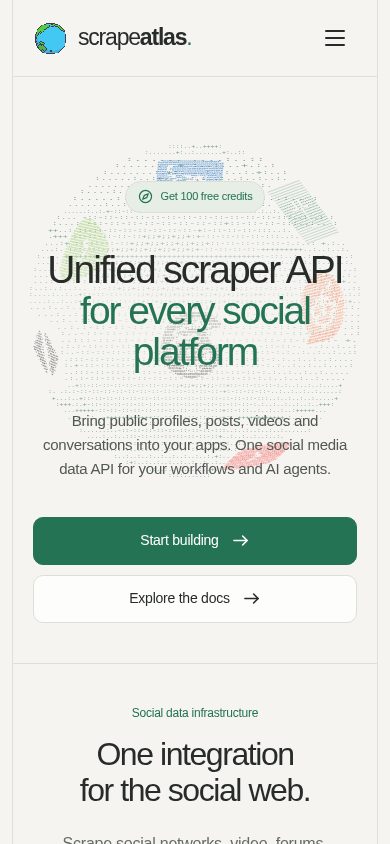
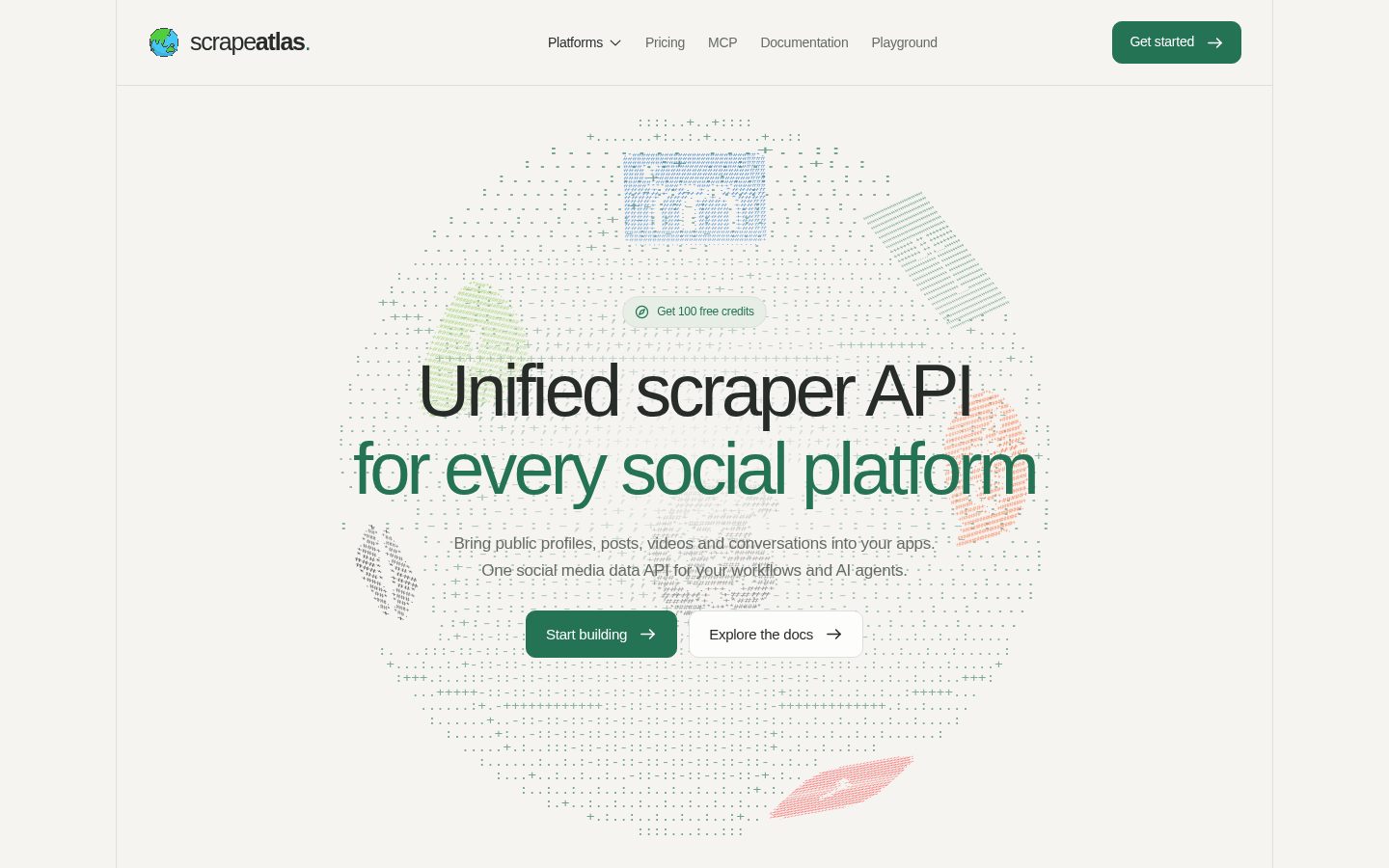
ScrapeAtlas is a unified API for retrieving public social media, video, and commerce data for apps and AI agents.

AI Panel Score

7.3/10

6 AI reviews

Reviewed

Facts checked against scrapeatlas.com

About ScrapeAtlas

ScrapeAtlas works through a REST API: a developer sends a request to an endpoint such as /v1/instagram/profile or /v1/youtube/video with a handle, URL, or search term and an API key, and receives structured JSON back containing fields like follower counts, view counts, post metadata, or shop statistics. The same data can be reached through a CLI (installed via npm, requiring Node.js 22+) that returns profiles, posts, and videos as JSON from the terminal, or through an MCP server that can be added to ChatGPT or Claude via OAuth so an assistant can retrieve public profiles, posts, or videos in response to a prompt.

The platform spans 47 named sources and 356 endpoints, covering mainstream social networks (Instagram, TikTok, X, Facebook, LinkedIn, Reddit, Threads, Pinterest, Snapchat), video platforms (YouTube, Twitch, Kick, Rumble, Kwai), commerce and marketplace sites (Amazon, Etsy, Depop, Vinted, Whatnot, TikTok Shop, Facebook Marketplace), ad libraries (Meta Ads Library, LinkedIn Ads Library), prediction markets (Polymarket, Kalshi), and community or link-in-bio tools (Discord-adjacent forums like Hacker News, Linktree, Medium, Substack, Skool). An interactive API playground lets users pick an endpoint, fill in request fields, and run a live call to see the JSON response and copy example code in cURL, JavaScript, TypeScript, Python, Go, or Java.

The listed use cases include brand monitoring (pulling comments and mentions from Reddit, X, and TikTok), creator discovery (combining profiles, content, and engagement data), video intelligence (transcripts, comments, and metadata), competitive intelligence (ad creatives and messaging), commerce research (product, price, and review data from Depop, Amazon, and Etsy), and feeding public social context to AI agents via MCP or HTTP. New accounts receive 100 free credits to start building.

Features

AI

  • AI Agent & Workflow Integration

    Connects via MCP or HTTP so AI agents can research, summarize and enrich workflows using live public social context, such as a creator's latest posts.

  • Remote MCP Server

    Hosts an MCP server at api.scrapeatlas.com/mcp exposing roughly 291 tools so AI agents and assistants like Claude, Cursor, and ChatGPT can query social data directly via natural language prompts.

Analytics

  • Brand Monitoring

    Aggregates public posts, comments and conversations from platforms like Reddit, X, and TikTok to track brand mentions and audience reactions.

  • Competitive Intelligence

    Gathers public ad creatives, content, messaging and engagement data to let users research and compare competitor strategies.

  • Creator Discovery

    Retrieves public profile data (followers, following, post counts) for social accounts to help users find and shortlist creators for campaigns.

  • Shop and Commerce Research

    Fetches shop and product data (followers, items sold, reviews) from commerce platforms such as Depop, Amazon, and Etsy for product discovery and shopping research tools.

  • Video Intelligence

    Pulls video metadata, view/like counts, transcripts and comments from platforms like YouTube to turn videos into structured research or content data.

Core

  • API Playground

    Lets users choose an endpoint, enter request fields, and run live API calls in-browser to view JSON responses and copy ready-made code examples in multiple languages.

  • Multi-Platform Endpoint Coverage

    Offers 356 documented endpoints across 47 platforms including Instagram, TikTok, X, YouTube, Facebook, LinkedIn, Reddit, Pinterest, Amazon, Etsy, Depop, Kalshi, Polymarket and more, each returning structured JSON.

  • Unified Social Media Data API

    Provides a single REST API at api.scrapeatlas.com to pull public profiles, posts, videos, comments, ads and conversation data from about 40 social and web platforms using one account and credential set.

Integration

  • CLI Tool

    Provides an installable command-line interface (@scrapeatlas/cli) for authenticating and retrieving profiles, posts and videos as JSON directly from the terminal.

  • Multi-Language Code Examples

    Supplies ready-to-use request snippets in cURL, JavaScript, TypeScript, Python, Go, and Java for every API endpoint.

Preview

ScrapeAtlas desktop previewScrapeAtlas mobile preview

Pricing Plans

Free

Contact sales

Get started with 100 free credits to try ScrapeAtlas's unified social data API before committing to a paid plan.

  • 100 free credits
  • Access to unified scraper API
  • 47 platforms, 356 endpoints
  • CLI and MCP support
  • API playground access

Pay as you go

Contact sales

Usage-based access to the full ScrapeAtlas API across all supported platforms; specific credit pricing is not listed on this page.

  • Access to all 47 platforms
  • Social profiles, posts, videos and conversations
  • Social commerce and ad library data
  • CLI and MCP integrations
  • Structured JSON responses

AI Panel Reviews

The Decision Maker

The Decision Maker

Strategic bet, vendor viability, timing, adoption approval
7.6/10

One key, 47 platforms, 356 endpoints — the integration math is the whole pitch.

“ScrapeAtlas bets that developers would rather pay per credit than maintain 47 scrapers. The MCP server and CLI make it an easy yes for AI agent teams specifically.”

356 endpoints across 47 platforms, from Instagram to Polymarket, behind one API key. That's the pitch: stop maintaining your own scraper fleet, call one vendor instead. The MCP server exposing roughly 291 tools to Claude or ChatGPT is the sharpest piece — it turns 'can my agent check a creator's latest posts' into a config line, not a project.

Two things give me pause. Pricing is usage-based with 100 free credits to start, but I couldn't find the actual per-credit rate anywhere public, which makes budgeting a guess until you're in. And platform-scraping APIs live at the mercy of the platforms they scrape — that's a structural risk for the whole category, not just this vendor.

The breadth is real and the CLI plus multi-language code snippets show a team building for working developers, not just a landing page. Pilot it on one use case — creator discovery or brand monitoring — before you wire it into anything load-bearing.

Competitive Positioning7.7

356 endpoints and an MCP server with ~291 tools is unusually broad coverage for a single-vendor API; the obvious alternative is building and maintaining per-platform scrapers in-house.

Reputation Risk6.5

No visible security or compliance detail, and scraping public data across 47 platforms carries inherent terms-of-service exposure the pricing page doesn't address.

Speed to Value8.0

100 free credits plus a playground with copyable cURL/Python/Go snippets means a working call in minutes, not weeks.

Strategic Fit7.8

Consolidating 47 scraper integrations into one API is a real architecture upgrade, not just a cost swap, especially for AI agent workflows.

Vendor Viability7.5

Docs, blog, changelog, and a live API playground all point to active development, though I couldn't confirm update cadence.

Pros

  • 356 endpoints across 47 platforms under one credential set
  • Native MCP server (~291 tools) for Claude, ChatGPT, Cursor agents
  • CLI and multi-language code examples lower integration time
  • 100 free credits to test before committing

Cons

  • Per-credit pricing isn't published, so cost at scale is unclear upfront
  • No visible security/compliance documentation for a data-access product
  • Scraping public platforms always carries platform-policy risk outside the vendor's control

Right for

Teams building AI agents or research tools that need broad social and commerce data without maintaining dozens of scrapers.

Avoid if

Skip it if you need guaranteed, predictable per-call costs locked in before you build.

The Domain Strategist

The Domain Strategist

Craft and strategy in the product's domain — adapts identity per category, same lens
7.6/10

356 endpoints behind one API key is real leverage, but you're building on infrastructure you don't control and can't fully price.

“ScrapeAtlas consolidates scraping for 47 platforms into one credential set and a REST/CLI/MCP surface. The architecture is sound, but the dependency graph underneath it is someone else's platform policy, not yours.”

Architecturally, this is the right call: one schema, one auth model, JSON normalized across 356 endpoints instead of 47 bespoke integrations your team would otherwise own. That consolidation is where the real engineering savings live — not in the per-call price, but in the maintenance headcount you don't need to hire to keep up with Instagram's markup changes.

The MCP server with roughly 291 tools is the forward-looking bet — wiring live social context into Claude or Cursor agents via OAuth is ahead of where most unified-scraper vendors sit today. But you're adopting their abstraction layer over platforms that actively fight scraping; if Instagram or TikTok change DOM structure or rate-limit harder, your outage is their outage, on their timeline, not yours.

Three years out, you've outsourced a brittle, adversarial problem to a specialist — good trade if their uptime holds, bad lock-in if endpoint coverage degrades unevenly across the 47 sources and you've already built product logic on top of it.

Category Positioning7.5

The MCP-first agent access puts it ahead of typical unified-scraper tooling, though usage-based pricing without visible credit rates leaves budget planning to guesswork.

Domain Fit8.0

REST plus CLI plus MCP covers how both backend engineers and agent-builders actually consume data today.

Integration Surface7.9

One credential set across REST, CLI, and MCP server at api.scrapeatlas.com/mcp means a single integration touchpoint instead of 47 separate client libraries.

Long-term Implications6.8

You inherit platform-policy risk across 47 third-party sites you don't control, with no visible SLA language to anchor an uptime commitment.

Strategic Depth7.8

356 endpoints with a live playground and six-language code generation shows real platform depth, not a thin wrapper.

Pros

  • Single credential set spans REST, CLI, and MCP across 47 platforms
  • 291-tool MCP server is a genuinely forward architecture for agent workflows
  • API playground generates working code in six languages before any client is built

Cons

  • Uptime and data-accuracy track record isn't something I could verify
  • Your dependency is ultimately on platforms actively hostile to scraping, outside ScrapeAtlas's control

Right for

Engineering teams who'd rather pay a specialist than staff scraper maintenance across dozens of platforms.

Avoid if

You need contractual uptime guarantees or can't tolerate silent endpoint degradation when a source platform changes its layout.

The Finance Lead

The Finance Lead

Money, total cost of ownership, contracts, procurement math
6.8/10

100 free credits, two tiers, zero credit prices. That's the whole rate card.

“Pay-as-you-go across 356 endpoints sounds clean until you try to model cost per call. Nobody can build a year-1 number off what's published today.”

Two tiers. Free, and pay-as-you-go. Both say "contact sales" where the number should be. 100 free credits to start, then unknown cost per credit, per platform, per endpoint. 47 platforms don't cost the same to pull — Instagram profile lookups and Amazon shop data are not the same unit economics internally, and that likely shows up in credit weighting. Without a rate card, you can't model it.

TCO at team-of-50 scale: can't build it. $100 starting price is listed, but starting price on usage-based billing tells you the floor, not the ceiling. Volume discounts, overage behavior, credit expiry — all unknown from what's public.

No contract terms visible either — term length, cancellation, auto-renewal windows. Usage-based billing usually means no lock-in, which is the one thing working in its favor here. But procurement will want a number before legal even opens the MSA.

Billing & Procurement6.0

API-key self-serve onboarding via the playground is light, but usage-based billing without posted rates adds finance review time.

Contract Flexibility6.5

Usage-based pricing implies no long-term lock-in, but I couldn't find stated term length or cancellation terms.

Pricing Transparency4.5

Both plans show "contact sales" instead of a credit price; only the $100 starting figure and 100 free credits are public.

ROI Clarity7.0

Structured JSON outputs like follower counts and view counts make per-call value easy to define once credit cost is known.

Total Cost of Ownership5.0

356 endpoints across 47 platforms likely carry different credit costs, but no published rate makes year-3 modeling guesswork.

Pros

  • 100 free credits to test real endpoints before any spend
  • Usage-based model avoids seat-based lock-in common in this category
  • API playground lets you verify output shape before writing code

Cons

  • No credit price published for either plan
  • Can't build a 3-year cost model without knowing per-call or per-platform rates
  • Starting price of $100 tells you the floor, not what volume costs

Right for

Teams that can absorb pricing uncertainty in exchange for broad platform coverage under one key.

Avoid if

Avoid if finance needs a locked-in cost model before approving the vendor.

The Domain Practitioner

The Domain Practitioner

Daily hands-on reality in the product's domain — adapts identity per category, same lens
7.6/10

One auth token for 356 endpoints, but the schema consistency across 47 platforms is the real test.

“356 endpoints behind one API key is the pitch, and the playground lets you check response shape before you commit code. Whether the JSON stays structurally sane across 47 unrelated platforms is the thing to stress-test with your own 100 credits, not the marketing page.”

/v1/instagram/profile and /v1/youtube/video sitting under the same credential set is genuinely useful for anyone building creator-intel tooling that would otherwise mean maintaining five separate scraper contracts. The multi-language snippets (cURL, Go, Java, TypeScript) in the playground mean you can sanity-check a response shape before committing to a client library, which saves a real afternoon.

The open question is schema drift. Forty-seven platforms means forty-seven different underlying page structures, and the daily fight with any unified scraper API is field consistency — does a 'followers' key mean the same thing on Depop as it does on Twitch, or do you end up writing per-platform normalizers anyway? Nothing in the docs I looked at addresses versioning or deprecation policy when a source platform changes its markup.

CLI requiring Node 22+ is a mildly annoying constraint for teams still on LTS branches, but it's a one-line nvm fix, not a blocker. The MCP server exposing ~291 tools is the more interesting bet — most competitors in this space haven't wired agent access this deep yet.

Day-3 Reality7.5

The unified-auth pitch holds up for prototyping; the real test is schema stability once you're pulling from 10+ platforms in production.

Documentation Practitioner-Fit7.4

The interactive playground with copy-paste code in six languages reads like it was built by someone who ships integrations, not just a marketer.

Friction Surface7.0

Node 22+ requirement for the CLI is a small but real version-pinning hassle for teams on older LTS.

Power-User Depth7.3

356 endpoints and 291 MCP tools suggest real depth, but discoverability of advanced endpoints beyond the obvious profile/video calls is untested here.

Workflow Integration7.8

CLI, REST, and MCP cover terminal, codebase, and agent workflows without forcing a single integration pattern.

Pros

  • Single credential set across REST, CLI, and MCP for 47 platforms
  • Playground generates ready-to-run code in six languages before you write a client
  • Agent access via ~291 MCP tools is deeper than most unified scraper APIs offer today

Cons

  • No visible policy on how schema changes or platform-side markup shifts get handled per endpoint
  • CLI's Node 22+ requirement adds friction for teams on older LTS versions

Right for

Teams building creator-intel or commerce-research tools who'd rather maintain one API contract than five platform-specific scrapers.

Avoid if

You need guaranteed long-term schema stability on a specific platform and can't tolerate response-shape surprises.

The Power User

The Power User

Daily human experience, onboarding, polish, learning curve, reliability
7.3/10

An API, not a product you use — which is kind of the point and kind of the catch

“ScrapeAtlas is built for developers calling endpoints, not for humans staring at a dashboard. What polish exists lives in the playground; everything else is on you to wire up.”

This is one of those tools you judge by the docs and the playground, because that's the whole interface. The API playground is the one place I can actually see craft — pick an endpoint, fill fields, get live JSON back, copy code in six languages. That's a real first-ten-minutes win, closer to welcome than homework.

But the moment you leave the playground for actual integration across 356 endpoints and 47 platforms, you're reading docs and writing error handling yourself. Nothing here tells me how a 404 looks, or what happens when Instagram changes its markup and your /v1/instagram/profile call quietly returns a different shape. For a product whose entire value is 'structured JSON you can trust,' that silence matters more than it would for a dashboard app.

Month three is really about whether your error handling held up, not whether you learned the tool. The 100 free credits get you a fair test before that question matters.

Daily Polish7.5

The playground with multi-language code output is a genuinely considered touch for a pure API product.

Learning Curve7.6

356 endpoints across 47 platforms is a lot of surface area, but one credential set and consistent JSON shape keep it from feeling like 47 separate tools.

Mobile Parity6.0

This is a REST API and CLI product, so mobile isn't really the axis it's judged on, but there's no mobile-facing surface to speak of.

Onboarding Experience7.8

100 free credits plus a live playground means you're seeing real JSON within minutes, not reading a quickstart first.

Reliability Feel6.2

I couldn't find error-state or rate-limit documentation, which matters when scraping 47 third-party platforms that can change without notice.

Pros

  • Live API playground lets you see real JSON before writing a single line of integration code
  • One account and credential set covers niche sources like Polymarket and Kalshi alongside mainstream platforms
  • Free credits let you test actual endpoints, not just a sandboxed demo

Cons

  • No visible documentation on error handling or what happens when a source platform changes its page structure
  • Usage-based pricing without visible per-credit rates makes it hard to budget past the free tier

Right for

A developer who wants one JSON contract across dozens of scraping targets instead of maintaining 47 separate integrations.

Avoid if

You need guaranteed uptime behavior and documented failure modes before you'll put this in a production pipeline.

The Skeptic

The Skeptic

Contrarian. Watch-outs, deal-breakers, broken promises, category patterns
6.6/10

47 platforms, one credential set, and a price you only see after you've built against it.

“356 endpoints is a real number and the playground backs it with live JSON. But public scraping products live and die on platform tolerance, and that risk sits entirely outside ScrapeAtlas's control.”

I've watched this category before — unified scraper APIs promising every platform under one key. Some survive by being faster to adapt when a source changes its markup. Others quietly drop endpoints one by one until the '47 platforms' claim is aspirational. Nothing here tells me which path ScrapeAtlas is on.

The 291-tool MCP server and six-language playground are concrete, verifiable claims — good sign, that's specific, not vague. Depop and Polymarket sitting next to Instagram and YouTube is a genuinely odd, genuinely useful mix if you need it.

But this entire business model depends on platforms not changing terms or blocking access, and that's a risk no vendor controls or fully discloses. Structured JSON from a REST endpoint is a thin abstraction if the underlying source fights back. Portability's fine — it's JSON, swap the client. Durability is the open question.

Competitive Differentiation6.8

Covering ad libraries and prediction markets like Polymarket alongside Instagram is a wider net than typical single-platform scrapers.

Exit Portability7.5

Plain JSON over REST, CLI, and MCP means swapping clients later is mechanical, not a migration project.

Long-term Viability5.8

A changelog and docs exist, but scraping 47 third-party platforms means constant maintenance pressure with no visible track record yet.

Marketing Honesty7.2

The H1 claims 'every social platform' but the docs list a bounded 47 — specific enough to check, not pure superlative.

Track Record Match6.5

356 named endpoints and a live playground back the headline claim, but I found no stated uptime or accuracy track record.

Pros

  • 356 documented endpoints spanning mainstream social, video, and niche markets like Kalshi
  • Live playground shows real JSON before writing code
  • Single credential set simplifies integration across REST, CLI, and MCP

Cons

  • Scraping public platforms is inherently fragile when source sites change structure or push back
  • No visible track record on uptime or data accuracy over time
  • 100 free credits won't reveal real cost at any meaningful volume

Right for

Teams who need breadth across niche and mainstream public data sources and can tolerate some scraping fragility.

Avoid if

You need guaranteed long-term data stability for a production pipeline with zero tolerance for source breakage.

Buyer Questions

Common questions answered by our AI research team

Features

How many platforms does ScrapeAtlas support?

ScrapeAtlas covers 47 platforms through 356 endpoints, including Instagram, TikTok, YouTube, Reddit, Amazon, Depop, Facebook, LinkedIn, X (Twitter), Pinterest, Twitch, Etsy, and many more.

Integration

Does ScrapeAtlas work with AI agents?

Yes. ScrapeAtlas connects to AI assistants through an MCP server, letting agents research, summarize, and enrich workflows with public social context via MCP or HTTP.

Setup

Can I use ScrapeAtlas from the command line?

Yes. ScrapeAtlas offers a command-line interface for retrieving data directly from a terminal in addition to its API.

Features

What kind of data format does the API return?

The API returns structured JSON, such as creator follower counts, video view counts, shop sales data, and other fields like post counts, likes, and engagement metrics.

Pricing

Is there a free trial or free credits?

Yes, new users get 100 free credits to start building with ScrapeAtlas.

Product Information

  • Company

    ScrapeAtlas
  • Pricing

    From $100

Platforms

web

About ScrapeAtlas

ScrapeAtlas provides a social media data API that extracts public profiles, posts, videos and conversations from major social networks for apps and AI agents.

Resources

Documentation
Blog
Changelog

Also in AI APIs