Application monitoring and error tracking platform for developers
Sentry is an error monitoring and performance tracking platform for software applications.
AI Panel Score
0 AI reviews
Sentry helps developers identify, diagnose, and fix errors in their applications across multiple programming languages and frameworks. The platform captures exceptions, performance issues, and other problems in real-time, providing detailed context and stack traces to help teams resolve issues quickly.
Correlates pull requests against real error and performance history to catch regressions before they ship to production.
An AI debugging agent that analyzes logs, commits, traces, and stack traces to explain why code failed and generates merge-ready patches to fix issues automatically.
Detects slow queries, N+1 database calls, and request timeouts to help identify performance bottlenecks before they impact users.
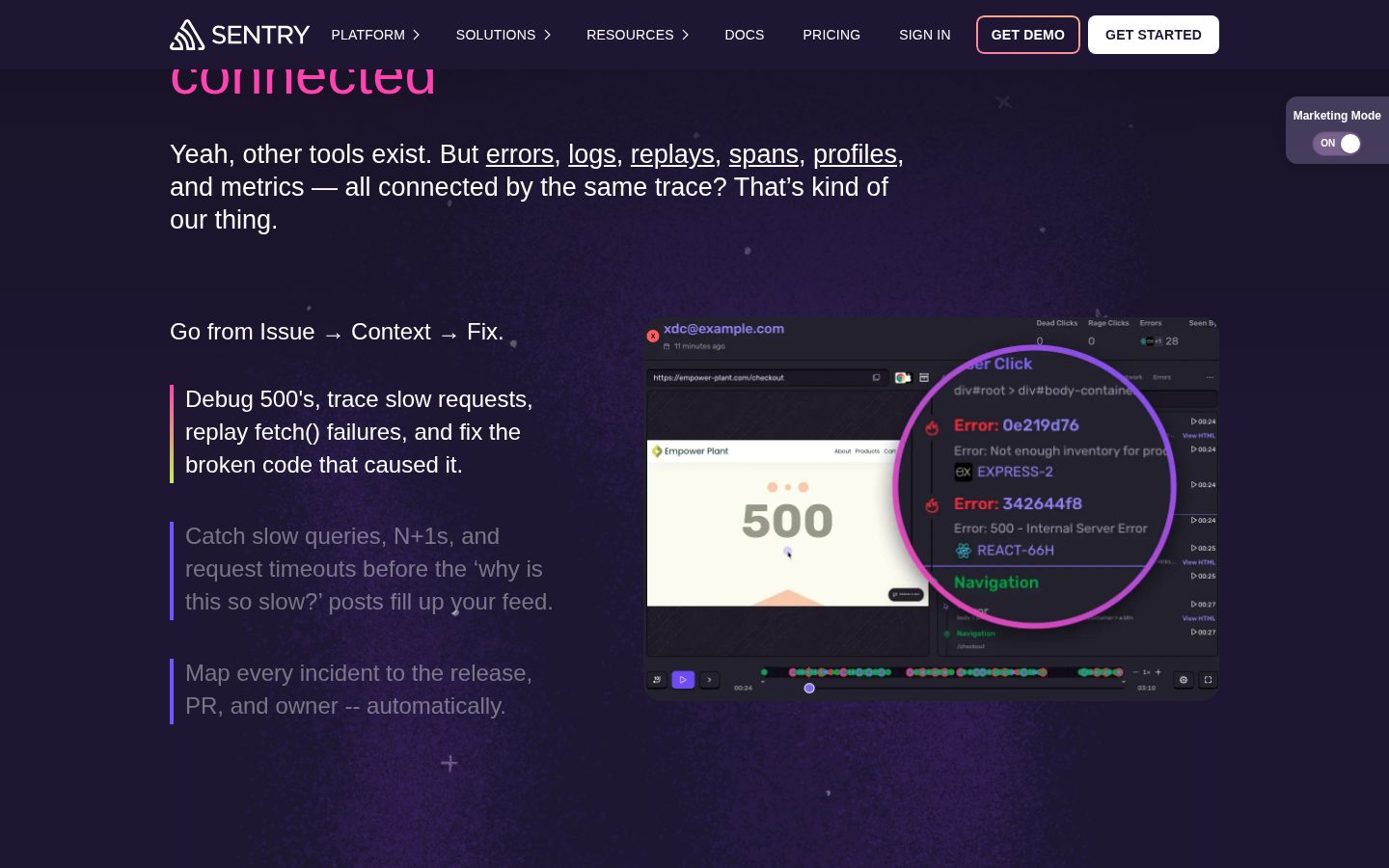
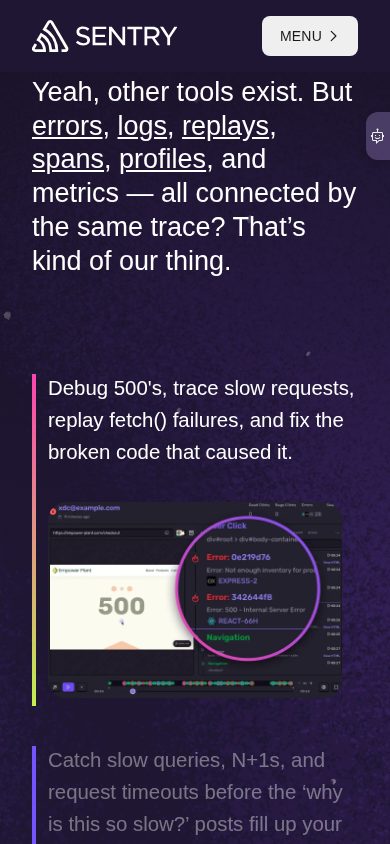
Records and replays user sessions including fetch() failures to provide visual context for debugging frontend issues.
Collects and connects application logs to traces and errors so all signals are correlated within the same debugging context.
Connects errors, logs, replays, spans, profiles, and metrics under the same trace to provide full context from issue to fix.
Captures exceptions and errors in real-time with detailed stack traces across multiple programming languages and frameworks.
Provides SDKs for over 20 platforms including Next.js, React, Python, Node.js, Android, iOS, Flutter, Go, Ruby, PHP, Java Spring Boot, and more, installable in a single command.
Maps every incident automatically to the specific release, pull request, and code owner responsible for the issue.
Integrates with GitHub, Slack, Jira, Linear, and coding agents via Sentry's MCP server to bring full issue context to every fix workflow.
For solo devs working on small projects
Everything to monitor your application as it scales
For teams that need more powerful debugging
For organizations with advanced needs
AI panel reviews are being generated for this product.
Common questions answered by our AI research team
The Business plan costs $80/mo compared to the Team plan at $26/mo, a difference of $54/mo (both billed annually). Upgrading to Business adds SAML + SCIM support, unlimited custom dashboards (vs. 20 on Team), unlimited metric alerts with anomaly detection (vs. 20 on Team), advanced quota management, and Insights with a 90-day lookback (vs. 30-day on Team).
Seer analyzes every signal — including logs, commits, traces, and stack traces — to explain why code failed, not just where. It generates precise, merge-ready patches to fix issues and also correlates PRs against real error and performance history to catch regressions before they ship.
Yes, Sentry supports SAML2 and SCIM single sign-on. These authentication options are available on the Business plan (SAML + SCIM support, with a note to 'See pricing'), while the Enterprise plan also includes them. The Team and Developer plans do not include SAML or SCIM.
Yes, you can set up Sentry for a Next.js project with just one command: `npx @sentry/wizard@latest -i nextjs`. Sentry explicitly states there are 'No agents to install' and 'No performance surprises,' meaning no additional agents or infrastructure changes are required.
Yes, Sentry integrates with GitHub, Slack, Jira, and Linear (also mentioning its MCP server for coding agents). However, third-party integrations are listed as a feature of the Team plan and above — they are not available on the free Developer plan.
Company
SentryFounded
2011Free Plan
AvailableSentry is a San Francisco-based application monitoring company offering error tracking, performance monitoring, and session replay for developers.