Snorkel AI logo

Snorkel AI Review

Visit

Programmatic data labeling and model development platform for AI teams

Snorkel AI is a platform for programmatically labeling training data and developing machine learning models.

AI Panel Score

7.8/10

6 AI reviews

Reviewed

About Snorkel AI

Snorkel AI is a data-centric machine learning platform that focuses on programmatic data labeling and model development. Instead of relying on manual data annotation, the platform allows users to write labeling functions that automatically generate training labels at scale.

The platform is designed for data scientists, ML engineers, and AI teams who need to create large labeled datasets for supervised learning tasks. Users can write Python functions that encode domain expertise and heuristics to label data, then combine multiple labeling functions to create training sets. Snorkel also provides tools for model training, evaluation, and deployment.

Key capabilities include weak supervision techniques, data programming workflows, model monitoring, and integration with popular ML frameworks. The platform supports various data types including text, images, and structured data. Snorkel AI aims to reduce the time and cost associated with manual data labeling while maintaining data quality.

The company emerged from Stanford University research and targets enterprise customers dealing with large-scale ML projects where traditional manual labeling approaches become impractical or expensive. Snorkel AI competes in the broader ML operations and data preparation market alongside platforms focused on data annotation, model management, and MLOps.

Features

AI

  • Agentic Coding Benchmarks

    Evaluates AI models on complex, real-world coding tasks using terminal-grade coding benchmarks with reproducible results and traces.

  • Model-Based and Rule-Based Evaluation

    Evaluates AI model behavior using both model-based and rule-based methods to measure output quality.

  • Realistic Simulations

    Runs realistic simulations to measure and evaluate AI agent behavior in real-world scenarios.

Analytics

  • Coverage Gap Targeting

    Identifies and targets specific data collection efforts to close coverage gaps revealed during the refinement cycle.

  • Failure and Disagreement Analysis

    Analyzes failures and disagreements in model outputs to identify coverage gaps and guide targeted data collection.

  • Meta-Evaluation

    Assesses and calibrates the evaluators themselves to ensure evaluation quality and reliability.

Automation

  • Programmatic Quality Control

    Applies automated, rule-based checks and verifiers to control data quality without relying solely on manual annotation.

  • Rubric-Guided Labeling Pipelines

    Runs rubric-guided task and labeling pipelines with precise inputs/outputs and automated checks.

Collaboration

  • Expert-in-the-Loop Review

    Pairs programmatic automation with calibrated human experts for correction and feedback to maintain high-precision data quality.

Core

  • Dataset Curation

    Curates high-quality, domain-specific datasets to accelerate AI use cases and performance through expert data services.

  • Evaluation Framework Development

    Designs and co-develops specialized evaluation frameworks tailored to an organization's models and data pipelines.

  • Rubric Design

    Defines tasks, IO contracts, and scoring rubrics to establish what 'good' looks like for AI model outputs.

Preview

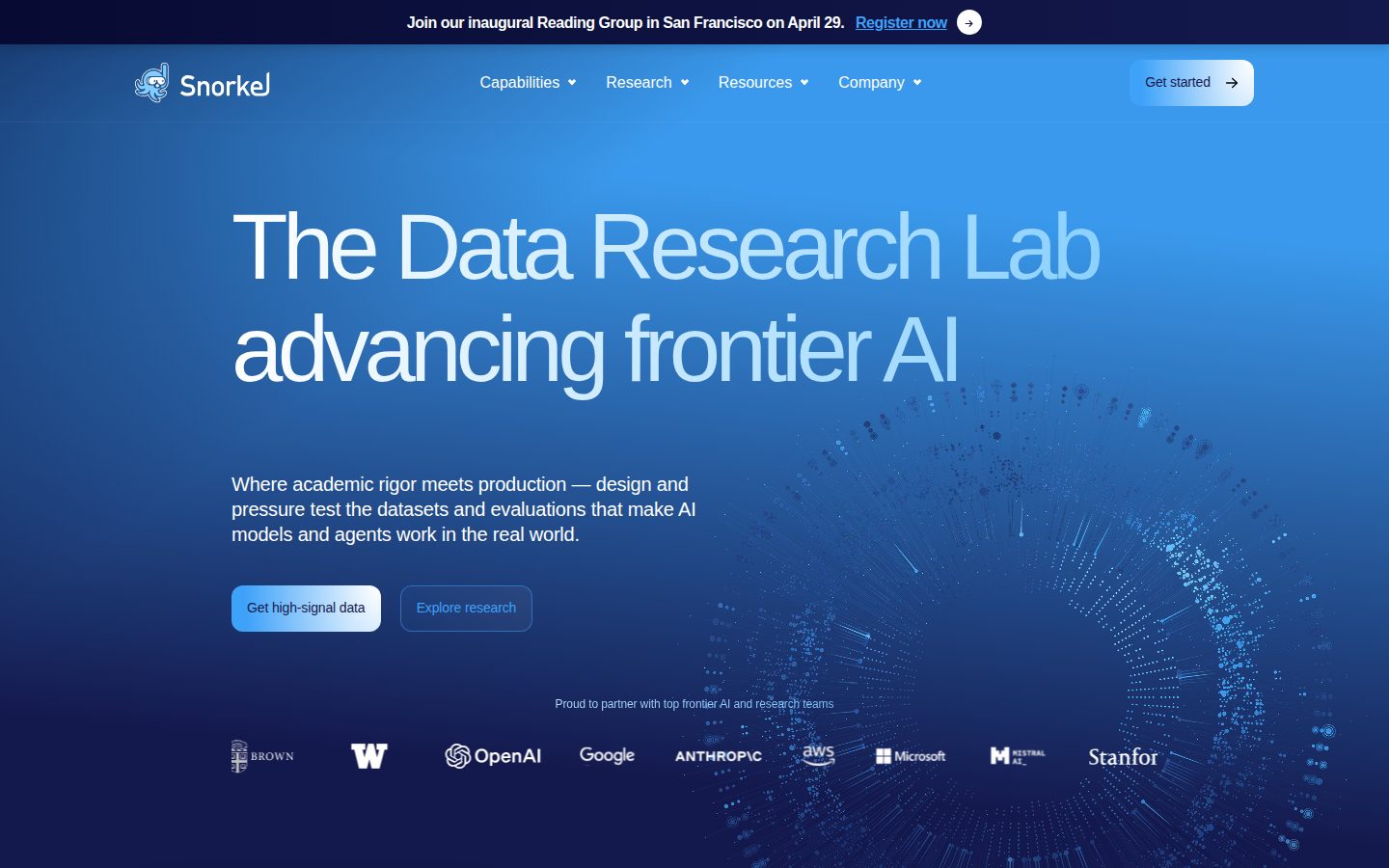
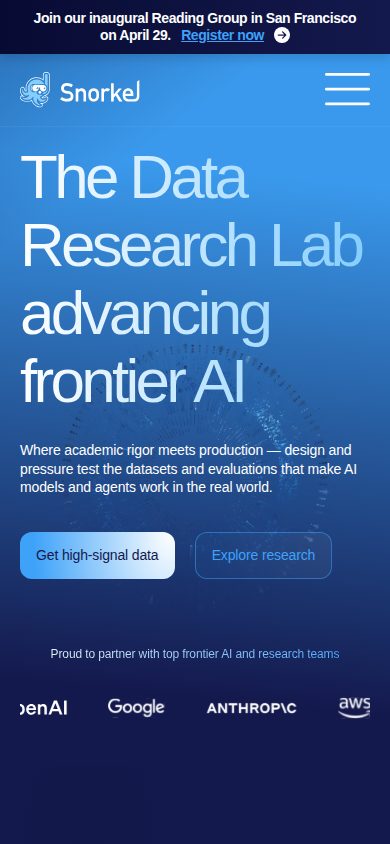
Snorkel AI desktop previewSnorkel AI mobile preview

Pricing Plans

Popular

Enterprise

Contact sales

Custom enterprise plan for Fortune 500 companies, frontier AI labs, and large organizations with dedicated data science teams needing programmatic data labeling, custom dataset development, and AI model training at scale. Pricing is not publicly listed and requires direct engagement with the Snorkel AI sales team for a tailored quote. Based on AWS Marketplace listings and industry estimates, entry-level contracts start around $50,000–$60,000/year, with larger deployments reaching six figures or more annually.

  • Snorkel Flow: programmatic data labeling and weak supervision platform
  • Custom dataset and eval development for frontier AI models
  • Curriculum-structured datasets with rubrics, reviewer guidance, and difficulty tiers
  • Bespoke benchmark expansions targeting specific model failure surfaces
  • Custom AI agents evaluated in real workflows with ROI-tied pass/fail criteria
  • Expert-curated data services (domain experts, including PhDs)
  • Deployment options: hosted cloud or on-premise/customer cloud
  • Integrations with Dask, Kubernetes, and TensorFlow
  • Programmatic labeling functions for text, image, and video data
  • Data versioning, auditing, and provenance tracking
  • Professional services and white-glove support
  • Compliance-friendly in-house data labeling (no external annotators required)

AI Panel Reviews

The Decision Maker

The Decision Maker

Strategic bet, vendor viability, timing, adoption approval
8.2/10

Snorkel AI sells programmatic data labeling to enterprise buyers, but it is a six-figure commitment.

A Stanford-born platform that replaces manual annotation with code-driven labeling. The catch is opaque enterprise-only pricing.

BNY, Wayfair, Chubb, the U.S. Air Force. That customer list is the real signal here, because Snorkel AI sells to buyers who run their own vendor reviews and still picked it.

The vendor question is solid. Spun out of the Stanford AI Lab in 2019, Snorkel closed a $100M Series D in May 2025 at a $1.3B valuation, with $237M raised total. Snorkel Flow turns labeling into Python functions instead of armies of annotators, and Expert-in-the-Loop Review keeps a calibrated human check on quality. Scale AI is the obvious rival, but it leans on outsourced labelers that Snorkel deliberately avoids.

The catch is the buy-in. There is no published price, and AWS Marketplace listings suggest entry contracts near $50,000 a year. This is an enterprise sale, not a swipe-the-card pilot. Run a scoped data project with one ML team for a quarter before committing a budget line.

Competitive Positioning8.0

A distinct in-house, code-driven alternative to Scale AI's outsourced-annotator model.

Reputation Risk8.5

BNY, Wayfair, Chubb and the U.S. Air Force as customers make this an easy board defense.

Speed to Value7.5

Labeling functions cut dataset time, but enterprise onboarding and data project scoping take real ramp.

Strategic Fit8.0

Programmatic labeling advances ML output rather than just trimming annotation cost.

Vendor Viability8.5

A 2019 Stanford spinout with $237M raised and a $1.3B Series D valuation in May 2025.

Pros

  • Strong customer base including BNY, Wayfair, Chubb and the U.S. Air Force.
  • Well-funded with $237M raised and a $1.3B valuation as of May 2025.
  • Snorkel Flow replaces manual annotation with reusable Python labeling functions.
  • Compliance-friendly in-house labeling avoids external annotators handling sensitive data.

Cons

  • No published pricing; entry contracts reportedly start near $50,000 a year.
  • Enterprise-only sales motion offers no cheap path to evaluate the platform.
  • Writing labeling functions assumes in-house data science skill that smaller teams lack.

Right for

Enterprise AI teams who build large supervised-learning datasets at scale.

Avoid if

Small teams who need cheap annotation without a six-figure contract.

The Domain Strategist

The Domain Strategist

Craft and strategy in the product's domain — adapts identity per category, same lens
8.2/10

Snorkel AI turns data labeling into programmatic infrastructure, but the engagement model is consultative, not self-serve.

Snorkel AI replaces manual annotation with programmatic labeling functions and rubric-guided pipelines for frontier model teams. For an ML platform owner picking a data substrate through 2029, the strategic call is process depth versus a custom-quote relationship.

An ML platform owner buying Snorkel AI is choosing how training data gets manufactured for years, and the architecture is the right bet. Programmatic Quality Control encodes domain expertise as versioned labeling functions and automated verifiers, so quality lives in code rather than headcount you rehire. Rubric Design pins down IO contracts and scoring before a single label is written — discipline that signals a team out of the Stanford AI Lab.

The process layer is where the craft sits. Expert-in-the-Loop Review pairs PhD reviewers with automated checks, and Failure and Disagreement Analysis closes coverage gaps the way Scale AI's pure-annotation model structurally can't. Founded in 2019 and backed by a $100M Series D at a $1.3B valuation, Snorkel is a durable bet.

But the catch is the engagement shape. There's no public pricing and no free tier — entry contracts start near $50,000/year and run consultative, so this is a strategic partner, not a tool you spin up in a sprint.

Category Positioning8.2

Sits ahead of pure-annotation vendors by owning the data-centric process layer for frontier model teams.

Domain Fit8.3

Rubric Design and Failure and Disagreement Analysis match how senior ML teams actually close coverage gaps.

Integration Surface7.6

Dask, Kubernetes, and TensorFlow integrations plus on-prem deployment fit enterprise ML stacks cleanly.

Long-term Implications8.0

Encoding labeling logic as versioned code creates a durable asset, though the consultative model deepens vendor reliance.

Strategic Depth8.5

Programmatic labeling functions and rubric-guided pipelines are genuine weak-supervision craft, not a checklist.

Pros

  • Programmatic labeling functions turn annotation quality into versioned, reusable code.
  • Rubric Design enforces IO contracts and scoring before labeling begins.
  • Expert-in-the-Loop Review pairs PhD reviewers with automated verifiers for high precision.
  • On-prem deployment keeps sensitive data in-house with no external annotators.

Cons

  • No public pricing and no free tier; every engagement needs a sales conversation.
  • Entry contracts near $50,000/year put it out of reach for small teams.
  • Consultative model means slower onboarding than a self-serve labeling tool.

Right for

ML platform teams who manufacture large training datasets at frontier scale.

Avoid if

Small teams who need a self-serve labeling tool with transparent pricing.

The Finance Lead

The Finance Lead

Money, total cost of ownership, contracts, procurement math
7.6/10

Snorkel AI ships no commercial price and the data-services line is the one finance underbudgets.

Snorkel Flow is quote-only, with an AWS Marketplace contract listed at $60,000 a year. Expert-curated data services bill on top of the platform and rarely fit a fixed forecast.

Snorkel AI publishes nothing commercial. The platform sells through sales. AWS Marketplace lists a 12-month Snorkel Flow contract at $60,000, and entry deals land near $50K-$60K/year. Larger deployments cross six figures fast.

TCO math. The Snorkel Flow license is only part of the bill. Expert-curated data services — domain PhDs reviewing your data — price per engagement, not per seat, so the dataset-development scope drives the real number. A free tier exists for evaluation but no trial converts cleanly to a quote. Compare Scale AI, which also negotiates per project; Snorkel at least keeps labeling in-house, which trims a compliance cost.

Snorkel raised an $85M Series C in 2021 at a $1B valuation, so vendor risk is low. However, every quote needs a sales call and a scoped data engagement, so model the services spend before the platform sticker.

Billing & Procurement7.0

AWS and Google Cloud Marketplace listings ease procurement, but every quote still requires direct sales engagement.

Contract Flexibility7.3

Hosted or on-prem deployment is offered, but every deal is custom and scoped through sales.

Pricing Transparency6.0

No commercial price is published; only an AWS Marketplace listing at $60,000 hints at a floor.

ROI Clarity8.2

Rubric-Guided Labeling Pipelines and Failure and Disagreement Analysis tie data spend to measurable model coverage gaps.

Total Cost of Ownership7.0

Expert data services bill per engagement on top of the Snorkel Flow license, making year-3 cost hard to forecast.

Pros

  • AWS and Google Cloud Marketplace listings give procurement a known entry contract near $60,000.
  • In-house expert labeling avoids external annotators, trimming a real compliance cost.
  • Rubric Design and Programmatic Quality Control tie data spend to measurable model coverage.
  • An $85M Series C at a $1B valuation keeps vendor risk low.

Cons

  • No commercial price is published anywhere; every tier requires a sales call.
  • Expert data-services engagements bill separately and are hard to forecast at year 3.
  • No self-serve plan exists for small teams below the six-figure budget range.

Right for

Enterprise AI teams who need programmatic labeling at scale.

Avoid if

Small teams who want a fixed, self-serve price.

The Domain Practitioner

The Domain Practitioner

Daily hands-on reality in the product's domain — adapts identity per category, same lens
7.8/10

Snorkel Flow makes labeling functions code-reviewable, but there is no door in under a five-figure contract.

Snorkel Flow lets data scientists write Python labeling functions instead of hand-annotating, and weak supervision resolves the disagreements. But there is no free tier, so a solo practitioner cannot test it.

A data scientist's day-three test isn't the labeling demo — it's whether labeling functions hold up as the schema drifts under them. Snorkel Flow lets you write Python functions that encode heuristics, then a label model resolves their disagreements into probabilistic training labels. Weak supervision, the technique this 2019 Stanford AI Lab spinout is named for.

Workflow fit is genuine for Python-native teams. Integrations with Dask, Kubernetes, and TensorFlow mean labeling functions run where the pipeline already lives, and the functions are version-controlled and code-reviewable like any other module. Snorkel Evaluate, GA since May 2025, adds programmatic evaluation and meta-evaluation for LLM and RAG systems. Scale AI leans on external human annotators; Snorkel keeps labeling in-house and auditable.

The catch is the entry door. There's no free plan and no self-serve tier — AWS Marketplace listings put entry contracts near $50,000 a year. The platform assumes a dedicated data science team, so a solo practitioner can't kick the tires.

Day-3 Reality8.0

Labeling functions are version-controlled Python, so they survive schema drift better than re-annotation.

Documentation Practitioner-Fit7.5

A versioned User Guide (v25.5) exists, but docs and access sit behind enterprise gating.

Friction Surface7.0

No self-serve onboarding means every evaluation starts with a sales engagement, not a sandbox.

Power-User Depth8.3

Meta-evaluation, failure-and-disagreement analysis, and custom evaluators give advanced teams real depth.

Workflow Integration8.2

Dask, Kubernetes, and TensorFlow integrations let labeling run inside an existing ML pipeline.

Pros

  • Labeling functions are Python, so they version-control and code-review like normal modules.
  • Weak supervision scales labeling without hiring external annotators or shipping data out.
  • Dask, Kubernetes, and TensorFlow integrations fit existing ML pipelines.
  • Snorkel Evaluate adds programmatic LLM and RAG evaluation beyond generic metrics.

Cons

  • No free plan or self-serve tier — every trial runs through sales.
  • Entry contracts near $50,000 a year price out small teams and individuals.
  • The platform assumes a dedicated data science team to operate it.

Right for

Data science teams who build large supervised datasets without external annotators.

Avoid if

Solo practitioners who want to test a tool before a sales call.

The Power User

The Power User

Daily human experience, onboarding, polish, learning curve, reliability
7.6/10

Snorkel AI replaces manual labeling with code, but the door is enterprise-only.

Snorkel Flow turns labeling functions into training data without an army of annotators. There is no free tier and no public price, which is the catch.

The first thing you notice is the wall. No free plan, no trial number on the page, just a Request dataset samples button and a sales form. For a tool spun out of the Stanford AI Lab in 2019, that is a confident bet that you already know you need it.

What earns its keep is Snorkel Flow, where you write Python labeling functions instead of clicking through rows one at a time. Combine enough of them and a labeled set appears at a scale manual annotation cannot touch. Scale AI sells you human annotators; Snorkel sells you the code that makes them mostly unnecessary.

The catch is the entry point. AWS Marketplace listings put contracts around $50,000 a year, so this is a procurement decision, not a Tuesday signup. Month three a trained data team moves fast here. The first month is real homework.

Daily Polish7.5

Snorkel Flow and rubric-guided pipelines are carefully built, though the public site leans more marketing than product detail.

Learning Curve7.4

Writing labeling functions in Python is real upfront work, but a trained data team scales fast by month three.

Mobile Parity7.5

Mobile is not a use case for a data-labeling platform, scored neutral.

Onboarding Experience6.8

No trial or self-serve path means the first ten minutes is a sales form, not the product.

Reliability Feel7.8

Data versioning, auditing, and provenance tracking plus on-prem deployment signal a platform built for serious workloads.

Pros

  • Programmatic labeling functions generate training data at a scale manual annotation cannot reach.
  • Strong Stanford research pedigree and enterprise features like data versioning and provenance tracking.
  • On-premise and customer-cloud deployment keeps sensitive labeling data fully in-house.
  • Expert-in-the-loop review pairs automation with calibrated human reviewers for quality control.

Cons

  • No free plan, no trial, and no public pricing means you cannot evaluate before a sales call.
  • Entry contracts near $50,000 a year put it out of reach for individuals and small teams.
  • Writing labeling functions is a real learning curve that first-month users will feel.

Right for

Enterprise AI teams who label training data at large scale.

Avoid if

Solo developers who want to try a tool before talking to sales.

The Skeptic

The Skeptic

Contrarian. Watch-outs, deal-breakers, broken promises, category patterns
7.6/10

Snorkel AI quietly became a data-services company, and a $1.3B valuation says the bet is real.

Founded in 2019 out of the Stanford AI Lab, Snorkel AI raised a $100M Series D in 2025 at a $1.3B valuation. The catch is opacity: pricing is contact-only and estimated entry contracts run $50,000 or more annually.

Watch what a vendor sells, not what it pitched. Snorkel AI started as programmatic labeling software. The current homepage sells expert datasets and evaluation as a service. That pivot is the tell — and not a bad one. Open-source roots from 2019, a $100M Series D in 2025 at a $1.3B valuation, backed by Greylock and Lightspeed.

The evidence holds up. Snorkel Flow still ships weak supervision and labeling functions, and the newer Rubric-Guided Labeling Pipelines pair automated checks with calibrated human experts. Real capabilities, not roadmap slides. But the moat is the worry — Scale AI owns the frontier-lab data contracts, and Labelbox sells annotation cheaper.

The yellow flag is exit portability. Bespoke datasets and evaluation frameworks are built around your failure surface, so leaving means losing curation work, not just files. No public pricing; AWS Marketplace estimates put entry contracts near $50,000 a year. Credible vendor. Just scope the engagement before you commit.

Competitive Differentiation7.4

Programmatic labeling plus expert-in-the-loop review is a real gap, but Scale AI and Labelbox crowd the data-services space.

Exit Portability6.9

Bespoke datasets and custom evaluation frameworks are built around your failure surface, so migration loses curation work.

Long-term Viability8.0

A $100M Series D at a $1.3B valuation with Greylock and Lightspeed backing signals a credible three-year bet.

Marketing Honesty7.5

Homepage leans on superlatives like highest quality, but the named pipelines and process steps are concretely described.

Track Record Match7.8

Founded 2019 from the Stanford AI Lab with a 2025 Series D — a pattern that matches surviving infrastructure vendors.

Pros

  • Strong funding signal: $100M Series D in 2025 at a $1.3B valuation with durable backers.
  • Snorkel Flow programmatic labeling reduces dependence on slow, expensive manual annotation.
  • Rubric-Guided Labeling Pipelines pair automated checks with calibrated human experts for quality control.
  • On-premise and customer-cloud deployment options suit compliance-sensitive enterprises.

Cons

  • No public pricing; estimated entry contracts start near $50,000 per year.
  • Bespoke datasets and evaluation frameworks make exit portability weak.
  • Scale AI and Labelbox compete directly in the data-services market.

Right for

Enterprise ML teams who need bespoke training and evaluation datasets at scale.

Avoid if

Small teams who want a cheap self-serve annotation tool.

Buyer Questions

Common questions answered by our AI research team

Features

What's included in a custom dataset development engagement?

Custom data development builds bespoke datasets, evals, and benchmark expansions targeting the exact failure surface you need to close, for when off-the-shelf coverage runs out.

Setup

Can I request sample datasets before committing?

Yes, dataset samples can be requested via the 'Request dataset samples' option available on the homepage.

Features

How does Snorkel handle edge-case coverage in training data?

Edge-case coverage is listed as one of Snorkel's proprietary process design choices, alongside calibrated expert review, rubrics, programmatic checks, and adjudication.

Features

Are specialized agents evaluated against custom rubrics?

Yes, specialized agents are evaluated against task-specific rubrics and programmatic pass/fail criteria tied to environment-grounded tasks, not generic benchmarks.

Product Information

  • Company

    Snorkel AI
  • Founded

    2019
  • Pricing

    Contact for pricing
  • Free Trial

    Available

Platforms

web

About Snorkel AI

Snorkel AI is a Redwood City-based AI data development platform that uses programmatic labeling and expert feedback to build specialized datasets for LLMs and enterprise models.

Resources

Documentation
Blog

Also in AI Data Tools