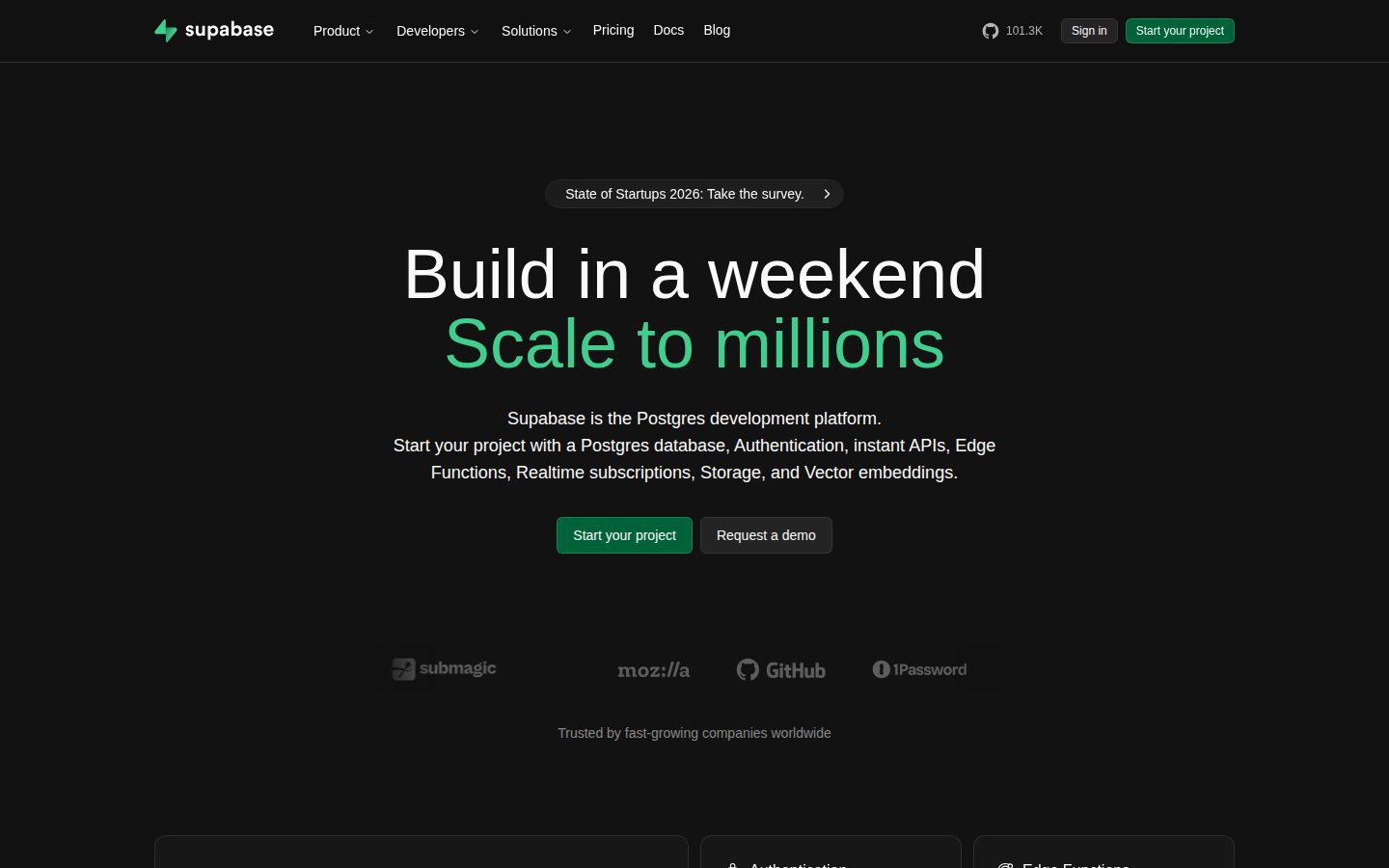
Supabase is a backend-as-a-service (BaaS) platform that bundles a set of open source tools around a PostgreSQL database. It is aimed at developers and engineering teams who need to build and ship applications without investing heavily in backend infrastructure. By combining a relational database with pre-built services, Supabase reduces the time required to go from idea to production.
The core of Supabase is a fully managed PostgreSQL database, which distinguishes it from competitors that use proprietary NoSQL stores. On top of that, it offers auto-generated RESTful and GraphQL APIs derived directly from the database schema, allowing frontend developers to query data without writing backend code. Additional services include row-level security for fine-grained access control, real-time data subscriptions over WebSockets, and a built-in authentication system supporting email/password, magic links, and OAuth providers.
Supabase also includes object storage for managing files and assets, as well as edge functions for running server-side logic closer to users. A web-based dashboard provides a SQL editor, table editor, log viewer, and project management tools, making it accessible to developers who prefer a GUI alongside those who work directly with SQL.
In the market, Supabase competes primarily with Google Firebase and AWS Amplify. Its main differentiator is the use of PostgreSQL and a commitment to open source licensing, which allows teams to self-host the entire stack if needed. This appeals to organizations with data residency requirements or those who want to avoid vendor lock-in.
Supabase offers a free tier suitable for hobby projects and early-stage development, with paid plans that scale based on usage and project needs. It is widely used by individual developers, startups, and teams building web and mobile applications across a broad range of industries.

Native support for vector operations and similarity search using pgvector extension for AI applications.
Web-based dashboard with real-time metrics, query performance insights, and application logging.
Triggers HTTP requests to external services when database events occur, enabling automated workflows.
Automatically generates RESTful and GraphQL APIs based on your database schema without additional configuration.
Serverless TypeScript functions that run close to users for custom business logic and API endpoints.
Provides S3-compatible object storage for handling file uploads, downloads, and media management.
Provides a fully managed PostgreSQL database with built-in optimizations and scaling capabilities.
Enables real-time data synchronization across clients with WebSocket-based subscriptions to database changes.
Built-in SQL editor with syntax highlighting and query execution for direct database manipulation.
Official SDKs for JavaScript, Flutter, Swift, and Kotlin to build cross-platform applications.
Implements PostgreSQL's native row-level security to control data access at the database level.
Offers comprehensive authentication with support for email/password, OAuth providers, and row-level security policies.
Perfect for hobby projects and getting started
For production applications with higher usage
For teams collaborating on multiple projects
For large-scale applications with custom requirements
Supabase hit $5B in October 2025 — the market just confirmed Postgres won the Firebase argument.
“Accel led a $200M Series D at $2B in April 2025, then $100M more landed at a $5B valuation four months later. Pro at $25/month and pgvector for embeddings make this a real bet for teams done arguing about Firebase.”
Five billion. That's Supabase's October 2025 valuation after Accel led a $200M Series D at $2B in April, then $100M more came in four months later. The market just told you Postgres won the BaaS argument Firebase used to own.
Paul Copplestone and Ant Wilson founded this in 2020. The platform ships pgvector for embeddings, Row Level Security at the database layer, and Edge Functions for serverless logic. Pro is $25/month per project. The free tier covers 500MB and 50,000 monthly active users — bottoms-up adoption isn't faked here.
But the jump from Pro at $25 to Team at $599 is steep, and the AI-workload pricing this round funds hasn't fully shipped. Run one production app on Pro for 90 days. If row-level security holds and the meter behaves, standardize. If not, you've spent $75.
Firebase still wins mobile-first shops, but Postgres-first teams now default to Supabase rather than rolling their own.
OpenAI and Hugging Face logos on the homepage make this an easy board defense in 2026.
Auto-generated APIs, pre-built auth, and the free 500MB tier mean a working backend in hours, not sprints.
Postgres-first advances most engineering directions rather than just saving cost on a Firebase line item.
Series D ($200M at $2B) plus Series E ($100M at $5B) four months later signals durable backing from Accel, Coatue, and Felicis.
Teams building Postgres-backed apps who want managed auth, storage, and real-time without running infrastructure.
Solo developers who only need a key-value store and a free tier forever.
“Supabase has become our go-to for rapid prototyping and even several production services. It's remarkably developer-friendly while maintaining the robustness we need at scale.”
I've been using Supabase across multiple projects for the past year, and it's transformed how quickly we can ship features. The managed Postgres with built-in auth, real-time subscriptions, and edge functions means my team spends less time on infrastructure and more time building. The postgres-first approach gives us confidence - we're not locked into proprietary query languages.
What really sold me was watching our junior developers become productive within days. The dashboard is intuitive, the TypeScript SDK is excellent, and the automatic API generation from database schemas saves weeks of work. Performance has been solid even as we've scaled to hundreds of thousands of users on our main app.
Postgres at the core with read replicas and connection pooling handles our load well, though we've hit some limits with real-time subscriptions at scale.
The pace of feature releases is impressive - vector embeddings, edge functions, and auth improvements shipped exactly when we needed them.
Native Postgres means every tool works, plus their APIs integrate beautifully with our existing stack.
RLS policies are powerful once you master them, SOC2 compliance helps with enterprise clients, but we'd love more granular audit logging.
Discord community is incredibly helpful, enterprise support is responsive, but complex issues sometimes take longer than ideal.
Supabase closed a $5B Series E in October 2025 — the lock-in lives in the management plane, not Postgres.
“Supabase closed a $100M Series E at a $5B valuation in October 2025, four months after the $200M Series D at $2B. The strategic call for a CTO is which lock-in you'd rather own: a portable database with a proprietary control plane, or a fully proprietary BaaS like Firebase.”
Postgres is the part you don't lose. The Auth schema, Storage policies, and Realtime broker are the parts you do — and that's where the real CTO question lives. Lock-in for Supabase sits in the management plane, not the database itself.
Pro at $25 per project ships an 8GB Postgres with pgvector, Edge Functions, and Row Level Security policies running inside the database. The October 2025 Series E at $5B — led by Accel and Peak XV, four months after the $200M Series D — buys roadmap confidence for a 3-year commitment.
But versus Firebase, you're trading a proprietary BaaS for a portable database plus a proprietary control plane. Versus Neon plus Clerk plus Cloudflare Workers, you trade integration speed for fewer vendors to replace. The 3-year call is which lock-in you'd rather own.
The open-source Firebase alternative is a clear lane and the $5B Series E in October 2025 confirms the seat.
Matches how senior engineers think about data — relational schema, SQL, RLS, portable skills across teams.
Official SDKs for JavaScript, Flutter, Swift, Kotlin plus CLI tooling for GitHub Actions, Vercel, and Netlify.
Postgres is the portable part; the Auth, Storage, and Realtime management plane is the real 3-year lock-in.
Real Postgres underneath with pgvector and Row Level Security at the database layer, not application middleware.
CTOs who want their backend dependency to be Postgres.
Teams who prefer a single proprietary BaaS like Firebase.
“After a year of building production apps with Supabase, it's become my go-to for projects that need auth, realtime features, and a Postgres database without the DevOps overhead. The developer experience is stellar, though debugging complex queries can sometimes be frustrating.”
I've been using Supabase daily since we migrated our main product from Firebase. The JavaScript SDK just clicks - auth flows that used to take days now take hours. Row Level Security was confusing at first, but once it clicked, it's incredibly powerful for multi-tenant apps.
What really won me over is the realtime subscriptions. We built a collaborative feature in two days that would've taken weeks before. The auto-generated APIs from your database schema feel like magic, though sometimes I wish I had more control over the exact shape of responses.
My biggest gripe? When complex RLS policies fail, the error messages can be cryptic. I've lost hours debugging why a query returns empty when it's actually a permissions issue.
The docs are comprehensive with great examples, and the API reference is auto-generated from your actual schema.
Discord is active and helpful, though finding solutions to edge cases sometimes requires digging through GitHub issues.
Query logs are helpful but RLS debugging is painful - error messages often don't tell you which policy failed.
The SDK is intuitive, TypeScript support is first-class, and the CLI tools are solid.
Queries are fast, realtime is snappy, but connection pooling limits on lower tiers can bite you in production.
“Supabase has become our go-to backend for marketing tools and data management. While it's more technical than typical marketing platforms, the flexibility and real-time capabilities have transformed how we handle customer data and analytics.”
I'll admit, when our engineering team first suggested Supabase for our marketing infrastructure, I was skeptical. But over the past year, it's become invaluable for powering our data-driven campaigns. We use it to store customer interaction data, build custom dashboards, and even power some of our interactive marketing experiences.
The real-time subscriptions have been game-changing for live campaign monitoring. During product launches, I can watch engagement metrics update instantly. The auth system simplified our gated content strategy too.
The learning curve was steep initially - this isn't your typical marketing tool. But once we got comfortable with SQL queries and the dashboard, we could build exactly what we needed without waiting for IT tickets.
Not built for campaigns specifically, but we've created powerful custom solutions on top of it.
Discord community is incredibly helpful, though enterprise support response times vary.
Requires technical knowledge, but the UI has improved significantly and documentation is excellent.
The API is fantastic - we've connected it to everything from Zapier to our CDP.
Building custom analytics dashboards with real-time data has given us insights we couldn't get elsewhere.
“Supabase has been a game-changer for our development costs - we've cut our database infrastructure spending by 70% while actually improving performance. The transparent pricing and generous free tier made it easy to justify the switch from our previous setup.”
I've been using Supabase for our internal tools and customer-facing applications since we migrated from AWS RDS last year. The financial impact has been remarkable - our monthly database costs dropped from $3,200 to under $1,000 while supporting 3x more users. What really sold me was the predictable pricing model. Unlike AWS where I'd get surprise bills from data transfer or IOPS, Supabase's pricing is straightforward: you pay for compute, storage, and bandwidth. Period. The free tier handled our development environments perfectly, saving us another $500/month. My only gripe is that enterprise features like SOC2 compliance reports require custom pricing discussions, which made budgeting tricky during our security audit season.
Clean monthly invoices, but lacks purchase order support which our procurement team needs.
Month-to-month billing with instant scaling, but annual contracts only offer 10% discount.
Their pricing calculator accurately predicted our costs within 5% - no hidden fees or surprise charges.
Usage dashboard makes it easy to track costs per project, though I wish it integrated with our BI tools.
Eliminated need for separate auth service, real-time infrastructure, and reduced DevOps overhead by 60%.
Supavisor and pgvector make Supabase usable past prototype, but the 8GB Pro ceiling forces an early upgrade.
“Built on real PostgreSQL with pgvector and HNSW indexing for embeddings, Supabase fits AI workloads that PlanetScale can't touch. The catch is the 8GB Pro database cap and a connection pooler that becomes a daily concern once you scale past the demo.”
Supavisor is the first thing an Engineer notices that other Firebase clones skip. Connection pooling for serverless workloads is the difference between a side project surviving a Hacker News spike and one throwing 'too many connections' at the worst moment.
The pgvector extension with HNSW indexing matters more than the marketing site suggests. Storing 1536-dimension embeddings next to relational data, querying both in one SQL statement — PlanetScale can't do that, Firebase doesn't pretend to. For RAG prototypes, real workflow win.
However, the 8GB database cap on the $25/month Pro tier hits sooner than expected once embeddings scale, forcing compute add-ons or a Team jump to $599. Docs read like engineers wrote them — CLI examples first, screenshots last — and an $80M Series C in September 2024 means the roadmap probably ships.
Works well daily for CRUD plus auth, but RLS debugging is a known friction once policies stack.
Docs lead with CLI examples and SQL snippets rather than marketing screenshots.
Cryptic RLS errors and a connection pooler you have to think about add real daily friction at scale.
Raw SQL access, Postgres extensions, and a self-host option give power users an escape hatch.
Postgres, auth, storage, edge functions, and pgvector cohere under one CLI and dashboard.
Engineers building AI-aware apps who want PostgreSQL with pgvector under one platform.
Teams whose database exceeds 8GB and cannot justify the Team tier.
“Supabase has been a game-changer for our team's projects. It's surprisingly easy to get a full backend running, though there are occasional rough edges that remind you it's still evolving.”
I've been using Supabase daily for about 14 months now, and it's become my go-to for any project that needs a database and auth. The magic is how quickly I can spin up what used to take weeks - database, authentication, real-time subscriptions, all ready in minutes. The dashboard is clean and intuitive, and I love being able to write SQL directly when I need to.
What really sold me was the developer experience. Everything just works together - the JS client is a joy to use, and features like Row Level Security finally make sense. Sure, I've hit some documentation gaps and the occasional service hiccup, but the team is responsive and things keep getting better. For the price, especially on the free tier, it's incredible value.
The dashboard is intuitive and the client libraries make development feel effortless.
The dashboard isn't really mobile-optimized, but I rarely need it on phone anyway.
Quick project setup with helpful templates, though some advanced features took digging to understand.
Generally solid, but I've experienced a few unexpected downtimes and slow query responses during peak times.
The free tier is generous enough for real projects, and paid tiers are very reasonable.
“Supabase promised to be the Firebase killer, but after a year of production use, I'm exhausted from dealing with half-baked features and cryptic errors. The potential is there, but the execution keeps falling short.”
I jumped on Supabase early, excited about open-source Firebase with Postgres. For simple CRUD apps, it's fine. But push it harder and cracks show everywhere. Their auth system randomly throws 'refresh token expired' errors that take hours to debug. Database connections drop during migrations with zero warning. The realtime features work... until they don't, usually right when a client demos.
What kills me is their roadmap promises. Edge functions were 'coming soon' for 6 months. Row-level security is powerful but the UI makes it impossible to debug why queries fail. I've lost entire days to their documentation being out of sync with actual behavior.
I'm migrating to managed Postgres + Auth0. More setup, but at least things work predictably.
PlanetScale or Neon for database, Clerk for auth - more reliable, better DX.
Features stay in beta forever while new shiny things get announced.
Random auth failures and connection drops in production are unacceptable.
No proper migration tools, no connection pooling UI, no query performance insights.
Discord support means waiting hours for community guesses, paid support barely better.
Common questions answered by our AI research team
Supabase offers a Free tier (up to 500MB database, 50,000 monthly active users), Pro tier ($25/month per project with 8GB database, 100,000 MAU), and Team tier ($599/month with additional collaboration features). Costs scale based on database size, bandwidth usage, and monthly active users, with additional charges for storage beyond included limits.
Supabase's real-time subscriptions use PostgreSQL's native replication and can handle thousands of concurrent connections per project, while Firebase Realtime Database is optimized for smaller concurrent user counts but offers better global CDN performance. Supabase provides more granular real-time filtering with PostgreSQL queries, whereas Firebase offers simpler but more limited real-time data synchronization.
Supabase supports OAuth providers (Google, GitHub, Apple, Discord, etc.), magic links, phone authentication, and SAML SSO on higher tiers. Row Level Security (RLS) leverages PostgreSQL's built-in security model, allowing fine-grained access control with SQL policies that are enforced at the database level for strong data isolation.
Migration from Firebase involves recreating database schemas in PostgreSQL and rewriting queries from NoSQL to SQL, which can be complex depending on data structure. Supabase provides migration guides and database import tools, but the process typically requires manual schema design and data transformation since the underlying database models differ significantly.
Supabase provides official JavaScript/TypeScript SDKs with specific support for React, Vue, Svelte, and React Native, plus community SDKs for other frameworks. It integrates well with CI/CD pipelines through GitHub Actions, Vercel, and Netlify, with CLI tools for database migrations and project management automation.
Company
SupabaseFounded
2020Location
SingaporePricing
From $25/moFree Plan
AvailableSupabase is an open-source backend-as-a-service platform built on PostgreSQL, offering managed databases, authentication, storage, and realtime APIs.