Tabnine logo

Tabnine Review

Visit

AI code assistant with enterprise-grade privacy and context controls

Tabnine is an AI code assistant for software development teams that prioritizes security, compliance, and organizational context.

Tabnine·Founded 2013·From $9/moFree PlanFree TrialAI Coding ToolsAI Agents & AssistantsAI Security

AI Panel Score

8.0/10

6 AI reviews

Reviewed

AI Editor Approved

About Tabnine

Tabnine operates as a plugin inside popular IDEs, offering real-time inline code completions as developers type, as well as chat-based assistance for generating, explaining, and refactoring code. Developers interact with it the way they would any code completion tool, but can also invoke AI agents to handle multi-step tasks within the editor.

The website emphasizes what it calls the 'missing layer in enterprise AI': organizational context. Tabnine's Enterprise Context Engine is designed to ingest a company's own repositories, coding standards, and internal patterns so that suggestions reflect the team's specific conventions rather than generic public code. This is positioned alongside agentic capabilities, meaning the system can take multi-step actions, not just single completions. Tabnine has been recognized in the Gartner Magic Quadrant for AI Code Assistants as a Visionary.

Tabnine targets enterprise software teams and individual developers who require compliance controls, private model deployment options, and data isolation — differentiating it from tools like GitHub Copilot or Cursor that rely more heavily on cloud-processed inputs. Pricing includes a free tier and paid plans; the website lists public pricing. Competitors in the category include GitHub Copilot, Cursor, Codeium, and Amazon CodeWhisperer.

Tabnine supports deployment in air-gapped or private cloud environments for enterprises with strict data residency requirements. It integrates with a wide range of IDEs including VS Code, JetBrains IDEs, Visual Studio, and others, and supports multiple programming languages.

Features

AI

  • AI Chat

    Conversational coding assistance across the software development lifecycle.

  • Code Completions

    Generates multi-line code suggestions based on context and coding patterns.

Automation

  • CLI Workflows

    AI-powered coding and automation directly from the terminal.

Collaboration

  • Centralized Control Plane

    Granular access controls, policy enforcement, and full auditability across teams.

Customization

  • Enterprise Context Engine

    Maps organizational architecture, frameworks, and standards to deliver org-specific suggestions.

  • Multiple LLM Support

    Allows developers to select and use their preferred language model.

Integration

  • Multi-IDE Support

    Operates across VS Code, JetBrains IDEs, and other popular development environments.

Security

  • IP Protection & License Scanning

    Identifies potential copyright issues and ensures generated code complies with licenses.

  • Provenance & Attribution

    Tracks origins of code suggestions to minimize IP liability for generated output.

  • Zero Data Retention

    Code never leaves the user's infrastructure in air-gapped or on-premises deployments.

Preview

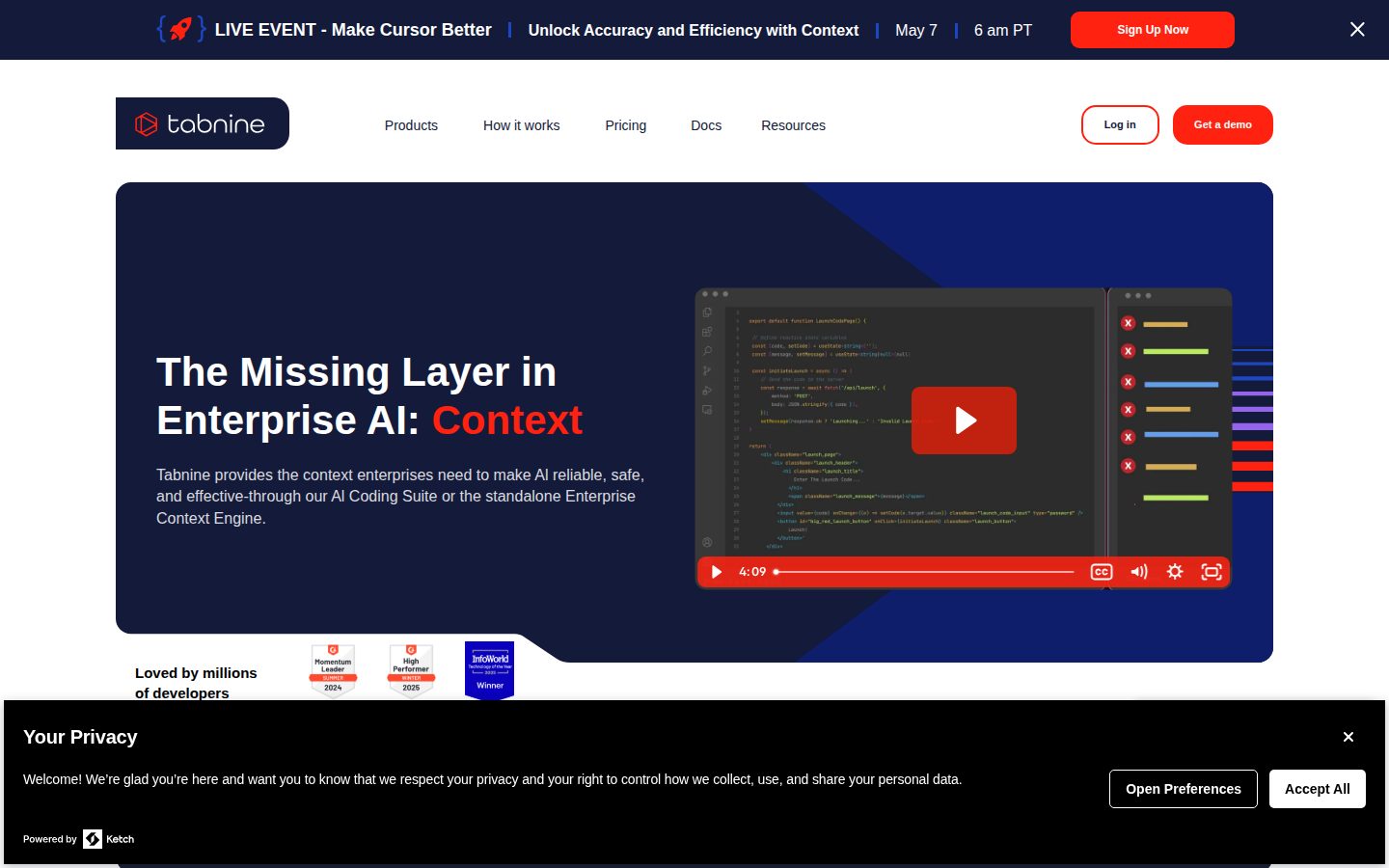
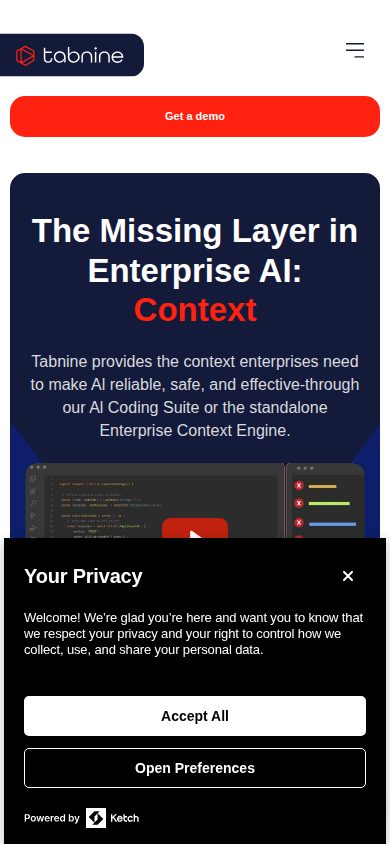
Tabnine desktop previewTabnine mobile preview

Pricing Plans

Tabnine Code Assistant

$39/monthly

Teams that want immediate productivity gains with AI code completions and chat, grounded in their codebase.

  • AI code completions for current line and full-function implementation
  • AI-powered chat in the IDE using leading LLMs (Anthropic, OpenAI, Google, Meta, Mistral)
  • Works in all major IDEs
  • Flexible deployment: SaaS, VPC, on-premises, or air-gapped
  • Zero code retention and no training on your code
  • Enterprise-grade compliance (GDPR, SOC 2, ISO 27001)
Popular

Tabnine Agentic Platform

$59/monthly

Teams that want agentic workflows, integrated context engine, and autonomous AI agents on top of all Code Assistant features.

  • Everything in the Code Assistant Platform
  • Autonomous agents with optional user-in-the-loop oversight
  • Tabnine CLI for terminal-native agentic AI coding
  • Integrated Context Engine with unlimited codebase connections (GitHub, GitLab, Bitbucket, Perforce)
  • MCP integrations: Git, Jira, Confluence, Docker, CI/CD, and more
  • Upgradeable to the full Tabnine Context Engine

AI Panel Reviews

The Decision Maker

The Decision Maker

Strategic bet, vendor viability, timing, adoption approval
7.8/10

The privacy-first Copilot alternative that enterprises can actually defend to legal.

Tabnine wins on compliance posture where GitHub Copilot loses deals. At $39-59/seat, it's priced for teams that need air-gapped deployment and can't afford an IP lawsuit.

Gartner Visionary placement. Zero data retention. On-prem deployment. That's a specific value proposition, and it's a real one. Regulated industries — defense, finance, healthcare — have been sitting out the Copilot wave precisely because of data residency concerns. Tabnine built for that buyer.

The Enterprise Context Engine is the real differentiator. Generic suggestions are table stakes now. Codeium does them free. What Tabnine is selling at $59/seat is org-specific context plus IP Protection and License Scanning — the things your legal team will ask about the morning after you standardize on any AI coding tool.

The tradeoff: teams that don't have compliance constraints are probably happier with Cursor or Copilot on raw suggestion quality. Tabnine's moat is governance, not speed. If your team doesn't need that moat, you're paying a premium for features that won't change their daily output.

Competitive Positioning8.0

Tabnine owns the air-gapped enterprise segment that GitHub Copilot and Cursor can't credibly serve, which is a durable positioning advantage.

Reputation Risk8.5

Gartner Magic Quadrant placement and SOC 2 / ISO 27001 / GDPR compliance make this a defensible board-level choice.

Speed to Value7.5

Multi-IDE support and inline completions mean developers are productive on day one, but the Context Engine requires codebase indexing to deliver its full payoff.

Strategic Fit8.0

If compliance is a blocker for AI adoption, this advances the org; if it isn't, the Context Engine is the only differentiating strategic play.

Vendor Viability7.5

Long-standing player in AI coding — predates Copilot — with Gartner recognition, but no public funding data confirms current runway.

Pros

  • Zero data retention and air-gapped deployment — the only real answer to enterprise legal objections
  • IP Protection and License Scanning built in, not an add-on
  • Multiple LLM support at $39/seat lets teams pick models without renegotiating the contract
  • Gartner Visionary recognition gives board-level cover for the decision

Cons

  • No changelog visible — hard to verify shipping velocity against Copilot or Cursor
  • Raw suggestion quality likely trails Cursor for teams without strict compliance needs
  • $59/seat for agentic tier is competitive, but only if the Context Engine actually reduces rework

Right for

Enterprise teams in regulated industries where air-gapped deployment and IP liability controls are blockers to adopting any AI coding tool.

Avoid if

Your team has no compliance constraints and cares mainly about suggestion quality and editor experience.

The Domain Strategist

The Domain Strategist

Craft and strategy in the product's domain — adapts identity per category, same lens
8.2/10

Enterprise context engine and zero-retention deployment make Tabnine the compliance-first bet.

Tabnine's architectural differentiator is data isolation — air-gapped deployment, zero code retention, and IP provenance tracking that GitHub Copilot can't match at the infrastructure level. At $59/seat for the Agentic Platform, it's priced for teams where a compliance failure costs more than the tooling budget.

The Enterprise Context Engine is the load-bearing feature here. Ingesting your own repos, standards, and conventions via GitHub, GitLab, Bitbucket, and Perforce — then grounding completions in that organizational graph — is a fundamentally different architecture than Copilot's general-model approach. Someone designed this for regulated industries, not demos.

The multiple LLM support layer is smart infrastructure thinking. Letting teams swap between Anthropic, OpenAI, Google, and private hosted models means you're not locked into Tabnine's model bets. The lock-in lives in the Context Engine configuration and the Centralized Control Plane policies — which is acceptable because those are your artifacts, not theirs.

The tradeoff: Cursor wins on raw UX velocity for greenfield developers who don't have compliance constraints. If your engineering team is in a regulated vertical — fintech, healthcare, defense — Tabnine's Gartner Visionary recognition and SOC 2/ISO 27001 posture make it the defensible enterprise choice. If they aren't, you're paying for controls you won't use.

Category Positioning7.8

Gartner Visionary placement is accurate — Tabnine owns the compliance-first lane but hasn't closed the UX gap with Cursor or Copilot for developer experience scores.

Domain Fit8.0

Air-gapped deployment, Centralized Control Plane, and GDPR/SOC 2/ISO 27001 compliance match how regulated enterprise engineering orgs actually operate.

Integration Surface8.3

VS Code, JetBrains, Eclipse, CLI, plus MCP integrations for Jira, Confluence, and CI/CD covers most enterprise stack surfaces without forcing workflow changes.

Long-term Implications8.2

If you invest in the Context Engine, your org-specific patterns become a compounding asset — but migrating that context graph later carries real switching cost.

Strategic Depth8.5

Context Engine plus provenance tracking plus multi-LLM flexibility shows genuine systems thinking, not just a completion wrapper.

Pros

  • Zero data retention and air-gapped deployment is a genuine architectural moat vs. GitHub Copilot
  • Multiple LLM support prevents model-layer lock-in
  • IP Protection and License Scanning directly addresses legal exposure that most CTOs are now accountable for
  • Context Engine with unlimited codebase connections on the $59 plan is serious enterprise value

Cons

  • No public changelog — hard to assess release velocity and roadmap execution confidence
  • Raw developer UX still trails Cursor for teams without compliance requirements
  • $39-$59/seat pricing requires clear ROI narrative to pass procurement in cost-sensitive orgs

Right for

Enterprise engineering teams in regulated industries where data residency and IP liability are non-negotiable.

Avoid if

Your team has no compliance constraints and prioritizes raw coding speed over data isolation controls.

The Finance Lead

The Finance Lead

Money, total cost of ownership, contracts, procurement math
7.8/10

$39/seat base, zero data retention, enterprise context engine — rare combination at this price

Tabnine publishes two clear tiers: $39 and $59/seat monthly. Enterprise privacy controls at this price point are uncommon in the category.

$39/seat for Code Assistant, $59 for the Agentic Platform. Both visible without a sales call. 50 seats × $59 × 12 = $35.4K/year at the higher tier. Add 30% seat creep: year 3 lands near $46K. Compare to GitHub Copilot Business at $19/seat — same 50 seats runs $11.4K/year. Tabnine's premium is real. The question is whether zero data retention and the Enterprise Context Engine justify 3× the spend.

For regulated industries, the math shifts. Air-gapped deployment plus IP Protection and License Scanning plus SOC 2/ISO 27001 compliance can replace separate legal review costs. That's a legitimate offset. The Agentic Platform's unlimited codebase connections via GitHub, GitLab, Bitbucket, and Perforce have organizational value that Copilot doesn't match on context depth, based on their pricing page.

No published overage rates, no changelog visible in the evidence. Contract terms — auto-renewal windows, cancellation clauses — aren't public. That's the friction point. Procurement will ask. Budget for a legal review cycle.

Billing & Procurement7.2

Monthly billing model and public pricing reduce procurement friction, but missing contract terms add a legal review cycle.

Contract Flexibility6.5

Auto-renewal terms and cancellation conditions aren't published; procurement will hit a black box at signature time.

Pricing Transparency8.2

Two tiers, both priced publicly at $39 and $59/seat — no sales call required, rare for enterprise-positioned tools.

ROI Clarity7.5

IP Protection, License Scanning, and zero data retention create measurable risk offsets, but developer productivity lift isn't quantified publicly.

Total Cost of Ownership7.0

Sticker is clear but no published overage rates; seat creep at 30% pushes 50-seat year-3 cost to ~$46K at the $59 tier.

Pros

  • $39/$59 tiers fully public — no pricing theater
  • Zero data retention and air-gapped deployment included, not add-on priced
  • IP Protection and License Scanning address real legal liability
  • Multiple LLM support including private hosted models — unusual at this price

Cons

  • 3× the per-seat cost of GitHub Copilot Business at $19/seat
  • No published auto-renewal or cancellation terms
  • No changelog visible — hard to assess release velocity
  • ROI story relies on risk avoidance, not published productivity metrics

Right for

Regulated enterprise teams where data residency and IP liability justify a $39-$59/seat spend.

Avoid if

Budget-constrained teams under 20 seats where Copilot at $19/seat covers 80% of the need.

The Domain Practitioner

The Domain Practitioner

Daily hands-on reality in the product's domain — adapts identity per category, same lens
8.1/10

Enterprise privacy moat is real; $59 agentic tier is where the daily workflow lives

Tabnine's zero-data-retention and air-gapped deployment aren't marketing copy — they're structural differentiators for regulated engineering teams. The $39 base tier is table-stakes completions; the $59 Agentic Platform is where the actual day-three workflow takes shape.

The Enterprise Context Engine is the real bet here. Feeding your own repos, conventions, and patterns into completions means suggestions that don't fight your team's architecture. GitHub Copilot gives you the internet's coding habits. Tabnine gives you your team's. That's a meaningful gap for shops with established internal frameworks or proprietary SDKs.

The $59 Agentic Platform ships with CLI-native agentic workflows, MCP integrations into Jira, Confluence, and CI/CD, plus unlimited codebase connections to GitHub, GitLab, Bitbucket, and Perforce. No changelog in the public evidence, which is a quiet warning sign — changelog absence usually means the release cadence isn't something the team wants scrutinized.

VS Code and JetBrains coverage is solid. Multiple LLM support with bring-your-own-model is a genuine power-user unlock. The tradeoff: teams that don't have compliance pressure or internal context worth injecting are paying a premium over Cursor for features they won't use daily.

Day-3 Reality7.8

Context Engine and LLM flexibility give daily completions real organizational signal, but no changelog makes it hard to assess how fast rough edges get patched.

Documentation Practitioner-Fit7.0

Docs confirmed present but no changelog shipped publicly — suggests docs may be feature-oriented rather than workflow-oriented.

Friction Surface7.5

Multi-IDE support across VS Code, JetBrains, Eclipse, and CLI reduces setup friction, but the absence of an API surface limits scripting and custom toolchain hooks.

Power-User Depth8.4

Multiple LLM support, air-gapped deployment, Centralized Control Plane with policy enforcement, and unlimited codebase connections at $59 is a serious power-user stack.

Workflow Integration8.2

CLI workflows plus MCP integrations into Jira, Confluence, and CI/CD mean the tool lives in the engineer's actual stack, not just the IDE.

Pros

  • Zero data retention and air-gapped deployment are structurally enforced, not just policy promises
  • Enterprise Context Engine injects org-specific patterns — completions that know your codebase, not just GitHub's
  • $59 tier bundles CLI agents, MCP integrations, and unlimited repo connections — feature-dense for the price
  • Multiple LLM support including private hosted models is a genuine differentiator vs Copilot

Cons

  • No public changelog — hard to evaluate release velocity or how fast reported friction gets fixed
  • No API surface in the evidence means limited custom toolchain integration
  • Teams without compliance requirements or internal context to inject won't get full value over cheaper alternatives
  • $39 base tier is completions-only — the workflow-relevant features sit behind the $59 gate

Right for

Regulated enterprise engineering teams who need air-gapped deployment and want AI suggestions grounded in internal codebase conventions.

Avoid if

Small teams or individual developers with no compliance requirements — Cursor or Codeium will cover the completions workflow at lower cost.

The Power User

The Power User

Daily human experience, onboarding, polish, learning curve, reliability
8.1/10

Copilot for teams that can't let their code leave the building

Tabnine's privacy-first positioning is real, not marketing — air-gapped deployment and zero data retention are actual product features, not footnotes. At $39-$59/seat, it's priced for teams that know exactly why they need it.

The Enterprise Context Engine is the thing that separates Tabnine from GitHub Copilot in a meaningful way. Copilot is great until your legal team asks where your code is going. Tabnine's answer — on-premises, VPC, air-gapped, your call — is a real answer. IP Protection and License Scanning on top of that means someone actually thought about the liability side, not just the autocomplete side.

Daily feel is harder to read from the outside. No public changelog is a small red flag — teams that ship constantly tend to show their work. Multi-IDE support across VS Code, JetBrains, Eclipse, and CLI is solid breadth. The $59 Agentic Platform tier with Jira, Confluence, and CI/CD integrations looks genuinely useful for mid-size engineering orgs.

Mobile is a non-story here, which is fine — nobody's writing production code on their phone. The real tradeoff: if you're a solo dev or small team without compliance pressure, Cursor or Codeium probably feel snappier and cost less friction to set up.

Daily Polish7.2

No public changelog visible, which suggests either infrequent updates or poor communication of them — hard to feel the care in daily iteration.

Learning Curve7.8

Code completions are immediately discoverable; the Agentic Platform's CLI workflows and MCP integrations reward time investment but aren't obvious on day one.

Mobile Parity4.5

No mobile story — but this is an IDE plugin for developers, so it's an expected gap rather than a broken promise.

Onboarding Experience7.5

Plugin-based setup across major IDEs is a known quantity, but enterprise context configuration for the Context Engine will take more than 10 minutes for most teams.

Reliability Feel8.0

SOC 2, ISO 27001, GDPR compliance certifications suggest a team that takes infrastructure seriously, which usually correlates with stability.

Pros

  • Zero data retention and air-gapped deployment are real, not aspirational
  • IP Protection and License Scanning address legal risk Copilot largely ignores
  • LLM flexibility — Anthropic, OpenAI, Google, Meta, Mistral, or your own private model
  • Gartner Magic Quadrant Visionary recognition gives procurement teams something to point at

Cons

  • No public changelog makes it hard to trust the pace of improvement
  • $39-$59/seat is a real budget line — harder to justify without clear compliance need
  • Context Engine setup complexity isn't a weekend project for most teams

Right for

Enterprise engineering teams with compliance requirements who need AI coding assistance that stays inside their infrastructure.

Avoid if

You're a solo developer or small team without data residency constraints — Cursor or Codeium will feel faster to set up and cost less.

The Skeptic

The Skeptic

Contrarian. Watch-outs, deal-breakers, broken promises, category patterns
7.8/10

Five-year survivor in a graveyard category — and the privacy moat is real

Tabnine is one of the oldest names in AI coding assistance. The enterprise privacy story is specific and defensible, not marketing vapor.

Three tells I check first. One: no changelog visible — can't verify shipping cadence independently. Two: API listed as absent — limits extensibility vs. Copilot. Three: $39/seat base is steep against GitHub Copilot at $19 and Codeium's free tier. That pricing only holds if enterprise buyers are actively paying for the compliance story.

The compliance story is actually coherent. Zero Data Retention, air-gapped deployment, IP Protection and License Scanning, Provenance and Attribution — these aren't vague promises. They're named, specific, purchasable features. Gartner Visionary placement is a yellow flag — not a green one — but it confirms category legitimacy. Multiple LLM Support is a real differentiator; most competitors lock you to one model.

Tradeoff worth naming: if your team doesn't have a legal or compliance forcing function, Cursor or Copilot beat Tabnine on UX and ecosystem momentum. The $59 Agentic tier competes directly with Cursor, which has stronger public developer traction. The moat is narrow but real — regulated industries, air-gap requirements, IP-sensitive codebases. That's a defensible wedge.

Competitive Differentiation8.2

Air-gapped deployment and IP licensing controls are absent from GitHub Copilot and Cursor — this is a specific, purchasable gap, not a positioning claim.

Exit Portability7.2

IDE plugin model means switching costs are low mechanically, but the Enterprise Context Engine's codebase indexing creates moderate organizational lock-in over time.

Long-term Viability7.0

No public funding data visible, no changelog to verify cadence — Gartner placement is encouraging but the absence of public shipping signals is a watch item.

Marketing Honesty7.5

'Missing layer in enterprise AI' is aspirational framing, but the underlying features — Zero Data Retention, Provenance and Attribution — are specific and verifiable on the pricing page.

Track Record Match8.0

Tabnine predates most competitors in this category; surviving through the Copilot era and landing Gartner Visionary status suggests durable execution, not flash.

Pros

  • Zero Data Retention and air-gapped deployment are real, named, deployable features — not slide-deck promises
  • Multiple LLM support lets teams swap underlying models including private hosted ones
  • IP Protection and License Scanning directly address the compliance risk most enterprise legal teams raise
  • IDE coverage is broad: VS Code, JetBrains, Visual Studio, Eclipse, CLI

Cons

  • No changelog visible — can't verify shipping velocity independently
  • $39/seat base tier is roughly 2x GitHub Copilot for teams without a hard compliance requirement
  • No public API listed, which limits custom integrations vs. competitors
  • Agentic Platform at $59/seat faces direct comparison to Cursor, which has stronger developer community momentum

Right for

Regulated or IP-sensitive enterprise teams that need air-gapped or private-cloud deployment with auditable controls.

Avoid if

Your team has no compliance mandate and is optimizing purely for developer UX or lowest cost per seat.

Buyer Questions

Common questions answered by our AI research team

Features

What does Tabnine do for developers?

Tabnine generates multi-line code completions and provides AI Chat across the development lifecycle — across VS Code, JetBrains IDEs, and the terminal.

Security

Does Tabnine train on my code?

No. Tabnine offers Zero Data Retention and air-gapped or on-premises deployment options. Code never leaves the customer's infrastructure in restricted-deployment configurations.

Security

How does Tabnine handle IP and licensing risk?

IP Protection and License Scanning identify generated code that may match restrictively-licensed sources. Provenance and Attribution track suggestion origins to minimize liability.

Features

Can I pick which LLM Tabnine uses?

Yes. Multiple LLM Support lets developers select their preferred underlying model, including private models hosted in the customer's environment.

Integration

Which IDEs does Tabnine support?

Tabnine works in VS Code, JetBrains IDEs (IntelliJ, PyCharm, WebStorm, etc.), Visual Studio, Eclipse, and via CLI for terminal-driven workflows.

Product Information

  • Company

    Tabnine
  • Founded

    2013
  • Pricing

    From $9/mo
  • Free Trial

    Available
  • Free Plan

    Available

Platforms

webmacwindowslinux

About Tabnine

Tabnine is an AI code completion and assistant tool based in Tel Aviv that integrates with major IDEs and supports multiple programming languages.

Resources

Documentation
Blog

Also in AI Coding Tools