Tana logo

Tana Review

Visit

Agentic meeting platform that ships work during the call, not after

Tana is an agentic meeting platform for product, engineering, and operations teams.

AI Panel Score

7.8/10

6 AI reviews

Reviewed

AI Editor Approved

About Tana

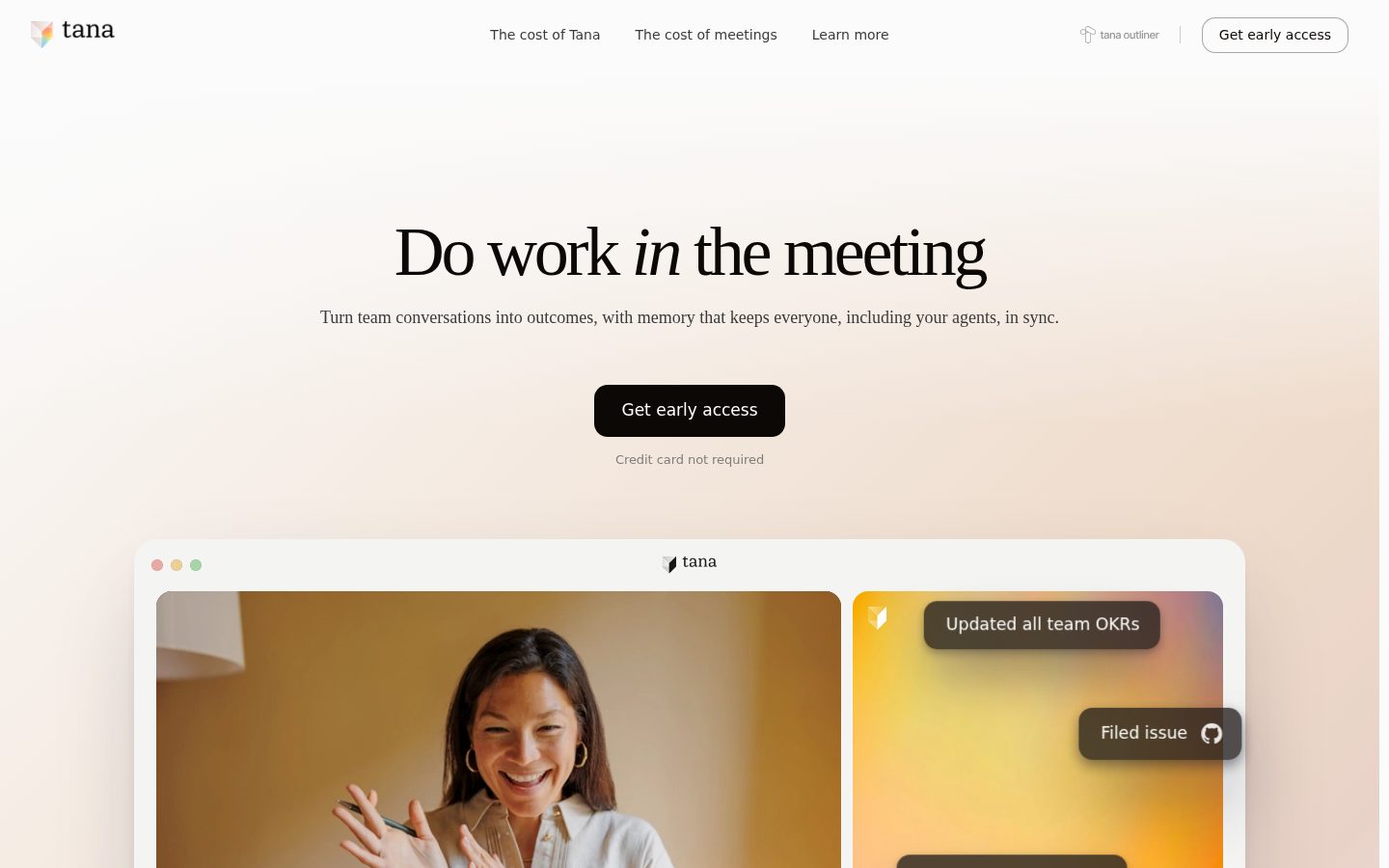
Tana sits inside a video call as the primary meeting surface, replacing or supplementing tools like Zoom and Google Meet. During a call, AI agents detect bugs, feature requests, and decisions from the audio stream, surface relevant context from prior meetings, and respond to direct queries through an in-meeting AI chat visible to all participants. When the call ends, Tana generates artifact outputs — customer journeys, storyboards, decisions — and ships items to GitHub, Linear, and connected issue trackers in the correct format.

Distinctive capabilities include Real-Time AI Agents embedded in calls, a Context Graph that persists across meetings, Merge Proposals (diff-based summaries showing what would change in the knowledge base after each call), Agent Skills (codified workflows configuring which tools an agent uses during a meeting), Rich Artifact Generation, and an MCP Server that lets external agents like Claude Code or Claude Desktop read and write the graph. A separate Third-Party Meeting Capture agent can join Zoom, Google Meet, or Microsoft Teams calls without replacing the meeting platform.

Tana is aimed at product, engineering, and operations teams that want call work to file itself rather than become a post-meeting cleanup task. It competes with Granola, Otter.ai, and Fireflies in the AI meeting category, but differentiates through the persistent context graph and the agentic, in-call workflow — agents act during the call, not after. Pricing follows a Free / Pro $20 / Max $80 / Business (custom) ladder, with SSO unlocked at the Business tier.

The platform runs in the browser and integrates with Google Calendar and Outlook via OAuth. Workspace-level granular access controls extend across the context graph, AI chats, and guest management. The MCP Server interface makes the graph addressable by external coding and desktop agents through a standard protocol.

Features

AI

  • Merge Proposals

    After each meeting or AI chat, Tana generates a diff-based proposal showing what existing graph records would be updated, which users must approve or reject before changes are applied — preventing noise accumulation.

  • Real-Time AI Agents

    AI agents embedded in the live video call that can detect bugs, feature requests, and decisions, research topics, share screens, and surface content from the context graph during the conversation.

Automation

  • Rich Artifact Generation

    Automatically produces structured outputs at the end of a call — including customer journeys, storyboards, annotated images, PRDs, and PR drafts — based on the full visual and conversational context captured during the meeting.

Collaboration

  • Collaborative AI Chat

    An in-meeting AI chat visible to all participants that can query the context graph, kick off agent commands, and be shared with specific teammates using granular access controls.

Core

  • Context Graph

    A persistent, collaborative knowledge base that automatically accumulates cross-meeting context including decisions, tasks, people, and projects, with a semantic type system that lets AI understand and categorize what is being discussed.

  • Native Video Calling

    Built-in video call environment with camera, microphone, speaker controls, emoji reactions, blurred backgrounds, screen sharing, and chat — supporting up to 50 participants without requiring a third-party platform.

Customization

  • Agent Skills

    Codified, reusable workflows that configure which tools and integrations an agent uses during a meeting; users define skills in natural language and Tana generates the skill definition automatically.

Integration

  • Calendar Integration

    Connects to Google Calendar and Outlook via OAuth to sync meetings, surface relevant context before calls, and automatically associate artifacts with the correct meeting record.

  • Issue Tracker and Code Tool Integrations

    Ships bugs, feature requests, and product decisions in the correct format directly to GitHub, Linear, and Jira during or after the call, and sends context-prefilled prompts to Cursor, Codex, and Lovable via deep links.

  • MCP Server for Inbound Agent Access

    Exposes an MCP server so external agents like Claude Code and Claude Desktop can read and write the Tana workspace, enabling integration with tools outside the native call environment.

  • Third-Party Meeting Capture

    An external meeting agent that can discretely listen in to Zoom, Google Meet, or Microsoft Teams calls to capture context when participants cannot use Tana's native video call.

Security

  • Granular Access Control

    Workspace-level permissions apply across the context graph, AI chats, and guest management, allowing teams to control who sees which content and enabling guest access to meetings via link without a Tana account.

Preview

Tana desktop previewTana mobile preview

Pricing Plans

Free

Free

For individuals getting started with Tana, including basic AI usage.

  • Host 5 meetings a month with AI transcripts and summaries
  • Connect 1 calendar
  • View and edit all your content
  • 50 AI queries

Pro

$20/yearly

For individual power users; $20/user/month early-bird (regular $30/user/month), billed yearly.

  • 20x more AI than the free plan
  • Unlimited hosted meetings
  • Botless meeting agent for Zoom, Teams, Google Meet
  • Integrations and full MCP
  • Everything in Free included

Max

$80/yearly

For heavy AI users needing more capacity; $80/user/month early-bird (regular $120/user/month), billed yearly.

  • 5x more AI than Pro
  • Dedicated support and onboarding
  • Unlimited agents, skills, and types
  • Integration support
  • Everything in Pro included

Business

Contact sales

For larger organizations; custom pricing requires contacting the vendor, billed yearly.

  • SAML SSO
  • Advanced security and controls
  • Designated customer success manager
  • Audit logs
  • Custom DPA and data residency/retention controls

AI Panel Reviews

The Decision Maker

The Decision Maker

Strategic bet, vendor viability, timing, adoption approval
7.8/10

Agentic meeting platform that does the work during the call, not after.

Tana's context graph and real-time AI agents are a genuine category step beyond Notion or Fireflies. No public API and limited mobile are the real friction points right now.

The supertag system and Merge Proposals feature are the story here. Agents detect decisions and bugs mid-call, then propose structured graph updates you approve before anything lands — that's a discipline most meeting tools completely skip. The $20/seat Pro tier with botless Zoom and Teams capture is priced to land without a procurement fight.

The tradeoff: no mobile app and no public API as of writing. That's a real gap for field teams and anyone who needs to pipe data downstream without MCP workarounds. Roam Research and Notion don't have real-time agents, but they do have integrations that IT won't push back on.

No public funding data, which the board will notice. The changelog is active, the feature velocity is high, and the compliance stack — SOC2, GDPR, HIPAA — is enterprise-ready. That's a defensible 36-month bet, not a guaranteed one.

Competitive Positioning8.2

Native video plus context graph plus agent skills has no direct equivalent — Notion and Fireflies are nowhere close to this architecture.

Reputation Risk7.5

SOC2, GDPR, and HIPAA compliance plus no model training on user data makes this a clean story for the board.

Speed to Value8.0

Botless capture for Zoom and Teams at Pro tier means teams don't need to change meeting behavior to see immediate output.

Strategic Fit8.5

Real-time agents filing Linear and GitHub issues during the call is a genuine workflow advance, not a cost-save on existing tools.

Vendor Viability7.0

No public funding data, but active changelog, enterprise compliance certs, and tiered pricing from $0 to custom Business suggest a functioning operation with real customers.

Pros

  • Merge Proposals prevent garbage accumulation in the knowledge graph — a real operational discipline
  • Real-time agents push to GitHub, Linear, and Jira during the call, not in a follow-up task
  • $20/seat early-bird Pro tier is easy to approve without a procurement process
  • HIPAA, SOC2, GDPR compliance stack ready for regulated industries

Cons

  • No mobile app limits use for anyone not at a desk
  • No public API yet — MCP server helps but isn't a full replacement
  • No public funding data makes a 3-year viability bet harder to defend
  • Max tier at $80/seat will require justification for cost-conscious teams

Right for

Product and engineering teams who run high-decision-density meetings and need outputs filed automatically to Linear, Jira, or GitHub.

Avoid if

Your team is primarily mobile or needs a mature REST API for downstream data pipelines.

The Domain Strategist

The Domain Strategist

Craft and strategy in the product's domain — adapts identity per category, same lens
8.2/10

Agentic meeting platform that collapses the post-meeting cleanup cycle into zero.

Tana's context graph plus real-time agents means work actually gets filed during the call, not in the 45-minute block after it. At $20/user/month early-bird, the operational ROI case is straightforward for any team losing hours weekly to meeting follow-through.

The merge proposal workflow is the operational centerpiece. Every AI-generated update surfaces as a diff requiring human approval before touching the context graph — that's change control, not just automation, and it's the right instinct for teams where bad data compounds fast. Otter and Fireflies transcribe; Tana commits structured records to a living knowledge base. That's a different product category pretending to share a name.

The integration surface is genuinely strong for a platform this early. Native Linear, GitHub, and Jira filing during the call, MCP server for inbound agent access, botless capture for Zoom and Teams — the stack fits how cross-functional teams actually operate. No public API is a gap the MCP partially covers, but data residency lives entirely in Tana's cloud until Business tier unlocks custom DPA controls.

The real constraint is mobile absence and the free plan's 5-meeting monthly cap. For ops teams running 30+ calls a week, Pro at $20/user is the floor, and Max at $80 is realistic for heavy AI workloads. If the context graph compounds value meeting over meeting as claimed, the switching cost grows fast — which is both the product's moat and the buyer's commitment.

Category Positioning8.2

Positioned above Otter and Fireflies on structured output, and above Notion on meeting-native workflow — occupies a distinct middle space that's currently undercrowded.

Domain Fit8.0

Real-time agents that file issues to Linear and Jira during the call match exactly how product and engineering teams actually want post-meeting work to flow.

Integration Surface8.3

MCP server, GitHub/Linear/Jira native integrations, and botless Zoom/Teams capture cover the core enterprise stack without requiring everyone to switch video platforms.

Long-term Implications7.8

Context graph value compounds with usage, but full cloud data residency with no self-host option and no public API creates meaningful lock-in before Business tier controls kick in.

Strategic Depth8.5

Supertag schema system plus merge proposals show genuine systems thinking — this isn't a transcription layer, it's a typed knowledge graph with change control.

Pros

  • Merge proposal system prevents AI noise from polluting the knowledge base — operationally sound design
  • Real-time agent filing to Linear, GitHub, and Jira eliminates the post-meeting action item lag
  • MCP server exposure means the workspace integrates with external agent workflows, not just human ones
  • HIPAA, SOC2, and GDPR compliance plus no training on customer data clears most enterprise procurement gates

Cons

  • No mobile app is a real gap for any exec whose meetings happen away from a desk
  • Free plan caps at 5 hosted meetings monthly — teams evaluate this under artificial constraints
  • Full data residency controls and custom DPA locked behind Business tier at custom pricing
  • Context graph lock-in grows with adoption — migration path out is not publicly documented

Right for

Product and engineering teams that run high-volume decision meetings and need structured outputs filed to their tools the same hour.

Avoid if

Your team runs meetings primarily on mobile or needs a self-hosted data environment below enterprise contract size.

The Finance Lead

The Finance Lead

Money, total cost of ownership, contracts, procurement math
7.8/10

$20/seat early-bird, SSO unlocked only at Business tier — classic SaaS ladder

Three published tiers, visible without a sales call. Business pricing requires contact, which is where the real budget risk lives.

$20/seat/month on Pro, billed yearly — $240/user/year. Early-bird framing suggests that price won't hold; regular rate is $30/seat. 50 users × $30 × 12 = $18K/year at steady state. Add 30% seat creep: year 3 lands around $23K. Max tier at $80/seat changes the math fast for AI-heavy teams.

SSO sits behind Business, custom-priced. That's the standard hostage move. Compare to Notion, which also gates SSO to enterprise. No surprise, but budget it anyway. No published overage rates on AI queries — 50 free queries, Pro gets 20x that, Max gets 5x Pro. Vague multipliers, not hard caps. Invoice unpredictability is the real exposure here.

MCP server and GitHub/Linear/Jira integrations are on Pro — no add-on tax there, which is procurement-friendly. No free trial; free plan caps at 5 hosted meetings/month. Migration in from Roam and Workflowy is supported. No public API beyond MCP. Data residency only at Business tier. Contract terms not published; assume annual auto-renewal standard.

Billing & Procurement7.2

MCP and integrations included on Pro with no add-on fees; SSO requires Business negotiation, adding procurement friction for organizations that mandate it.

Contract Flexibility6.5

Billed yearly with no published cancellation or auto-renewal window terms — category norm is 30-60 day notice, unconfirmed here.

Pricing Transparency7.5

Three tiers visible on the pricing page; Business is contact-only, and AI query limits use multipliers rather than hard numbers.

ROI Clarity7.8

Merge Proposals and issue-tracker integrations create measurable outputs — filed GitHub issues, updated CRM records — making value traceable beyond soft productivity claims.

Total Cost of Ownership7.0

Early-bird rate expires to $30/seat; 50-user year-3 TCO around $23K before Business-tier SSO costs, which aren't published.

Pros

  • Three tiers published without a sales call
  • MCP, GitHub, Linear, Jira integrations included on Pro — no add-on tax
  • HIPAA, SOC2, GDPR compliance listed — reduces security review friction
  • No AI training on user data, per published policy

Cons

  • SSO gated to Business tier — custom pricing, no public number
  • AI query limits expressed as multipliers, not hard caps — invoice risk
  • Early-bird pricing signals rate increase ahead
  • No published auto-renewal or cancellation terms

Right for

Teams under 20 users who need structured meeting outputs connected to a knowledge graph and already use Linear or GitHub.

Avoid if

Your org mandates SSO before procurement sign-off and needs a fixed per-seat cost to close a PO.

The Domain Practitioner

The Domain Practitioner

Daily hands-on reality in the product's domain — adapts identity per category, same lens
7.8/10

Tana's context graph is genuinely clever — if you're willing to learn the grammar

Tana is rebuilding the meeting workflow from inside the call: agents file issues to Linear, update the graph, and draft artifacts before you close the tab. The supertag system and merge proposals are real differentiators, but the learning curve is steep and mobile is basically absent.

The merge proposal system is the thing that catches my attention. After every call, Tana generates a diff showing exactly what would change in your knowledge graph — you approve or reject it. That's not a feature most Notion or Otter.ai workflows can replicate. It means your accumulated context stays clean instead of turning into a graveyard of AI-generated noise. For anyone managing recurring projects or client relationships across meetings, that compounds fast.

Day three is where the supertag grammar starts to bite. Defining a #person or #project schema is powerful, but it demands you think like a database designer before you think like a knowledge worker. Compared to how naturally Notion or Roam let you start messy and organize later, Tana front-loads the structure tax. The $20/month Pro tier unlocks unlimited hosted meetings and the botless Zoom and Teams agent — worth it if you live in back-to-back calls, but the free plan's 5-meeting cap will frustrate anyone evaluating seriously.

No mobile app is a real gap for any knowledge worker doing post-meeting capture on the go. The MCP server for Claude Code integration and native Linear and GitHub issue filing are strong signals that the team builds for practitioners who script and automate. The ceiling here is high. The floor requires patience.

Day-3 Reality7.2

Supertag schema setup front-loads cognitive work; merge proposals and the context graph pay off only after the system is populated.

Documentation Practitioner-Fit7.0

Changelog is public and feature-specific, which is a good signal, but no public blog or API docs surface makes depth hard to verify.

Friction Surface6.8

No mobile app and a 5-meeting monthly cap on free make daily use awkward for anyone not already on the Pro plan.

Power-User Depth8.5

Agent Skills in natural language, MCP server for Claude Desktop and Claude Code, and unlimited agents on Max at $80/month give power users real ceiling.

Workflow Integration7.9

Calendar OAuth, botless Zoom and Teams capture, and native Linear and GitHub filing reduce the context-switching tax meaningfully.

Pros

  • Merge proposals keep the knowledge graph clean — no silent AI writes
  • Native Linear, GitHub, and Jira filing during the call, not after
  • MCP server lets external agents like Claude Code read and write the workspace
  • No AI training on user data, SOC2 and HIPAA compliant

Cons

  • No mobile app — post-meeting capture on the go is broken
  • Free plan caps at 5 hosted meetings per month — too low for real evaluation
  • Supertag schema system demands upfront structure investment before payoff
  • No public API docs visible; MCP is the primary programmatic surface

Right for

Teams running structured, recurring meetings — product reviews, customer calls, research syncs — who already use Linear or GitHub and want meeting artifacts to land in the right place automatically.

Avoid if

You need mobile capture or want to start messy and organize later the way Roam or Obsidian let you.

The Power User

The Power User

Daily human experience, onboarding, polish, learning curve, reliability
7.8/10

Meetings that actually file the ticket — if you can get your team on the platform

Tana has genuinely rethought what happens during a meeting, not just after. The agents-during-the-call idea is real differentiation, but the closed ecosystem is a real ask.

The pitch is unusually specific: work gets done in the meeting, not after. Real-time agents that detect bugs and file them to Linear or GitHub while you're still talking — that's not a Notion feature. The Merge Proposals system, where AI suggests graph updates you approve or reject, is the kind of thoughtful anti-noise design that shows someone on the team actually worried about what happens three months in when the context graph is full of junk.

The tradeoff is structural. Tana wants to be your video call platform too. Native video up to 50 participants, its own call environment. That's a big behavioral ask when everyone's calendar runs on Zoom or Google Meet. The third-party meeting capture option softens this, but it's the backup, not the default.

Mobile is limited — their own words, essentially. For a tool billing itself as a persistent knowledge graph, that's a friction point. Free plan caps at 5 meetings monthly and 50 AI queries, so real evaluation needs the $20 Pro tier.

Daily Polish7.5

Merge Proposals and inline commands suggest careful daily-use thinking, but the changelog-only web presence makes it hard to gauge micro-copy polish across the full surface.

Learning Curve6.5

Agent Skills defined in natural language helps, but the supertag schema system and context graph will demand real investment before month-two payoff.

Mobile Parity4.5

Described as limited at time of writing — web and Mac only, which is a genuine daily-use gap for a persistent knowledge platform.

Onboarding Experience6.8

Supertags and context graphs are powerful but conceptually dense — the first 10 minutes will feel like homework for most people coming from Notion or Roam Research.

Reliability Feel7.5

Cloud-native with HIPAA and SOC2 compliance suggests infrastructure seriousness; no public API historically but MCP server now exists as a core integration path.

Pros

  • Real-time agents file issues to Linear, Jira, and GitHub during the call — not just summaries after
  • Merge Proposals keep the knowledge graph clean by requiring human approval of AI-suggested updates
  • Third-party listener works quietly in Zoom and Google Meet for teams that can't switch video platforms
  • HIPAA, SOC2, GDPR compliant — serious enough for regulated teams

Cons

  • Mobile is limited — a persistent knowledge graph you can't check on your phone is half a tool
  • Native video call requirement is a big ecosystem shift; most teams won't abandon Zoom willingly
  • Free plan's 5 meetings and 50 AI queries per month isn't enough to actually evaluate this
  • No public API yet — MCP server helps but external integrations are still limited

Right for

Product and engineering teams who live in Linear or GitHub and want meeting outcomes to land there automatically.

Avoid if

Your team is mobile-first or won't consider switching away from Zoom as the primary meeting platform.

The Skeptic

The Skeptic

Contrarian. Watch-outs, deal-breakers, broken promises, category patterns
7.2/10

Ambitious pivot, real differentiation — but two flags before you commit

Tana started as a graph-based PKM and is now pitching itself as an agentic meeting platform. The supertag-plus-context-graph angle is genuinely different. But the product description and website are describing different products.

Two flags immediately. The product description talks about bullet editors and supertags. The website says 'do work in the meeting' with AI agents filing Linear tickets in real time. That's not polish drift — that's a full category pivot. Which Tana are you buying?

The differentiation is real if the new framing holds. Merge Proposals — a diff-based approval system before AI writes to your graph — is one of the smarter anti-noise ideas I've seen. Most competitors like Notion AI or Fireflies just write into a flat doc. The context graph accumulating across meetings, with a semantic type system, could be genuinely durable. $20/month early-bird is reasonable. 50 AI queries on free is tight.

Exit story is the weak point. No public API on the PKM side. Data lives in Tana's cloud. The MCP server helps but only outbound. If they pivot again in 18 months — and the evidence suggests they might — migration is manual. Watch the changelog cadence.

Competitive Differentiation8.0

Merge Proposals and the typed context graph across meetings is a concrete gap vs. Fireflies, Notion AI, and Otter — none of them model structured knowledge accumulation this way.

Exit Portability5.0

No public API on the core workspace, data in Tana's cloud, and import from Roam/Workflowy is inbound-only — leaving is a manual export problem.

Long-term Viability6.5

Changelog exists, HIPAA and SOC2 compliance listed, early-bird pricing signals active commercial push — but no public funding data and a mid-flight pivot are yellow flags.

Marketing Honesty5.5

The meta description says 'agentic meeting platform'; the product description describes a PKM with supertags — these are not the same product story, and that gap ages poorly.

Track Record Match6.5

The PKM-to-meeting-platform pivot matches Roam Research's trajectory of slow category drift, which did not end well for Roam's growth; could go either way here.

Pros

  • Merge Proposals diff system is a genuinely novel guard against AI noise accumulation
  • Typed context graph with supertag schemas is meaningfully different from flat-doc competitors like Notion or Fireflies
  • HIPAA, SOC2, and GDPR listed — real compliance signals, not just a badge
  • MCP server enables external agents like Claude to read/write the workspace

Cons

  • Product description and website are pitching two different products — PKM vs. agentic meeting platform
  • No public API on core workspace; cloud-only data storage makes exit messy
  • 50 AI queries on free plan is very tight for evaluation
  • Mid-flight category pivot with no public funding data — viability is an open question

Right for

Teams who live in structured knowledge work — product, research, CS — and want meeting outputs that write back into a typed graph rather than a flat doc.

Avoid if

You need a clean data export path or are evaluating a stable, category-settled tool for a risk-averse organization.

Buyer Questions

Common questions answered by our AI research team

Security

Is Tana HIPAA compliant?

Tana is HIPAA Compliant, as listed among its compliance certifications alongside SOC2 and GDPR.

Security

Does Tana train AI models on my data?

Tana does not train AI models on your data.

Features

What types of work does Tana's meeting agent automate?

Tana's meeting agent automates tasks like filing issues, drafting contracts, updating OKRs, triaging bugs, synthesizing customer research, updating CRMs, and drafting follow-up emails — all during or immediately after meetings.

Setup

Does Tana support SSO?

Tana supports SSO.

Integration

Does Tana have an API or MCP integration?

Tana is MCP & API first, meaning it offers both API access and MCP integration as core platform capabilities.

Also in AI Meeting Assistants