Tempus Review
VisitAI-powered precision medicine and clinical intelligence platform
Tempus is an AI and data platform for precision medicine used by clinicians and researchers.
AI Panel Score
7.9/10
6 AI reviews
Reviewed
AI-powered precision medicine and clinical intelligence platform
Tempus is an AI and data platform for precision medicine used by clinicians and researchers.
AI Panel Score
6 AI reviews
Reviewed
Tempus is an AI and data platform for precision medicine used by clinicians and researchers. It applies artificial intelligence to clinical, molecular, and imaging data to help physicians make more informed treatment decisions, with a primary focus on oncology. The platform serves large health systems, academic medical centers, and pharma and life sciences research teams that need multimodal genomic and clinical data at scale. Pricing is quote-based through an enterprise model, with no free plan or trial. Capabilities include genomic profiling, the Tempus One assistant, Tempus Lens real-world data, algorithmic tests, clinical trial matching through NEXT, EHR integration, ECG-AI, and digital pathology. TopReviewed's six-seat AI review panel scored it 7.9/10, praising the 40-million-record de-identified data asset and multimodal coverage across genomics, radiology, and cardiology while noting that the contact-only model slows procurement and offers no self-serve entry point for evaluation before commitment.
Tempus is a healthcare technology platform that combines genomic sequencing, clinical data aggregation, and artificial intelligence to support precision medicine. Founded in 2015, the company collects and structures large volumes of real-world clinical and molecular data, enabling physicians to access relevant patient insights at the point of care. Its core offerings span genomic testing, data licensing, and AI-driven analytics tools.
The platform is primarily used in oncology, where matching patients to appropriate therapies based on their molecular profiles is critical. Tempus operates a proprietary database of de-identified clinical and genomic records, which it uses to train machine learning models and surface treatment-relevant patterns. Clinicians can use the platform to compare a patient's molecular profile against historical cases to identify potential therapy options or clinical trial eligibility.
Beyond direct clinical use, Tempus licenses its data and analytical infrastructure to life sciences companies, pharmaceutical firms, and academic researchers. These partners use Tempus datasets and AI tools to support drug discovery, clinical trial design, and patient stratification. The company also offers tools for radiology and cardiology, expanding its footprint beyond oncology.
Tempus competes in the broader precision medicine and clinical genomics market alongside companies such as Foundation Medicine and Guardant Health. Its differentiation lies in the breadth of its multimodal data — combining genomic, imaging, and clinical records — and the AI layer built on top of that data. The company went public on the Nasdaq in 2024, reflecting growing institutional interest in AI-driven clinical decision support.
Algorithmic models connected to Tempus assays that provide additional diagnostic and predictive insight, such as the PurIST® algorithm for pancreatic cancer therapy selection.
An AI-enabled algorithm applied to electrocardiogram data to help identify underdiagnosed cardiac patients.
An AI-enabled assistant designed for healthcare providers and researchers to support clinical and research workflows.
Provides AI-assisted digital pathology analysis to support oncology diagnosis and treatment decisions.
Aggregates over 40 million de-identified research records to enable real-world data analysis for life sciences research and drug development.
A platform to find, access, and analyze multimodal real-world data for research and clinical insights.
A radiology AI solution offering imaging analysis across multiple modalities including therapy response evaluation, lung, breast, cardio, and prostate assessments.
An AI-powered notetaker tool for neurology and psychiatry providers to streamline clinical documentation.
Provides contract research organization services including clinical trial execution and enrollment to support pharmaceutical and biotech drug development programs.
Identifies and closes gaps in care by matching patients to potentially life-saving clinical trials within the Tempus network.
Performs molecular profiling of tumor samples, including paired tumor/normal and transcriptome sequencing, to identify targeted therapies and clinical trials for cancer patients.
Connects Tempus tools and data directly into electronic health record systems used by healthcare providers and academic medical centers.
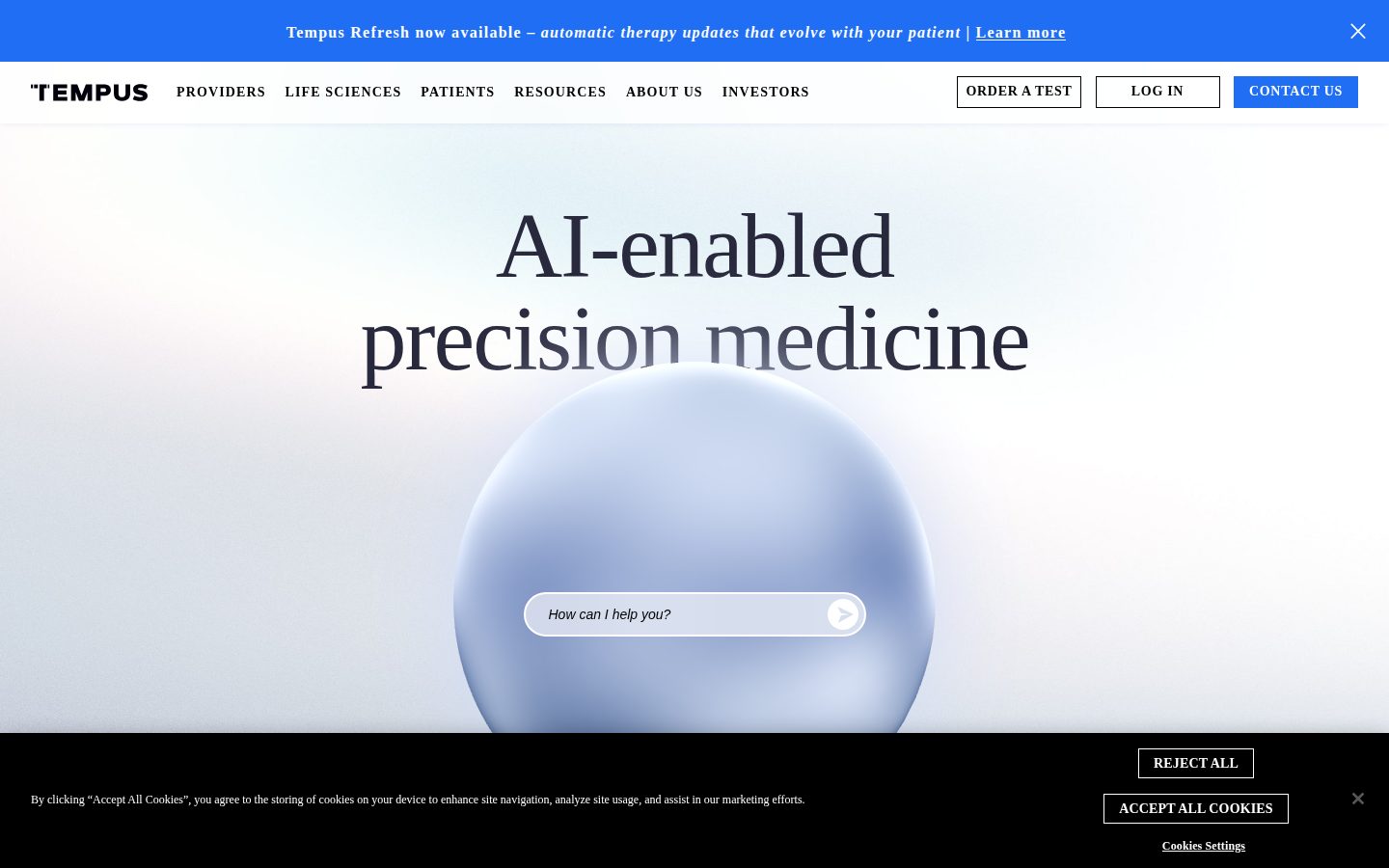
Tempus sells diagnostic, clinical-trial, and data-license services to health systems, payers, and pharma. Pricing depends on the product line (sequencing tests, Lens, Next, etc.) and is not published. Contact sales.

Nasdaq-listed, 40 million records deep — Tempus is a serious precision medicine bet.
“Tempus went public in 2024 with the largest clinical-molecular dataset in the category. This isn't a startup gamble — it's a platform decision.”
Founded 2015, public 2024, 40 million de-identified research records in Lens. That's not a pitch deck number — that's a genuine data moat. Foundation Medicine and Guardant Health compete on genomics, but neither brings multimodal data — genomic, imaging, clinical — plus an AI layer in one stack. The viability question answers itself.
The breadth is real. ECG-AI for cardiology, Tempus PRO Notetaker for neurology and psychiatry, Pixel for radiology imaging, NEXT for clinical trial matching. That's not feature bloat — that's a platform play. The tradeoff: you're buying into a complex, multi-product relationship with no published pricing. Every dollar gets negotiated. Budget cycles will be slower.
Pilot on one disease area — oncology is the strongest anchor. Don't try to standardize across specialties until you see the EHR integration hold up in production.
No public competitor combines genomic profiling, imaging AI, and 40 million real-world records in a single licensed platform.
A publicly traded, HIPAA-compliant precision medicine platform is a board-defensible choice in 2025.
EHR integration and contact-only pricing mean procurement and deployment cycles won't be short.
Multimodal AI across oncology, cardiology, and radiology advances clinical capability, not just cost reduction.
Nasdaq IPO in 2024 and nine years in market — this company isn't going anywhere.
Large health systems or pharma research teams that need multimodal genomic and clinical data at scale.
You're a smaller practice or clinic without the IT infrastructure to absorb EHR integration work.

Multimodal clinical data at 40 million records makes Tempus a serious precision medicine infrastructure bet.
“Tempus has built a genuinely differentiated data asset — genomic, imaging, and clinical records unified under one AI layer. For health systems operating in oncology, the clinical trial matching, digital pathology, and algorithmic tests represent real decision-support depth, not just dashboards.”
The 40 million de-identified research records in Tempus Lens is the number that matters. Foundation Medicine sequences well; Guardant Health owns liquid biopsy. Tempus's moat is multimodal breadth — pairing genomic profiling with imaging via Tempus Pixel and structured EHR data. That's a harder architecture to replicate than a single-assay competitor.
From a clinical workflow standpoint, NEXT for trial matching and PurIST® for pancreatic therapy selection show that the AI layer is connected to actual treatment decisions, not research abstraction. ECG-AI and Tempus PRO Notetaker in neurology suggest real specialty expansion, though those capabilities are earlier-stage than the oncology core.
The tradeoff worth naming: contact-only pricing and no published API docs means integration timelines are institutional negotiations, not self-service deployments. If we adopt this, in 3 years our clinical informatics team is deeply coupled to Tempus's data licensing terms — that's a governance conversation before a technology one.
2024 Nasdaq IPO signals institutional validation; multimodal data differentiates from Foundation Medicine's sequencing-only and Guardant's liquid biopsy positioning.
Clinical trial matching via NEXT and EHR integration address the two highest-friction points in oncology workflows for practicing physicians.
EHR integration is listed as a capability but no public API docs exist, meaning integration depth is determined by enterprise negotiation, not technical self-assessment.
The data licensing model creates durable value but also long-term contractual dependency — data portability terms will govern the exit cost if the relationship changes.
PurIST® algorithmic tests and multimodal data fusion across genomics, imaging, and clinical records demonstrate platform-grade depth, not point-solution thinking.
Health systems and academic medical centers running high-volume oncology programs that need genomics, trial matching, and imaging AI under one data agreement.
You need a self-service, API-first integration or your primary use case sits outside oncology today.

40 million records, zero published prices — enterprise genomics math is opaque by design
“Tempus operates a legitimate, differentiated platform with 40M+ de-identified records and multimodal AI across oncology, cardiology, and neurology. No pricing is public — not a number, not a range, not a tier.”
No pricing page. No trial. No published rate card. Every contract starts with a sales call. That's standard for clinical genomics — Foundation Medicine and Guardant Health run the same playbook — but procurement teams should budget 60-90 days to close, minimum. EHR integration is listed as a feature, which means IT onboarding costs are real and not reflected anywhere public.
The platform's 40M de-identified records and features like PurIST® algorithmic testing and Tempus Lens suggest a mature data asset. Genomic profiling, clinical trial matching, and ECG-AI span multiple departments — meaning multi-stakeholder procurement, not a single budget owner. Year 3 TCO at a mid-size health system likely compounds: sequencing contracts, Lens data licensing, NEXT matching, and EHR integration fees are all separate line items.
ROI is measurable in theory — trial enrollment gaps closed, therapy matches made — but the value story depends on internal clinical champions documenting outcomes. Without a published overage structure or contract term norms, budget risk sits with the buyer.
Enterprise-only model with no self-serve path means high procurement friction, multi-stakeholder sign-off, and likely 60-90 day sales cycles.
No public contract terms, renewal windows, or cancellation policy — category norm is multi-year locked agreements with limited termination rights.
Zero public pricing across all product lines — genomic profiling, Lens, NEXT, ECG-AI — all require direct sales engagement.
Clinical trial matching and PurIST® algorithmic outputs offer measurable clinical endpoints, but financial ROI attribution requires internal tracking infrastructure.
Multiple discrete product lines (sequencing, data licensing, CRO services, EHR integration) suggest TCO compounds fast with no public ceiling.
Health systems and pharma teams with dedicated procurement resources and a clinical champion ready to justify sequencing and data-licensing spend.
Your procurement team needs a price before a sales call, or you're evaluating on a 90-day budget cycle.

Tempus is precision medicine infrastructure, not just another clinical dashboard
“40 million de-identified records backing the AI layer is a real moat. For oncology teams ordering genomic profiling, this is the platform that actually closes the loop between sequencing and care decisions.”
Genomic Profiling with paired tumor/normal and transcriptome sequencing is the core workflow anchor. When a patient's molecular panel comes back, having that result surface alongside matched historical cases and open trial eligibility through NEXT — without leaving the EHR — is genuinely different from what Foundation Medicine offers at the point of care. EHR Integration isn't a checkbox feature here; it's how the whole thing becomes daily habit rather than a separate login.
Day three reality: the PRO™ Notetaker for neurology and psychiatry is a smart add, but specialty teams outside oncology will feel the product is still finding its footing. ECG-AI and Tempus Pixel are promising, but the docs show zero public changelog, zero API documentation. That's a signal. Configuring Lens for a research query or customizing ALGOS outputs likely requires account management, not self-service.
No published pricing is the honest friction. Contrast with Guardant Health, which at least gives test-level cost signals. Budget conversations with administration drag when every number requires a sales call. For academic medical centers with established contracts, that's fine. For smaller oncology practices, it's a real barrier.
EHR integration and clinical trial matching via NEXT reduce context-switching for oncology teams, but no self-service configuration means day-three questions go through account reps.
Docs=N in the evidence; the website reads for institutional buyers, not for the clinician configuring a Lens query at 7am before rounds.
No public docs, no changelog, no API access listed — every edge case requires human escalation, which accumulates friction across a busy clinical week.
ALGOS, Lens, and multimodal data access suggest real depth for research-oriented power users, but discoverability without docs or a self-serve sandbox is unclear.
EHR-connected genomic results surfacing therapy options and trial eligibility at point of care is the workflow fit that competitors like Foundation Medicine don't match.
Academic medical centers and large oncology practices ordering regular genomic profiling who want AI-assisted trial matching embedded in their EHR.
You're a small practice or single-specialty group without a procurement team to manage enterprise contract negotiation and onboarding.

40 million records deep, but the front door is deliberately locked
“Tempus is serious infrastructure for serious clinical problems — oncology, genomics, real-world data at scale. It's not a tool you browse; it's one you get sold.”
Founded in 2015, went public on Nasdaq in 2024, and sitting on what they call the world's largest library of clinical and molecular data — that's not a startup flexing, that's a platform with real weight behind it. The genomic profiling, the PurIST® algorithm for pancreatic cancer therapy selection, the 40 million de-identified research records in Tempus Lens — this is infrastructure-grade stuff. Foundation Medicine and Guardant Health are the named competitors, and Tempus's multimodal angle (genomic plus imaging plus clinical records) is a real differentiator.
The tradeoff is contact-only pricing and a website that tells clinicians almost nothing about what onboarding actually looks like. No docs, no changelog, no pricing page in the evidence. That's a deliberate enterprise sales motion, not a product gap — but it means day-one friction is entirely dependent on your sales rep.
For a working clinician, the EHR integration and Tempus One AI assistant are what decide whether this becomes daily habit or quarterly report. Web-only platform with no free trial means you're committing on faith before you've felt the thing.
Features like Tempus PRO Notetaker and Tempus One suggest real investment in daily-use UX, but no public docs or changelog makes it hard to gauge how carefully the small stuff is handled.
EHR integration suggests it meets clinicians where they already work, but the breadth of tools — genomics, radiology, cardiology, psychiatry — means the learning surface is wide.
Web-only platform listed, no mobile app in evidence — for clinicians moving between rooms and patients, that's a real limitation.
No free trial, no pricing page, and contact-only access means onboarding starts with a sales call — the product itself may be smooth, but the ramp is controlled entirely by Tempus.
A company that IPO'd in 2024 handling HIPAA-compliant genomic and clinical data has to be solid infrastructure — regulatory pressure alone demands it.
Health systems, oncology practices, and pharma research teams that need enterprise-grade genomic and real-world data infrastructure with clinical workflow integration.
You need transparent pricing, a self-serve trial, or mobile access before committing to a platform.

40 million records and a Nasdaq listing — harder to dismiss than most
“Tempus went public in 2024 with a multimodal data moat that Foundation Medicine can't easily replicate. The pitch is ambitious but the evidence mostly holds.”
Three tells upfront. One: 'world's largest library' in the meta description — the kind of superlative that ages poorly. Two: no API docs, no changelog, no pricing page visible. Three: contact-only sales with zero public tier anchors. All standard for enterprise healthcare, but still flags.
What's actually real: 40 million de-identified records is a specific, meaningful number. The PurIST® algorithm for pancreatic therapy selection, ECG-AI for cardiac screening, Tempus Pixel for radiology — these aren't vaporware feature names, they're named products with clinical use cases. EHR integration matters here. Data without workflow access dies in clinical settings. Tempus Lens for real-world data licensing is where pharma money likely lives.
Exit portability is rough. Genomic data, clinical integrations, proprietary ML models — you don't walk away clean. That's not unique to Tempus; Foundation Medicine and Guardant Health carry the same lock-in. The 2024 IPO buys survival runway. If the data moat holds, it's a real 3-year bet.
Multimodal data stack — genomic, imaging, clinical records combined — is a real gap vs. Foundation Medicine's narrower genomics focus.
Genomic sequencing, proprietary ML models, and deep EHR integration make clean migration close to impossible.
Public company post-2024 IPO with pharma data-licensing revenue and 40M records creates durable institutional stickiness.
'World's largest library' with no API docs or pricing visible is aspirational framing with thin public verification.
Founded 2015, public on Nasdaq in 2024 — nine years without folding in a hard-to-survive category is a real signal.
Health systems, pharma, and academic researchers who need multimodal real-world data at scale and can navigate enterprise procurement.
You need transparent pricing, clean data portability, or a self-serve evaluation path before committing.
Common questions answered by our AI research team
Beyond oncology, Tempus covers Neurology & Psychiatry, Cardiology, Radiology, and Infectious Disease, offering solutions like Tempus PRO™ Notetaker, ECG-AI, and Tempus Pixel imaging tools across these specialties.