Build conversational forms and chatbots with visual drag-and-drop interface
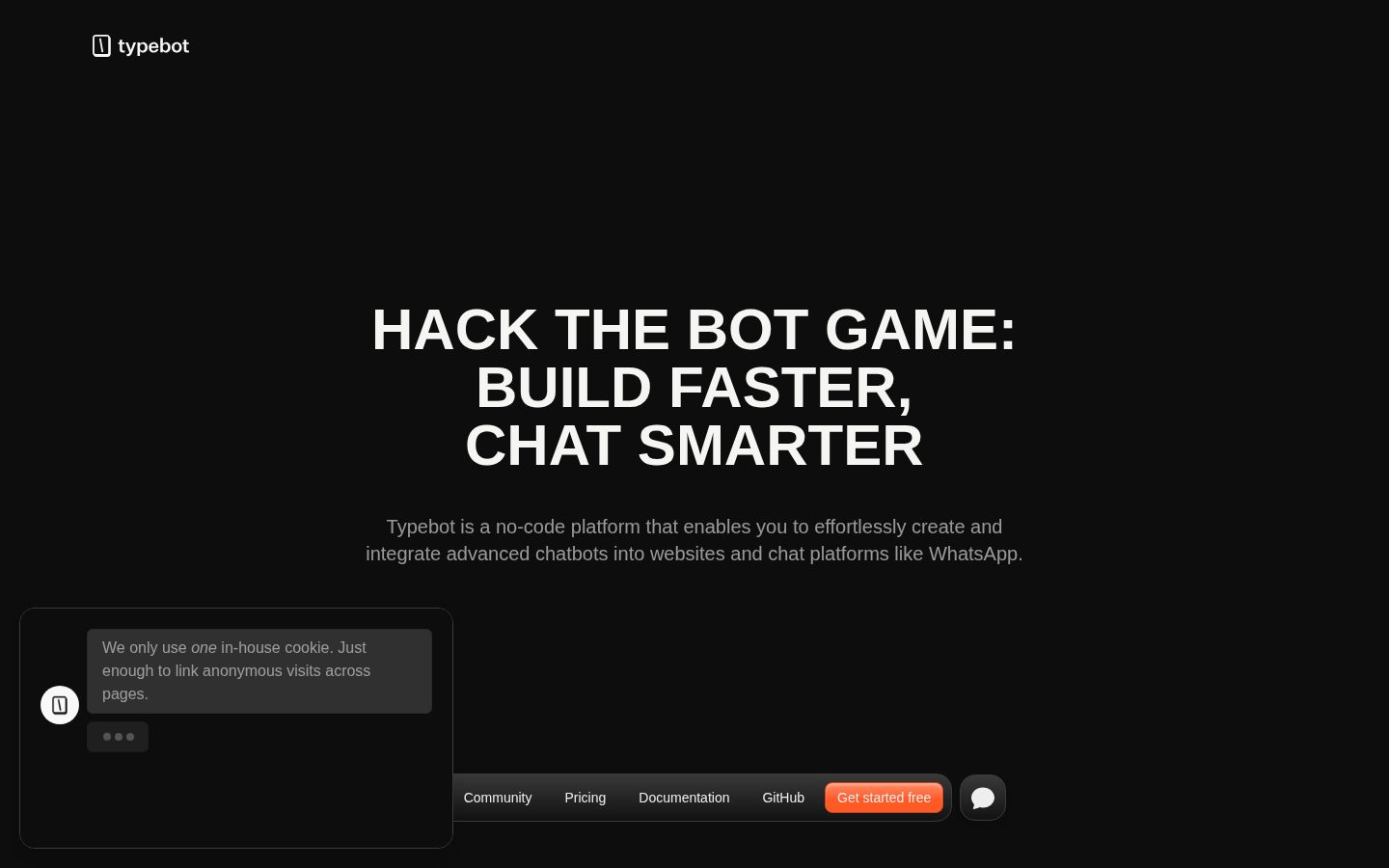
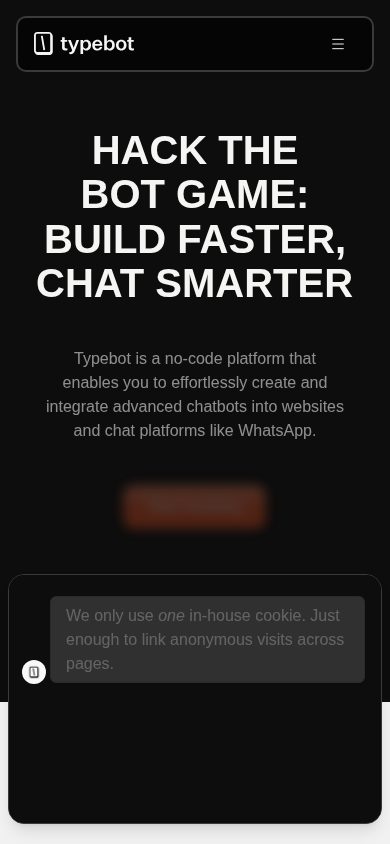
Typebot is a no-code platform for creating interactive forms, surveys, and chatbots using a visual builder.
AI Panel Score
6 AI reviews
Reviewed
Typebot is a no-code platform that allows users to create interactive conversational forms, surveys, quizzes, and chatbots through a visual drag-and-drop builder. The platform transforms traditional static forms into engaging conversational experiences that can increase completion rates and user engagement.
The tool is designed for businesses, marketers, researchers, and developers who want to create more interactive data collection experiences without requiring programming skills. Users can build complex conversational flows with conditional logic, integrate with popular tools and services, and customize the appearance to match their brand.
Key capabilities include a visual flow builder, conditional branching, integration with webhooks and third-party services, custom styling options, and analytics to track form performance. Typebot supports various input types including text, multiple choice, file uploads, and payment collection.
Typebot competes in the conversational form and chatbot builder market alongside tools like Typeform, Landbot, and Chatfuel. It differentiates itself by offering open-source flexibility and self-hosting options, making it appealing to users who want more control over their data and customization options.
Connect with any AI provider while controlling data injection and associated costs.
Metrics on drop-off rates, completion rates, and CSV export of conversation data.
Include data in form URLs to segment users and use that data directly in flows.
Connect typebots to child flows and track completion metrics with drop-off rate analytics.
Invite teammates to work simultaneously on typebot projects with shared access.
Compose chatbots using diverse input types including text fields, buttons, date pickers, and payment inputs.
Customize fonts, colors, shapes, and shadows with reusable design templates.
Insert personalized JavaScript and CSS code to override default behaviors and styling.
Route bots through a branded URL instead of Typebot's domain.
Connects directly with OpenAI, Google Sheets, Zapier, Google Analytics, and Meta Pixel.
Deploy one bot across custom domains, embedded containers, popups, chat bubbles, WhatsApp, and via HTTP requests.
Information security management certified to the ISO 27001 standard.
Solo use; 200 chats/month. Unlimited typebots, integrations, webhooks.
2,000 chats/month, 2 seats. Branding removed; $10 per 500 overage chats.
10,000 chats/month, 5 seats. Adds WhatsApp integration, custom domains, analytics.
Custom chat and seat limits with SLAs, SSO, dedicated IP, ISO 27001.
Bootstrapped to roughly $40K MRR with AGPL self-hosting, Typebot is the indie play in conversational forms.
“Baptiste Arnaud bootstrapped Typebot solo and kept the codebase on AGPL with self-hosting on the table. Pro at $89 a month for 10,000 chats undercuts Typeform Business, but the team is still small.”
One developer in Paris built this and answers his own GitHub issues. Baptiste Arnaud has shipped Typebot since 2021 with AGPL source and a managed cloud at typebot.io. Solo-founder risk is real, but the open-source escape hatch is real too.
The product itself is solid. Sub-Typebot Linking lets teams chain flows with drop-off analytics, and 45+ Building Blocks cover payments, file uploads, and WhatsApp without Typeform's polish tax. Pro is $89 a month for 10,000 chats and 5 seats. Typeform Business starts north of $80 for fewer responses.
The catch is vendor scale. ISO 27001 covers the certification box, but there's no enterprise motion, no public funding, and the bus factor is one. Self-host the AGPL build for a marketing pilot, keep managed Pro for paid teams, revisit in 12 months.
Open-source moat against Typeform and Landbot, but neither brand is going anywhere.
A board can defend an ISO 27001 indie tool with a self-host escape hatch, but will ask about the founder.
45+ Building Blocks and a visual canvas mean a first form ships in an afternoon.
Conversational forms with payment and WhatsApp blocks fit marketing and onboarding workflows cleanly.
Solo founder, no disclosed funding, bus factor one; AGPL self-host hedges the worst case.
Indie marketers who need conversational forms without Typeform pricing.
Enterprises who need 24/7 vendor SLAs and dedicated CSMs.
Typebot's AGPLv3 plus self-host path is the right strategic bet against Typeform for control-conscious teams.
“Baptiste Arnaud has bootstrapped Typebot solo since June 2020, shipping 45+ Building Blocks and a self-hostable AGPLv3 core that Typeform structurally can't match. For a Head of Conversational Design picking a forms substrate through 2029, the call is whether open-source data control beats Typeform's polish and brand depth.”
Baptiste Arnaud launched Typebot solo in June 2020 and has held the shape — one engineer, AGPLv3 core, public roadmap on GitHub. The Flow Editor and 45+ Building Blocks are the visible product; the leverage is that you can fork it the day pricing or direction stops working.
The Pro plan at $89 per month buys 10,000 chats, 5 seats, WhatsApp, and Custom Domains, with $10 per 500 overage above that. Native Integrations hit OpenAI, Google Sheets, and Meta Pixel directly. ISO 27001 on Enterprise is unusual depth for a solo-founded tool.
But the craft ceiling sits below Typeform on visual polish and Landbot on enterprise CX surface. The tradeoff is sovereignty for finish. The 3-year ceiling is the open-source conversational forms substrate — strongest fit where data residency and self-host optionality outrank brand-grade form aesthetics.
Clear sovereignty wedge against Typeform and Landbot in the conversational forms category.
45+ Building Blocks and the Flow Editor match how engineering-led teams actually compose conversational forms.
Native Integrations cover OpenAI, Google Sheets, Zapier, and Meta Pixel directly without middleware.
Solo-founder risk exists, but AGPLv3 self-host option means you can fork rather than be stranded.
AGPLv3 plus ISO 27001 on Enterprise is real strategic shape, but visual craft trails Typeform.
Engineering-led teams who need self-hostable conversational forms with data control.
Marketing teams who prioritize visual polish over open-source sovereignty.
$39 Starter, $89 Pro, no annual discount — Typebot bills monthly because chats don't sit still.
“Four published tiers from Free to Pro at $89/month, plus quote-based Enterprise. Bootstrapped vendor, no annual prepay discount, and overage starts at $10 per 500 chats above the Starter limit.”
Typebot is bootstrapped. Founder Baptiste Arnaud runs the managed cloud; no VC, no funding rounds. Functional Source License flips to Apache 2.0 after two years. That matters for procurement — self-host is a real exit, not a marketing line.
Model a Pro shop. $89/month × 12 = $1,068/year. Five seats included. Need 12K chats? Overage kicks in past 10K — Starter's published rate is $10 per 500. Compare Typeform Business at $83/month for 10K responses, no self-host. Landbot Pro lands near $100/month.
The catch is no annual discount. Vendor states monthly-only because chats fluctuate. Honest, but it kills the standard 17% prepay haircut. Enterprise unlocks SSO, ISO 27001, dedicated IP — all quote-based. WhatsApp integration is Pro-tier only. Branding removal starts at Starter.
No annual prepay discount and no published Pro-tier overage table; Enterprise SSO, ISO 27001, and dedicated IP all sit behind a sales call.
Monthly-only billing means no auto-renewal lock-in; FSL-to-Apache 2.0 license gives a real exit path after two years.
Three tiers visible without a sales call — Personal, Starter $39, Pro $89; Starter overage rate ($10 per 500 chats) is published.
Real-time analytics with drop-off rates and CSV export make completion-rate ROI measurable; volume-tied billing keeps cost-per-chat visible.
Pro lands $1,068/year before overage; self-host eliminates seat creep but adds infra cost the pricing page does not quantify.
Small teams who want a self-hostable conversational form builder under $100/month.
Procurement teams who need annual prepay discounts and contractual SLAs at the Pro tier.
Typebot ships the self-host escape hatch Typeform never built — the AGPL repo is the moat.
“Typebot is the conversational form builder where the source code is on GitHub and the WhatsApp channel ships in the same flow editor as the website embed. The catch is the chat meter — Starter at $39 caps at 2,000 chats and overage runs $10 per 500.”
Most form builders hand you a hosted dashboard and a page about data sovereignty. Typebot hands you a Docker compose file. The baptisteArno/typebot.io repo is the real product — fork it, run your own Postgres, the chat meter disappears.
Sub-Typebot Linking is the practitioner tell. Marketers building a 6-step qualifier can reuse the email-capture sub-flow across campaigns and still see drop-off rate per node. Typeform charges for Logic Jumps and won't let you nest forms at all. The tradeoff is the canvas — drag-and-drop is fine, but keyboard navigation lags Landbot and there's no command palette.
Docs read like the contributor wrote them. The self-host guide covers Postgres tuning and S3 buckets in detail. Hosted pricing front-loads pain at Starter — 2,000 chats vanishes in one ad campaign, and $10 per 500 overage adds up before the $89 Pro upgrade feels justified.
Visual builder holds up for branching flows, but Starter chat caps bite fast on a live campaign.
Self-host docs cover Docker, Postgres, and S3 in detail — clearly written by the people running it.
Canvas drag-and-drop is solid, but no keyboard command palette and overage emails arrive only at 80%/100%.
Custom JS/CSS injection, sub-typebot reuse, and an AGPL fork path give power users real ceiling.
Native WhatsApp, OpenAI, Google Sheets, and webhooks land in the same canvas with no marketplace detour.
Marketers who run their own infra and want WhatsApp flows without per-seat lock-in.
Teams that need polished mobile apps and zero-config hosting from day one.
Typebot is the self-host-friendly conversational form builder, with honest chat-billing and a solo-founder feel.
“Open-source at the core, $89/month for 10,000 chats and 5 seats on Pro with WhatsApp. Typeform still wins polish on the respondent side, but Typebot wins on control.”
Most form builders feel like SaaS first, product second. Typebot reads the other way — a working visual flow tool with the GitHub repo right there if you'd rather self-host. The chat counter is honest too: one conversation equals one chat, however many messages.
Baptiste Arnaud shipped this solo in 2020 and it shows. Sub-Typebot Linking with drop-off analytics on child flows is the kind of thing teams ask for after six months, not before launch. Hidden Fields for URL-passed data is small but the people who need it really need it. 45+ Building Blocks covers payment inputs and file uploads, not just multiple choice.
The catch is the seat math. Pro at $89/month gets 10,000 chats and 5 seats with WhatsApp included, but Typeform's polish on the respondent side still wins the premium B2B feel. Starter at $39 just to remove branding is steep for solo makers.
Honest chat counter and drop-off analytics on child flows show the team sweated the small daily mechanics.
Visual drag-and-drop with conditional branching and sub-typebots stays discoverable from first hour to month three.
Web-only builder targeting embedded chat surfaces; mobile parity is not the buying criterion here.
Free Personal plan with 200 chats and 45+ Building Blocks lets you build a real flow inside ten minutes.
ISO 27001 certification and an active GitHub repo signal a maintained codebase, though feel is hard to judge from public materials.
Builders who want a no-code conversational form tool they can also self-host.
Teams who need premium respondent polish for enterprise B2B surveys.
Solo founder, Paris 2020, $623K ARR — Typebot is the open-source bet against Typeform's lock-in.
“Baptiste Arnaud has shipped Typebot solo since 2020, reaching roughly $623K ARR by 2024 according to Latka. The catch is the bus factor — one maintainer, a recent license flip from AGPL to FSL, and Landbot owning the enterprise tier.”
Solo founder. Paris. 2020. That's the cohort. Baptiste Arnaud has been shipping Typebot alone for six years, and Latka pegged the ARR around $623K in 2024. Small team math. Tiny burn. Different risk profile than a VC-backed chatbot vendor.
The Visual Flow Builder is the real wedge. Drag-and-drop, 45+ building blocks, native OpenAI integration. Self-hosting is the exit story Typeform never offered. Free tier covers 200 chats. Starter is $39 with 2,000 chats and a $10 overage per 500. Honest meter.
But the catch is the solo-maintainer bus factor. The license flipped from AGPL to FSL recently — read the terms before you commit. Landbot has the enterprise budget Typebot can't match. Fair option if you self-host.
Open-source self-host wedge is real against Typeform and Landbot, but feature surface is narrower.
Self-hosting plus owned data is the cleanest exit story in the conversational forms category.
Single maintainer plus a 2024 license flip from AGPL to FSL is a yellow flag for a three-year bet.
Pricing page shows the overage meter plainly and ARR figures are publicly tracked on Latka.
Six years of solo OSS shipping fits the survivor cohort, but solo maintainers often stall at $1M ARR.
Teams who want self-hosted conversational forms.
Enterprises who need a vendor with a board.
Common questions answered by our AI research team
The Pro plan costs $89/month, includes 5 seats and 10,000 chats/month, with extra chats available at tiered pricing.
Yes, WhatsApp integration is available on the Pro plan ($89/month) and Enterprise plans.
At 80% usage you receive a heads-up email. At 100%, another email is sent and your chat limit is automatically upgraded to the next tier.
Branding removal is available on the Starter plan ($39/month) and above; it is not available on the free Personal plan.
Custom domains are available on the Pro plan ($89/month) and Enterprise plans.
Typebot is an open-source, self-hostable platform for creating advanced chatbots and integrating them into websites, WhatsApp, and other channels.