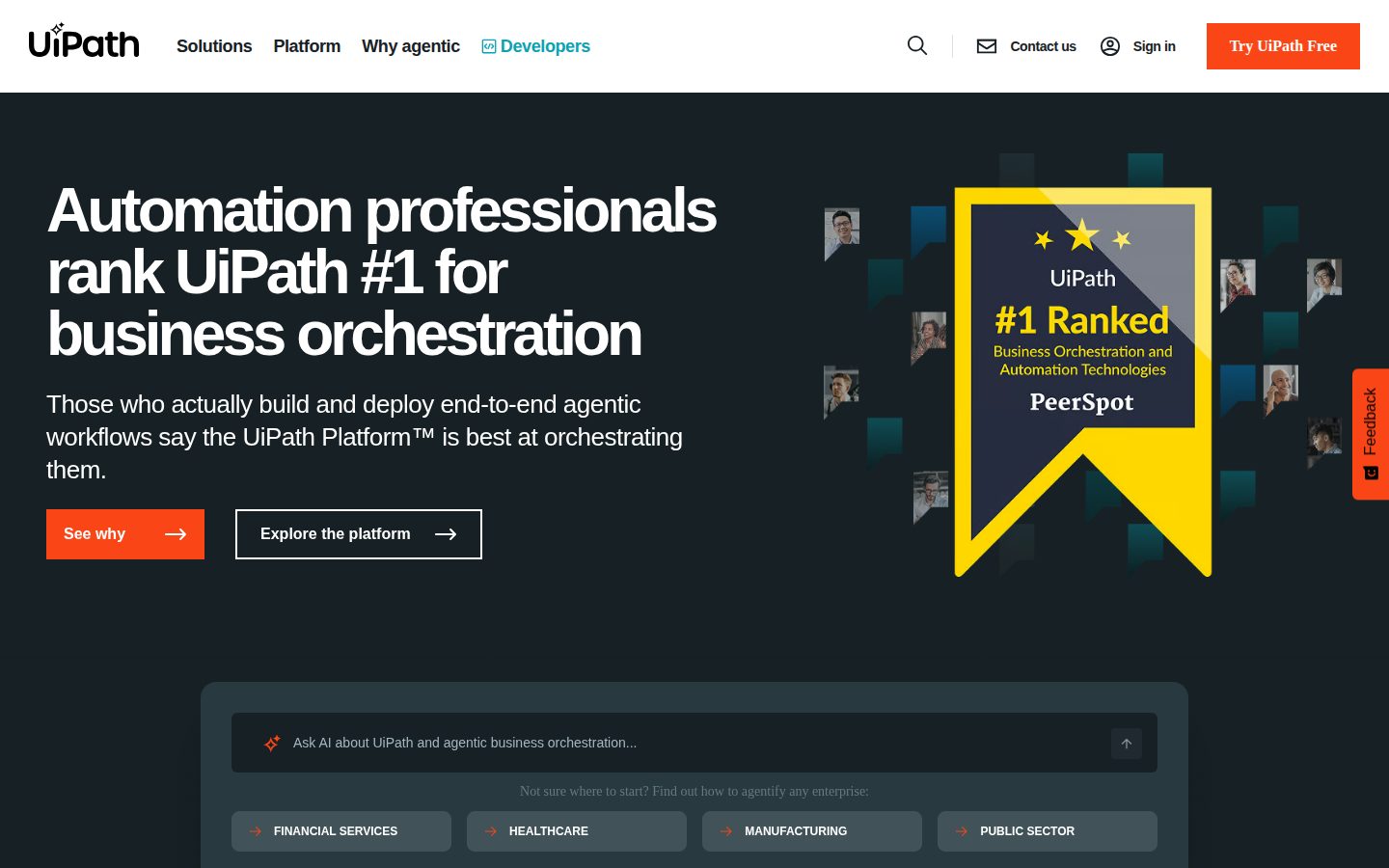
Enterprise automation platform combining RPA, AI agents, and workflow orchestration
UiPath is a robotic process automation and agentic AI platform for automating enterprise workflows at scale.
AI Panel Score
6 AI reviews
Reviewed
AI Editor ApprovedApproved and published by our AI Editor-in-Chief after full panel analysis.In practice, users build automation workflows using UiPath Studio, a visual development environment that supports both low-code drag-and-drop design and full-code development. Automations can interact with desktop applications, web interfaces, APIs, and documents. Robots are deployed and managed through UiPath Orchestrator, a centralized control layer that handles scheduling, monitoring, and access control across attended and unattended automation scenarios.
The platform integrates agentic AI capabilities that allow autonomous agents to reason through multi-step tasks, not just follow scripted paths. Key features include document processing (extracting and classifying data from unstructured documents), AI-powered computer vision for UI interaction, a process mining tool for discovering automation candidates, and a testing suite for validating automations. UiPath supports integration with third-party AI agents and models, positioning it as an open orchestration layer rather than a closed ecosystem. It holds FedRAMP authorization for public sector use and has achieved AIUC-1 certification for AI agent security.
UiPath targets large enterprises across financial services, healthcare, insurance, manufacturing, and the public sector, with use cases ranging from invoice processing and claims management to HR operations. Pricing is not publicly listed on the main site and appears to be contact-based for enterprise plans, though a free trial and a community edition are available. Primary competitors in the RPA and hyperautomation space include Automation Anywhere, Blue Prism (now SS&C), Microsoft Power Automate, and SAP Build Process Automation.
UiPath can be deployed on cloud (SaaS), on-premises, or in hybrid configurations. It exposes a public API for programmatic management of robots and orchestration jobs. Supporting resources include a documentation portal, UiPath Academy for training and certification, and an active community forum for automation practitioners.
Agentifies end-to-end processes using an open, flexible, and interoperable architecture that integrates UiPath agents, third-party agents, UI automations, and API-based workflows.
Delivers real-time monitoring of workflows, agents, and automation processes to maintain visibility across operations.
Orchestrates end-to-end agentic workflows where AI agents handle decision-making tasks while robots execute structured UI and API-based actions.
Processes documents using AI and robots to automate document-heavy workflows such as claims, invoices, and policy ingestion.
Enables business owners, low-code users, developers, and IT teams to co-create automations through fast prototyping and collaborative workflows.
Enables quick outcome validation through fast prototyping and collaboration before eventual production deployment.
Supports building and integrating third-party agents alongside UiPath agents, UI automations, and API-based workflows within a unified platform.
Provides audits and guardrails that de-risk AI adoption and manage agent, application, and tool sprawl to meet compliance requirements.
Provides FedRAMP-authorized deployment options for governmental and public sector organizations requiring federal compliance standards.
Provides fine-grained governance with role-based access to manage permissions across agents, applications, and tools.
Free trial or free-tier access to get started with UiPath automation and agentic AI platform
Enterprise and custom pricing for organizations requiring full agentic automation, orchestration, AI governance, and industry-specific solutions. No public list prices are available.
Public on the NYSE for four years, profitable, and quietly betting the farm on agentic automation.
“UiPath has been public since 2021, did $1.43B in revenue last fiscal year, and outlasts most names on a 5-year contract. The harder question is whether the agentic-AI repositioning is real product, and on UiPath Orchestrator plus Document Understanding it mostly is.”
Public companies don't usually fail vendor reviews. UiPath has been on the NYSE since April 2021, did $1.43B in revenue last fiscal year, and isn't going anywhere. That's the easy half of the analysis.
The hard half is whether the agentic-AI repositioning is real or a stock-price story. UiPath Orchestrator running autonomous agents alongside structured bots is a genuine product shift, not slideware. But Microsoft Power Automate sits inside the E5 license most enterprises already bought, and bundled-default risk is the actual competitor here.
Pilot UiPath where document complexity actually justifies the spend — claims, invoices, regulated workflows where Document Understanding earns its keep. For vanilla approval flows in a Microsoft shop, the answer's already on the desktop. Defending this to the board is easy when the use case is hard.
Clear leader versus Automation Anywhere and Blue Prism, but Microsoft Power Automate's E5 bundling is real bundled-default pressure.
FedRAMP authorization plus AIUC-1 certification and public-company financials make this a board-defensible pick.
Contact-sales pricing past the $25/month Basic tier and UiPath Academy training mean payback is quarters, not weeks.
Strong fit for document-heavy regulated workflows; weaker if the use case is generic approval routing in a Microsoft shop.
Public on NYSE since April 2021, $1.43B FY25 revenue with $1.666B ARR up 14% — the 3-year survival question is settled.
Enterprises who run document-heavy regulated workflows at scale.
Microsoft shops who only need vanilla approval automation.
Maestro reframes UiPath from bot vendor to orchestration layer, and that pivot is the actual 3-year decision.
“UiPath's Maestro launch in February 2026 moved the company's center of gravity from RPA executor to agent orchestrator, which is the harder defensible position. The catch is whether the orchestration story holds when Microsoft Power Automate ships the same shape at one-third the cost.”
Maestro is the platform pivot worth pricing into the 3-year decision. Launched February 2026, it coordinates UiPath agents, third-party agents, robots, and humans across long-running workflows spanning hours, days, sometimes weeks. That shape moves UiPath from bot-vendor to process orchestrator, which is harder to displace.
Microsoft Power Automate compresses the same workflow at one-third the cost when the customer already pays for E5. Automation Anywhere ships parity on the agentic story but lacks FedRAMP authorization and AIUC-1 certification, which matter more in regulated buys than marketing suggests. Bring-your-own-model on the Enterprise tier is the right call for a category where model leadership rotates quarterly.
The catch is that Maestro inherits the legacy of UI automation, where any Windows update can shatter a screen-scrape. UiPath has been public since 2021 and durable through three platform cycles, but the moat now lives in Orchestrator's governance layer, not the robots beneath it.
Category leader in RPA but contested by Microsoft Power Automate on price-to-E5 customers.
Fits the enterprise RPA shape and now the agentic shift, with FedRAMP for the public sector.
Open third-party agent integration, BYO model on Enterprise, and cloud, on-prem, or hybrid deployment.
Public since 2021 and durable, but UI-automation legacy carries ongoing screen-scrape fragility.
Maestro orchestrates long-running multi-agent workflows and AIUC-1 certification raises the agent-security bar.
Enterprise automation teams who run regulated processes at scale.
Small teams who already pay for Microsoft E5 licenses.
Basic at $25/month is the decoy — real UiPath contracts start at $50K and run to seven figures.
“UiPath publishes a $25/month Basic tier capped at 2 robots in Europe; Standard and Enterprise are contact-sales with list around $8-10K per unattended bot annually. The math gets serious fast — 25 bots is a $200K+ floor, and global deployments cross seven figures.”
Published $25/month Basic is marketing, not procurement. Two robots, five users, EU-only. The real conversation starts when sales picks up. Vendr benchmarks list near $8-10K per unattended bot per year, with Orchestrator licensed separately.
List-rate math on 25 unattended bots: 25 × $9K = $225K, before attended robots, Orchestrator, and Document Processing. Year-3 floor lands $800K-$1.2M after the 25-35% volume discount enterprises secure. Automation Anywhere is the closest peer at roughly $750/month for one unattended bot plus Control Room. Microsoft Power Automate Premium is $15/user — two orders of magnitude cheaper, narrower scope.
The catch is opacity. No public rate card, BYO AI model and CyberArk vault behind Enterprise, every overage negotiated. UiPath is public (NYSE: PATH, $1.46B FY24 ARR) and FedRAMP authorized — federal procurement clears. Budget six figures minimum, demand overage rates in writing.
Public company (NYSE: PATH, $1.46B FY24 ARR) with FedRAMP authorization removes the usual vendor-onboarding friction for regulated buyers.
Standard enterprise contract shape — multi-year terms, negotiated overage rates, no published cancellation policy.
Only the $25/month Basic decoy is published; Standard and Enterprise are contact-sales with no public rate card.
RPA is one of the most measurable software categories — hours saved times loaded FTE rate produces a defensible number.
25 unattended bots run $200K+ annually at list, with year-3 deployments landing $800K-$1.2M after typical 25-35% volume discounts.
Enterprises who need FedRAMP-authorized RPA at scale.
Teams who want predictable per-seat pricing without contact-sales negotiation.
UiPath Studio is still a Windows desktop IDE in 2026 — that fact alone decides team fit.
“Studio is the most mature RPA authoring environment in the category, and it shows in the Activities panel, debugger, and Orchestrator publish flow. The friction is Windows-only authoring and a learning curve that Power Automate's Copilot side-steps for simple flows.”
Open Studio, build a sequence, publish to Orchestrator — the loop is tight once you've climbed the curve. The Activities panel is encyclopedic: every SAP transaction, every Excel range op, every Citrix selector is already wrapped. A fresh Power Automate Desktop install feels like a starter kit next to this.
The catch is Studio runs on Windows, period. For a mixed team on macOS or Linux, that means a remote desktop or a dev VM per developer. Long Running Workflow with BPMN is genuinely useful for human-in-the-loop processes, but selectors still break when target apps update.
Orchestrator is where the platform earns its ~$420/month unattended robot price — queues, schedules, asset vaulting, RBAC are production-grade. Power Automate is closing the gap on simple flows, but for a 200-bot estate Orchestrator wins on day 90.
Studio + Orchestrator loop stabilizes once you climb the curve, but Windows-only authoring is a daily fact.
Deep portal and Academy paths, but dynamic selector and Long Running Workflow docs lag the actual UI.
Selectors break on app updates and the BPMN modeler buries useful primitives several menus deep.
Encyclopedic activity library, full .NET expression access, and custom activities scale from citizen to senior dev.
Activities cover SAP, Citrix, Excel, and mainframe deeply, with a tight publish-to-Orchestrator flow.
Enterprise RPA developers who run Windows-based automation at scale.
Solo developers who want a free, web-first automation tool.
Studio and Orchestrator are the grown-ups in the RPA room — the contact-sales gate is the catch.
“UiPath has been compounding since 2005, and you can feel it in Studio's depth and Orchestrator's grown-up scheduling layer. The pricing page hides the real number behind a sales call once you outgrow the $25 Basic tier.”
Twenty years of features stacked into one IDE — Studio bundles drag-and-drop activities, full C# code, Document Understanding and computer vision. The depth is real. Empty projects ship with actual sample workflows, which most enterprise tools still skip.
Orchestrator is the part that makes me trust this for serious work. Schedules, queues, role-based access, audit trails, FedRAMP authorization. Microsoft Power Automate has caught up on the easy stuff, but Orchestrator still feels like the adult in the room when ten unattended robots need to run overnight without surprises.
The catch is the price and the path to it. Basic is $25/month, but the minute you need unattended bots or on-prem you are talking to sales — public reports peg real enterprise deals around $87K/year. Studio rewards investment, the docs indicate Academy certification matters, and casual users will feel underwater by week two.
Studio's empty states ship sample workflows and the Recorder is genuinely well-tuned, though the IDE shows its 20-year layered history.
Studio rewards investment, but Academy certification is essentially expected and casual builders drown by week two.
Mobile is not the use case — automation development is laptop-shaped and UiPath does not pretend otherwise.
Basic is $25 and Community edition is free, but the path past trial mode runs through a sales call.
Orchestrator scheduling, queues, audit trails, and FedRAMP authorization signal a platform that has earned public-sector trust.
Enterprises who run dozens of mission-critical automations across hybrid infrastructure.
Solo users who want a transparent monthly price.
Twenty years in, finally GAAP-profitable, but the agentic-AI rewrite makes RPA-incumbent a yellow flag.
“UiPath survived the part of the category curve where Blue Prism stalled and Automation Anywhere stayed private. The harder question now is whether RPA-incumbent is still the right shape when Microsoft Power Automate ships in the M365 bundle.”
Twenty years on, the resume is real. Founded 2005 in Bucharest, public on NYSE since April 2021, $1.611B in FY2026 revenue at 13% growth, and the first GAAP-profitable year in company history. Not the resume of a vendor I worry about disappearing.
But position is the question. RPA-incumbent was a defensible shape in 2018. In 2026, Microsoft Power Automate ships inside every M365 commercial seat, and agentic AI makes scripted UI automation feel like the legacy half of the stack. UiPath's response — Agentic Workflow Orchestration, FedRAMP authorization, bring-your-own-model on Enterprise — is sensible but reactive.
Exit math is decent. UiPath Studio workflows are vendor-specific, the surrounding APIs less so. The honest read: strong-survivor brand, not a category-defining bet anymore. Yellow flag is permanent silver-medalism in a category Microsoft now bundles.
Real moat in FedRAMP-authorized public-sector deployments, but Microsoft Power Automate bundling inside M365 is structural pressure UiPath cannot price-match.
UiPath Studio workflows are vendor-specific and the Orchestrator state is platform-locked, though APIs and documents have analogs elsewhere.
Public, $1.611B FY2026 revenue, $1.69B cash, first GAAP-profitable year — three-year bet is safe even if growth is moderating.
Site is technical and concrete — contact-sales pricing called out plainly, no over-promising on agentic-AI capabilities.
Twenty-year-old vendor, public on NYSE since 2021, FY2026 GAAP-profitable — outlasted Blue Prism independence and most of the cohort.
Enterprises with FedRAMP requirements who need on-premise RPA at scale.
Teams already standardized on Microsoft Power Automate inside M365.
Common questions answered by our AI research team
The Basic plan starts at $25 per month, designed for individuals and small teams starting their automation journey.
Yes, bringing your own AI model is available on the Enterprise tier for both Automation Cloud and Test Cloud plans.
Yes, UiPath is FedRAMP authorized, as noted under its Public Sector solutions.
Yes, on-premise hosting is available on the Standard and Enterprise tiers for Automation Cloud.
Yes, UiPath supports bringing your own credential vault including CyberArk®, Azure Key Vault, and other industry-leading providers, available on the Enterprise tier.
Company
UiPathFounded
2005Pricing
Contact for pricingFree Trial
AvailableFree Plan
Available


Empower your business with UiPath automation platform. Leverage agentic automation to drive AI transformation, streamline workflows, and boost productivity.