Enterprise software solutions for digital transformation and business process optimization
Upland Software provides cloud-based enterprise software solutions for workflow automation and digital transformation.
AI Panel Score
6 AI reviews
Reviewed
Upland Software is a provider of cloud-based enterprise software solutions that help organizations streamline business processes and accelerate digital transformation initiatives. The company offers a comprehensive portfolio of applications spanning project management, customer experience management, workflow automation, and business process optimization.
The platform serves mid-market and enterprise customers across various industries including financial services, healthcare, manufacturing, and technology. Upland's solutions are designed to integrate with existing enterprise systems and provide scalable tools for managing complex business workflows, customer relationships, and operational processes.
Key capabilities include project portfolio management, customer journey mapping, document management, compliance tracking, and analytics. The software aims to help organizations reduce manual processes, improve operational efficiency, and enhance customer experiences through automated workflows and data-driven insights.
Upland Software positions itself in the enterprise software market as a provider of industry-specific solutions that can be customized to meet unique business requirements. The platform emphasizes ease of implementation and user adoption, targeting organizations looking to modernize legacy systems and improve cross-departmental collaboration.

Upland RightAnswers increases agent efficiency and self-service capabilities, delivering cost savings by improving access to organizational knowledge.
Upland Qvidian uses AI to automate responses to sales proposals and RFPs, saving 60% of the time typically spent on those tasks.
Upland BA Insight provides intelligent enterprise-wide search that enables 75% faster decisions by locating information spread across siloed document libraries and sites.
Upland's contest platform enables organizations to run high-impact national sweepstakes and promotional campaigns that drive revenue and audience engagement.
Upland Adestra delivers AI-created, personalized content across multiple channels, achieving measurable increases in email engagement rates.
Upland Qvidian streamlines RFP response and presentation processes by replacing one-off approaches with a repeatable, time-saving strategy.
Upland BA Insight consolidates and searches information spread across various sites, siloes, and document libraries within an organization.
Upland RightAnswers reduces demand on IT customer support teams by enabling end-user self-service access to knowledge and solutions.
Upland InterFAX provides cloud-based fax connectivity that enables secure document transmission across distributed networks, such as connecting patients with transplant waiting lists.
Upland Adestra provides deliverability workshops that identify factors affecting sender reputation and provide actionable steps to improve email inbox placement rates.
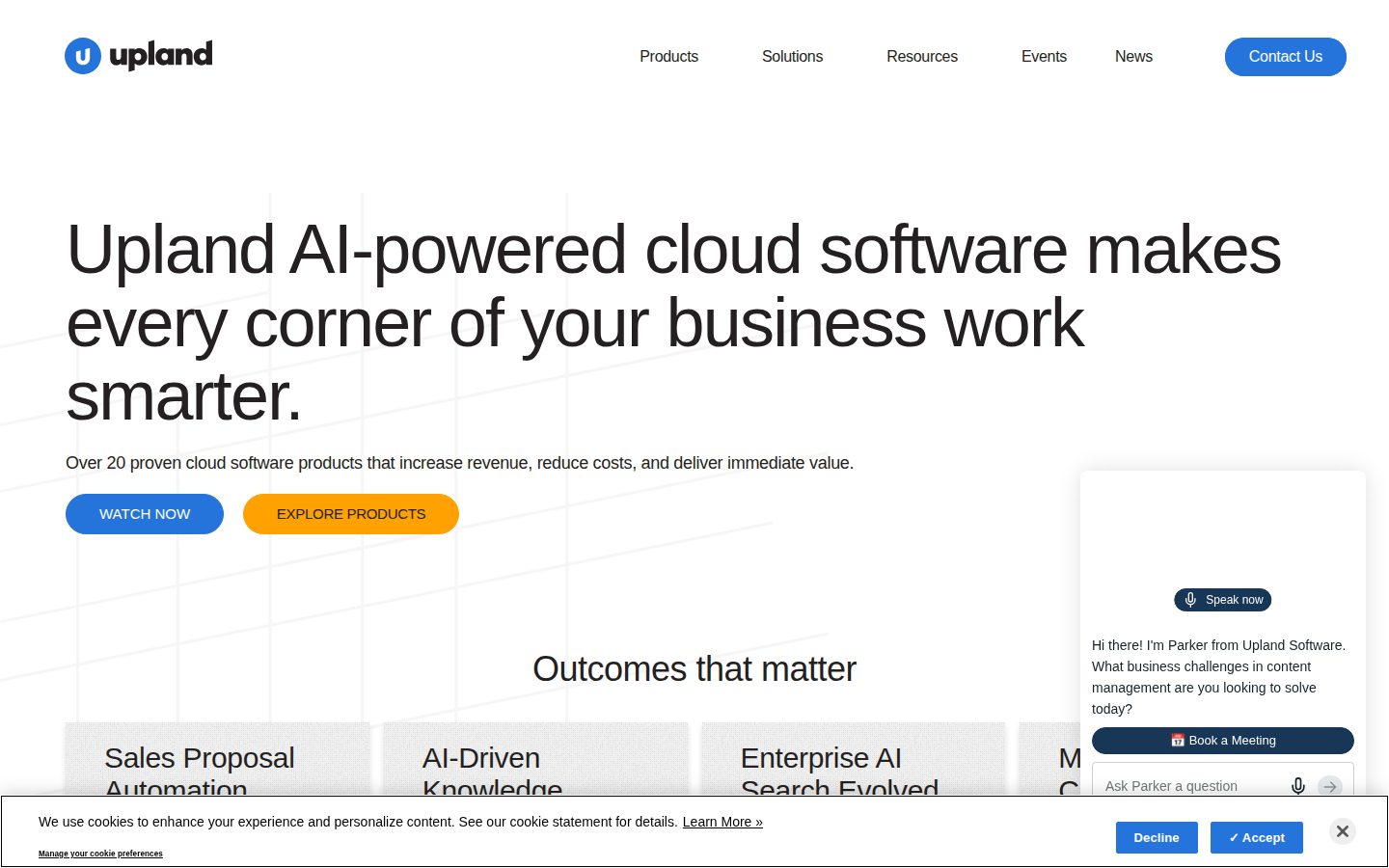
Contact for pricing. Upland Software offers AI-powered cloud software products for enterprise customers across sales proposal automation, knowledge management, enterprise search, and customer engagement.
Upland is a safe public vendor, but recent divestitures raise a fair portfolio-direction question.
“A NASDAQ-listed software company that won't fail a viability review. The catch is a 21% revenue drop from selling off products in 2025.”
A vendor that has been public since 2014 won't fail a viability review. Upland trades on NASDAQ and refinanced its debt out to 2031. That part a buyer can defend without sweating it.
The product is the real question. Upland Qvidian automates RFP and proposal responses and claims a 60% cut in the time those tasks eat, which is genuine value for a sales team drowning in submissions. Loopio is the sharper standalone pick here, but Upland bundles RightAnswers knowledge management and BA Insight enterprise search under one contract.
The catch is direction. FY2025 revenue fell roughly 21% as Upland sold off products to sharpen the portfolio, and a board will ask whether the app you bought is one of the keepers. Pilot the specific product you need, get roadmap commitments in writing, then decide.
The bundle competes on breadth, but standalone rivals like Loopio are sharper per category.
A NASDAQ-listed vendor is an easy choice to defend to peers and the board.
Upland Qvidian claims a 60% cut in RFP response time, a fast and measurable payback.
Strong if you consolidate several tools, weaker as a single point solution.
Public since 2014, profitable at 27% adjusted EBITDA margin, debt refinanced to 2031.
Enterprises who already run several Upland applications under one contract.
Buyers who need certainty that a specific product stays in the portfolio.
Upland is twenty acquired products under one logo, not one platform you architect against.
“Upland Software bundles 20-plus separately built cloud applications spanning RFPs, knowledge management, and enterprise search. Each tool is capable, but the portfolio shares no common substrate, which shapes the three-year integration story.”
Upland Software is a roll-up, and the architecture shows it. Public on Nasdaq since its 2014 IPO, the company assembled 20-plus cloud products through acquisition rather than building one platform. Standardizing here means standardizing on a vendor, not a stack — each product carries its own data model, admin layer, and lineage.
The individual craft is real. Upland Qvidian automates RFP responses with a documented 60% time saving, and Upland BA Insight delivers federated enterprise search across siloed libraries. For a knowledge-management mandate, RightAnswers is a credible alternative to ServiceNow Knowledge Management at a likely lower entry cost.
But the catch is coherence. These tools don't share an intelligence layer or a single API surface, so integration work lands on your team product by product. Upland is also mid-pivot — divesting lower-margin lines in 2025 — so confirm your specific product is core before a three-year commitment.
Upland is pivoting toward higher-margin AI knowledge management, narrowing but clarifying its position.
Solutions map well to enterprise RFP, knowledge, and search workflows mid-market teams run.
No shared substrate or unified API across the 20-plus products means per-tool integration work.
Roll-up structure plus an active 2025 divestiture cycle leaves product-line continuity uncertain.
Individual products like Qvidian and BA Insight show mature, domain-specific craft.
Enterprise IT teams who need one specific Upland product like Qvidian or RightAnswers.
Architects who want a single unified platform with a shared data model and API.
Every Upland number starts in a sales call, and you are buying a portfolio, not a product.
“Upland publishes no pricing, so each of its 20-plus cloud products is quote-only. The real budgeting question is which two or three modules you actually need, not the portfolio brochure.”
Upland Software sells no sticker. Over 20 cloud products, all quote-only. Founded 2010, public on NASDAQ as UPLD, 1,100-plus enterprise customers per their site.
TCO math. You do not buy 'Upland.' You buy a module: Qvidian for RFP automation, BA Insight for enterprise search. Each is its own contract, its own renewal date. Budget mid-market deals in the tens of thousands per module. The catch is portfolio drift — separate invoices, separate terms, no consolidated discount unless you negotiate one. 2025 revenue fell 21% on divestitures, and $232M in notes payable makes vendor risk non-trivial.
ROI is measurable per module. Qvidian claims 60% less time on proposals; Adestra cites a 133% email engagement lift. Compare Responsive for RFPs, which posts clearer terms. Push for termination rights and negotiate each renewal alone.
Enterprise invoicing is standard, but multiple separate contracts add procurement friction.
Separate renewal dates per module give some leverage but require negotiating each deal alone.
No published pricing anywhere; all 20-plus products are quote-only behind a sales call.
Module-level metrics like Qvidian 60% proposal time saved and Adestra 133% engagement lift are measurable.
Per-module contracts and integration services make all-in cost hard to model upfront.
Enterprises who need one or two specific Upland modules and can negotiate hard.
Buyers who want transparent published pricing without a sales call.
Upland is twenty-odd separate tools under one logo, so your day-three reality depends entirely on which one you got.
“Upland Qvidian and RightAnswers are real practitioner tools with concrete time savings. But you adopt one product, not a suite, and they share no common workspace.”
A proposal writer judges a tool by whether the RFP shred still feels like manual copy-paste at 4pm on a deadline. Upland Qvidian is built for that fight — a content library, reusable answers, and AI draft assist the vendor pegs at 60% time saved.
The friction is structural. Upland is a roll-up of 31-plus acquired products, and Qvidian, RightAnswers, and BA Insight were separate companies before Upland bought them. They share no workspace, login model, or design language. Responsive, formerly RFPIO, gives a tighter single-product experience; Upland gives depth in one silo and a sales call for anything else.
What lands is that each tool is mature — BA Insight enterprise search and RightAnswers have years of real workflow behind them. But the catch is you're buying a product, not a platform. There's no public docs site or changelog, so pick the one tool that fits and ignore the logo.
Individual products like Qvidian are mature and built for daily RFP work, with a vendor-cited 60% time saving.
No public docs site or changelog, so scoping upgrades requires an account-management call.
The roll-up of 31-plus acquired products means inconsistent UX once a team touches more than one tool.
Tools like BA Insight enterprise search and RightAnswers knowledge base have years of real depth behind them.
Each tool fits its own workflow well, but the products do not share a workspace or login model.
Proposal and knowledge teams who need one mature tool for one workflow.
Buyers who expect a unified suite where products share a workspace.
Upland Software is twenty tools under one logo, and you feel the seams.
“A deep bag of enterprise apps that each solve a real problem well. The catch is they were bought, not built together, so the daily feel varies tool to tool.”
Upland Software is not one product, it is a shelf. Over 20 cloud apps under one name, picked up through acquisitions since the company started in 2010. Upland Qvidian handles RFP responses and claims 60% time saved, Upland RightAnswers runs a self-service knowledge base, Upland BA Insight does enterprise search. Each is a genuine tool. They just were not designed in the same room.
That is the day-three truth. You are not learning Upland, you are learning whichever app you bought, and a Qvidian user and an Adestra user live in different products with different polish. Pegasystems feels more like one coherent platform, even if it is heavier. Upland trades that unity for pick-what-you-need range.
There is no free plan and no public price, just a contact form, so this is a demo-and-contract decision. With 1,100+ enterprise customers it is clearly durable. But anyone hoping for one seamless suite should know the seams are still there.
Polish varies tool to tool because the portfolio was assembled through acquisitions, not built as one.
You learn one app like Upland Qvidian, not a shared system, so each tool is its own curve.
Enterprise back-office workflow software where mobile is not the primary use case, scored neutral.
No free plan or public price means onboarding starts with a demo and a contract, not a Tuesday login.
A public company since 2014 with 1,100+ enterprise customers signals durable, dependable software.
Enterprise teams who need one specific workflow tool solved well.
Small teams who want a single unified suite they can try today.
A roll-up of 20-plus acquired products on Nasdaq, with revenue heading the wrong way.
“Upland is a public company that grew by buying 30-plus tools and stitching them under one brand. The catch is the portfolio shrank and 2025 revenue fell 21 percent.”
Upland Software went public on Nasdaq in 2014 and grew the way roll-ups do — buying 30-plus companies and rebranding them under the Upland name. That is durability, sort of. It is also why "portfolio" means 20-plus separate products, not one platform.
The individual tools have real track records. Upland Qvidian automates RFP responses and claims 60 percent time savings; Upland RightAnswers does knowledge management against the likes of ServiceNow. But the marketing leans hard on AI now, and these are mature products with AI features added, not AI-native builds. The bigger tell: 2025 revenue came in around $217M, down 21 percent from the prior year.
The yellow flag is consolidation risk. Roll-ups divest products that underperform, so the tool you buy may get sold or sunset. Exit is per-product, with no shared portability story.
Individual tools like Qvidian compete on par with Responsive and ServiceNow, but the bundle itself adds no clear edge.
Each acquired product locks data its own way and there is no shared export or migration path across the portfolio.
Nasdaq-listed with HGGC backing, but a 21 percent revenue decline and roll-up divestiture risk cloud the 3-year bet.
The homepage pitches AI heavily, but these are mature acquired tools with AI added on, not AI-native products.
A public company since 2014 with 1,100-plus enterprise customers, though the 2025 revenue drop matches a roll-up under strain.
Enterprises who want a specific Upland product like Qvidian for RFP automation.
Buyers who want one unified platform rather than a portfolio of acquired tools.
Common questions answered by our AI research team
Upland Adestra uses AI to create personalized, multichannel content, driving a 133% increase in email engagement.
Company
Upland SoftwareFounded
2010Pricing
Contact for pricingFree Trial
AvailableUpland Software is an Austin-based enterprise software company offering a portfolio of cloud applications for marketing, sales, and operations.