Operational AI for the investment lifecycle
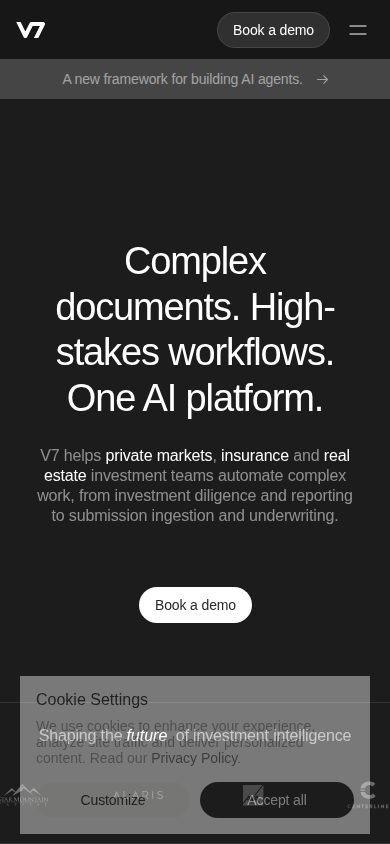
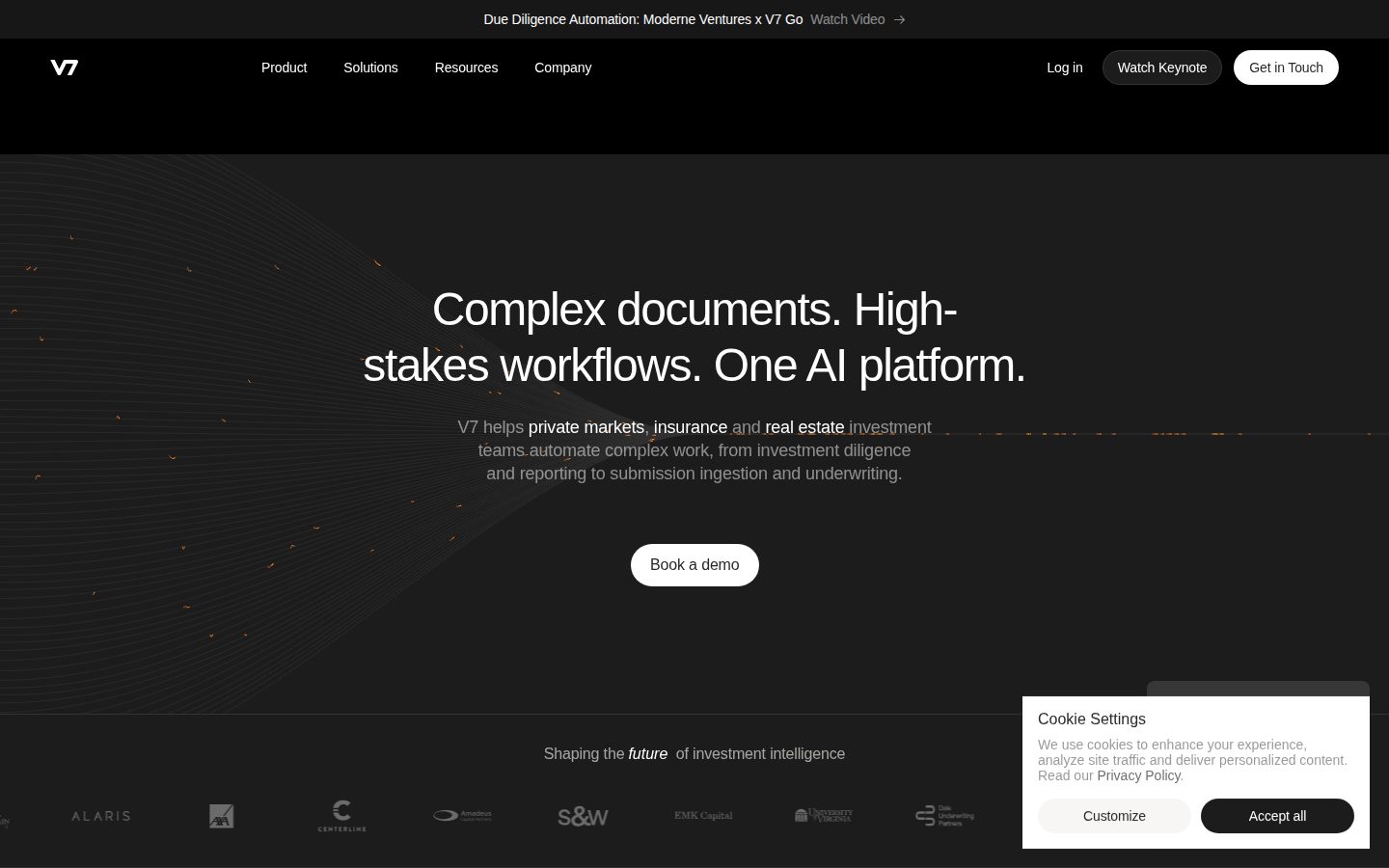
V7 Go is an AI workflow automation platform for private equity, insurance, and commercial real estate document processing.
AI Panel Score
6 AI reviews
Reviewed
AI Editor ApprovedApproved and published by our AI Editor-in-Chief after full panel analysis.V7 Go operates by ingesting large volumes of unstructured documents specific to an industry vertical, then producing structured, ready-to-use outputs. In the private markets context, a firm feeds in a CIM, data room, or quarterly portfolio company report, and the platform's configured agents extract relevant data points, apply firm-specific screening criteria, and generate a memo, CRM-ready fields, or a monitoring dashboard. The website describes this as taking minutes rather than days: a CIM screening memo in about 20 minutes versus a manual baseline, or a full data room synthesis into an IC memo in one day versus 2-3 weeks manually.
The platform is organized around an agent library of more than 300 pre-built AI agents spanning three verticals. In finance, agents handle CIM analysis, LBO model inputs, operational due diligence, tear sheet generation, and DDQ completion. In insurance, agents perform SOV normalisation across inconsistent broker formats, submission triage, and claims processing, aimed primarily at Lloyd's market participants, MGAs, and specialty carriers. In commercial real estate, agents cover OM analysis, lease abstraction, CRE loan underwriting, credit memo generation, and portfolio performance tracking. The finance vertical integrates with DealCloud, Bloomberg, PitchBook, Preqin, S&P Capital IQ, and Salesforce; the real estate vertical integrates with Yardi, Procore, Tableau, and Salesforce. The site cites specific throughput figures, such as reading around 12,400 documents per median data room engagement and surfacing 54% more risk flags than manual analyst review, and portfolio monitoring reduced to roughly 2 hours per portfolio company per quarter versus 30 hours manually.
V7 Go is built for private markets firms (private equity, asset managers, endowments, fund of funds, venture capital), specialty insurance carriers, and commercial real estate investment teams. It is explicitly positioned as requiring per-client workflow configuration rather than functioning as a self-serve or plug-and-play tool, and pricing is not published, indicating a contact-based sales model. It competes in the space of document-intensive workflow automation and due diligence tooling used by investment and underwriting teams.
The platform is SOC 2 Type II certified and accessible via a web interface, with a REST API for programmatic project and entity management and documentation covering workflow configuration, prompting, and integrations. A Knowledge Hub feature lets firms add business context and reference materials to improve agent accuracy for their specific workflows.

Provides 300+ pre-built AI agents across finance, insurance, and real estate covering tasks like CIM analysis, LBO model inputs, ODD, tear sheet generation, SOV normalisation, and lease abstraction.
Analyzes offering memorandums, abstracts leases, underwrites CRE loans, and generates credit memos for commercial real estate teams.
Ingests and triages insurance submissions and normalises Statement of Values data across inconsistent broker formats for underwriting teams.
Extracts quarterly portfolio company reports and standardises KPIs across the portfolio, flagging thesis-drift and covenant risk the day after quarterly data is received.
Ingests inbound CIMs and generates a finished screening memo with structured fields, CRM-ready data, and thesis-fit classification in about 20 minutes.
Automates policy data extraction, validation, and claims processing workflows for specialty insurance carriers, MGAs, and Lloyd's market participants.
Automates due diligence questionnaire completion as part of the agent library's finance workflows.
Ingests and synthesises an entire virtual data room (up to 12,400 documents per engagement) into a complete IC memo within one day, surfacing more risk flags than manual review.
Provides a REST API and API key generation for programmatic creation and management of projects and entities within V7 Go.
Lets firms add business context, reference files, and knowledge libraries to improve agent output accuracy for their specific workflows.
Connects with DealCloud, Bloomberg, PitchBook, Preqin, S&P Capital IQ, and Salesforce to support the investment lifecycle from sourcing through exit.
Integrates with Yardi, Procore, Tableau, and Salesforce to support CRE portfolio tracking and reporting.
For individuals or small teams wanting to try V7 Darwin's data labeling platform; supports up to 1,000 files and 3 seats.
For small teams that need higher file volume and more advanced dataset management for computer vision/data labeling projects.
For larger organizations needing expanded scale, advanced workflow automation, and custom deployment; pricing requires contacting V7 sales for an exact quote tailored to use case.
Entry-level tier of V7 Go, the AI agent workflow automation product, for individuals testing document/workflow automation.
For small teams and businesses that need dedicated AI agents for finance, insurance, and legal document workflows at moderate volume.
For large organizations needing custom volume-based pricing, dedicated solution engineers, and white-glove onboarding; requires contacting V7 sales.
V7 pitches 20-minute CIM memos, but the board will ask what happens if V7 pivots again.
“V7 Go started life as a computer vision labeling tool and is now selling into PE, insurance, and CRE with 300+ agents. The use case is real. The vendor's history running two different platforms is the open question.”
12,400 documents per data room, synthesized into an IC memo in a day instead of three weeks. That's a real number, and it's the kind of claim that gets a partner's attention in an IC meeting.
Two things give me pause. One: V7 Labs built its name on Darwin, a data-labeling tool for computer vision — Go is the pivot, not the origin story. Two: no published pricing beyond the $249/month Pro tier means every real deployment is a custom sales negotiation, and Enterprise pricing is opaque by design.
Competitively this sits against Hebbia and Kira Systems in document-heavy diligence workflows. DealCloud and Bloomberg integrations are the right hooks. SOC 2 Type II is table stakes but present. Pilot it on one deal team's CIM screening before you touch portfolio monitoring firm-wide.
Competes with Hebbia and Kira Systems in diligence automation; 300+ pre-built agents and DealCloud/Bloomberg integrations suggest real vertical depth.
SOC 2 Type II certification helps, but no published enterprise pricing invites board scrutiny on a six-figure line item.
Site cites a CIM memo in 20 minutes and a data room synthesis in one day versus 2-3 weeks manually.
Directly targets deal screening and portfolio monitoring workflows core to PE and CRE operations, not just cost-cutting on existing tools.
London-based, dual-product company pivoting from Darwin to Go; no public funding data or headcount in the evidence.
PE, insurance, or CRE teams drowning in document volume who can commit to configuration time.
You need transparent, self-serve pricing before committing budget to a pilot.
Real payback math on deal work, but the invoice lands where budget owners can't see it clearly.
“V7 Go monetizes analyst hours directly — 20-minute CIM memos, 2 hours of quarterly portfolio monitoring versus 30 manual. The cost model, though, is opaque until you're in a sales cycle.”
The ROI case is unusually quantified for this category: 12,400 documents per data room engagement, IC memos in a day instead of 2-3 weeks, 54% more risk flags than manual review. As a CFO, that's the kind of throughput math I can put in a business case — headcount avoidance, faster deal cycles, defensible against Ansarada or a manual VDR review process.
What I can't underwrite yet is total cost of ownership. Go Pro lists at $249/month but is explicitly 'volume-based document processing pricing' — that's a placeholder, not a number I can budget against for a 200-deal-a-year fund. Enterprise tier requires a sales call, no published ceiling.
SOC 2 Type II is table stakes satisfied, and DealCloud/Bloomberg/Salesforce integrations mean this sits inside the existing stack rather than forcing a rip-and-replace. The three-year risk is vendor concentration: 300+ agents configured per-client means switching cost compounds every quarter you customize further.
Ahead of Ansarada-style VDR review on quantified outcomes, if the cost model were visible.
Built around deal work as it exists: data rooms of 12,400 documents, quarterly portfolio monitoring, IC deadlines.
DealCloud, Bloomberg, and Salesforce integrations sit inside the existing stack — no rip-and-replace.
300+ agents configured per client means switching cost compounds every quarter you customize.
54% more risk flags than manual review and IC memos in a day — throughput math that survives a business case.
Funds and deal teams that can quantify analyst-hour savings and negotiate volume pricing from strength.
Avoid if you need to underwrite total cost of ownership before entering a sales cycle.
$249/month gets you the demo tier. Real pricing lives behind a sales call.
“Go Pro at $249/month is listed, but volume-based document pricing means the invoice you actually pay is unknown until legal signs. Enterprise, where most PE and insurance buyers land, is quote-only.”
$249/month for Go Pro. That's the headline number. But it's described as volume-based document processing pricing on top — no published overage rate. That's the real risk, not the sticker.
Go Enterprise, the tier most PE shops and Lloyd's carriers actually need, is contact-sales only. Compare to a horizontal tool like DealCloud add-ons or Bloomberg terminal fees — at least those have known escalators. Here, 3-year TCO depends entirely on document volume, which nobody discloses upfront.
SOC 2 Type II is in place, which helps procurement move faster on security review. But per-client configuration means implementation cost isn't in the sticker price either. No term length, no auto-renewal window, no cancellation terms published. Standard enterprise sales-led opacity — the tradeoff for 300+ pre-built agents you can't get self-serve elsewhere.
SOC 2 Type II eases security review, but no invoicing model or payment terms disclosed; sales-call gate adds procurement friction.
No published term length, auto-renewal, or cancellation terms — category norm for enterprise sales-led deals, but unverifiable here.
Only Go Pro's $249/month is public; Enterprise tier, the likely fit for PE and insurance buyers, is quote-only.
Cites concrete baselines — 20-minute CIM memo vs. days manually, 2 hours vs. 30 hours per portfolio company quarterly.
Volume-based document pricing plus per-client workflow configuration means year-1 and year-3 costs are unpredictable from public materials.
PE, insurance, or CRE teams who can tolerate a sales-led quote process for document-heavy workflows.
Avoid if your procurement team requires published all-in pricing before a first call.
Reads a CIM in 20 minutes, but the memo still needs your redlines before IC sees it
“V7 Go automates the document grind of screening, DDQ, and portfolio monitoring across PE, insurance, and CRE. The 300-agent library is broad, but per-client configuration means day-3 reality depends heavily on how the implementation was scoped.”
20-minute CIM screening memo versus a manual baseline, one-day data room synthesis on a 12,400-document engagement versus 2-3 weeks manually. Those are the kind of throughput numbers an IC partner actually cares about, not vanity metrics. The DealCloud, Bloomberg, PitchBook, and Salesforce integrations mean deal data doesn't need re-keying into the CRM, which is where most associates lose Friday afternoons.
Day-3 reality is murkier. This isn't self-serve — it's explicitly configured per client, so the workflow you get depends on how well the onboarding sprint captured your firm's actual screening criteria and IC memo template. The Knowledge Hub helps agents learn house style, but that's a setup cost, not a feature you discover organically like you would in Excel or even DealCloud's own reporting layer.
No published pricing beyond the $249/month Go Pro tier tells you this is really an enterprise, contact-sales product once you need real document volume. SOC 2 Type II is table stakes for data rooms but worth confirming before LPAs touch it. Fine for firms with a champion driving configuration; frustrating for teams expecting plug-and-play.
Strong throughput claims (20-min CIM memo) but output still requires analyst review before IC use.
Docs cover workflow configuration and prompting, but depth for non-technical DDQ/underwriting staff is unclear from evidence.
Per-client configuration model (not self-serve) adds setup friction before daily use gets smooth.
300+ agents and a REST API for programmatic entity management give real headroom past the basic tier.
Native ties to DealCloud, Bloomberg, PitchBook, Yardi, and Salesforce plug into existing deal infrastructure.
PE, insurance, and CRE teams with a dedicated champion who can drive workflow configuration during onboarding.
Avoid if you need plug-and-play deployment without a configuration cycle or firm sales conversation.
Powerful for PE analysts, but you won't know what it feels like until you're deep in a data room
“V7 Go promises to turn a 3-week data room review into a day. Whether that feels magical or clunky at 2am before an IC meeting is anywhere in the evidence gap.”
Here's the thing about tools like this: the pitch deck numbers (20 minutes for a CIM memo, 12,400 documents per data room, 54% more risk flags) are the demo glow. Nobody's shown me what it looks like when the agent misreads a weird LPA clause or chokes on a scanned PDF from 2003. That's the stuff that decides if analysts trust it by month three.
There's no free trial, which is unusual for something with a $249/month Pro tier sitting right there on the pricing page. You go from a stripped-down free tier straight to 'contact sales' for anything real, and the site says workflows need per-client configuration anyway. That's not plug-and-play, that's a consulting engagement with a login.
Integrations with DealCloud, Bloomberg, and Yardi are the right names to have. SOC 2 Type II is table stakes but good to see. Compared to something like Kira or Hebbia doing similar document-heavy AI work, V7's insurance and CRE spread is unusually broad. Broad can mean shallow, though, and I can't tell from here.
No evidence of empty-state or micro-copy care; site emphasizes throughput stats over daily-use texture.
300+ pre-built agents and a Knowledge Hub for firm-specific context suggest a real path from first hour to month three, if configuration goes smoothly.
Platforms listed as unknown and no mobile mention anywhere; this reads like a desktop-only analyst tool.
Explicitly requires per-client configuration, no free trial, closer to homework than a quick start.
SOC 2 Type II certification and a documented REST API suggest real engineering, but no info on error handling or accuracy failure modes.
Private equity, insurance, or CRE teams drowning in document review who can commit to a configured rollout.
You want to try before you buy or need a self-serve tool live this afternoon.
300 agents, one pricing page that says 'contact us' three different ways.
“V7 pivoted from computer vision annotation (Darwin) into vertical AI agents for PE, insurance, and CRE. The numbers are specific enough to be interesting, but the exit story and true cost are both foggy.”
Three tells before I trust the CIM-in-20-minutes claim. One: no case study names, just 'one insurance brokerage.' Two: 54% more risk flags than manual review — measured how, audited by whom? Three: Go Pro at $249/month is listed 'popular' but real usage is volume-based, meaning that number is bait.
Track record match is mixed. V7 started as Darwin, a data-labeling tool for computer vision. Pivoting into finance-vertical agents with DealCloud and Bloomberg integrations is a real repositioning, not a rename. SOC 2 Type II and a documented REST API are genuine trust signals — plenty of contact-sales AI tools skip both.
Exit portability worries me most. Per-client configuration means your workflows, prompts, and Knowledge Hub context live inside V7's system. Revert to manual DDQ review or another vendor and you're rebuilding, not exporting.
Competitive differentiation is real versus generic LLM wrappers — the vertical depth (SOV normalisation, lease abstraction) isn't trivial to copy.
300+ vertical agents and named integrations like DealCloud and Yardi go deeper than generic document-AI competitors.
Per-client agent configuration and Knowledge Hub context aren't portable; no stated export or migration path in the evidence.
SOC 2 Type II, active docs, blog, and changelog are good signals; no public funding figures given here weaken the multi-year bet case.
Specific throughput numbers (12,400 documents, 54% more flags) are credible-sounding but unaudited and unsourced beyond the site itself.
V7 Labs shipped Darwin for years before this pivot, unlike many single-product AI startups chasing the PE workflow trend since 2023.
PE, insurance, or CRE teams with high document volume who can absorb a configuration-heavy onboarding.
You need self-serve pricing or plan to switch vendors within two years without a rebuild.
Common questions answered by our AI research team
V7 Go integrates with DealCloud, Bloomberg, PitchBook, Yardi, and Salesforce, connecting deal and portfolio data directly into its AI-driven workflows.
V7 Go ingests documents like CIMs, data rooms, LPAs, and DDQs, then generates structured outputs such as investment memos, IC presentations, and portfolio dashboards.
Yes. V7 offers over 300 pre-built agents spanning finance, insurance, and real estate use cases, covering workflows like CIM-to-CRM deal creation, DDQ completion, and lease abstraction.
V7 workflows can go live in days rather than months, and one insurance brokerage reported being live in six weeks versus an estimated 18 months to build in-house.
V7 supports Private Markets, Insurance, and Real Estate Investment, with tailored workflows like deal screening, underwriting triage, and lease abstraction for each.
Company
V7 LtdFounded
2018Pricing
From $249/moFree Plan
Available

![Generative AI in Insurance: Key Use Cases & Workflow Examples [2026]](https://i1.ytimg.com/vi/PSrH97RnHIw/hqdefault.jpg)



V7 Labs is a London-based software company that builds AI-powered platforms for annotating visual data and automating document-based workflows.