Vic.ai logo

Vic.ai Review

Visit

AP automation software for enterprise finance teams

Vic.ai is an AI-native accounts payable automation platform for mid-market and enterprise finance teams.

AI Panel Score

7.8/10

6 AI reviews

Reviewed

About Vic.ai

In practice, AP teams using Vic.ai receive invoices through email, SFTP, API, or mobile upload into a centralized inbox called Vic Inbox. The platform extracts structured header and line-level data using AI, matches invoices against purchase orders, routes exceptions for human resolution, and sends coded and approved invoices directly into the connected ERP — with the goal of minimizing manual touchpoints throughout the process.

Beyond core invoice processing, Vic.ai includes a Vendor Portal where suppliers can submit invoices and check payment status independently, reducing inbound inquiry volume. Bill Pay functionality allows payment execution within the same workflow rather than requiring a switch to a separate system. The platform also covers corporate card transactions and employee expenses, and provides analytics dashboards tracking invoice volumes, cycle times, exception rates, and team productivity. VicAgents, a newer capability, are AI agents designed to complete discrete finance tasks autonomously within defined parameters rather than simply surfacing recommendations for humans to act on.

Vic.ai targets mid-market and enterprise companies, with solution packaging oriented around the concerns of CFOs, Controllers, and AP Managers. Pricing is not publicly listed and is typically structured as an enterprise contract requiring a demo and scoping conversation. Competitors in the AP automation category include Tipalti, Basware, Medius, Stampli, and SAP Concur Invoice.

The platform integrates natively with SAP, Microsoft Dynamics 365, GP, Business Central, Oracle, and Coupa, sitting in front of the ERP and pushing processed invoices into it. Infrastructure runs on AWS with AES-256 encryption, SSO and MFA support, and the platform holds SOC 1 Type II, SOC 2 Type II certifications and operates under an ISO 27001 framework.

Features

AI

  • Global & Local AI Model Architecture

    Uses global AI models trained across the entire customer base for header-level predictions combined with customer-specific local models for line-level coding decisions.

  • VicAgents

    AI agents that autonomously complete discrete finance tasks end-to-end within defined parameters, rather than merely assisting human operators.

Analytics

  • Analytics & Insights

    Delivers reporting and dashboards covering AP performance metrics including invoice volumes, cycle times, exception rates, spend visibility, and team productivity.

Automation

  • Approval Routing

    Routes invoices for approval based on learned patterns and configured rules, escalating only items that genuinely require human review to minimize approver interruptions.

  • Invoice Processing

    Captures invoices from email, SFTP, API, or mobile and extracts structured header and line-level data using AI trained on a large global invoice dataset, eliminating manual keying.

  • PO Matching

    Matches invoices against purchase orders across multiple dimensions, flags exceptions, and routes them for resolution without holding up the rest of the processing queue.

Collaboration

  • Vendor Portal

    Provides vendors a self-service interface to submit invoices and check payment status, reducing inbound vendor inquiry volume for AP teams.

  • Vic Inbox

    A centralized, auditable inbox for managing inbound invoices and vendor email that replaces shared AP email inboxes with a structured workflow layer.

Core

  • Bill Pay & Payments

    Executes vendor payments directly within the Vic.ai workflow, removing the need to switch between AP and external payment systems.

  • Expense Management

    Manages corporate card transactions and employee expenses within the same platform as AP, giving finance teams a unified view of spend.

Integration

  • ERP Integrations

    Provides native integrations with SAP, Microsoft Dynamics, Oracle, and other major ERP systems, pushing coded and approved invoices directly into the ERP.

Security

  • Trust & Security

    Supports SOC 1 Type II and SOC 2 Type II certifications, ISO 27001 framework, AES-256 encryption, SSO/MFA, and AWS infrastructure with penetration testing and defined AI training data practices.

Preview

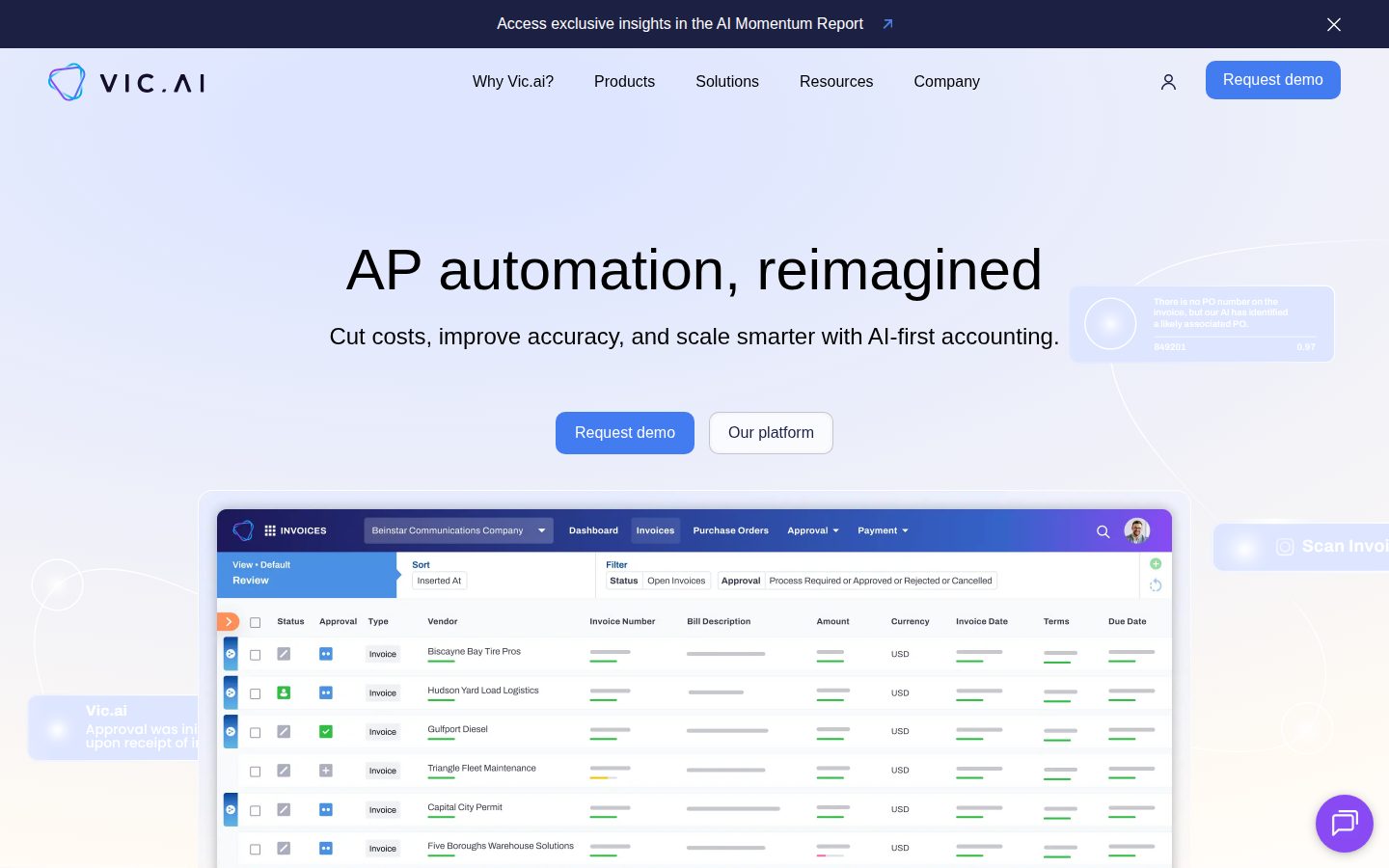
Vic.ai desktop previewVic.ai mobile preview

Pricing Plans

Contact Sales

Contact sales

Custom pricing for finance teams looking to automate AP processes with AI. Vic.ai requires a discovery call to provide tailored pricing based on company revenue, invoice volume, and ERP platform.

  • AI-powered accounts payable automation
  • Integration with major ERP platforms (NetSuite, SAP, Oracle, Dynamics, etc.)
  • Invoice processing automation
  • Productivity and accuracy improvements for AP teams
  • Tailored onboarding based on invoice volume and company size

AI Panel Reviews

The Decision Maker

The Decision Maker

Strategic bet, vendor viability, timing, adoption approval
7.8/10

Solid AI-native AP automation with a 7-month payback and no public pricing.

Vic.ai is a purpose-built AP automation platform with real architecture differentiation — global plus local AI models is smarter than what Tipalti or Stampli publish. The 7-month payback claim is credible if invoice volume justifies the enterprise contract.

The dual-model architecture matters. Global models for header predictions, local models for line-level coding — that's not marketing, that's a defensible technical approach. The changelog is absent and pricing is opaque, but SOC 1 and SOC 2 Type II certifications plus ISO 27001 tell me this isn't a startup winging it on security.

VicAgents is the bet worth watching. Autonomous task completion rather than surfacing recommendations is the right direction, but it's newer and the evidence doesn't show production depth yet. Tradeoff: if you want fast, low-friction onboarding, the no-templates claim is compelling — Diesel Direct hitting 97% accuracy without setup is real signal.

No public pricing means every deal is a negotiation. That's fine for enterprise, but it slows the pilot conversation. Three questions before signing: What's the contract length? What's the ERP integration cost? Who owns the data if you leave?

Competitive Positioning7.8

The global-plus-local AI model architecture is a genuine differentiator versus Tipalti and Stampli, which rely more on rules-based routing.

Reputation Risk7.5

AI-native AP automation is a credible board-defensible category, and the 7-month payback claim gives CFOs a concrete number to point at.

Speed to Value8.0

Seven-month payback period plus no-template onboarding and 99% accuracy out of the box is a strong time-to-impact story.

Strategic Fit8.1

VicAgents and the end-to-end workflow — invoice capture through VicPay — advances AP capability rather than just digitizing existing manual steps.

Vendor Viability7.2

No public funding data and unknown headcount, but SOC 2 Type II certifications and native SAP/Oracle integrations suggest an established, not nascent, operation.

Pros

  • Dual AI model architecture — global for headers, local for line-level — is smarter than category norm
  • No templates or coding required; Diesel Direct hitting 97% accuracy is credible third-party signal
  • Full-cycle coverage: Vic Inbox through VicPay, plus Vendor Portal, in one platform
  • SOC 1 and SOC 2 Type II plus ISO 27001 — security story holds up for enterprise procurement

Cons

  • No public pricing means every deal requires a full sales cycle before you can compare options
  • VicAgents is newer capability with no public depth on production use cases yet
  • No changelog published, so it's hard to assess shipping velocity from outside

Right for

Mid-market or enterprise finance teams running high invoice volumes who want AI-native AP automation that integrates directly with SAP, Oracle, or Dynamics.

Avoid if

You need transparent SaaS pricing upfront or are a smaller company where the enterprise contract structure won't pencil out.

The Domain Strategist

The Domain Strategist

Craft and strategy in the product's domain — adapts identity per category, same lens
8.2/10

AI-native AP architecture with a dual-model design that serious controllers should evaluate carefully.

Vic.ai's global-plus-local model architecture is the most technically differentiated position in the AP automation category. The 7-month payback claim and 99% accuracy figure are aggressive but backed by named customer evidence from Diesel Direct.

The dual-model architecture — global models for header predictions, customer-specific local models for line-level coding — is not a marketing distinction. That's a real design decision that reflects someone who understands why AP coding is hard: headers generalize, GL allocations don't. Stampli and Medius don't publish anything comparable on model architecture. That's a moat worth noting.

VicAgents is the strategic bet I'm watching. If autonomous task execution inside defined parameters matures, that's the difference between a processing tool and a genuine AP operating layer. Right now it's a newer capability per the docs, so I'd evaluate it as a roadmap signal rather than a production dependency in year one.

The opaque pricing is the practical friction point. Enterprise contract with no public floor means budget conversations start blind, and mid-market controllers will feel that during procurement. SOC 1 and SOC 2 Type II plus ISO 27001 framework clears the compliance bar for most finance orgs.

Category Positioning8.2

Sits ahead of Stampli on architectural maturity and targets the same mid-market segment as Tipalti, but with a stronger AI-native claim backed by specific accuracy metrics.

Domain Fit8.3

Vic Inbox, PO matching, approval routing, and Bill Pay cover the full AP control cycle that a controller actually owns, not just data capture.

Integration Surface8.0

Native integrations with SAP, Microsoft Dynamics 365, Oracle, and Coupa cover the ERP surface area of most mid-market and enterprise finance stacks.

Long-term Implications7.8

If we adopt this, in 3 years our AP workflow is structurally dependent on Vic.ai's ERP push layer — switching cost is real, but the VicAgents roadmap is where the compounding value lives.

Strategic Depth8.5

The global-plus-local AI model split shows genuine domain depth — not a generic LLM wrapper applied to invoice PDFs.

Pros

  • Dual-model AI architecture is a genuine technical differentiator, not positioning language
  • Full AP workflow coverage from Vic Inbox through Bill Pay removes the hand-off friction I deal with in multi-tool setups
  • SOC 1 Type II, SOC 2 Type II, and ISO 27001 framework clears enterprise compliance requirements without exceptions
  • 7-month payback period with named customer evidence is a credible ROI anchor for budget conversations

Cons

  • No public pricing means procurement cycles start without a cost anchor — frustrating for controllers building business cases
  • VicAgents is described as a newer capability, so autonomous task execution is a roadmap bet rather than a proven control today
  • No changelog or API docs visible publicly, which limits pre-sales technical diligence on integration stability

Right for

Mid-market or enterprise controllers running high invoice volumes through SAP, Oracle, or Dynamics who want AI-native AP with a credible compliance posture.

Avoid if

Your finance stack is outside the named ERP integrations or your procurement process requires transparent public pricing before engaging a vendor.

The Finance Lead

The Finance Lead

Money, total cost of ownership, contracts, procurement math
7.2/10

99% accuracy claim is specific; the invoice you'll actually pay is not.

Vic.ai's AI architecture and 7-month payback claim are concrete anchors. Pricing opacity makes budget forecasting a liability until contract signature.

Global plus local AI model architecture is the real differentiator here. Header predictions trained across the entire customer base, line-level coding tuned per customer. 99% accuracy on invoice extraction, with Diesel Direct at 97% as a named reference. VicAgents adds autonomous task execution — not just recommendations. Feature depth matches enterprise need.

The math problem: no public pricing. Zero. Year 1 cost is unknown until a sales call. Category norm for AP automation runs $8–$25 per invoice or $500–$2,000 per month per module, depending on volume. At 50,000 invoices annually, that gap is $400K–$1.2M over 3 years. Compare Tipalti or Stampli — both disclose more upfront. No published overage rate on Vic.ai is the real budget risk.

Contract terms aren't disclosed publicly. Auto-renewal windows and termination clauses are negotiable blind. The 7-month payback claim is specific but unverifiable without the contract number. ROI story is plausible; ROI proof requires your own invoice volume data.

Billing & Procurement5.5

Enterprise sales motion with discovery call required adds 3–6 weeks of procurement friction before a PO can be issued.

Contract Flexibility4.5

No public auto-renewal terms, cancellation policy, or term length disclosed — standard enterprise contract risk with no mitigating transparency.

Pricing Transparency2.5

No pricing page, no tier structure, no published per-invoice or per-seat rate — full sales motion required before any number appears.

ROI Clarity6.5

Diesel Direct 97% accuracy and 7-month payback are named, specific anchors; actual ROI still depends on invoice volume and undisclosed contract structure.

Total Cost of Ownership5.0

7-month payback claim exists, but without list pricing, integration costs, or overage rates, 3-year TCO modeling requires assumptions across every line item.

Pros

  • 7-month payback period is a specific, testable claim
  • 99% invoice accuracy with named customer reference (Diesel Direct)
  • Global plus local AI model architecture is differentiated versus Tipalti and Stampli
  • Full AP workflow including VicAPSuite and VicPay in one contract

Cons

  • Zero pricing transparency — no page, no tier, no ballpark
  • Overage rates and volume thresholds not published anywhere
  • Contract terms, auto-renewal windows, and termination clauses are opaque
  • No free trial means no technical validation before contract commitment

Right for

Mid-market and enterprise AP teams processing high invoice volumes who can absorb a sales-led procurement process.

Avoid if

You need to model TCO before engaging sales or require pricing transparency for budget approval.

The Domain Practitioner

The Domain Practitioner

Daily hands-on reality in the product's domain — adapts identity per category, same lens
8.1/10

AI-native AP automation with real no-touch numbers — but pricing opacity stings

Vic.ai's dual-model architecture and 85% no-touch invoice processing rate are the kind of numbers that actually move an AP manager's week. No public pricing and no changelog makes enterprise evaluation harder than it needs to be.

The global-plus-local AI model split is genuinely thoughtful architecture for AP work. Global models handle header predictions — vendor name, invoice date, amounts — where cross-customer training adds real signal. Local models handle GL coding decisions, where your chart of accounts is your chart of accounts. That's the right division. The 99% accuracy claim is bold, but Diesel Direct's reported 97% in production gives it some grounding.

Vic Inbox replacing shared AP email inboxes is the daily workflow win most AP teams actually need. Shared inboxes are where invoices die. The Vendor Portal for self-service status checks attacks inbound inquiry volume directly — that's hours back per week. VicAgents doing autonomous task completion, not just flagging for humans, is ahead of where Stampli and Tipalti currently sit in their shipped roadmaps.

The no-public-pricing and no-changelog situation is a real friction point during evaluation and renewals alike. The docs indicator shows N, which means practitioners are flying somewhat blind on implementation specifics. Enterprise-only positioning means solo controllers and small AP teams are simply not the target — and that's fine, but know it going in.

Day-3 Reality7.8

85% no-touch processing and Vic Inbox suggest daily friction is low once configured, but no changelog means it's hard to know what's quietly changed in production.

Documentation Practitioner-Fit5.5

Docs availability is marked N in the evidence, which means practitioners can't self-serve on implementation questions — a real gap for a technically complex enterprise deployment.

Friction Surface8.0

Vendor Portal and centralized inbox cut two of the highest-friction AP tasks — vendor inquiry calls and inbox triage — without requiring AP staff to change their core behavior.

Power-User Depth7.9

VicAgents for autonomous task execution and configurable approval routing rules suggest genuine depth, but discoverability of advanced features can't be verified without public docs or a changelog.

Workflow Integration8.5

Native ERP integrations with SAP, Oracle, Dynamics, and Coupa mean invoices push directly into the ledger without a manual export step — that's the workflow fit AP teams need.

Pros

  • Dual-model AI architecture (global for headers, local for GL coding) is genuinely well-suited to AP work
  • 85% no-touch invoice processing and 7-month payback period are concrete, evaluable claims
  • Vendor Portal reduces inbound vendor inquiry volume without AP team involvement
  • VicAgents move beyond recommendation surfaces toward actual task completion

Cons

  • No public pricing — every evaluation requires a scoping call, which adds weeks to a buying decision
  • No public docs or changelog, making it hard to track what changed after a deployment
  • No free trial means committing significant evaluation time before touching the product
  • Enterprise-only packaging rules out smaller finance teams who'd benefit from the AI model

Right for

Mid-market or enterprise AP teams running SAP, Oracle, or Dynamics who process high invoice volumes and need ERP-connected automation without templating overhead.

Avoid if

You're a controller at a sub-50-person company or need transparent pricing and self-serve documentation to justify a purchase internally.

The Power User

The Power User

Daily human experience, onboarding, polish, learning curve, reliability
8.1/10

Serious AP automation that earns its enterprise price tag

Vic.ai is genuinely AI-native, not just AI-labeled. A 7-month payback claim and 99% accuracy number give finance teams something real to take to a CFO.

The global-plus-local AI model architecture is legitimately smart. Global models learn from the whole customer base for header data; customer-specific models handle line-level coding. That's not a checkbox — that's the reason the docs claim 97% accuracy for a customer like Diesel Direct without requiring templates or setup. Compared to Tipalti or Stampli, that no-template pitch is a meaningful differentiator for teams currently buried in exception queues.

VicAgents is the thing worth watching. Autonomous task completion versus just surfacing recommendations is a real architectural bet. The Vendor Portal and Vic Inbox also solve the exact daily annoyances AP managers actually complain about — the shared inbox chaos, the vendor inquiry calls.

The tradeoff is opacity. No public pricing, no changelog, no free trial. You're flying blind until the demo. Mobile is web-only and the evidence is thin on how good that actually feels day-to-day. Enterprise-grade muscle, but you'll earn every insight through a sales process.

Daily Polish7.5

Vic Inbox and approval routing suggest intentional workflow design, but no changelog and thin public UI evidence make it hard to know if micro-details are actually sweat over.

Learning Curve7.8

No-template setup lowers the floor, and the analytics dashboards covering cycle times and exception rates suggest the depth is there for month-three power users.

Mobile Parity5.5

Web-only platform with mobile listed only as an invoice upload channel — not a real mobile experience for approvers or managers on the go.

Onboarding Experience7.8

No coding or templates required is a real promise — the docs indicate AI delivers 99% accuracy out of the box, which removes a notorious friction point in AP tool rollouts.

Reliability Feel8.2

SOC 1 and SOC 2 Type II certifications, ISO 27001 framework, AWS infrastructure, and AES-256 encryption suggest a team that takes the boring-but-critical stuff seriously.

Pros

  • Global + local AI model architecture is genuinely differentiated, not marketing spin
  • Full AP workflow in one place — invoice capture through Bill Pay, no system-switching
  • 7-month payback period claim gives finance teams a concrete ROI conversation
  • SOC 1, SOC 2, ISO 27001 — security stack is enterprise-ready without asterisks

Cons

  • No public pricing means every evaluation starts with a sales call
  • Mobile is basically an invoice upload portal, not a real product
  • No changelog or public product roadmap — hard to track what's actually shipping
  • VicAgents is newer and the depth of autonomous capability isn't well-evidenced yet

Right for

Mid-market or enterprise AP teams processing high invoice volumes who want AI that actually removes manual work, not just flags it.

Avoid if

You're a small team that needs transparent pricing and a self-serve trial before committing.

The Skeptic

The Skeptic

Contrarian. Watch-outs, deal-breakers, broken promises, category patterns
7.2/10

99% accuracy claims and no changelog — two things that don't live together comfortably

Vic.ai has a real architecture story — global plus local AI models is a defensible design, not marketing vapor. But the evidence gaps are loud: no pricing page, no changelog, no API docs visible.

Three tells from the meta description alone. 'Revolutionize.' '5X efficiency.' '99% accuracy.' The kind of superlatives that age poorly when a customer hits a complex three-way PO match on a multi-entity SAP setup. That said — the global/local model architecture is a real differentiator. Most competitors like Stampli or Basware are template-based or rules-heavy. Training across an entire customer base for header predictions while keeping line-level models customer-specific is a legitimate design choice.

Two yellow flags. No changelog visible — for an AI platform shipping VicAgents, that silence is strange. No public pricing either, which is category norm for enterprise but still obscures competitive positioning against Tipalti, which does publish tiers.

Exit portability is the honest concern. The platform sits in front of your ERP, which sounds clean until you've spent 18 months with your approval routing and coding logic locked inside Vic.ai's local models. Migration cost is real, even if the ERP stays intact.

Competitive Differentiation7.5

Dual-model architecture plus VicAgents gives a credible technical edge over rules-based competitors like Basware and SAP Concur Invoice.

Exit Portability5.8

Approval logic, coding patterns, and local AI models live inside Vic.ai — ERP survives, but institutional workflow knowledge doesn't port cleanly.

Long-term Viability6.5

No changelog, no public funding data, no API docs visible — the signals that would make this a confident 3-year bet are missing from public materials.

Marketing Honesty5.5

'99% accuracy' and '85% no-touch' in the meta with no methodology — aspirational language without backing docs visible.

Track Record Match7.0

Global-plus-local AI model design matches patterns from durable AP automation winners, not the template-rule vendors that stalled out.

Pros

  • Global + local AI model split is a real architectural differentiator, not just a feature rename
  • SOC 1, SOC 2 Type II, ISO 27001, AES-256 — enterprise security box is checked with specifics
  • 7-month payback claim is concrete and falsifiable, unlike most ROI language in the category
  • Full-workflow coverage — invoice capture through VicPay — reduces the multi-vendor problem

Cons

  • No changelog visible for a platform actively shipping AI agents — hard to trust the cadence
  • No-touch rate and accuracy claims have no public methodology to validate against
  • Local AI model lock-in means migration cost is higher than the ERP integration makes it appear
  • Contact-only pricing makes shortlisting against Tipalti or Medius opaque

Right for

Mid-market finance teams running SAP or Dynamics with high invoice volume and a controller who wants fewer manual touchpoints, not just a dashboard.

Avoid if

You need transparent pricing before a procurement cycle or a clean, low-friction exit path within 18 months.

Buyer Questions

Common questions answered by our AI research team

Integration

What ERP systems does Vic.ai integrate with?

Vic.ai integrates with all major ERP and accounting systems via a flexible, scalable open API. Specific ERP names are not listed in the available content.

Features

How accurate is Vic.ai at processing invoices?

Vic.ai achieves a 99% invoice accuracy rate without coding or setup required, and customers like Diesel Direct report a 97% accuracy rate on invoices.

Pricing

How long before Vic.ai pays for itself?

Vic.ai has a 7-month payback period.

Setup

Does Vic.ai require coding or templates to set up?

No coding or templates are required. Vic.ai's AI eliminates the need for templating altogether, delivering 99% accuracy out of the box.

Features

Does Vic.ai handle both invoice processing and bill pay?

Yes. Vic.ai covers the full AP workflow including invoice processing (VicAPSuite™) and bill pay (VicPay™), along with a vendor portal for payment control.

Also in AI Accounting