Anyscale logo

Anyscale Review

Visit

Distributed AI training and data pipelines, powered by Ray

Anyscale is a managed compute platform for running distributed AI training, data curation, and inference workloads at scale.

Anyscale·Founded 2019·Usage-basedFree TrialMachine Learning PlatformsAI CloudLLM Platforms

AI Panel Score

8.0/10

6 AI reviews

Reviewed

About Anyscale

Users interact with Anyscale by writing standard Python code using Ray's APIs, then deploying those workloads to managed GPU clusters without rewriting cloud-specific infrastructure. Typical workflows include reading data from object storage like S3, applying GPU-accelerated transformations in parallel, and writing results back—all orchestrated through decorators and class-based actors. Code templates are available on the platform to accelerate common patterns like embedding generation or distributed training.

Anyscale highlights several specific platform capabilities: fine-grained hardware allocation that lets individual functions or classes run on different CPU, GPU, or TPU configurations; multi-cloud execution across AWS, GCP, Azure, Nebius, and CoreWeave without cloud-specific rewrites; pooled GPU resources that dynamically reallocate capacity across teams as demand shifts; and advanced observability including GPU monitoring. Security features include SSO, SAML, SCIM, and audit logs for multi-team governance.

Anyscale targets AI platform engineers and machine learning teams at organizations building or fine-tuning foundation models, particularly those already using frameworks like PyTorch, vLLM, SGLang, or XGBoost. New accounts receive $100 in free credits to start. The platform competes with managed AI compute services such as Google Cloud Vertex AI, AWS SageMaker, and Databricks, as well as self-managed Ray deployments on Kubernetes.

Anyscale supports post-training frameworks like SkyRL and veRL, which are natively built on Ray. The platform runs on web-based interfaces with workloads executing on cloud infrastructure; there is no desktop client. An API and Python SDK are the primary developer interfaces, enabling programmatic job submission and cluster management.

Features

AI

  • Batch Embedding Generation

    Processes and generates embeddings at scale in parallel across multiple GPU workers for downstream search, retrieval, or training use cases.

  • Distributed Model Training

    Orchestrates model training across GPU clusters with elastic scaling, last-mile data preprocessing, and GPU observability using Ray Train.

  • Multimodal Data Curation

    Large-scale pipelines for curating and preparing multimodal data across videos, images, text, and audio using distributed GPU processing.

  • Post-Training Workloads

    Runs LLM inference and training on post-training frameworks like SkyRL and veRL, which are natively built on Ray.

Analytics

  • Advanced Observability

    Provides GPU observability and monitoring for distributed training and data-intensive AI pipelines running on Ray clusters.

Core

  • Efficient Distributed Communication

    Leverages Ray's in-memory distributed object store or direct transport over RDMA for high-throughput communication across nodes.

  • Fine-Grained Hardware Allocation

    Composes workloads with distributed functions and classes each running on different CPUs, GPUs, TPUs, or accelerator racks like NVL72.

  • Multi-Cloud Orchestration

    Runs the same code across AWS, GCP, Azure, Nebius, or CoreWeave to maximize GPU access across regions without cloud-specific rewrites.

  • Pooled GPU Resources

    Enables training and inference on a shared resource pool, dynamically reallocating capacity as workload demand shifts to maximize utilization.

  • Simple Python APIs

    Executes Python functions and classes on a distributed cluster with a single decorator, enabling orchestration of work across thousands of nodes.

Integration

  • Multi-Framework Support

    Scales existing AI libraries like PyTorch, vLLM, SGLang, and XGBoost with Python APIs across thousands of nodes using Ray's native and third-party library ecosystem.

Security

  • Secure Access Controls and Governance

    Provides access controls and authentication including SSO, SAML, SCIM, and audit logs for secure multi-team security and governance.

Preview

Anyscale desktop previewAnyscale mobile preview

Pricing Plans

Popular

Free Trial

Free

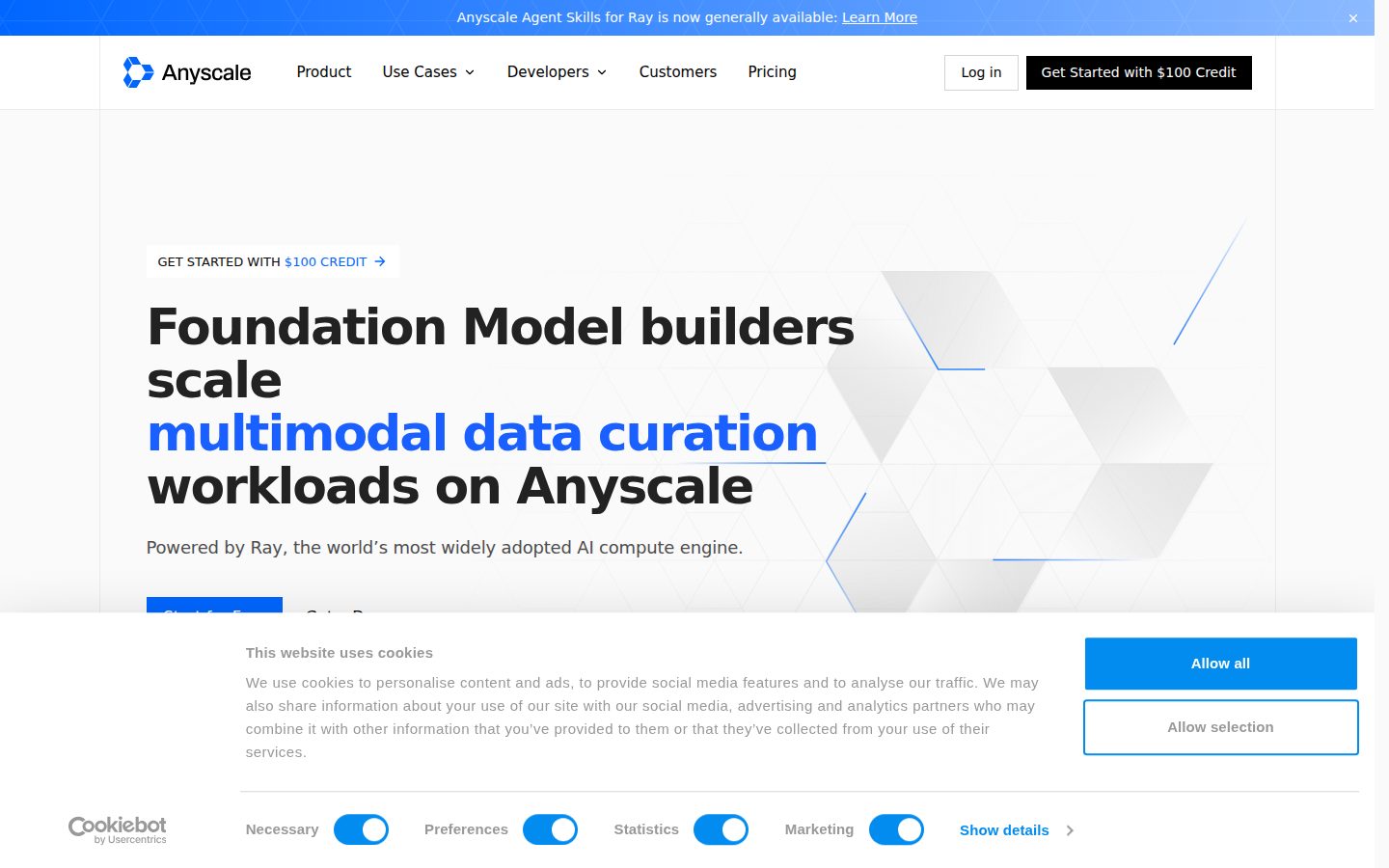
Get started with Anyscale platform for building and scaling Foundation Models

  • $100 free credit to start
  • Access to Ray-powered AI compute engine
  • Distributed model training support
  • Multimodal data curation pipelines
  • Batch embedding generation
  • Post-training workload support

AI Panel Reviews

The Decision Maker

The Decision Maker

Strategic bet, vendor viability, timing, adoption approval
8.2/10

41,000 GitHub stars isn't hype — Ray is the distributed AI foundation teams actually use.

Anyscale is the managed layer for teams already betting on Ray. If you're building or fine-tuning foundation models at scale, this is the shortest path from Python code to GPU cluster.

500 million Ray downloads isn't a vanity stat. It means your engineers already know the primitives, which cuts onboarding time dramatically versus standing up SageMaker or Vertex AI from scratch. The fine-grained hardware allocation — running individual functions on CPUs, GPUs, or NVL72 racks — solves a real problem: cluster idle time. Pooled GPU resources that dynamically reallocate across teams make that case even stronger.

The tradeoff is lock-in to the Ray abstraction. If Ray falls out of favor, your Anyscale code doesn't port cleanly to Databricks. That's a real consideration, not a dealbreaker, but the board will ask.

Pricing is usage-based with no public floor — $100 free credit gets you started, but no public data on enterprise rates. Pilot it against a real workload before you standardize. The multi-cloud support across AWS, GCP, Azure, and CoreWeave gives you leverage in that negotiation.

Competitive Positioning8.0

Multi-cloud execution across AWS, GCP, Azure, and CoreWeave without rewrites is a genuine differentiator versus SageMaker or Vertex AI's cloud-native lock-in.

Reputation Risk8.0

Adopting the managed layer for the industry's leading distributed compute engine reads as a smart, defensible call to any technical board member.

Speed to Value7.5

Code templates for embedding generation and distributed training accelerate first workloads, but usage-based pricing with no public tiers makes ROI math slow to close.

Strategic Fit8.5

Native support for SkyRL and veRL post-training frameworks puts this squarely in foundation model infrastructure, not just cost optimization.

Vendor Viability8.5

Ray's 41,000 GitHub stars and 500M downloads signal a durable open-source foundation that makes Anyscale harder to kill than a pure SaaS bet.

Pros

  • Ray's open-source gravity (500M downloads) means engineers arrive with existing skills
  • Fine-grained hardware allocation reduces GPU idle time across shared clusters
  • Multi-cloud support across five providers gives real negotiating leverage
  • Native SkyRL and veRL support for post-training workloads is ahead of SageMaker

Cons

  • Hard dependency on Ray means migration costs are real if the ecosystem shifts
  • No public enterprise pricing — budgeting requires a sales conversation
  • No changelog visible; hard to assess release cadence from the outside

Right for

AI platform teams running distributed training or data curation workloads who are already in the Ray ecosystem.

Avoid if

You're running standard ML pipelines with no foundation model ambitions — SageMaker is simpler and cheaper for that scope.

The Domain Strategist

The Domain Strategist

Craft and strategy in the product's domain — adapts identity per category, same lens
8.4/10

Ray's 41K GitHub stars aren't hype — Anyscale turns that OSS gravity into a real platform.

Anyscale is a managed compute layer purpose-built for foundation model workflows, backed by the most battle-tested distributed Python runtime in the category. For teams already writing Ray code, this is the shortest path from prototype to production-scale GPU clusters.

Fine-grained hardware allocation that lets individual functions target different CPUs, GPUs, or NVL72 racks is the kind of composability that actually matters when you're running mixed preprocessing and training stages. SkyRL and veRL support signals they're tracking the post-training frontier, not just the 2022 fine-tuning playbook. The Python decorator API keeping orchestration inside familiar code — not YAML manifests or cloud-console workflows — is a real practitioner win.

The tradeoff is lock-in to Ray's abstractions. If your team isn't already on Ray, the onboarding cost is non-trivial, and in 3 years your entire pipeline architecture is shaped by Ray's actor model. SageMaker and Vertex AI let you escape to managed containers; Anyscale's exit costs more.

Multi-cloud reach across AWS, GCP, Azure, Nebius, and CoreWeave is differentiated — Databricks can't match that GPU access flexibility today. Pricing is usage-based with no published rates, which makes budget forecasting harder than competitors with per-node pricing pages.

Category Positioning8.3

Multi-cloud GPU orchestration across five providers including Nebius and CoreWeave is a meaningful moat that SageMaker and Vertex AI don't match at this flexibility level.

Domain Fit8.9

S3-native data pipelines, map_batches with num_gpus=1, and PyTorch/vLLM/XGBoost integrations match exactly how ML teams actually structure training and inference workflows.

Integration Surface8.5

Multi-framework support for PyTorch, vLLM, SGLang, and XGBoost plus S3 read/write means it fits into existing ML stacks without forcing rewrites.

Long-term Implications7.6

Ray abstraction lock-in is real — adopting Anyscale means your pipeline architecture couples to the actor model, making future migration to Kubernetes-native alternatives expensive.

Strategic Depth8.8

RDMA transport, pooled GPU resource scheduling, and native post-training framework support (SkyRL, veRL) show genuine distributed systems depth beyond basic managed notebooks.

Pros

  • Fine-grained hardware allocation per function/class is architecturally rare — Databricks and SageMaker don't offer this granularity
  • 41,000 GitHub stars and 500M downloads means the Ray runtime under the hood is deeply validated, not a proprietary black box
  • Multi-cloud support across AWS, GCP, Azure, Nebius, and CoreWeave maximizes GPU capacity options without code rewrites
  • Native SkyRL and veRL support keeps post-training workflows current

Cons

  • No published pricing — usage-based with zero rate transparency makes budget modeling a spreadsheet nightmare
  • Hard Ray dependency means teams not already on Ray face a real adoption hill, not just onboarding friction
  • No changelog listed in docs capabilities, which makes it harder to track platform evolution before committing

Right for

ML platform teams running foundation model training or post-training pipelines who are already invested in the Ray ecosystem.

Avoid if

Your team uses Kubeflow or managed containers as the orchestration layer and has no existing Ray surface area.

The Finance Lead

The Finance Lead

Money, total cost of ownership, contracts, procurement math
7.2/10

$100 trial credit, then a blank invoice — GPU burn rate unknown until you're in.

Anyscale runs distributed Ray workloads across 5 clouds with strong technical depth. No published per-GPU rates means TCO is a modeling exercise, not a calculation.

$100 free credit to start. That's the only public number on the pricing page. No per-GPU-hour rate, no tier structure, no overage cap. Usage-based on GPU clusters at scale — this can be $50K/month or $500K/month depending on utilization. No published rate means no 3-year model without a sales call.

Compare to SageMaker or Vertex AI, where at least spot and on-demand GPU rates are published. Anyscale's multi-cloud execution across AWS, GCP, Azure, Nebius, and CoreWeave is genuinely differentiated — but pooled GPU resources and dynamic reallocation are features that make billing harder to predict, not easier. Fine-grained hardware allocation down to NVL72 racks suggests enterprise-tier spend.

Contract terms aren't public. Auto-renewal windows, termination clauses — unknown. ROI is measurable if GPU utilization rates are tracked via their observability tooling, but that requires internal discipline. Procurement will need a call. Budget 60 days to close.

Billing & Procurement5.5

Usage-based invoicing on GPU clusters with no public rates means procurement friction is high and budget variance risk is real.

Contract Flexibility4.5

No public auto-renewal terms, cancellation policy, or term length — all require direct vendor negotiation.

Pricing Transparency3.5

No per-GPU rates published; only the $100 trial credit is visible without a sales conversation.

ROI Clarity6.5

GPU observability and utilization monitoring exist, giving teams the raw data to build ROI cases if they instrument carefully.

Total Cost of Ownership5.0

Usage-based GPU billing at foundation-model scale is inherently unpredictable without published rate cards or tier ceilings.

Pros

  • Multi-cloud execution across 5 providers without code rewrites
  • Fine-grained hardware allocation including NVL72 racks
  • SSO, SAML, SCIM, and audit logs included — no SSO tax visible
  • Ray ecosystem with 500M+ downloads reduces lock-in risk

Cons

  • No published GPU-hour rates — TCO is unmodelable pre-call
  • No pricing tiers visible; every deal is a negotiation
  • Contract terms entirely opaque from public evidence
  • $100 trial credit burns fast at GPU cluster scale

Right for

AI platform teams already on Ray who need managed multi-cloud GPU orchestration at foundation-model scale.

Avoid if

Your team needs predictable monthly invoices before committing budget.

The Domain Practitioner

The Domain Practitioner

Daily hands-on reality in the product's domain — adapts identity per category, same lens
8.2/10

Ray's managed layer finally grows up — serious infrastructure for serious distributed ML

Anyscale wraps Ray's 41,000-star distributed compute engine in managed GPU infrastructure, handling the cluster plumbing that kills ML platform teams. It's built for foundation model workloads, not notebooks and hobby fine-tunes.

The Python API story is genuinely good. Decorating a function to run across thousands of nodes without rewriting cloud-specific infra is the right abstraction. The `map_batches` with `num_gpus=1` pattern, S3 read/write via `ray.data.read_parquet`, confidence-score filtering — these are practitioner-shaped APIs, not demo APIs. The code templates for embedding generation and distributed training suggest the docs were written by someone who's actually debugged a Ray cluster at 3am.

Day-three reality: Ray is the lock-in. That's not a knock — it's a clear contract. But if your team isn't already Ray-fluent, the learning curve lands on you before Anyscale's managed layer helps. SageMaker and Vertex AI let you start with familiar managed containers. Anyscale asks for Ray commitment upfront.

The fine-grained hardware allocation — mixing CPUs, GPUs, TPUs, NVL72 racks per function — is the power-user feature that SageMaker can't touch. Multi-cloud across AWS, GCP, Azure, Nebius, CoreWeave without rewrites is real leverage for teams chasing GPU availability. $100 free credits gets you through a legitimate test workload.

Day-3 Reality8.0

Decorator-based orchestration and S3 native integration suggest low daily friction once Ray fluency exists, but Ray itself is a prerequisite the platform doesn't eliminate.

Documentation Practitioner-Fit8.3

Specific code patterns like `ds.filter(col('scores') > 0.85)` and `map_batches` with explicit batch sizes and GPU counts read like engineer-authored docs, not marketing copy.

Friction Surface7.5

No changelog is publicly visible, and pricing is fully opaque beyond the $100 trial credit, which creates budget forecasting friction for platform teams.

Power-User Depth9.0

Fine-grained hardware allocation per function, RDMA direct transport, NVL72 rack support, and native SkyRL/veRL post-training integration are genuinely advanced capabilities not available in SageMaker.

Workflow Integration8.5

Standard Python APIs with Ray, PyTorch, vLLM, SGLang, and XGBoost support means most ML practitioners don't rewrite existing code — they annotate it.

Pros

  • Fine-grained hardware allocation per function/class is unusually powerful — mix CPUs, GPUs, TPUs in a single workload
  • Multi-cloud execution across five providers without code rewrites solves real GPU availability problems
  • Native SkyRL and veRL support for post-training means no adapter shims
  • Practitioner-shaped APIs — `ray.data`, `map_batches`, decorator orchestration — fit existing PyTorch workflows

Cons

  • Ray fluency is a hard prerequisite — the managed layer doesn't hide Ray, it amplifies it
  • Pricing is fully opaque beyond $100 trial credit, making cost forecasting difficult for budget-conscious platform teams
  • No changelog visible publicly, so tracking breaking changes requires active monitoring
  • No free plan; usage-based pricing with no published rates means enterprise teams need a sales call before committing

Right for

ML platform teams already running Ray who need managed GPU cluster orchestration at foundation model scale.

Avoid if

Your team is Ray-naive and needs a managed on-ramp — SageMaker or Vertex AI will ship you faster in that case.

The Power User

The Power User

Daily human experience, onboarding, polish, learning curve, reliability
8.1/10

If you're training foundation models, this is the tool SageMaker wishes it was.

Anyscale is serious infrastructure for serious AI teams. It's not trying to onboard everyone — just the ones who need to run GPU clusters across AWS, GCP, and Azure without rewriting everything.

The $100 free credit entry point is smart. Enough to run something real, not enough to hide the bill. And the pitch is concrete: write Python with Ray decorators, point at an S3 bucket, get distributed GPU processing across thousands of nodes. No cloud-specific rewrites. That's a real promise, and 500 million Ray downloads suggests the underlying engine isn't vaporware.

Here's where daily life gets complicated though. This is an API-and-SDK product. There's no desktop client, and the web interface is mostly job monitoring. Mobile is essentially decorative. If you're the kind of person who checks your training run from your phone at 11pm, you're staring at a read-only dashboard at best. Compare that to Databricks, which at least tries to give you a functional browser experience.

The learning curve is steep and they know it. Code templates help. Fine-grained hardware allocation — running different functions on different CPU, GPU, or TPU configs — is genuinely powerful but takes a while to internalize. Month three, this probably feels natural. Day three, you're reading a lot of docs.

Daily Polish6.5

Web-first product with no changelog published and GPU observability as the main UI feature — functional but not fussed over.

Learning Curve6.8

Fine-grained hardware allocation across CPUs, GPUs, and TPUs is powerful but the SDK-first model means you're in docs for a while before it clicks.

Mobile Parity3.5

Web platform, no desktop client, no mobile experience — for a tool running overnight GPU jobs, that's a real gap in the monitoring story.

Onboarding Experience7.2

The $100 free credit plus code templates for embedding generation and distributed training give new users a real running start, not a blank canvas.

Reliability Feel8.0

Ray's 41,000 GitHub stars and 500 million downloads suggest the compute engine underneath is battle-tested, which matters more here than spinner design.

Pros

  • Multi-cloud without rewrites — same code runs on AWS, GCP, Azure, Nebius, CoreWeave
  • Ray's open-source foundation means you're not locked into a black box
  • Pooled GPU resources with dynamic reallocation is genuinely useful at team scale
  • SSO, SAML, SCIM, and audit logs means it can actually survive enterprise procurement

Cons

  • Mobile experience is essentially nothing — bad if you monitor overnight training runs
  • No public pricing beyond the $100 trial credit, which makes budgeting a conversation
  • Ray-required architecture means you're adopting a framework, not just renting compute
  • Steeper learning curve than SageMaker for teams new to distributed compute patterns

Right for

ML platform engineers at organizations actively building or fine-tuning foundation models on GPU clusters.

Avoid if

You're a small team that needs simple hosted training without learning distributed systems concepts first.

The Skeptic

The Skeptic

Contrarian. Watch-outs, deal-breakers, broken promises, category patterns
7.8/10

41,000 GitHub stars is real signal — but so is the lock-in question

Ray's open-source gravity gives Anyscale a moat most managed compute plays never get. The exit story is messier than it looks, though.

Three tells I noticed before going deep. One: no changelog listed in the scraped capabilities — not fatal, but a yellow flag for shipping cadence transparency. Two: pricing is usage-based with no public floor — the $100 trial credit tells me nothing about what production actually costs. Three: 'Foundation Model builders' is a very narrow ICP bet. Either inspired focus or a cliff when that cycle cools.

The differentiation is real, though. Ray's 500 million downloads isn't vaporware — that's SageMaker and Vertex AI fighting a framework with actual organic adoption. Multi-cloud across AWS, GCP, Azure, Nebius, and CoreWeave without code rewrites is a genuine gap vs. hyperscaler-native tools. Fine-grained hardware allocation per function, including NVL72 racks, isn't commodity.

Exit portability is the tricky part. Ray is open-source — you can self-host. But Anyscale's abstractions, pooled GPU resource management, and SCIM governance layer are proprietary. Migration means rebuilding ops, not just repointing an endpoint. That's a medium lock-in, not a high one. But it's not clean.

Competitive Differentiation8.0

Multi-cloud GPU orchestration without cloud-specific rewrites and native support for SkyRL and veRL post-training frameworks is a clear gap vs. SageMaker and Vertex AI.

Exit Portability6.5

Ray itself is portable, but Anyscale's pooled GPU management, SCIM governance, and cluster orchestration layer create real re-platforming work if you leave.

Long-term Viability7.2

No public funding data visible and no changelog in the scraped evidence; Ray's open-source momentum is a backstop, but execution transparency is thinner than I'd want for a 3-year bet.

Marketing Honesty7.5

Claims map to real Ray features — Distributed Model Training, Multimodal Data Curation — but 'Foundation Model builders' framing is aspirational enough to raise an eyebrow.

Track Record Match8.2

Ray's 41,000 GitHub stars and genuine framework adoption is the pattern of winners like Databricks (Spark) — managed layer on beloved open-source, not a blank-slate bet.

Pros

  • Ray's 500M+ downloads means the underlying engine has real organic gravity — not a proprietary wrapper on nothing
  • Multi-cloud across five providers including CoreWeave and Nebius without code rewrites is a genuine differentiator
  • Fine-grained hardware allocation per function, including NVL72 racks, goes deeper than category norm
  • Native post-training framework support (SkyRL, veRL) targets a real workflow gap vs. hyperscaler tools

Cons

  • No public production pricing — $100 trial credit tells you nothing about what scaled GPU workloads actually cost
  • No changelog visible in public evidence — hard to assess shipping cadence from the outside
  • Anyscale-specific ops layer (pooled GPU management, SCIM governance) creates medium lock-in beyond just Ray
  • Narrow 'foundation model builder' ICP is a focused bet that could look dated if the training-at-scale cycle shifts

Right for

ML platform teams already using Ray or PyTorch who need managed multi-cloud GPU orchestration without rewriting cloud-specific infrastructure.

Avoid if

You need transparent, predictable production pricing before committing or you're running standard ML workloads where SageMaker or Vertex AI integrations already cover the surface area.

Buyer Questions

Common questions answered by our AI research team

Features

Does Anyscale support GPU-accelerated batch processing?

Yes, batch processing with GPU acceleration is supported. The code example shows `map_batches` with `num_gpus=1` and `batch_size=64` for running object detection on GPU.

Integration

Can I read data directly from S3 buckets?

Yes, S3 is supported. The code example uses `ray.data.read_parquet("s3://my_data_metadata")` to load data and `ds.write_parquet("s3://bucket/curated/")` to write results back to S3.

Setup

Is Ray required to use Anyscale?

Yes, Anyscale is built on Ray, an open-source distributed compute engine. All code examples use the `ray` library directly.

Features

Does Anyscale support multimodal data like video and audio?

Yes, multimodal data is supported. Anyscale offers large-scale pipelines for curating and preparing multimodal data across videos, images, text, and audio.

Features

Can I filter dataset results by confidence score?

Yes, datasets can be filtered by confidence score using `ds.filter(col("scores") > 0.85)`, as shown in the code example which retains only high-confidence results.

Also in Machine Learning Platforms