Atlan logo

Atlan Review

Visit

Governed metadata infrastructure that gives AI systems enterprise context

Atlan is a metadata management platform that builds a governed data graph connecting enterprise data sources to AI systems.

Atlan·Founded 2015·Contact for pricingAI Data ToolsAI ComplianceAI Search & Knowledge

AI Panel Score

7.2/10

6 AI reviews

Reviewed

AI Editor Approved

About Atlan

Atlan works by first connecting to an organization's data stack through more than 80 connectors, pulling metadata from databases, warehouses, BI tools, and other business systems into a unified graph structure. This graph tracks column-level lineage across the data estate, so users and AI agents can trace how data moves and transforms between systems. Data teams, business users, and AI applications interact with this graph through a search and discovery interface, a marketplace for finding certified data assets, and integrations into tools like Slack, Teams, and various AI assistants.

The platform's distinguishing components include Context Agents, which automatically write and update descriptions, ontology entries, glossary terms, and README-style documentation for data assets rather than requiring manual upkeep. The Context Engineering Studio lets teams build and test a shared context model before deploying it to destinations like Cortex, Genie, Claude, or Codex. Atlan also offers a Context Lakehouse, an Iceberg-native storage layer built with open formats and vector-native search, and an MCP (Model Context Protocol) server that allows LLMs to query lineage, glossary terms, and data quality metrics directly when generating responses.

Atlan is built for enterprise data teams, data governance leads, and organizations deploying AI systems that need to ground outputs in verified business context. It is positioned in the data governance and metadata management category alongside vendors such as Collibra, Alation, and data.world. Pricing is not published; the company directs prospective customers to contact sales for enterprise deployment, indicating a contact-based pricing model typical of enterprise software sold on annual contracts.

Features

AI

  • Context Agents

    AI teammates that automatically write and maintain documentation, ontology, glossary terms, READMEs, and data quality metrics to make enterprise data AI-ready.

  • Context Engineering Studio

    A studio where humans and AI collaboratively bootstrap, test, and ship shared context/world models to destinations like Cortex, Genie, Claude, or Codex.

Analytics

  • Context Layer Readiness Assessment

    A self-assessment tool for organizations to measure their context-layer readiness before deploying enterprise AI.

  • Data Lineage

    Provides column-level, end-to-end lineage tracking that forms the backbone of the Enterprise Data Graph.

Collaboration

  • Data Marketplace

    A self-serve discovery layer where business users can find, understand, and request certified data assets with full context inside Slack, Teams, or any AI assistant.

Core

  • Context Lakehouse

    An Iceberg-native, open-format context store with a graph-plus-file architecture and vector-native search built for AI workloads.

  • Enterprise Data Graph

    Unifies metadata from 80+ sources with column-level lineage into a living, queryable foundation across the entire data estate.

Customization

  • Governance APIs and Admin Tooling

    Documented APIs and configuration tools for connector setup, governance, and Context Agent administration for engineers and admins.

Integration

  • Connectors & Apps

    Over 80 connectors that pull metadata from business systems and data sources into the Enterprise Data Graph.

  • MCP Server

    A Model Context Protocol server that connects AI agents directly to the Enterprise Data Graph so LLMs can query lineage, glossary, and data quality at runtime.

Support

  • Interactive Demo Hub

    Provides interactive and on-demand demos covering Context Agent workflows, lineage exploration, and AI-ready data setups.

  • Product Documentation

    Official docs covering connector setup, governance APIs, Context Agent configuration, and how-to guides for administrators and data engineers.

Preview

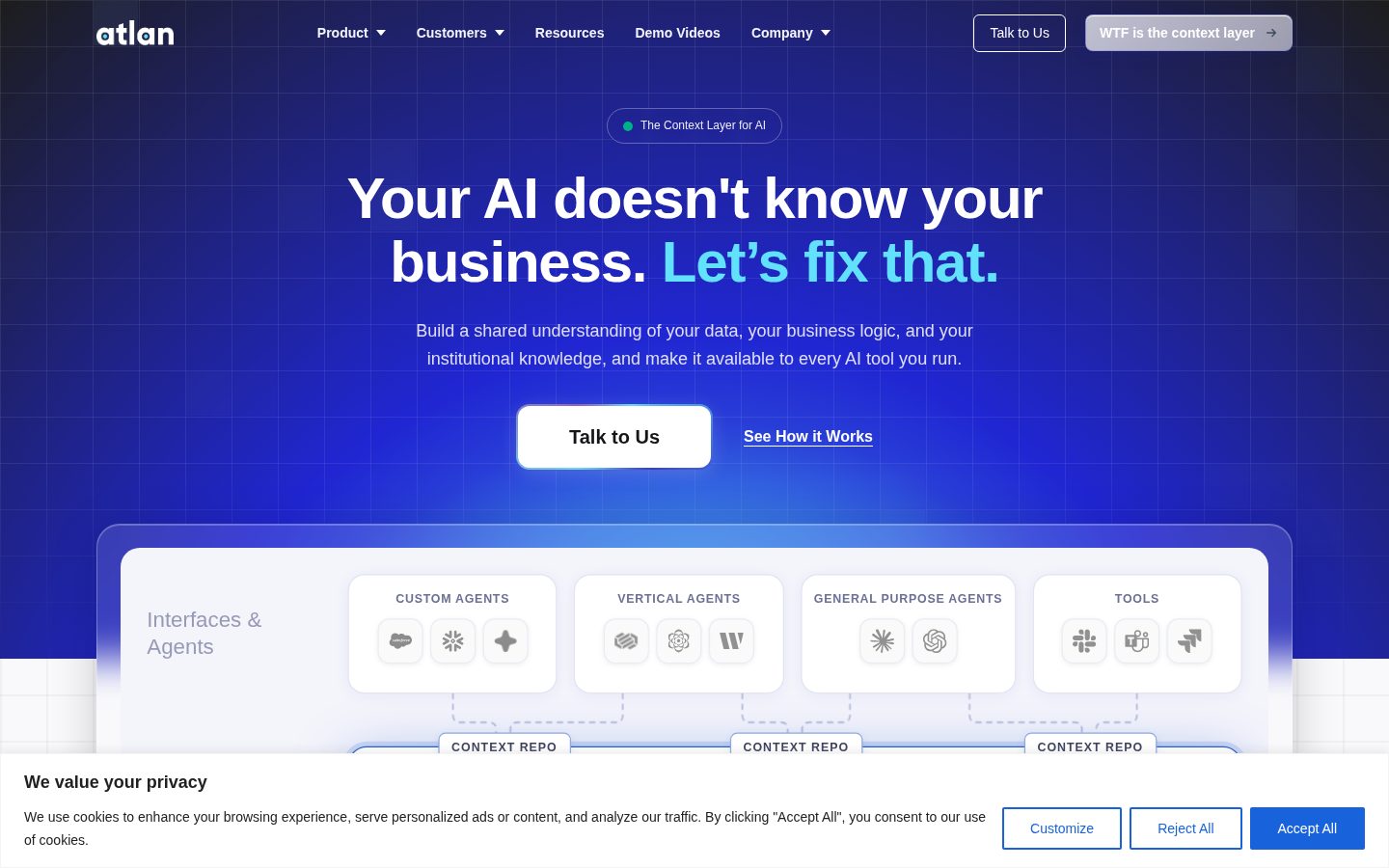
Atlan desktop previewAtlan mobile preview

Pricing Plans

Contact Sales

Contact sales

Atlan is an enterprise data catalog and governance platform (the 'Context Layer for AI') sold via a sales-led model to organizations of all sizes, from startups to large enterprises. Atlan does not publish list pricing on its website; pricing is customized based on user seats, data volume, integrations, and governance/feature scope, and requires contacting Atlan's sales team for a quote.

  • Enterprise data graph unifying metadata, lineage, and business context across warehouses, databases, pipelines, and BI tools
  • Data discovery, cataloging, and semantic search
  • Data lineage and governance/access control
  • AI-powered documentation and query assistance
  • Custom integrations/connectors and dedicated support (tiers commonly referenced as Starter/Professional/Team and Enterprise)

AI Panel Reviews

The Decision Maker

The Decision Maker

Strategic bet, vendor viability, timing, adoption approval
7.6/10

Atlan bets metadata governance becomes the AI control plane. Smart bet, long sales cycle.

Real product with a real category next to Collibra and Alation. No pricing page, no free trial — this is a board-approved procurement project, not a pilot.

80+ connectors, column-level lineage, an MCP server so LLMs query governance data at runtime. That's not vaporware — that's infrastructure a data team can actually stand up.

Two things worth noting. One: this competes directly with Collibra and Alation, both entrenched incumbents with existing enterprise contracts. Two: Context Agents claim to auto-generate roughly 80% of documentation, which is the real pitch — governance that doesn't need a headcount to maintain.

No published pricing, no free trial, contact-sales only. That's normal for this category but it means a 3-6 month evaluation before you know the number. This isn't a tool you slip in under a team budget — it's a data governance decision the CDO owns, and the board will ask about it either way.

Competitive Positioning7.5

Sits against Collibra, Alation, and data.world; the MCP server and Context Agents are a differentiated AI-era pitch versus legacy catalog tools.

Reputation Risk8.0

Governance and lineage tooling reads as prudent, not experimental, to a board — category norm is conservative buyers here.

Speed to Value6.5

Contact-sales pricing, no free trial, and 80+ connector setup implies months to first value, not weeks.

Strategic Fit8.0

Column-level lineage plus an MCP server addresses a genuinely new problem: grounding AI agents in verified business context, not just cataloging data.

Vendor Viability7.5

No public funding data given, but 80+ connectors and named enterprise positioning suggest a mature, funded platform, not an early-stage bet.

Pros

  • Column-level lineage across 80+ connected sources
  • MCP server lets LLMs query governance data at runtime
  • Context Agents automate ~80% of documentation work per their own claim

Cons

  • No published pricing or free trial slows evaluation
  • Competes against entrenched incumbents like Collibra and Alation
  • Contact-sales model means long procurement cycle before ROI is provable

Right for

Enterprise data teams already deploying AI agents who need governed, traceable context at scale.

Avoid if

Skip if you don't yet have a dedicated data governance function to own the rollout.

The Domain Strategist

The Domain Strategist

Craft and strategy in the product's domain — adapts identity per category, same lens
8.1/10

A real metadata graph with column-level lineage, betting your governance model on AI-generated context.

Atlan's Enterprise Data Graph and MCP server put it ahead of catalog incumbents on AI-readiness. The 80%-automated documentation claim is the thing I'd pressure-test before signing a multi-year contract.

80+ connectors and column-level lineage put Atlan on par with Collibra and Alation for catalog fundamentals. What differentiates it is the MCP server — LLMs querying lineage and glossary at runtime is the right architectural answer to grounding AI agents in verified context, not a bolt-on chatbot.

Context Agents generating 80% of documentation before human review is the part I'd stress-test hardest. That's a governance model shift: my stewards move from authors to certifiers. Fine if the review workflow is rigorous, risky if certification becomes rubber-stamping at scale.

Three-year lens: the Context Lakehouse (Iceberg-native, vector-search) signals Atlan wants to own storage, not just metadata — that's a deeper commitment than a typical catalog contract. No published pricing means seat-and-volume-based contracts that scale awkwardly as your estate grows. Category positioning is strong: this looks like where Collibra and Alation are being forced to go, not where they already are.

Category Positioning8.2

Sits ahead of Collibra, Alation, and data.world on AI-runtime context serving, from what I could see.

Domain Fit8.0

Human certification of AI-generated context matches how governance leads actually work — draft, review, certify.

Integration Surface8.5

80+ connectors and an MCP server serving Cortex, Genie, Claude, and Codex give broad reach into existing AI stacks.

Long-term Implications7.8

Shifts stewards to reviewers of AI output, a real workflow bet that pays off only with disciplined review cadence.

Strategic Depth8.3

Column-level lineage plus an Iceberg-native Context Lakehouse shows genuine architectural investment beyond catalog basics.

Pros

  • Column-level lineage across 80+ connectors gives real traceability, not sampled metadata
  • MCP server lets LLMs query governance data directly at runtime
  • Context Agents cut manual documentation burden significantly per vendor claims

Cons

  • No published pricing forces a sales cycle before you can budget
  • 80% AI-generated documentation claim needs independent validation of review rigor
  • No free trial, so evaluation depends entirely on vendor-run demos

Right for

Enterprise data governance teams standing up AI agents that need certified, lineage-backed business context.

Avoid if

Avoid if you need transparent self-serve pricing or lack the governance staff to certify AI-generated documentation at scale.

The Finance Lead

The Finance Lead

Money, total cost of ownership, contracts, procurement math
6.4/10

Zero published numbers. Contact sales for everything, including the tier names.

No pricing page, no free trial, no published tiers. Standard enterprise-catalog playbook, priced like Collibra and Alation, opaque like both.

No list price. No free plan. No trial. Contact-sales-only, quote built from seats, data volume, connector count, governance scope. That's category norm for enterprise catalogs — Collibra and Alation run the same play. Doesn't make it cheap to evaluate.

80+ connectors, column-level lineage, Context Agents writing 80% of documentation automatically. Real capability. But TCO isn't just license fees. Budget migration time, connector setup per source, admin training on Context Engineering Studio. Year 3 all-in cost depends entirely on data estate size — nobody publishes a number to anchor against.

ROI story: Context Agents cut manual documentation work, MCP server reduces AI hallucination on business data. Plausible, but unmeasured in public materials. No case study math shown here. Procurement will need a pilot scope and a hard quote before this clears finance review, not a pricing page skim.

Billing & Procurement4.5

Sales-led onboarding, no self-serve path, standard enterprise procurement friction.

Contract Flexibility5.0

Enterprise annual contract implied; no term or auto-renewal terms published.

Pricing Transparency3.0

No pricing page, no tiers shown, sales-quote-only like Collibra and Alation.

ROI Clarity6.0

Context Agents claim ~80% automated documentation, a real metric, but no dollar ROI case shown.

Total Cost of Ownership5.5

80+ connector setup and governance admin overhead likely, but no numbers to model against.

Pros

  • 80+ connectors and column-level lineage are concretely documented
  • Context Agents automate ~80% of documentation work per vendor claim
  • MCP server gives LLMs runtime access to governed metadata

Cons

  • No published pricing anywhere, not even a starting figure
  • No free trial to test fit before a sales conversation
  • TCO impossible to model without a quote in hand

Right for

Enterprise data governance teams with budget for a sales-led annual contract.

Avoid if

You need a self-serve quote or a free trial before looping in procurement.

The Domain Practitioner

The Domain Practitioner

Daily hands-on reality in the product's domain — adapts identity per category, same lens
7.6/10

Solid graph, real lineage, but you'll spend a week just wiring up 80 connectors.

Atlan's Enterprise Data Graph and column-level lineage are legit infrastructure, not vaporware, and the MCP server is a smart bet on where AI agents are headed. The daily friction is in governance overhead: certifying AI-generated docs doesn't disappear just because Context Agents write the first draft.

Column-level lineage across 80+ connectors is the real deal — that's the backbone every catalog tool claims and few deliver cleanly. Context Agents doing 80% of the documentation draft is a genuine time-saver versus the manual glossary upkeep I've done in Alation and Collibra deployments. But 80% automated still means someone owns the last 20%, and that reviewer queue becomes a new daily job, not a one-time setup task.

Workflow-wise, the MCP server is the interesting bet: LLMs querying lineage and quality metrics at runtime, via SQL/API/SDK, means less context-switching between catalog UI and pipeline code. That's a real integration win if your agents actually use it.

No published pricing, no free trial — sales-led enterprise motion means a procurement cycle before you ever touch the product. Docs cover connector setup and governance APIs, which reads like engineers wrote them, not marketing. Power-user depth looks strong on paper; onboarding 80 connectors and validating the graph is where week one actually goes.

Day-3 Reality7.0

Lineage and graph are solid, but reviewing AI-generated context becomes a recurring queue, not a one-time task.

Documentation Practitioner-Fit7.9

Docs cover connector setup and governance APIs directly, suggesting engineer authorship, not just marketing copy.

Friction Surface7.0

80+ connectors to configure and certify before the graph is trustworthy is a multi-week onboarding lift.

Power-User Depth7.8

Context Engineering Studio and governance APIs give admins real depth, though contact-only pricing hides tier gating.

Workflow Integration7.8

MCP server and Slack/Teams integration mean less UI-hopping, a real edge over Collibra-style siloed catalogs.

Pros

  • Column-level lineage across 80+ connectors is production-grade, not a demo feature
  • MCP server puts lineage and quality metrics directly in reach of LLM agents at runtime
  • Context Agents cut manual glossary/doc upkeep by an estimated 80%

Cons

  • No published pricing or free trial forces a sales cycle before any hands-on evaluation
  • AI-drafted context still needs human certification, adding a review workflow, not removing one
  • Iceberg-native Context Lakehouse is a newer bet with less track record than Alation or data.world's core catalogs

Right for

Enterprise data governance teams already juggling 80+ source systems who need lineage feeding AI agents directly.

Avoid if

You want transparent self-serve pricing or a free trial before committing engineering time to connector setup.

The Power User

The Power User

Daily human experience, onboarding, polish, learning curve, reliability
6.9/10

Impressive graph, but you'll never touch it without a sales call.

Atlan's got the plumbing — 80+ connectors, column-level lineage, an MCP server. Whether it feels good day to day is anyone's guess since there's no way to try it yourself.

No free trial, no pricing page, no sandbox you can poke at. Everything here is a demo you schedule, not a product you open Tuesday morning and just start using. That matters because this whole pitch is about making AI systems trustworthy day-to-day, but I can't tell you what day three feels like when day one is a sales call.

The feature list is genuinely deep — Context Agents writing docs automatically, column-level lineage, a Context Lakehouse built on Iceberg, an MCP server for LLMs to query governance data live. That's real engineering, not vaporware dressed up. Compared to Collibra or Alation, Atlan's AI-native framing feels newer and more ambitious.

But 'contact sales' is the whole onboarding experience right now. No public docs on setup time, no changelog to see how fast they ship. For enterprise data teams that's normal. For everyone else, it's homework before you even see the tool.

Daily Polish6.0

No visible product screenshots or changelog to judge day-to-day craft, only marketing copy.

Learning Curve7.5

Context Engineering Studio and Readiness Assessment suggest a deliberate onboarding path for governance teams, though it targets specialists not casual users.

Mobile Parity4.0

Platform is web-only, no mobile mention anywhere I could find.

Onboarding Experience5.5

No free trial or self-serve start — first step is a sales conversation, per the contact-based pricing model.

Reliability Feel6.5

Column-level lineage and human certification steps suggest care, but no uptime or error-state evidence exists.

Pros

  • 80+ connectors and column-level lineage give it real breadth versus Collibra or data.world
  • Context Agents automate roughly 80% of documentation work before human review
  • MCP server is a genuinely forward-looking bet on how LLMs will consume enterprise data

Cons

  • No free trial, no published pricing — pure sales-led friction
  • Web-only, no mobile story at all
  • Hard to judge daily feel without hands-on access

Right for

Enterprise data governance teams already juggling multiple sources who need AI systems grounded in verified context.

Avoid if

You want to try before you buy, or you're a small team without a dedicated data governance function.

The Skeptic

The Skeptic

Contrarian. Watch-outs, deal-breakers, broken promises, category patterns
6.7/10

Rebranded from data catalog to 'context layer' the same month everyone else did.

Atlan's core lineage and cataloging story is real and mature. The AI repositioning — Context Agents, MCP server, Context Lakehouse — arrived fast and reads more like a pivot deck than a shipped product line.

No pricing page. Contact sales, same as Collibra and Alation. Fine for enterprise software, but it means no anchor to compare against — and this category has a habit of quoting six figures once you're in the room.

The H1 says 'Your AI doesn't know your business.' That's the kind of superlative every metadata vendor is running right now. 80+ connectors and column-level lineage are concrete and verifiable claims. Context Agents delivering '80% of the context layer before human review' is a specific number, but it's Atlan's own claim with no third-party benchmark attached.

I've seen this exact repositioning before — data.world did something similar, Alation too. Doesn't mean it fails. Means the AI layer is newer than the catalog underneath it, and newer means less battle-tested. Exit story is middling: the graph and lineage data has real lock-in once agents depend on it at runtime via MCP.

Competitive Differentiation7.0

MCP server and Context Lakehouse are genuinely distinct vs. Collibra/Alation, though the category is racing to the same feature set.

Exit Portability6.0

Metadata graph and MCP-served context create real dependency once AI agents query it at runtime — no stated export path.

Long-term Viability7.0

80+ connectors and enterprise contract-based pricing suggest real deployment scale; no public funding or team data provided to confirm runway.

Marketing Honesty6.0

H1 leans aspirational ('doesn't know your business'); core lineage claims are concrete but the 80% Context Agent stat is unverified and self-reported.

Track Record Match6.5

Matches the established catalog-to-context pivot seen across data.world and Alation; not yet proven at the AI layer.

Pros

  • Column-level lineage across 80+ connectors is a mature, verifiable core capability
  • MCP server gives a concrete, differentiated answer to the 'AI needs enterprise context' problem
  • Human review step for Context Agent output before certification

Cons

  • No published pricing — contact-sales only, standard for the category but zero transparency
  • AI-layer claims (80% automation) are vendor-reported with no external validation
  • Runtime dependency on the graph via MCP raises exit costs if priorities shift

Right for

Enterprise data governance teams already running multiple BI and warehouse tools who need lineage before deploying AI agents.

Avoid if

Avoid if you want transparent pricing or a lightweight tool without a sales cycle.

Buyer Questions

Common questions answered by our AI research team

Integration

How many data sources does Atlan connect to?

Atlan connects to 80+ data sources, pulling context across warehouse SQL, BI definitions, and business applications into a single Enterprise Data Graph.

Features

What is the Atlan MCP server used for?

The Atlan MCP server lets LLMs and AI agents query lineage and governance data directly at runtime, activating certified context for every downstream AI tool through SQL, APIs, and SDKs.

Features

Does Atlan provide column-level data lineage?

Yes, Atlan builds an Enterprise Data Graph with column-level lineage, tracing data from source tables through pipelines to business definitions and outputs.

Features

How do Context Agents generate documentation automatically?

Context Agents read the Enterprise Data Graph — including SQL query history, BI semantics, and pipeline code — to automatically generate asset descriptions, link business terms, produce metrics, and build ontologies, delivering roughly 80% of the context layer before human review.

Features

Can humans review AI-generated context before it ships?

Yes, domain experts resolve conflicts between sources, annotate edge cases, and certify AI-generated drafts as production-ready before that context ships to AI agents and users.

Product Information

  • Company

    Atlan
  • Founded

    2015
  • Pricing

    Contact for pricing

Platforms

web

About Atlan

Atlan is a data catalog and governance platform based in San Francisco that helps enterprises organize, document, and manage data and AI assets.

Resources

Documentation
Blog

Also in AI Data Tools

Atlan Review — AI Panel Score 7.2/10 | TopReviewed.ai