Unified API for accessing multiple AI models from different providers
OpenRouter is an API gateway that provides unified access to AI models from various providers through a single interface.
AI Panel Score
6 AI reviews
Reviewed
AI Editor ApprovedApproved and published by our AI Editor-in-Chief after full panel analysis.OpenRouter is an API aggregation service that provides developers with unified access to a wide range of AI models from various providers through a single, standardized interface. The platform eliminates the need to manage multiple API keys and different integration protocols by offering a consistent OpenAI-compatible API format.
The service supports models from major AI providers including OpenAI, Anthropic, Google, Cohere, Meta, and many others, allowing users to access GPT models, Claude, Gemini, LLaMA, and numerous open-source alternatives. Developers can easily switch between models or test different options without rewriting their applications, as OpenRouter maintains API compatibility across all supported models.
OpenRouter targets developers, businesses, and researchers who want flexibility in their AI model selection without the complexity of managing multiple provider relationships. The platform offers features like model routing based on performance or cost preferences, usage analytics, and simplified billing across multiple AI services.
The service operates in the growing AI API marketplace where businesses seek to avoid vendor lock-in and want the ability to optimize their AI usage based on specific requirements like cost, performance, or model capabilities. OpenRouter positions itself as a middleware solution that provides choice and flexibility in an increasingly diverse AI model ecosystem.

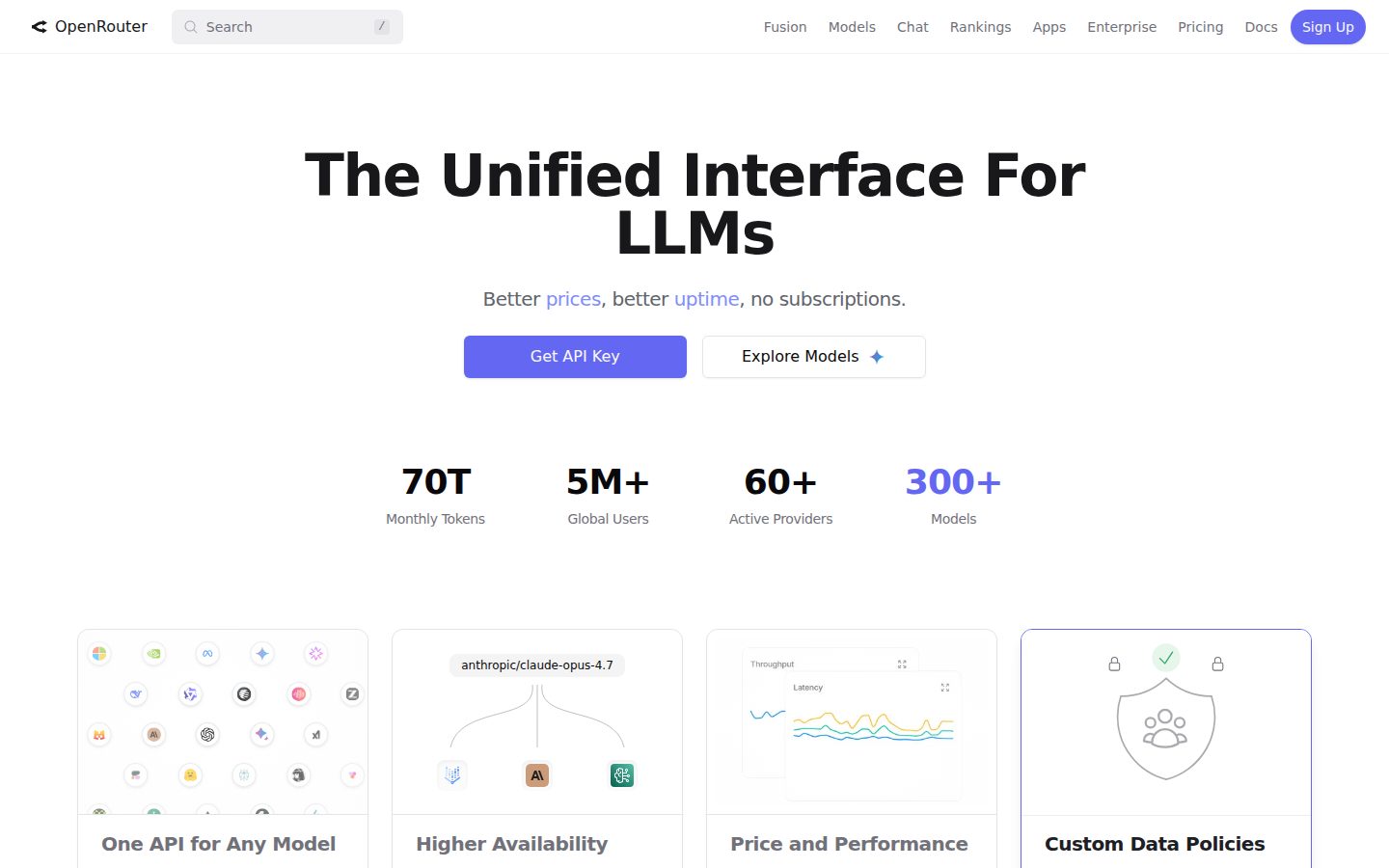
Offers access to over 300 active models from 60+ providers including Anthropic, OpenAI, and Google through one interface.
Displays token usage statistics across models, labs, and public applications to track relative usage and trends.
Provides a multi-turn agent workflow SDK with a callModel function that supports tool calls, stop conditions, and cost tracking across 300+ models.
Includes create-agent-tui and create-headless-agent skills to scaffold personalized coding agents with a terminal UI or headless mode for scripts and pipelines.
Organizes OpenRouter projects into separate environments, each with its own API keys, routing defaults, guardrails, and observability settings.
Uses a credit system that can be applied across any model or provider without requiring subscriptions.
Runs inference at the edge to minimize latency between users and their AI model responses.
Automatically falls back to alternative providers when one goes down, ensuring reliable uptime for AI model requests.
Provides a single API endpoint to access all major AI models, with full OpenAI SDK compatibility out of the box.
Allows organizations to configure fine-grained data policies that restrict which models and providers can receive their prompts.
Community tier with limited model access
Credit-based; pay per token at posted model rates
Custom pricing with volume discounts and SLAs
A unified LLM gateway your engineers already use on a personal card — sanction it before procurement notices.
“Founded 2023 by Alex Atallah, VC-backed, public per-token pricing with a 5% credit markup and 200+ models behind one OpenAI-compatible endpoint. The buying decision isn't whether to use it — it's whether to make the shadow usage official before a renewal cycle hits.”
Most AI teams have an OpenRouter API key in someone's .env file. Usually personal card. Usually because the Anthropic API rate-limited a launch demo, and the engineer needed Claude, GPT-4o, and Llama running through one client without rewriting three SDKs.
Vendor read is mid-conviction. Founded 2023, Alex Atallah from OpenSea is a credible founder, the changelog ships weekly, developer mindshare is real on Twitter and Discord. The catch is structural — aggregation layers historically get squeezed when upstream providers fix their own pain.
Sanction it for indie squads and prototype teams. Don't standardize the platform org on it for production agents at $50K+/month spend until the SLA story matures. Pilot three teams for 90 days; the 5% premium is fair for the optionality.
Developer mindshare leader against Portkey, LiteLLM Cloud, and Vercel AI Gateway in the indie and agent-builder segment.
Defensible to a board — widely adopted, Atallah pedigree, but the aggregator-vs-provider tension is a real story to manage.
Drop-in OpenAI SDK replacement. Working through three model providers in under an hour, no procurement involved.
Multi-model access through one OpenAI-compatible endpoint matches how AI teams actually want to evaluate and route models in 2026.
Founded 2023, founder credibility from OpenSea, weekly shipping cadence — solid early-stage signals against a structurally hard category.
Engineering leaders who want to standardize multi-model access across teams without renegotiating contracts with every LLM vendor.
Companies whose AI workload sits on a single provider where the volume discount math beats a 5% aggregator markup.
Provider Routing and Fallback Models turn LLM choice from a contract decision into a runtime decision.
“OpenRouter's architectural bet is that the model is no longer the unit of vendor commitment — the request is. Provider Routing lets a single call resolve to whichever underlying API is fastest, cheapest, or available, which is the right shape for a category where capability rankings change quarterly.”
The architectural primitive worth naming is Provider Routing. A call to claude-3.5-sonnet can resolve to Anthropic, AWS Bedrock, or Google Vertex by latency, price, or availability. Fallback Models extend that — when GPT-4o is down, the request fails over to Claude or Gemini without application-level retry logic.
Adopt OpenRouter as the default LLM client and model-selection moves from engineering tickets into a runtime config. Auto Router classifies prompts and dispatches to the optimal model for cost or capability. Compare LiteLLM Proxy: same shape, self-hosted, ops FTE. Compare Vercel AI Gateway: tied to the Vercel ecosystem.
The strategic catch is that the abstraction is only as durable as the OpenAI Chat Completions schema it wraps. If providers diverge — and Anthropic's Messages API already does — the gateway either leaks or carries a translation tax that grows with provider count.
Developer-mindshare leader in LLM gateways against Portkey, LiteLLM Cloud, Helicone routing, and Vercel AI Gateway.
Matches how serious AI engineers actually work — model-agnostic prompts, runtime selection, OpenAI-compatible client code.
Single OpenAI-compatible endpoint plus webhook callbacks plus BYOK — the integration surface fits any LLM stack already in production.
The gateway pattern is durable for 24-36 months; the open question is whether providers diverge faster than the abstraction can keep up.
Provider Routing, Fallback Models, and Auto Router show a team that understands LLM choice as an infrastructure concern, not a vendor concern.
AI engineering teams building agents or LLM features who need to switch models without rewriting code or renegotiating contracts.
Platform teams whose model lineup has converged on one or two providers where direct API integration is simpler.
Public per-token pricing plus a 5% credit markup — clean to forecast until single-provider scale tips the math.
“OpenRouter publishes per-model token pricing on a single page and adds a 5% markup at credit purchase, with BYOK as the lever for high-volume workloads. The math is honest at any scale; the question is when the 5% premium stops being worth the optionality.”
Prepay credits, charged per million input and output tokens at provider rates plus 5% on credit purchase. Free tier ships several models at zero cost with throughput limits. No seat fees, no minimum commitment, no contact-sales motion until enterprise.
Year-three math for a 50-engineer team running prototypes through OpenRouter — $5K/month across Claude, GPT-4o, and Llama — lands $60K/year direct cost plus $3K/year aggregator premium. Forecastable. Compare running directly against the Anthropic API and OpenAI API: the ~5% saved doesn't pay for the engineering time maintaining two SDKs and reconciling two invoices.
The breakeven question is when one provider dominates the workload. An agent doing $30K/month of pure Claude calls saves $1,500/month going direct with a volume commitment — but the BYOK route keeps OpenRouter's gateway features at near-zero markup. Gateway as infrastructure, not as the billing layer.
Single invoice replaces three or more provider invoices — meaningful procurement reduction at multi-model orgs.
Prepaid credits, no monthly commitment, no auto-renewal trap — finance can model spend as a variable line, not a fixed contract.
Per-model pricing published publicly with the 5% credit markup disclosed up front — no hidden tiers, no contact-sales for self-serve usage.
Per-call cost is visible in the dashboard, splittable by model and project — clean attribution against feature ROI.
5% markup is honest below $20K/month; above that, single-provider workloads start losing the math against direct volume discounts.
Companies whose LLM workload spans multiple providers where the operational cost of multi-vendor procurement exceeds the 5% gateway premium.
Buyers running a single dominant model on a single provider where direct contracts and volume discounts beat any aggregation layer.
Drop-in OpenAI client, swap the base URL — the path of least resistance for model-agnostic AI engineers.
“OpenRouter sells itself as one API for many models, and the practitioner reality matches that — change OPENAI_API_BASE, prefix the model with a provider slug, run. The friction shows up later, around feature parity and provider-specific quirks the gateway can't fully smooth over.”
The integration disappears from your head fast. Set the base URL to openrouter.ai, prefix the model with anthropic/ or openai/ or meta-llama/, keep the OpenAI Python SDK. First Claude call lands in three minutes. Compare integrating Anthropic's native SDK alongside OpenAI's: separate clients, separate retry logic, separate streaming.
The friction is the long tail. Anthropic prompt caching, OpenAI strict structured outputs, Gemini multi-turn function calling — features the OpenAI Chat Completions surface doesn't cleanly express. OpenRouter exposes most as extra parameters, but the docs lag by weeks; you find the right flag through GitHub issues and the Discord.
The model marketplace is the workflow win. Trying DeepSeek-V3 or Llama 3.3 is a one-line change — no signup, no key juggling. For prototype work and evals, that's real loop reduction. Compare LiteLLM self-hosted: same breadth, more ops overhead.
Three-line change to the OpenAI client and you are running against Claude, GPT-4o, and Llama 3.3 — the integration disappears from daily mental load.
Quickstarts are engineer-shaped and accurate; the long-tail provider-quirk docs lag the actual feature surface by weeks.
Provider-specific feature parity (prompt caching, structured outputs strict mode) lags native APIs — workarounds are findable but undocumented.
Provider Routing rules, Fallback Models, and Auto Router give serious depth once you read the API reference end to end.
Drop-in OpenAI compatibility means existing prompt-engineering, retry, and streaming patterns transfer with no rework.
AI engineers and backend developers building LLM features who want to test and route across multiple providers without maintaining multiple SDKs.
Teams that need provider-native features (caching, fine-tuning, latest tool-use schemas) on day one rather than days later.
The dashboard does what the homepage promises, which is rarer than it should be in 2026 AI infrastructure.
“OpenRouter's dashboard shows per-model spend, per-key usage, and per-call latency without anyone having to wire up Prometheus first. The whole experience reads as built by people who actually use the tool — not always true in this category.”
First half hour: paste an OpenRouter key into the OpenAI SDK, change the base URL, run a script. The first Claude call lands. The first Llama call lands. The first DeepSeek call lands. No provider signup loop, no billing portal hopping. That part is good.
The rankings page is the small detail that says the team gets it. Sort 200+ models by daily token throughput across the whole user base — a real-time signal of which model AI engineers are picking this week. Compare the Anthropic console or OpenAI dashboard: both show only your usage.
The friction is the catch every gateway carries. When a provider has a bad day, OpenRouter has a bad day. Status page is honest, Discord is active. But your agent times out and you can't tell whether it's your code, the gateway, or the upstream model — diagnostic ambiguity is the price of the abstraction.
Dashboard shows per-model spend, per-key usage, and latency per call without external instrumentation — small details that read as built by users.
OpenAI-SDK familiarity transfers in minutes; Provider Routing and Auto Router reward serious users who read the full API reference.
Dev infra category — mobile is not a meaningful use case; web dashboard works on phone for spend checks.
First call lands in under five minutes — paste the key, change base URL, run. Genuinely the fastest path in the category.
Honest status page and active Discord; the catch is diagnostic ambiguity when an upstream provider has issues — three layers, one error.
AI engineers and indie builders who want fast model experimentation and clear cost visibility without standing up their own observability stack.
Production teams whose uptime model can't absorb a third dependency between their app and the LLM provider.
Well-built, founder-credible, and adopted — but the structural position aggregators occupy is the question, not the markup.
“OpenRouter is well-built, founder-credible, and adopted — Alex Atallah from OpenSea, founded 2023, 200+ models behind one endpoint. The category math is the real question, because LLM gateways sit in a position the providers themselves keep eyeing.”
The green-flag stack is real. Founder pedigree from OpenSea, a 2023 vintage that shipped through three model-generation cycles, public pricing with a 5% markup that hides nothing, and developer-mindshare lead over Portkey, LiteLLM Cloud, Vercel AI Gateway, and Helicone routing.
The category math is the real question. Aggregators that sat between an open API and its consumers — RapidAPI, the early SMS aggregators that Twilio routed around — eventually face an upstream provider deciding the gateway is the product. Anthropic and OpenAI both ship batch APIs, model-selection logic, and prompt routing now.
The honest read: OpenRouter has 24-36 months of runway in this shape, and the team is good enough to pivot. But gateway-only is not a 5-year defensible position when the providers themselves keep adding the gateway features.
Auto Router and Provider Routing are real features; the moat is mindshare and execution speed, not technical defensibility.
Code is OpenAI-compatible — switching to direct provider APIs or to LiteLLM is bounded engineering work, not a rebuild.
Founded 2023, well-funded, shipping fast — but the structural question is whether the upstream providers leave room for a gateway-only business.
Public per-token pricing, disclosed 5% markup, no contact-sales motion below enterprise — the pitch matches the product.
Aggregator-shaped businesses historically face upstream-provider pressure — the pattern is real and not OpenRouter-specific.
Engineering teams who want a multi-provider abstraction now and can absorb a vendor migration if the category consolidates in 2027-2028.
Buyers expecting the LLM gateway category to look the same in 3 years — the upstream-provider pressure makes that unsafe to assume.
Common questions answered by our AI research team
No. OpenRouter does not mark up provider pricing. Prices shown in the model catalog are exactly what providers charge, matching what you see on their websites.
No. When routing/fallback is enabled, you are billed only for the successful model run. Failed or fallback attempts are not billed.
No. OpenRouter does not train on your data. Provider-side retention can also be disabled at the account level or per API call.
Yes. The API is OpenAI-compatible. Update the base URL and model names, and the OpenAI SDK works out of the box.
Free plan limits are 50 requests per day and 20 requests per minute. Free users with paid credits get 1,000 requests on free models at 20 RPM, with no limits on paid models.
Company
OpenRouterFounded
2023Pricing
Usage-basedFree Trial
AvailableFree Plan
Available


OpenRouter is a New York-based unified API gateway for large language models, letting developers access 300+ LLMs through a single endpoint.