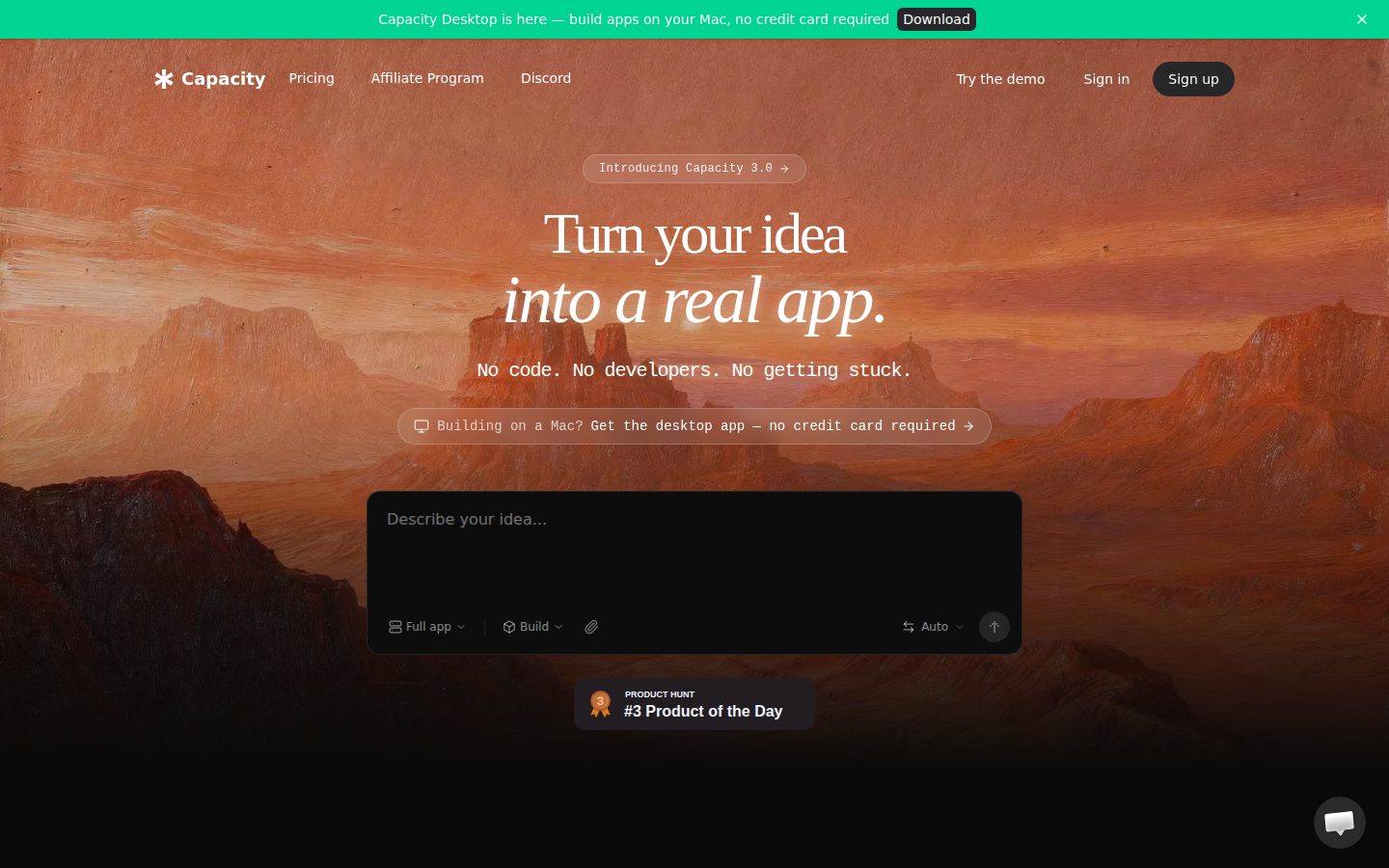
Turn your idea into a real app, no code required
Capacity Desktop is a no-code app-building platform for people without coding experience.
AI Panel Score
6 AI reviews
Reviewed
AI Editor ApprovedApproved and published by our AI Editor-in-Chief after full panel analysis.To build with Capacity, a user types a description of their app idea in everyday language rather than technical terms. Instead of immediately generating output, Capacity first asks clarifying questions about what the app is for, who will use it, and how it should feel, then builds the app based on those answers. Once built, the app can be viewed and tested right away, and users can request changes by describing what looks wrong or what they want different, in plain words.
The apps produced are described as functioning like real products rather than demos: they can include member accounts, logins, saved information, and payment processing. Capacity states that the app, its data, and its members belong to the user, not the platform, and that users can export their app's code and leave at any time with no lock-in. Publishing is handled with one click to generate a shareable link, and a custom domain can be connected within minutes. If something breaks or doesn't work as expected, an "AI co-founder" feature diagnoses and fixes the issue based on a plain-language description of the problem, and is described as available at any time.
Capacity is aimed at people with no coding experience who want to build a functional app without hiring a developer. The first app is free to build, with no credit card required. Paid usage is based on a credit system, where credits are spent when building or changing an app and do not expire.

Lets users connect their own accounts for Claude, GPT, Gemini, Grok, DeepSeek, Kimi and other models and switch models per task, paying providers directly at cost.
Shows exactly what each AI session costs since users pay their model provider directly rather than buying marked-up credits.
Generated apps can include member accounts, logins, saved information, and payments as with typical real-world products.
Runs the generated app directly inside Capacity so users can watch changes land in real time without switching tabs or setup.
Writes a plain-English specification for every feature before building, allowing users to review and correct it prior to AI generation.
Converts plain-English descriptions into working web, mobile, desktop, and game applications.
Saves a snapshot after every AI step so users can restore any previous version in one click if a change breaks something.
Provides over 80 designer templates and matches app style to a described aesthetic like 'warm and friendly' or 'serious and premium'.
The Publish tab lines up a user's GitHub repository, Vercel project, and production settings, checking them before shipping the app live to its own URL.
Stores projects as standard folders and git repositories on the user's own machine rather than in a cloud workspace, keeping code fully portable and owned by the user.
Automatically installs required development tools so non-technical users can skip manual terminal setup.
Build your first full app or MVP
For advanced builders and continuous development
For teams managing multiple products
No-code app builder that exports real code and doesn't trap your data.
“Capacity turns plain-English prompts into apps with logins and payments, then lets you leave with the codebase. The pricing and lock-in terms are unusually clear for this category.”
$25 a month, 100 credits, no credit card for the first app. That's a real freemium funnel, not a fake one.
Two things stand out. One: local-first storage, projects live as git repos on your machine, not locked in a cloud workspace. Two: the Growth tier at $69 includes full codebase export, so 'no lock-in' isn't just marketing copy. Bring-your-own-model support for Claude, GPT, and Gemini means you pay providers directly instead of marked-up credits, which is the right instinct.
The gap: credits don't expire, but nothing I could find says how many credits a real app costs to build or fix, so the unit economics are opaque until you're in it. Version snapshots and one-click restore cover you when the AI co-founder gets it wrong.
Pilot it for a real MVP, not a toy.
Bring-your-own-model billing at cost is a real differentiator versus the obvious credit-markup alternative.
Local-first storage and codebase export at $69/mo directly address the lock-in question most no-code tools dodge.
One-click publish via GitHub/Vercel and a free first app get a working product live fast.
Advances non-technical teams' ability to ship real apps rather than just cutting dev-tool cost.
Docs, changelog, and a full pricing page with four tiers all present — looks actively maintained.
Non-technical founders who want a real, exportable app with accounts and payments without hiring a developer.
Skip if you need predictable per-build cost before committing budget.
Local-first storage and real code export make this a no-code tool an engineer could actually defend.
“Capacity generates full-stack apps from plain-language specs with git-backed local project storage and no lock-in. The architecture is unusually credible for the no-code segment, but the ceiling is still bounded by what an agentic spec-writer can reliably ship.”
Local-first project storage as standard folders and git repos is the detail that matters here. Most no-code platforms trap you in a proprietary workspace; Capacity's own docs claim exportable codebase and 'no lock-in,' which means the three-year exit cost is a git clone, not a rebuild. That's the right architecture if you're worried about a non-technical founder painting themselves into a corner.
Bring-your-own-model support (Claude, GPT, Gemini, Grok, DeepSeek) plus a spend dashboard is a sane cost model, but it also means your generation quality is only as good as whichever model the user points at it that day. Version snapshots after every AI step give you a safety net, which is table stakes for agentic building but still worth crediting.
The credit system starts at $25/month for 100 credits, scaling to $299/month for 1,000 — fine for prototypes, unclear for teams shipping continuously. This is a strong on-ramp tool, not yet a system of record for production engineering teams.
Sits ahead of typical no-code tools by offering exportable code and BYO-model support, positioning it closer to a developer-friendly on-ramp than a locked SaaS builder.
Built for non-coders describing apps in plain language, which is a different workflow shape than how senior engineers actually build and review software.
One-click publish through GitHub and Vercel is a real integration point, but there's no API listed, which caps how far this plugs into an existing engineering pipeline.
Local git storage and stated full codebase export at the Growth tier ($69/mo) genuinely limit lock-in risk over a 3-year horizon.
Plain-English spec review before generation and one-click restore snapshots show real thought about agentic failure modes, not just demo polish.
Non-technical founders who want a real, ownable codebase without hiring a developer for the first build.
You're an engineering team that needs API access and code review integrated into an existing CI pipeline.
$25 to $299 a month, credits that never expire, but no published credit-to-feature rate.
“Four tiers, all priced on the page. The real cost variable is credit burn per app, and that's not quantified anywhere.”
$25/month gets 100 credits. $69/month gets 250, plus full code export and custom domains — that's the tier procurement will actually want, since Starter locks out ownership until Growth. No stated cost-per-credit-per-feature. That's the gap. You can't model year-1 spend without knowing how many credits a real app burns.
TCO scenario: solo builder on Growth, $69 × 12 = $828/year. Add credit overage if 250 runs dry mid-project — unpriced. Year 3, assuming one tier bump to Professional at $129, lands near $2,500 cumulative, plus BYO model costs paid directly to Claude, GPT, or Gemini providers.
No mention of contract term or auto-renewal that I could find — monthly billing implied, no lock-in claimed. Local-first storage and full code export mean exit costs are near zero, rare in this category. Fine tradeoff: pricing transparency is strong, credit-burn transparency is not.
Simple SaaS billing, free first app with no credit card, low onboarding friction for non-technical buyers.
Monthly billing implied, credits never expire, and export/local-first storage removes lock-in risk.
All four tiers and prices visible on the pricing page, no sales call required.
AI Spend Dashboard shows per-session cost, but no benchmark for credits-per-feature to size payback.
Credit-per-build cost isn't published, so 3-year spend can't be modeled precisely.
Non-technical founders who want a real app with logins and payments without hiring a developer.
You need a predictable per-project cost before committing budget.
Local-first git repos and BYO-model billing are the interesting parts, not the prompt-to-app pitch.
“Capacity targets non-coders, but the architecture underneath — local folders, git, exportable code, per-provider AI billing — is clearly engineer-influenced. Whether that matters day-3 depends on how good the 'AI co-founder' actually is at diagnosing real breakage.”
Version snapshots after every AI step with one-click restore is the feature I'd actually want in any agentic tool, not just a no-code one. Local-first storage as standard git repos is the other tell — someone building this has been burned by cloud lock-in before. That's a real differentiator versus the obvious alternative that keeps your project trapped in a hosted workspace.
But the target user is explicitly non-technical, so power-user depth is a question mark. Bring-your-own-model support for Claude, GPT, Gemini, Grok, DeepSeek is nice for cost control (spend dashboard shows actual provider cost, no credit markup), but that's an engineer's concern, not a founder-with-an-idea's concern. Credits at $25/mo for 100, non-expiring, is fine for prototyping, thin for iteration cycles.
Docs coverage exists (docs, blog, changelog) but nothing I could find shows depth on debugging the generated codebase once exported. 'Describe the bug in plain words' is a fine day-1 pitch. Day 3, when the AI co-founder can't parse an ambiguous fix request, that's where this either holds up or doesn't.
Snapshot/restore per AI step is a real safety net, but no evidence on how well the AI co-founder handles nontrivial bugs post-generation.
Docs, blog, and changelog all exist per evidence, but no indication of depth on exported-code maintenance or troubleshooting.
One-click publish, automatic dev environment setup, and in-app live preview remove several manual setup steps most no-code tools leave in.
BYO-model switching and full codebase export (Growth tier, $69/mo) suggest a path beyond beginner use, but scaling depth is largely unproven from what I can see.
Local git repos and GitHub/Vercel publish flow are engineer-friendly, but the whole product assumes a non-coder's workflow, not an existing dev's.
A non-technical founder who wants a real, payment-capable app live fast without hiring a developer.
You're an engineer who wants full manual control over the generated codebase from day one.
Asks good questions before it builds anything, which is rarer than it sounds.
“Capacity front-loads clarifying questions instead of just spitting out a wrong guess. That's a small thing that saves you a lot of frustrated re-prompting later.”
Most of these prompt-to-app tools just guess and hope you fix it in chat. Capacity asks what the app's for, who uses it, how it should feel, before touching code. That's the kind of decision you only make if you've watched real non-technical people get lost on step one.
The stuff that matters at 3pm on day three is here too: version snapshots after every AI step, one-click restore if something breaks, an in-app preview so you're not tab-switching to see if your change landed. Local-first storage means your project's a real folder on your machine, not trapped in someone's cloud. That's a genuine trust signal for people who've been burned by lock-in before.
Where it gets complicated is money. $25/month for 100 credits sounds fine until you realize credits burn on every build and every change, and export/custom domains don't show up until the $69 Growth tier. Bring-your-own AI model is smart for cost control but adds a setup step non-coders may not expect. Solid tool, just don't expect the sticker price to be the real price.
Snapshot-per-step, in-app preview, and plain-English spec review show attention to the small daily friction points.
80+ templates and plain-language editing keep month-one approachable, but credit-based pricing and BYO-model setup add a layer to learn.
Platforms listed are web and Mac only; evidence is silent on a dedicated mobile app experience.
Clarifying questions before building, free first app, and no credit card required lowers the homework feeling.
One-click version restore and an always-on AI co-founder for bug fixes suggest real thought went into failure recovery.
Non-coders who want a real, publishable app with logins and payments without hiring a developer.
You need a true mobile app or want predictable flat-rate pricing regardless of how much you tinker.
No-code with an export button — the exit story is doing the heavy lifting here.
“Local-first storage and full codebase export at $69/month is the rare no-code claim with teeth. But 'AI co-founder' and 'real products, not demos' are the kind of superlative that ages poorly if the credit meter runs dry mid-build.”
Bubble and Glide own this space historically, both burned users on lock-in. Capacity's pitch — export your code, own your data, local git repos — is the direct answer to that scar tissue. If the docs and changelog hold up, that's a real differentiator, not marketing.
Track record is harder to judge. Payments, logins, member accounts — all named, all plausible for AI-generated stacks. No mention of what happens at scale, or what breaks first. 'AI co-founder' fixing bugs 'day or night' is confident phrasing for a support feature with no incident history shown.
Credits don't expire, which is fair. But $25/month buys 100 credits with no stated cost-per-build, so the real price is foggy. Export exists on Growth ($69+) not Starter. That's a meaningful gate for the free-tier crowd this is aimed at.
BYO-model billing and local git storage separate it from marked-up-credit no-code incumbents, though the core prompt-to-app flow is now category standard.
Local-first storage plus full codebase export on the Growth plan ($69/mo) is a genuinely clean exit path versus typical no-code lock-in.
Docs, blog, and changelog present; no team size, funding, or user numbers given, which is expected but leaves viability unproven.
'Real app, no code required' and 'AI co-founder' are aspirational framing around what's still an AI app generator with guardrails.
Named capabilities (payments, logins, snapshots) are specific, but no evidence of build success rates or failure modes.
Non-technical founders who want a working MVP and a real exit if Capacity changes direction.
You need export or custom domains on the cheapest $25/month tier.
Common questions answered by our AI research team
You can start for free with no credit card required. Paid plans use credits that you spend when you build or change things, and those credits never expire.
No coding experience is needed at all. You describe your idea in plain words and Capacity handles the technical side, including all code, servers, and settings.
Yes. Apps built with Capacity can include member accounts, logins, saved data, and payments, along with everything else a real product needs.
Yes. You can connect your own custom domain name in minutes, with no setup or waiting required.
Just describe the problem in plain words, like 'the button doesn't work,' and your AI co-founder finds and fixes it, explaining what happened in plain language, day or night.


Capacity is a platform that lets users describe an app idea in plain language and generates a working web application, including hosting and domain setup.